
Someone on r/NoStupidQuestions asked what the real difference is between googling something and asking ChatGPT. The top-voted reply put it in one line. Google is an index of links to answers, and ChatGPT can use the same kind of index but does one more step, which is to read what it found and write you an answer.
Fundamentally what’s the difference between Googling something and asking ChatGPT?
Couple of disclaimers first:- I am very much anti-AI- I’ve never used ChatGPT and don’t plan on it either I’m not concerned with the ethics of AI usage with this particular question only. Also this question is more in reference to simple, s...
That one more step is what makes an LLM search engine, and it hides the part most people never ask about. Whose index is it reading? This guide defines the term, then lays out what runs underneath each of the six big engines, with what each vendor documents and what's only inferred. I read every vendor page cited here on October 19, 2026.
What an LLM search engine is
An LLM search engine is a large language model joined to a search system. It decides whether a question needs fresh facts, turns the question into one or more searches, filters what comes back, and writes a single answer that cites the pages it used. ChatGPT search, Perplexity, Claude with web search, Gemini, Grok and Google's AI Mode all work this way.
You'll see the same four steps in each vendor's docs, under different names. For the model underneath, see how large language models work.
| Step | What happens | Where a vendor documents it |
|---|---|---|
| Decide | The model judges whether to search at all | Anthropic says Claude "determines when to search based on the prompt" |
| Rewrite and fan out | The question becomes several searches | Google's AI Mode issues "multiple related searches concurrently across subtopics" |
| Retrieve and rerank | Results come back and get filtered | With Anthropic's newer web search tool, Claude writes code to filter results before they reach its context |
| Ground and cite | The answer is written from the results, with links | Gemini's API returns inline citations tied to the parts of the answer they support |
According to Microsoft's Copilot Studio docs, Copilot Studio agents run the same loop on public sites. It sends grounding queries to the Bing index and scores what comes back.
Each step is a place where your page can drop out. A question that skips search never reaches your page. A fan-out query you don't rank for won't either, and a page that survives retrieval can still be filtered out before the model writes a word.
How it differs from a classic search engine
A classic search engine ranks pages and stops. You get ten links and do the reading yourself. An LLM search engine does the reading for you, so the list you used to judge gets replaced by one answer with a few sources attached.
The thing most explainers skip is that the model isn't the part doing the searching. I find it useful to split every LLM search engine into two layers. The answer layer is the model that writes and cites. The index layer is the crawler and search index that supplies the pages. The answer layer gets the headlines, but the index layer decides which pages the model ever sees, and it runs on crawlers you can name in robots.txt.
Some engines own both layers. Others rent the index layer from a partner, and a few won't say. If you're new to the jargon around this, our guide to LLM SEO, GEO, AEO and AIO sorts out the names.
Know exactly what AI says about your competitors.
RankControl's Recon Agent monitors competitor citations across ChatGPT, Perplexity, Claude, Gemini, Grok, Google AI Mode, and Google AI Overviews. See where they show up and you don't.

What runs underneath each LLM search engine
This is the index layer for the six engines, checked against each vendor's own pages on October 19, 2026. "Documented" means the vendor says it in its own docs. "Inferred" means the evidence is strong but the vendor's product docs don't state it.
| Engine | Crawler or fetcher | Index or search partner | Status | Source and date |
|---|---|---|---|---|
| ChatGPT | OAI-SearchBot fills OpenAI's own index; ChatGPT-User fetches pages for user actions | OpenAI's index plus outside partners; Bing named for Enterprise and Edu | Crawler documented; Bing documented for Enterprise and Edu only; the mix per answer not published | OpenAI crawler docs and Help Center, read Oct 19, 2026 |
| Perplexity | PerplexityBot surfaces and links sites; Perplexity-User visits pages when a user asks | Its own index; no partner named | Crawler documented; any licensed index reported only by third parties | Perplexity crawler docs, read Oct 19, 2026 |
| Claude | Claude-SearchBot improves search quality; Claude-User visits pages for users | Brave Search, listed as a web search subprocessor | Inferred; the web search tool docs name no provider | Anthropic crawler page (updated Apr 7, 2026), web search docs, Trust Center |
| Gemini | Googlebot, through the Google Search index | Google Search, used to ground Gemini answers | Documented | Google crawler page (updated Oct 15, 2026), Gemini API docs (updated Oct 13, 2026) |
| Google AI Mode | Googlebot, through the Google Search index | Google Search, with query fan-out | Documented | Google Search blog, Mar 5, 2025 |
| Grok | No crawler or robots.txt page found | Web Search and X Search tools; index not named | Tools documented; index undocumented | xAI tool docs, read Oct 19, 2026 |
A few rows need more than a cell.
ChatGPT
OpenAI's crawler docs say OAI-SearchBot is "used to surface websites in search results in ChatGPT's search features" and that robots.txt changes take about 24 hours to apply. The same page never mentions Bing. That comes from OpenAI's Help Center, which says Enterprise and Edu workspaces may share search queries with Bing. How the mix shifted between Bing, Google results and OpenAI's own index over 2025 and 2026 is a long story, and does ChatGPT search use Bing tells it in full.
Perplexity
Perplexity's crawler page describes PerplexityBot as built "to surface and link websites in search results on Perplexity" and says it isn't used to train models. It says nothing about Bing or any other partner. Some outside reporting claims Perplexity tops up its index with licensed results, but I couldn't find Perplexity saying that, so the table marks it unconfirmed.
Claude
This is the row to mark carefully. Anthropic's web search tool docs cover versions, pricing at $10 per 1,000 searches, and citations of up to 150 characters, but name no search provider. Its crawler help page lists Claude-SearchBot and Claude-User and doesn't name one either. The evidence sits in Anthropic's Trust Center instead.
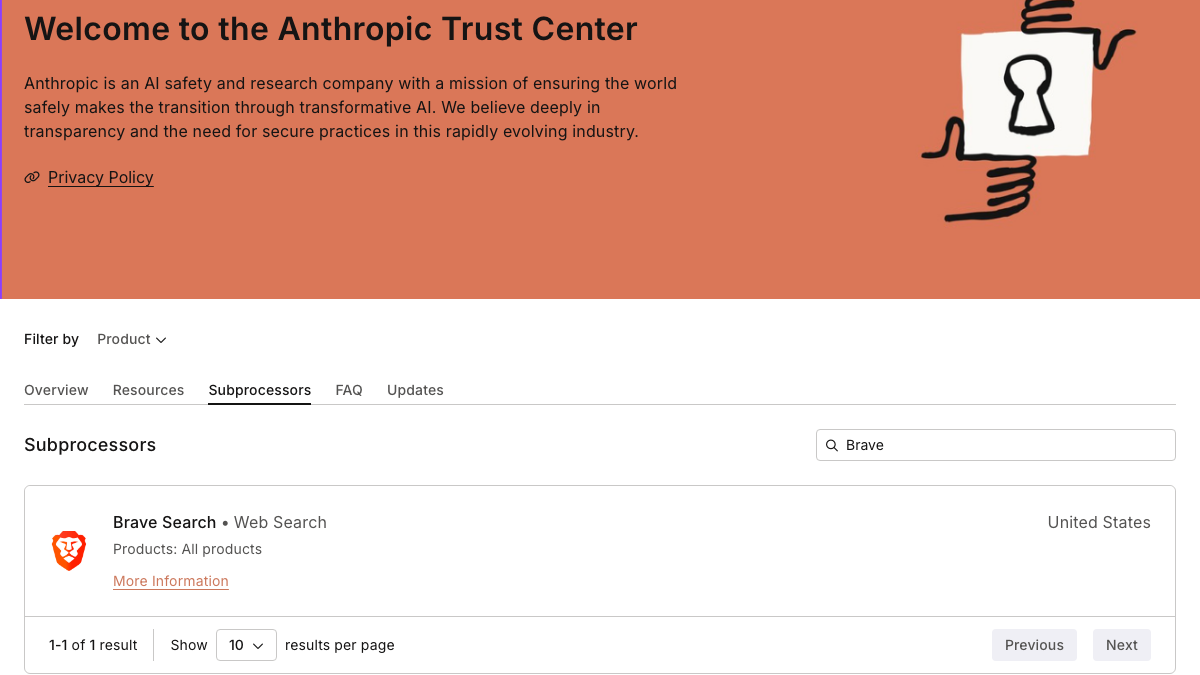
A subprocessor list shows who handles data. It doesn't show how results get chosen, and Brave could be one source among several, which is why the table says inferred.
Gemini and AI Mode
Google owns both layers, but they don't share one switch. Google's crawler page says the Google-Extended token controls whether your content is used for "grounding" in Gemini Apps. The same page says Google-Extended "does not impact a site's inclusion in Google Search," and AI Mode is part of Search. So blocking Google-Extended can take you out of Gemini's grounded answers while AI Mode keeps citing you. On the API side, Gemini's grounding docs say the model "automatically generates one or multiple search queries and executes them" when it judges a search would help.
Grok
xAI's web search docs say the tool can "search the web in real-time and browse web pages," and Grok also has an X Search tool for posts on X. Neither page names an index. Grok was the only engine of the six where I couldn't find a published crawler name or robots.txt rule, so there's no documented way to opt out.
How an LLM search engine picks sources, briefly
Once the index layer hands over candidates, the answer layer chooses. The details differ by engine, and other guides here go deeper, so this part stays short.
The best academic test of what helps is the GEO paper from Princeton and partners, presented at KDD 2024. Adding citations, quotes and statistics to a page lifted its visibility in generated answers by up to 40%. One caveat the headline skips is that the team tested a generative engine they built in the style of Bing Chat, then checked results on Perplexity. It points the right way, but it measured a lab engine, so today's production engines may weigh things differently.
Freshness seems to count too. Ahrefs, which sells SEO tools, looked at about 17 million cited URLs and found that pages cited by AI assistants averaged 1,064 days old, against 1,432 days for plain organic results. Google's engine leans hardest on its own rankings, and that link is getting tighter. BrightEdge, another SEO vendor, tracked AI Overview citations that also rank organically and saw the share climb from 32.3% to 54.5% over 16 months.
For depth, go engine by engine:
- Our side-by-side test of how AI engines choose sources to cite shows what each engine cited for the same questions.
- What is an AI citation engine covers why engines read far more pages than they cite.
- How AI engines cite Reddit, YouTube and Wikipedia breaks down which kinds of sites each engine favors.
The answer layer also changes how sources look, and Google changed it again in October. On October 15, Google said AI Overviews and AI Mode would show links higher up in responses and more often, as The Verge reported that day.
Links will appear ‘higher up in responses more frequently’ in Google’s AI Mode and AI Overviews. https://t.co/D06fi4pBEL
 The Verge@vergeOct 15, 2026
Google's Robby Stein added that use of Preferred Sources, which lets people pick sites they want to see more of, has grown more than seven times since the start of the year.
26 content formats. Published on your domain. Matched to your brand.
Guides, comparisons, listicles, case studies, and more. RankControl generates content that gets cited by ChatGPT, Perplexity, Claude, Gemini, Grok, Google AI Mode, and Google AI Overviews.

What the index layer means for your site
The table turns into a short to-do list. Each engine can only cite what its index layer can reach, so access comes first.
- Check robots.txt and your firewall for OAI-SearchBot, PerplexityBot, Claude-SearchBot and Googlebot. Blocking any of them takes you out of that engine's index layer.
- Decide on Google-Extended on purpose. Blocking it limits Gemini's grounded answers but leaves Search, and so AI Mode, alone.
- Since Bing is a named ChatGPT partner, verify your site in Bing Webmaster Tools.
- If the Brave link holds, a cheap test for Claude is to search your key pages in Brave Search and see if they show up.
- For Grok, the only lever right now is being findable on the open web and active on X.
Our robots.txt checklist for AI crawlers has the exact user agents and rules.
The harder part is that this table won't hold still. Google updated its crawler page on October 15 and its Gemini grounding page two days before that. Claude's web search tool now comes in three versions, and the newest is dated March 2026. Fixing access once is easy. The real problem is knowing when an engine that used to cite you quietly stopped.
Keep track of all six engines
By hand, checking 50 buyer questions on seven engines every week takes about six hours. Add the time to notice that one engine dropped you, and work out whether it was the index layer or the answer layer. These are rough estimates.
RankControl's AI visibility tracking runs your 50 questions every week on ChatGPT, Perplexity, Claude, Gemini, Grok, Google AI Mode and Google AI Overviews. Our tracking marks each answer as mentioned, cited or both, and records which competitors and sources each engine used.
You can keep this table yourself with a spreadsheet, a robots.txt check and a weekly round of questions. Or RankControl's agents can run the weekly checks across seven engines, those six among them, while you work on the pages they should be citing.

Your competitors are getting cited by AI. You're not.
Every day without citation tracking is a day your competitors pull ahead in ChatGPT, Perplexity, and Claude.