Google made about $63 billion from search ads in the three months to June 2026. ChatGPT's whole ad business, by OpenAI's own count, is on pace for $1 billion a year. Put those two side by side and you get the real story of search engine marketing statistics in 2026. The money is still in Google, and new ad slots are being built around it.
Most stat pages for this topic list a hundred numbers with no source and no date. I went the other way. Every figure below has a named source and a date, and I checked each one in October 2026. As of that date the latest reported quarter is Q2 2026, so that's what I use. Alphabet hadn't yet reported Q3, and I won't guess at it.
Search engine marketing statistics at a glance
| Figure | Number | Source and date |
|---|---|---|
| Google Search and other ad revenue, Q2 2026 | $63.27B, up 17% | Alphabet, July 22, 2026 |
| Microsoft search ad revenue (excluding traffic costs), FY26 Q4 | Up 10% | Microsoft, July 29, 2026 |
| US search ad revenue, 2025 | $114.2B, up 11% | IAB and PwC, April 16, 2026 |
| US social media ad revenue, 2025 | $117.7B, up 32.6% | IAB and PwC, April 16, 2026 |
| Average cost per click, Google and Microsoft Ads | $5.42 | LocaliQ, June 1, 2026 |
| Average click-through rate | 6.64% | LocaliQ, June 1, 2026 |
| ChatGPT Ads annualized run rate | $1B | OpenAI, August 31, 2026 |
| Google's worldwide search share | 89.94% | Statcounter, September 2026 |
| Bing's US search share | 9.89% | Statcounter, September 2026 |
How big search ad spend is in 2026
Start with Google, because nobody else comes close. In its second-quarter earnings release, filed with the SEC on July 22, 2026, Alphabet reported $63.27 billion in "Search & other" revenue. That's up 17% from $54.19 billion a year earlier.
That one line is about three of every four dollars Google makes from ads. Total Google ad revenue was $81.63 billion in the quarter, so YouTube and the ad network split what's left.
The line I'd look at twice is the smallest one. Google Network, the money Google earns placing ads on other people's sites, slipped from $7.35 billion to $7.30 billion over the same year. YouTube ads grew 13%. So Google's own pages are growing and everyone else's are flat, which is the same pattern our look at Google's Q1 2026 earnings found a quarter earlier.
A careful reader should keep one caveat in mind. Alphabet's number is worldwide and includes more than ads on the results page, since "other" also covers Google properties such as Gmail and Maps. It isn't the same thing as US search spend, so don't stack it next to the IAB figure below as if they measured the same pie.
Microsoft and Bing
Microsoft gives a growth rate, not a dollar figure. Its FY26 Q4 release, for the quarter that ended June 30, 2026, says search ad revenue excluding traffic acquisition costs rose 10%, or 9% in constant currency.
Ten percent is slower than Google's 17%. It's still steady growth for a search engine with a single-digit share of the world's queries, and it matters to anyone buying ads in the US, where Bing's share is close to double its global one (more on that below).
The US market as a whole
The IAB and PwC Internet Advertising Revenue Report, published April 16, 2026, covers all US digital ads for 2025. The total hit $294.6 billion, up 13.9%. Search, which IAB says includes AI search, brought in $114.2 billion, or 38.8% of the total. It grew 11%, down from 15.9% the year before.
Social media is the headline. It brought in $117.7 billion, 40% of the total, and grew 32.6%, nearly three times as fast as search.
Here's an odd detail I noticed while reading the recap. Its own text still says search revenue holds "the largest share of revenue dollars," right next to a social figure that's bigger. The likely reason is that IAB counts social as a channel that cuts across ad formats like display and video, while search is a format. Either way, social pulled in more money than search last year, while search's growth slowed from 15.9% to 11%.
What search ad clicks cost
The most-cited click price this year comes from LocaliQ's 2026 search advertising benchmarks, last updated June 1, 2026. LocaliQ built them from "thousands of our customers' advertising campaigns across Google Ads and Microsoft Ads," covering 20-plus industries. Its own promo for the report put the count at more than 13,000 search campaigns.
| Measure | All-industry average, 2026 |
|---|---|
| Cost per click | $5.42 |
| Click-through rate | 6.64% |
| Conversion rate | 8.18% |
| Cost per lead | $66.69 |
| Cheapest clicks | Arts and entertainment, $1.63 |
| Priciest clicks | Attorneys and legal services, $9.87 |
So a click costs a bit over five dollars on average, and a lead costs about $67. The spread between industries is six-fold, which is why an "average CPC" quoted without the industry tells you very little.
LocaliQ also said clicks got slightly more expensive over the year while cost per lead fell for the first time in five years. Conversion rates rose enough to cover the pricier clicks.
Keep in mind who's in the sample. LocaliQ sells ad management, so these are its own clients' campaigns, not a census of all advertisers. It still names its platforms, its date and roughly how many campaigns it covers, which is more than most SEM stat pages manage. Its averages also mix Google and Microsoft clicks, so don't expect them to match a Google-only account.
A small detail made the click-price point for me. In the Google Ads keyword data I pulled for this post, the phrase "google ads cost per click" listed a cost per click of $46.79. Advertisers pay close to fifty dollars a click to reach people asking what a click costs.
When prices creep up, the PPC crowd on Reddit has a fairly settled answer. In an r/Google_Ads thread about CPCs rising while conversion rates held, the replies said to judge it by cost per acquisition, not CPC, and to check Auction Insights for new rivals entering the auction before touching bids.
Your competitors are building backlinks while you read this.
Organic outreach, social mentions, and citations from Editorial Circle member sites, with managed backlinks available as an add-on. Grow your domain authority without running the campaign yourself.
Paid ads are taking more of the clicks
Click share has been moving toward ads too. In an analysis cited on Similarweb's blog on June 10, 2026, SEO consultant Aleyda Solis tracked how clicks split on results pages from January 2025 to January 2026. For headphones, text ads and product listing ads together went from 16% of all clicks to 36%. For jeans, paid went from 18% to 34%.
Those are two shopping categories, so I wouldn't stretch them to every query. They still show the direction. Ads roughly doubled their share of the clicks on those pages in one year.
Fewer searches send a click at all now, too. SparkToro put zero-click searches at about two in three Google searches in early 2026, and our zero-click search statistics go through that figure and the studies that disagree with it. So paid and organic are splitting a smaller pool of clicks.
What that means for a budget is the subject of our paid vs organic search comparison, so I'll leave the cost-per-visit math there.
Ads inside AI Overviews
Google has been adding places to sell ads on the same results page. I think of this as the toll-booth count, meaning the number of spots on one page where Google can charge for a click. In 2026 that count went up twice.
The first new booth is the AI Overview itself. Google's help page on ads and AI Overviews says ads can show above or below an AI Overview in all 200-plus markets where Overviews run. Inside the Overview, ads are live in English on mobile and desktop in 12 countries, the US among them.
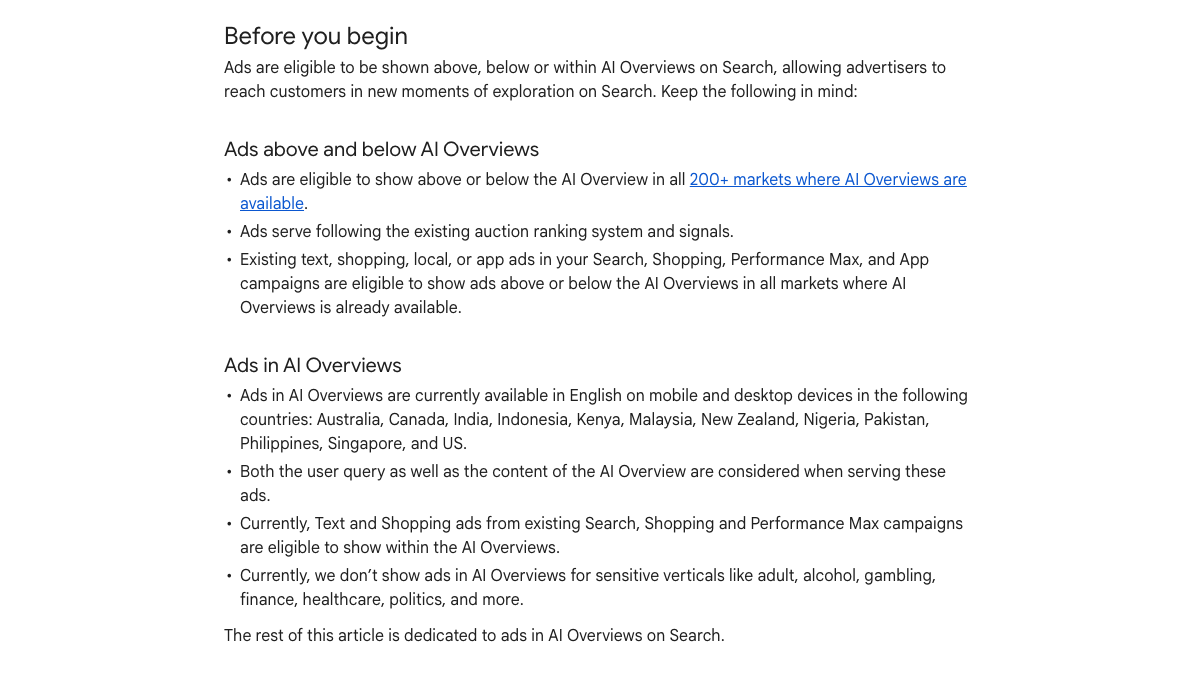
Two lines on that page matter for anyone reading their own reports. Advertisers can't opt out of the placement, and Google Ads doesn't split out reporting for ads shown inside AI Overviews. So you can be buying that slot today without any way to see it in your account.
Sensitive categories are excluded for now, including finance, healthcare, alcohol and gambling. Text and Shopping ads from existing Search, Shopping and Performance Max campaigns are the ones that qualify. Our guide to ads in AI Overviews covers what this does to organic clicks.
Ads in AI Mode, from May to October 16
The second new booth is AI Mode. At Google Marketing Live on May 20, 2026, Google announced two formats for it. Conversational Discovery ads answer a person's specific question with an ad. Highlighted Answers let a relevant ad appear on the list AI Mode gives when someone asks for recommendations, like the best language apps for a trip.
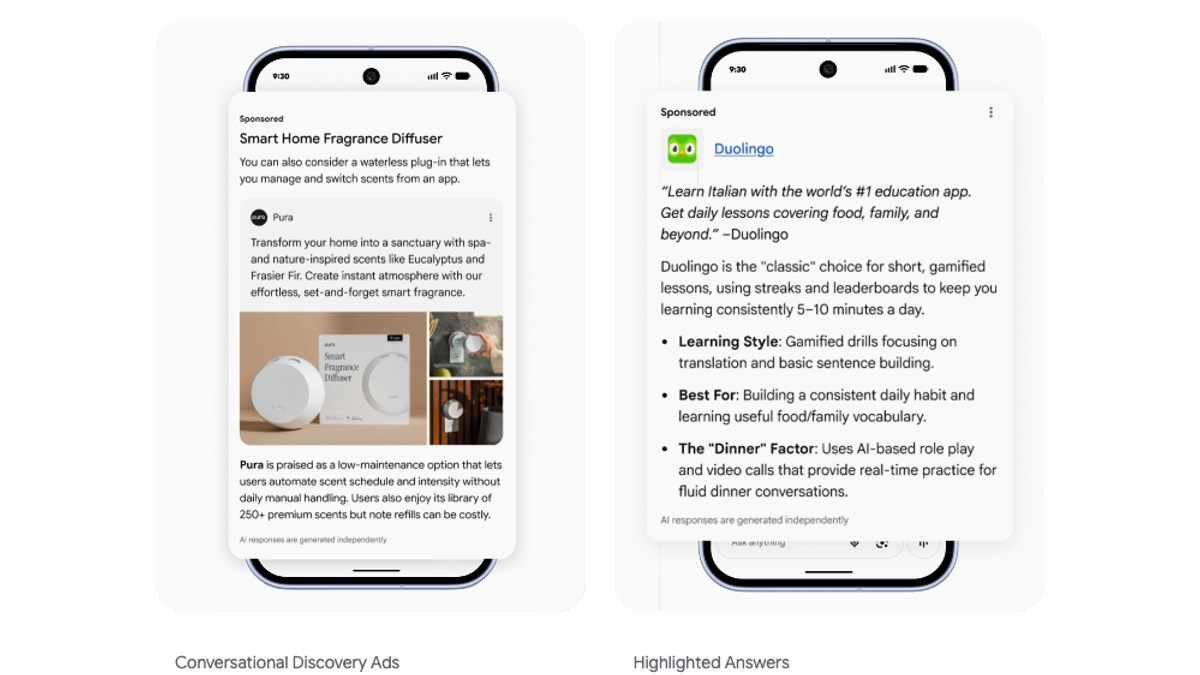
Both carry a Sponsored label. The second is the one that matters most to organic teams, since the paid pick sits on the same list as the brands AI Mode chose without being paid.
Then, on October 16, 2026, SEO consultant Glenn Gabe flagged that Google had begun testing ads in AI Mode for people who have Personal Intelligence turned on. That's the setting that lets Google's AI use what it knows from your connected apps. The report he linked said the test could let ads draw on a broader picture of a person's interests instead of the single query they typed.
Confirmed -> Google begins testing ads in AI Mode for users with Personal Intelligence enabled "If expanded, it could create opportunities to reach consumers with ads informed by a broader understanding of their interests and needs, rather than relying solely on individual
 Glenn Gabe@glenngabeOct 16, 2026
I couldn't open the full article behind that post, so I'm only going as far as the headline and the line Gabe quoted. For now it's a test, and I found nothing from Google on where or when it might expand.
AI Max is the door to the new slots
Google's May 20 post was blunt about what advertisers need to reach these formats. It told them to "build a strong foundation with AI Max for Search, AI Max for Shopping campaigns and Performance Max." The new ad slots favor the campaign types where Google's automation picks the queries and writes the copy.
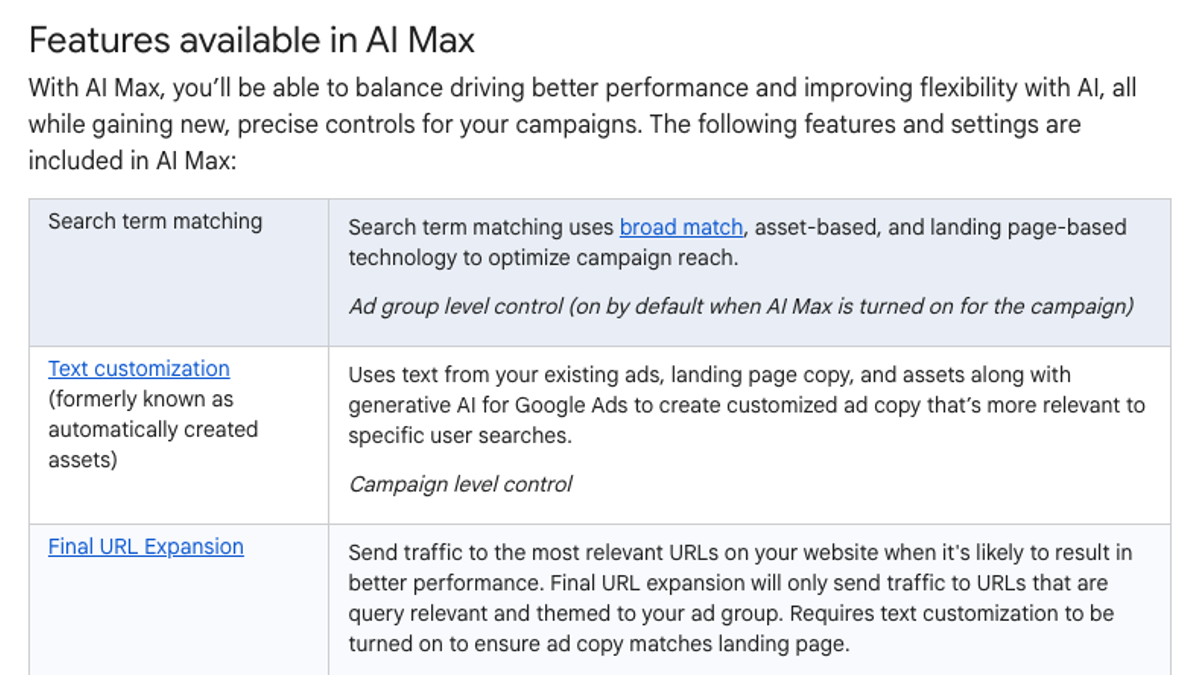
Google's help page lists what AI Max switches on. Search term matching reaches past your keyword list. Text customization writes ad copy from your landing pages and existing ads. Final URL expansion sends each click to whichever page Google thinks will do best, and it needs text customization on to work.
That's a lot of control handed over in exchange for reach. Our AI Max checklist for B2B teams covers what to test before you turn it all on.
You're getting AI traffic. But do you know where it comes from?
RankControl credits every visit to the assistant that sent it: ChatGPT, Perplexity, Claude, Gemini, Copilot, or Grok. Full source attribution, next to your Google traffic.
ChatGPT ads and the $1 billion figure
The biggest new seller of search-style ads isn't Google. On August 31, 2026, OpenAI said ChatGPT Ads had reached a $1 billion annualized revenue run rate in less than 200 days after launch. The same post said tens of thousands of advertisers use it, ads are available in more than 40 countries, and self-serve buying was opening that day across India, Europe, the Middle East and North Africa.
Read "run rate" carefully. It's the latest month's revenue times twelve, not a year of money in the bank. OpenAI also said small and mid-sized businesses now make up "a material share" of the business since its Ads Manager opened in May, and that CPC and outcome-based bidding now run most campaigns.
For scale, Google's Search line brought in about $63 billion in 91 days, or roughly $700 million a day. ChatGPT's yearly ad pace equals about a day and a half of Google Search revenue. That's fast for a program OpenAI started testing in February, and still small next to Google.
The advertisers trying it are less impressed than the headline. A small e-commerce owner on r/OpenAI posted in October that a $50-a-day test showed 7,652 impressions and 64 clicks, while their own analytics showed no matching visits. They also reported about €85 in extra card charges they couldn't explain, and said the support chatbot couldn't either.
ChatGPT Ads = TOTAL SCAM
I tested ChatGPT Ads today for my tiny e-commerce business. Created and launched a single campaign with a $50 daily budget and was charged the expected $50. For the next two hours, I kept refreshing the dashboard. The campaign was active, b...
The replies weren't kinder. One commenter said $54 bought 1,618 impressions, 19 clicks, one email signup and no sales. Another said $500 of spend brought no conversions on keywords that convert well on Google and Microsoft. Those are a few people's accounts, not a study. Still, billing and tracking complaints came up across several ad subreddits this fall.
Our post on ChatGPT ads testing covers how the program got here, from the US pilot to the August expansion.
Search engine market share in 2026
Market share tells you where the auctions are. Statcounter's September 2026 data puts Google at 89.94% of worldwide search. Bing is a distant second at 5.29%, with Yahoo, Yandex, DuckDuckGo and Baidu each under 1.5%.
The US looks different. There, Statcounter has Google at 85.19% and Bing at 9.89%, close to one search in ten. So if your buyers are in the US, Microsoft Ads reaches a much bigger slice of them than the world number suggests.
Statcounter counts page views from its tracking code across a large set of sites, so it measures where visits come from, not how many searches each engine handles. Our SEO statistics roundup has the mobile and desktop split from the same data.
Search engine marketing statistics to stop quoting
Some numbers keep showing up on top-ranking stat pages with no source, no sample and no date. The page ranking second on Google for "ppc statistics 2026" lists over 200 numbers and names zero sources. Here's what I'd drop, and what to use instead.
| Stat you'll see | Why to drop it | Use this instead |
|---|---|---|
| ChatGPT ads at "$320M," AI Overview ads at "$140M," Perplexity at "$48M" | Labeled estimates, with no source or method | OpenAI's own $1B run rate, August 31, 2026 |
| AI Overviews on "37% of queries" with "18% lower CTR" | No study, sample or date given | A dated study with its sample, such as Pew's 2025 browsing panel |
| "Google 62%, Amazon 14%, Bing 6%" of ad platform share | No source, and no word on whether it measures spend or clicks | Company filings for revenue, Statcounter for search share |
| "Google Ads returns $2 for every $1" | Undated, and not a measure of any one account | Your own cost per lead next to LocaliQ's $66.69 |
| Search share with no month attached | Shares move, and old figures get recycled | Statcounter, with the month named |
One more on Perplexity. It stopped selling ads, as our piece on Perplexity ads and B2B visibility explains, so any 2026 Perplexity ad revenue figure needs a very good source.
What these numbers mean for your budget
The pattern across all of this is fairly clear. Search ad money keeps growing at Google, Microsoft and now OpenAI. Click prices drift up. And the number of paid slots on each page keeps going up, from ads around AI Overviews to ads inside them, then onto AI Mode's lists.
For an advertiser that's mostly good news, since there's more inventory to buy. For anyone counting on organic clicks, it's the opposite. Each new booth on the page sits between the searcher and the free results.
My view is that paid search stays the fastest way to buy demand, and nothing in these numbers changes that. But a channel where the seller keeps adding booths, and where you can't even see one of them in your reports, is a channel you rent. If your plan is all paid, the October 16 test is a good prompt to price out what the same traffic would cost to earn through organic pages.
Where RankControl fits
RankControl doesn't run or manage ads. We work on the other side of the page. We write articles for the questions your buyers search and publish them as native posts on your own site, so organic traffic builds without a cost per click. Our content engine writes each article against the pages already ranking for its keyword.
We also track your Google and Bing rankings and check how seven AI engines answer your buyer questions every week, through our AI visibility tracking. Our analytics show the visits that arrive from AI answers once you connect a traffic source. Expect traffic from Google first, with AI citations coming more slowly as other sites link to and mention you.
You can do the organic side by hand. By our rough estimate, writing and publishing eight solid articles a month takes 16 to 24 hours, and checking 50 buyer questions on seven AI engines takes about six hours a week. Or RankControl can do that work every month for one flat plan at $400/mo, with a 7-day free trial, while your paid team keeps buying the clicks that need buying.
We'll show you exactly where your brand stands in AI search.
No commitment. $0 due today, cancel anytime. See how ChatGPT, Perplexity, Claude, Gemini, Grok, Google AI Mode, and Google AI Overviews talk about your brand today.