
Open an AI visibility tool's homepage and count the engine logos across the top. Eight, usually. Pick the cheapest plan, add your brand, and the dashboard shows three. Nothing was hidden exactly; the other five were sitting one tier up, or behind a "talk to sales" box. This page answers one question: which AI engines do visibility tools actually track on the plan you'd buy, not the plan on the homepage?
Ten tools make up this comparison: Semrush AI Visibility Toolkit, Ahrefs Brand Radar, RankControl, AthenaHQ, Profound, Peec AI, Scrunch, Rankscale, Otterly.AI and Writesonic. I read every vendor's pricing page and docs myself, and unless a row says otherwise, each cell in the matrix was checked on October 19, 2026. For a ranked pick rather than a lookup table, see our best AI search visibility tools by engine list.
Why engine coverage decides what you see
Each engine pulls its own crowd, and the split is nowhere near even. StatCounter's US figures for September 2026 put ChatGPT at 75.17% of AI chatbot visits. Gemini follows at 13.26%, then Copilot at 6.64%.
Perplexity drops to about 3% from there, Claude sits under 2%, and DeepSeek barely registers at all. Worldwide the order shifts: Perplexity climbs to 5.85% and overtakes Copilot, so a US-only brand and a global one may genuinely need different engines tracked.
These shares move fast, too. Gemini climbed from under 3% in October 2025 to about 13% a year later in StatCounter's monthly series, and Claude broke past 7% in July 2026 before falling under 2% by September. A tool that skips an engine can look fine for months, right up until your buyers move to the one it never covered.
One gap is easy to miss. StatCounter has no column for Grok or Meta AI, so neither share gets measured there, a hole in the data rather than proof nobody uses them.
A busy r/aeo thread put the stakes plainly. ChatGPT, Perplexity, Gemini and AI Overviews all behave differently, the original poster wrote, so a tool tracking only one or two gives you a false picture of where you stand. Our post on per-engine citation data shows exactly how far apart those answers can get.
Coverage lists change between two checks
Here's the case that convinced me to date every row. On September 25, 2026, Writesonic's Enterprise card read "all 10 AI platforms tracked." By October 19, the same card read "All 9 AI platforms tracked."
The live list now opens with ChatGPT, Perplexity, Claude and Gemini, then Grok and Copilot, both Google surfaces, and Muse Spark, Meta's model. Nothing explains whether an engine left or the count was simply corrected.
Call it the tier line: the spot on a pricing page where an included engine turns into an add-on or an Enterprise quote. Vendors move that line quietly, and a buyer who read the page in spring may now be paying for a list that no longer exists.
So treat the whole matrix as a snapshot with a date stamped on it, and re-check the vendor's own page yourself before you sign, and again before you renew.
Which AI engines visibility tools track, plan by plan
Every row starts from the cheapest paid plan, and the codes mean the same thing throughout.
Base means the engine sits on that cheapest paid plan. Free or Trial means it's also on the vendor's free tier or trial. Add-on means a monthly fee on top of the cheapest plan, price shown. Pick 3 means it's one of three models you choose on that plan. Ent. means Enterprise or a custom quote only, and a plan name such as Starter means that plan. No means the vendor states it isn't tracked at any price, and "Not stated" means it's missing from the vendor's own list.
| Tool | Cheapest paid plan | ChatGPT | Perplexity | Claude | Gemini | Grok | AI Mode | AI Overviews | Copilot | Meta AI | DeepSeek | Checked |
|---|---|---|---|---|---|---|---|---|---|---|---|---|
| Semrush AI Visibility Toolkit | $99/mo, 25 prompts | Base | Base (weekly report) | No | Base | No | Base | Base (weekly report) | No | No | No | Oct 19, 2026 |
| Ahrefs Brand Radar | Custom Prompts from $50/mo | Base | Base | Base (Custom Prompts) | Base | No | Base | Base | Base | Not stated | Not stated | Oct 19, 2026 |
| RankControl | $400/mo, 50 questions | Base | Base | Base | Base | Base | Base | Yes, in Google rankings (shown and cited) | No | No | No | Oct 19, 2026 |
| AthenaHQ | Starter $295/mo | Free | Free | Starter | Free | Starter | Starter | Free | Free | Starter | Starter | Oct 19, 2026 |
| Profound | Enterprise quote (free 7-day trial) | Trial | Ent. | Ent. | Trial | No | Ent. | Trial | Ent. | Not stated | Ent. | Oct 19, 2026 |
| Peec AI | Starter $95/mo, pick 3 models | Pick 3 | Add-on or Ent. (page lists both) | Ent. | Pick 3 | Ent. | Pick 3 | Pick 3 | Pick 3 | Ent. (Meta Spark) | Ent. | Models Oct 19, prices Sep 26, 2026 |
| Scrunch | Core $250/mo, 125 prompts | Base | Base | Ent. | Ent. | Ent. | Ent. | Base | Base | Ent. | Not stated | Oct 19, 2026 |
| Rankscale | Essentials from $20/mo (credits) | Base | Base | Base | Base | Base | Base | Base | Base | Not stated | Base | Oct 19, 2026 |
| Otterly.AI | Lite $29/mo, 15 prompts | Base | Base | Add-on $29 | Add-on $9 | No | Add-on $9 | Base | Base | Not stated | Not stated | Oct 19, 2026 |
| Writesonic | Starter $79/mo billed yearly | Base | Ent. | Ent. | Base | Ent. | Ent. | Base | Ent. | Ent. (Muse Spark) | Not stated | Oct 19, 2026 |
The sources are each vendor's own pricing page, plus Semrush's knowledge base, Ahrefs' Brand Radar page and Scrunch's FAQ pages. Peec AI's prices load in the browser and wouldn't render on my October 19 read, so those come from a September 26 check.
A few patterns jump out of that table. Copilot is the US market's third-biggest chatbot by StatCounter's count, yet four of the ten cheapest plans leave it out. Meta AI sits on exactly one self-serve plan, AthenaHQ's Starter. Grok is flatly "No" at four vendors and Enterprise-only at three more.
15 hours a week manually. Or 15 minutes with RankControl.
Track citations, monitor competitors, and fix content gaps across every AI search engine. Automatically.

What each cheapest plan covers, and what the rest costs
Semrush AI Visibility Toolkit
Standalone, the toolkit runs $99 a month for 25 prompts, or it rides inside Semrush One Starter at $199 for 50. Its engine list depends on which report you're looking at: the weekly Brand Performance report covers ChatGPT, Perplexity and Gemini plus both Google AI surfaces, while the daily Prompt Tracking report covers only three, ChatGPT Search, AI Mode and Gemini.
No plan adds Claude or Grok, and Copilot, Meta AI and DeepSeek are missing with no upgrade path. For a buyer whose audience sits on ChatGPT and Google, that $99 plan already covers the engines carrying most US traffic.
Ahrefs Brand Radar
Ahrefs actually sells two products under one name, and they don't cover the same engines. The AI Visibility Index tracks ChatGPT, Perplexity and Gemini, plus Copilot and both Google surfaces, across a shared prompt set the page puts at 481 million, re-tested monthly. It starts at $199 a month per platform, or $699 for the full set.
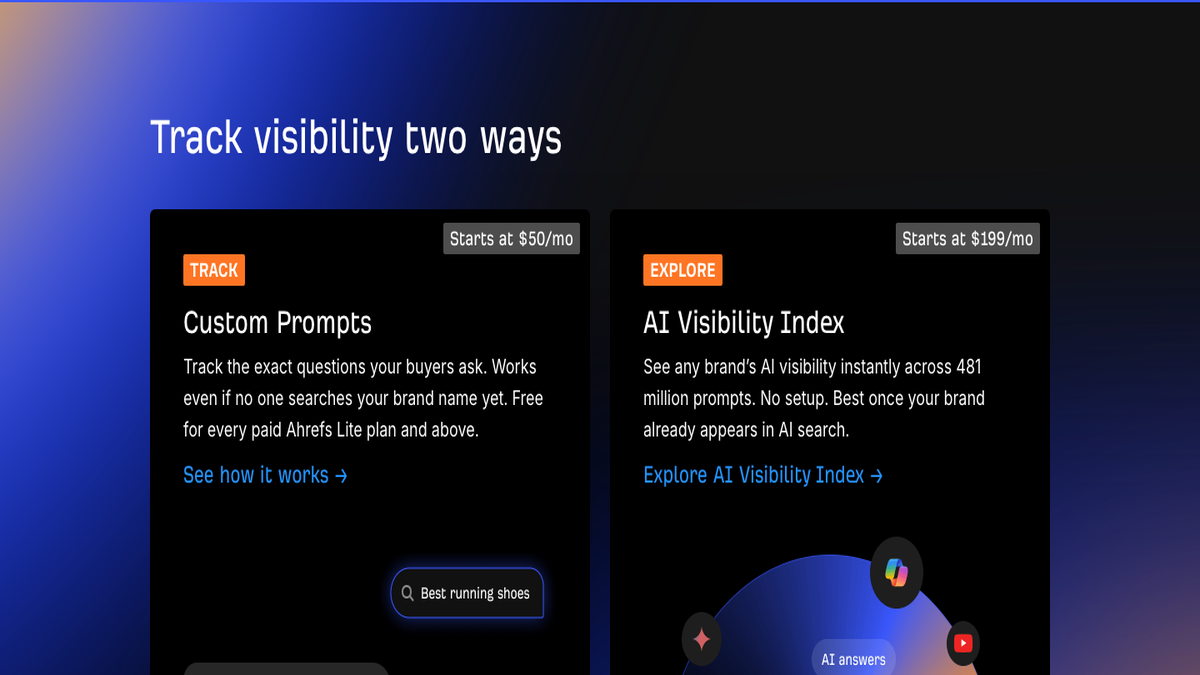
Custom Prompts, where you write your own questions, starts at $50 a month and comes free in small amounts on every paid plan from Lite at $129. Claude only shows up there, where the card reads "Claude available." Grok isn't on either product, and Ahrefs says nothing about Meta AI or DeepSeek. On the Index, every extra engine costs another $199, so its tier line is a price per platform.
RankControl
RankControl runs one plan, so the cheapest plan and the whole plan are the same thing. That plan checks 50 questions a week across seven engines: ChatGPT, Perplexity and Claude, plus Gemini, Grok, Google AI Mode and Google AI Overviews. The same weekly rankings check also records whether an AI Overview showed for a tracked keyword, and whether it cited your site.
No add-on tier and no Enterprise quote hides an engine behind a wall. RankControl costs $400 a month, with a 7-day free trial, and doesn't track Copilot, Meta AI or DeepSeek, worth knowing if your buyers live inside Microsoft 365.
That price buys more than tracking, since the same plan writes and publishes articles on your site and runs outreach too. Our AI visibility tracking page shows what a weekly check reports, and why we track seven engines explains how that set got picked.
AthenaHQ
AthenaHQ draws its own tier line between free and paid, not between plans. The free Essential tier already covers ChatGPT, Perplexity and Gemini, plus AI Overviews and Copilot. Starter, at $295 a month or $245 billed yearly, jumps straight to 11 models by adding AI Mode, Claude and Grok, then DeepSeek, Meta AI and Mistral.
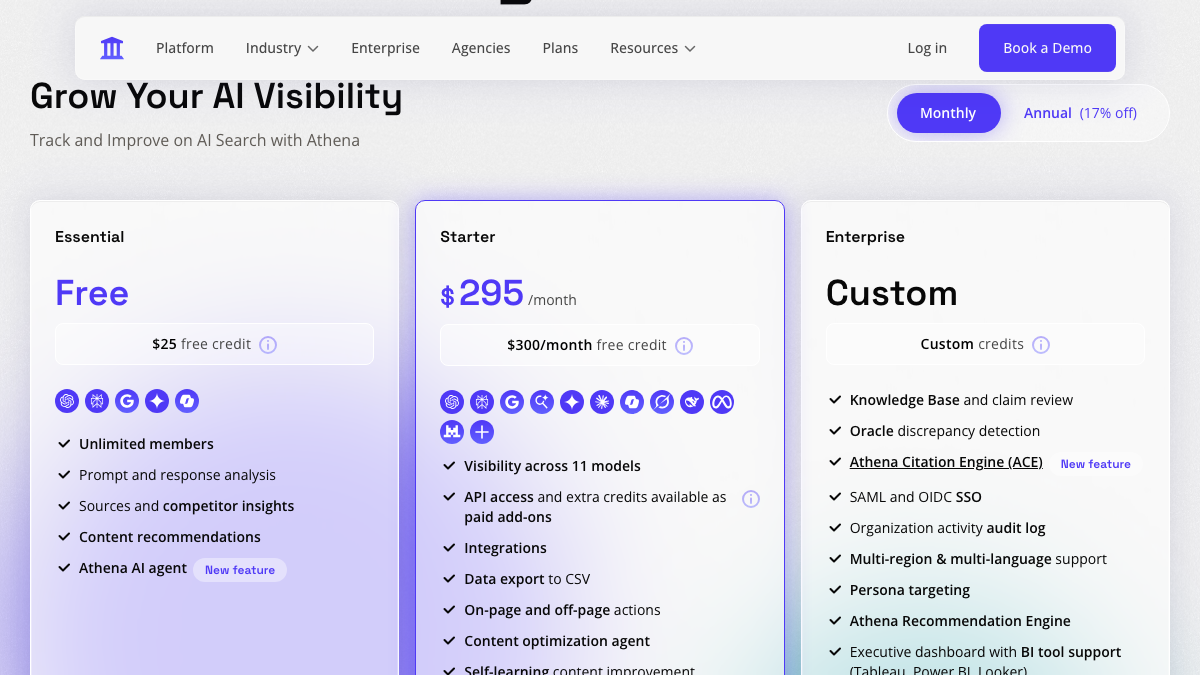
That makes Starter the one self-serve plan here that fills every column in the matrix. It runs on credits, so you choose which models get scanned and on which days. Our RankControl vs AthenaHQ comparison covers the rest of that trade.
Profound
There's no self-serve paid plan at Profound. Its free trial runs 50 prompts a day for seven days on ChatGPT, Gemini and AI Overviews, and everything past that is an Enterprise quote covering "up to 9 answer engines." That list adds Perplexity, AI Mode and Copilot, then DeepSeek, Claude and Exa. Grok isn't on it at any price, and Meta AI doesn't appear on the list either.
Peec AI
Peec's tier line works like a menu. Starter costs $95 a month for 50 prompts, and from there you choose three models out of a base list of six: ChatGPT, Gemini and Copilot, plus AI Mode, AI Overviews and Naver AI. Each extra model beyond your three cost $30 a month on Starter back on September 26, which puts five of the six at roughly $155 combined.
Claude, Grok, DeepSeek and Meta Spark sit on Enterprise only. Perplexity is the strange one. On October 19 the page listed it in both the self-serve add-on section and the Enterprise section at once, as it did across three separate checks in September. Ask Peec which one applies before you count on it.
Scrunch
Scrunch Core costs $250 a month for 125 prompts across four engines: ChatGPT, Perplexity, AI Overviews and Copilot. Enterprise lifts that to nine, adding Claude, Gemini and Meta AI, plus AI Mode and Grok. DeepSeek isn't listed on either tier. New prompts, per Scrunch's FAQ, get checked daily for 14 days and then every 72 hours after that. Gemini sitting at Enterprise-only is an odd call, given it's the second-biggest chatbot in StatCounter's own US numbers.
Rankscale
Rankscale doesn't gate any engine by plan. Every paid plan starting with Essentials at $20 a month lists ChatGPT, Gemini, Perplexity and Claude, and Grok, DeepSeek and Copilot are all there too, alongside Mistral and both Google surfaces.
The real catch sits inside the credits. On Pro, at $99 for 1,200 credits, a ChatGPT answer costs 0.25 credits while a Claude answer costs 2, so whichever engines you switch on quietly decide how many answers your plan can actually buy. Meta AI isn't on the list at all.
Otterly.AI
Otterly's base plan covers ChatGPT, AI Overviews, Perplexity and Copilot outright. Everything past those four is an add-on, and the price of each one climbs with the plan you're on.
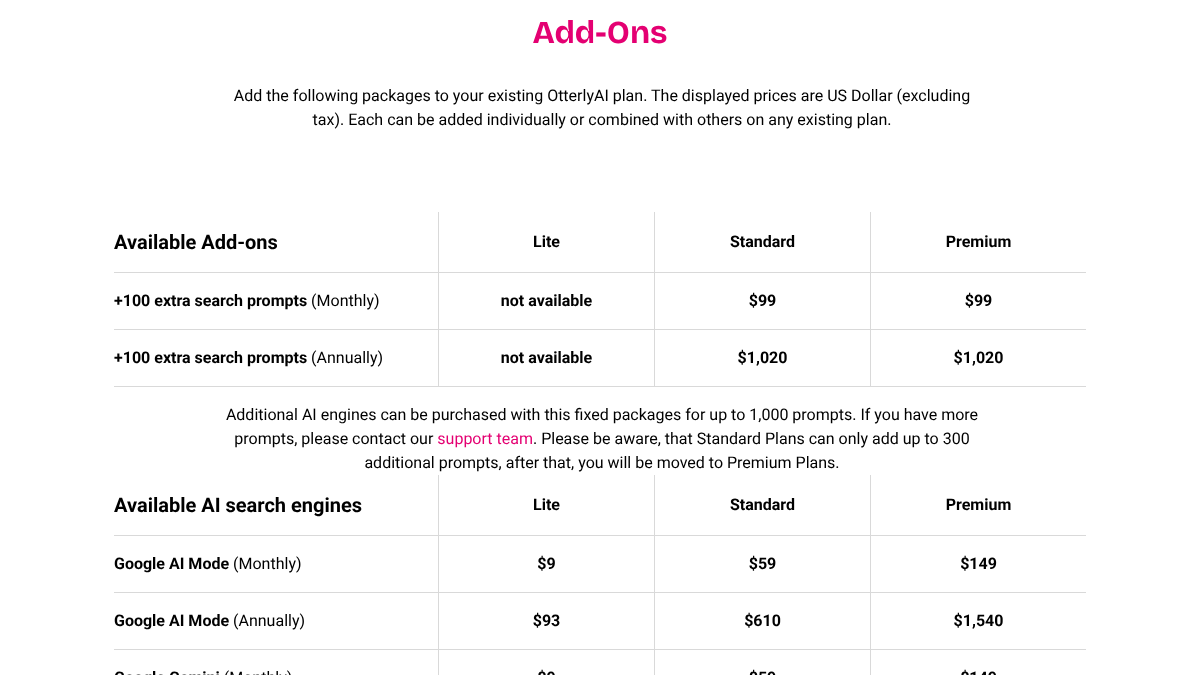
On Lite, AI Mode and Gemini each cost $9 and Claude costs $29, so all seven engines together run $76 a month for just 15 prompts. On Standard, with 100 prompts, that same set costs $189 plus $59, $59 and $109, landing at $416 a month total. Grok isn't offered on any plan here. Our RankControl vs Otterly.AI comparison runs the rest of that math.
Writesonic
All three of Writesonic's paid self-serve plans track the exact same trio, ChatGPT, Gemini and AI Overviews, checked daily. Starter runs $79 a month billed yearly for 50 prompts, Basic is $199, and Growth is $399. Moving up through those tiers buys more prompts and more features, never a new engine.
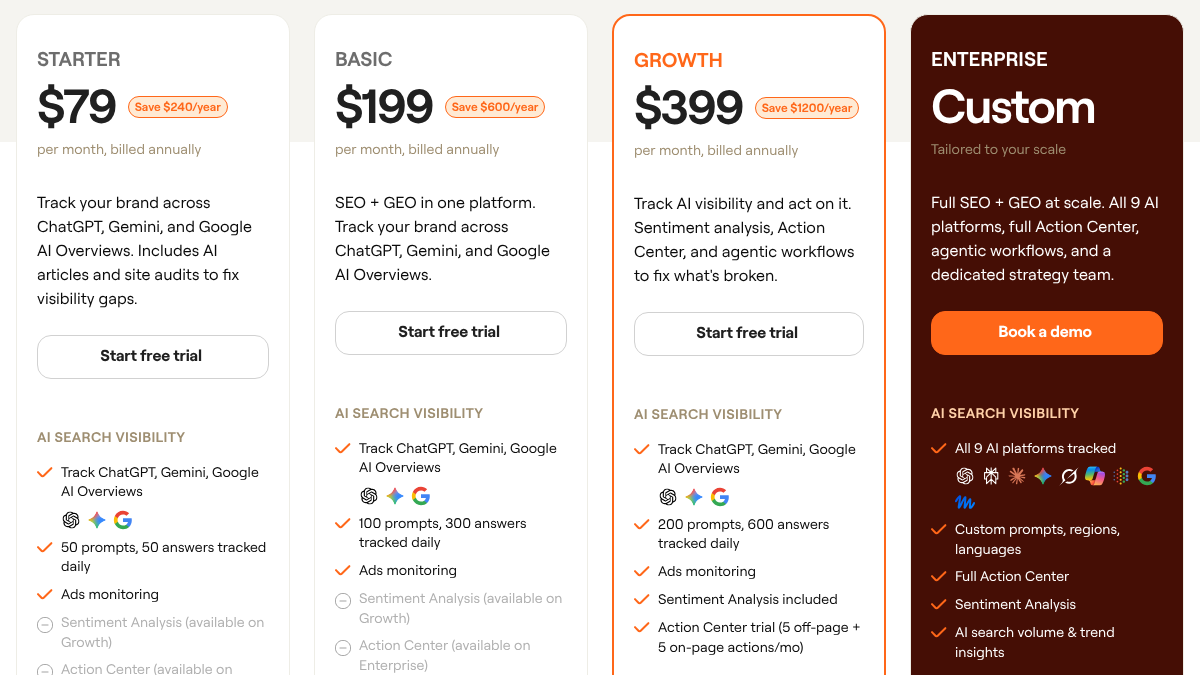
Every remaining engine, Perplexity and Claude included, sits on the custom Enterprise plan whose own count slid from 10 to 9. Our RankControl vs Writesonic comparison covers what else differs between the two.
AI search traffic grew 835% this year. Is your content ready?
RankControl generates 26 content formats optimized for ChatGPT, Claude, and Perplexity. Published on your domain, matched to your brand.

The price of covering the engines your buyers use
This matrix gets a lot more useful once you actually pick a set and price it out. Take every chatbot StatCounter puts above 1% in the US: ChatGPT, Gemini and Copilot, plus Perplexity and Claude. Add Google's AI Overviews and AI Mode, and that's seven engines total. Here's the cheapest plan at each tool that covers every one of them.
Rankscale covers the set from $20 a month, with the credit catch described above. Ahrefs covers it on Custom Prompts from $50 a month, since that card reads "all platforms" and Claude is included. Otterly.AI covers it for $76 a month on Lite with three add-ons stacked on, or $416 on Standard. AthenaHQ covers it on Starter at $295 a month flat.
Profound, Peec AI, Scrunch and Writesonic all need an Enterprise quote to get there, because Claude sits on Enterprise at every one of those four. Semrush can't cover the full set on any plan it sells, and RankControl covers six of the seven at $400, with Copilot the single engine missing.
Prompt count shifts that order considerably. Fifteen prompts on Otterly's Lite is barely a sample, and the same seven engines at 100 prompts cost more than RankControl's entire plan. Our breakdown of price per tracked question runs that exact math for every tool on this list.
Which setup fits your buyers
Start with where your buyers actually ask their questions, not with the tool. An r/localseo thread about which tracker to pick kept landing on the same answer: it depends on the two or three engines a business's own customers really use. Match that set to a plan from there.
For SEO teams already inside Semrush whose buyers sit on ChatGPT and Google, the best pick is Semrush's $99 toolkit, because it covers five engines weekly with no add-ons tacked on.
For B2B brands selling into Microsoft-heavy companies, the best pick is Ahrefs Brand Radar, because its AI Visibility Index tracks Copilot and its Custom Prompts card covers every platform at once.
For teams that want the seven main engines at one fixed price, the best pick is RankControl, because no single engine sits behind an add-on, and the same plan also publishes articles and runs outreach.
For consumer brands that specifically need Meta AI and DeepSeek, the best pick is AthenaHQ Starter, since it was the only self-serve plan with both as of October 19.
For enterprise teams already mid-contract-talk, the smartest move is getting the engine list in writing, with a date attached. Writesonic's slide from 10 to 9 shows exactly why that matters.
How to check a vendor's engine list yourself
You don't need a separate tool to run this check. Open the pricing page, find the engine list for the plan you'd actually buy, and note anything marked add-on or "contact us." Then open the docs too, since the list can differ report by report, the way Semrush's does. Write the date next to whatever you find.
Google offers one surface for free, at least. Search Console added a Generative AI features report for AI Overviews and AI Mode, and Google says it had reached every site by August 31, 2026. It only covers Google, though, so every other engine still needs a tracker of its own. Our roundup of free AI visibility tools lists what else you can check without paying for anything.
Expect disagreement between tools, too. An r/DigitalMarketing poster who compared Similarweb, Semrush and Profound against Peec AI and Ahrefs said each one handed back very different figures. Replies in that thread blamed differing engine lists and differing ideas of what "visible" even means. Pick one tracker, keep its engine list fixed, and compare it against itself week over week rather than against a different tool entirely.
Reading the list once isn't really the problem. Knowing when it changes, or when an engine your buyers already moved to was never on it in the first place, is. You can re-check every vendor's page by hand each quarter. Or RankControl can check the seven engines every week and tell you when a new citation shows up, while you spend that time on your own product instead.

Built by the team that got cited in 48 hours.
Content generation, backlink building, AI visibility tracking, and Google rankings. One platform, zero guesswork.