
On September 27 we ran one brand, the help desk company Help Scout, through the free AI visibility checkers we could find. HubSpot's grader gave it 70 out of 100 on Gemini, with the verdict "This score is great." The same report scored its share of voice on Gemini at 1 out of 10.
Both numbers can be true, and that's the lesson of free AI visibility tools. Each one measures something different, so the headline score matters less than knowing what's underneath it. Here are ten free tools worth using in 2026, what each one showed us and what each one hides until you pay. Everything was checked on September 27, 2026.
How we picked and ranked them
Every tool here costs $0 for the part we describe, with no trial clock. First-party reports from Google and Bing come first, since they're data about your own site from the engines themselves. The brand checkers come next, ranked by how much they show without an account. We tried the third-party checkers with Help Scout, a brand we'd tracked before, and noted anything that blocked us.
1. Google Search Console
Search Console's generative AI report is the first thing to open, because it's Google's own data. Available to every site since August 31, it shows how often your pages appeared in AI Overviews and AI Mode, broken down by page, country, device and date.
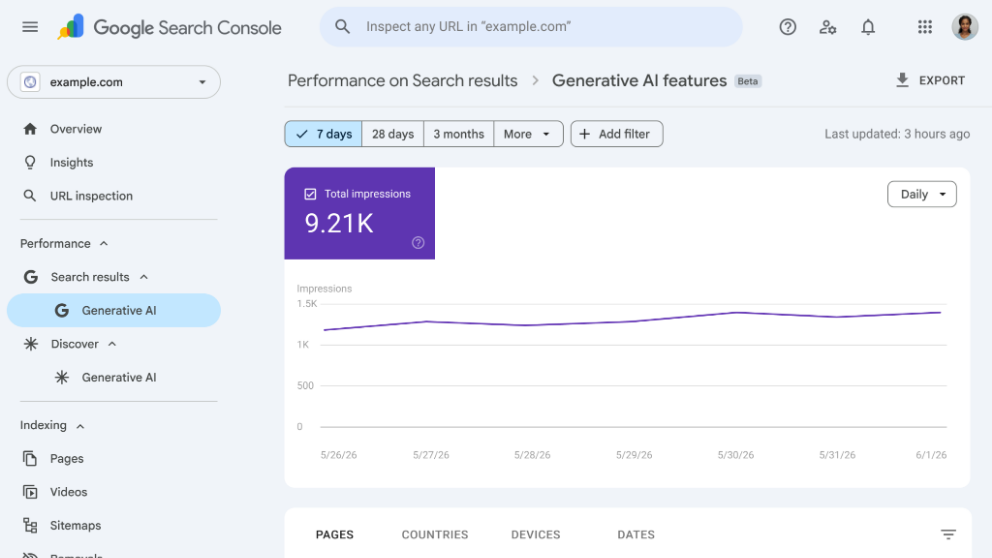
What it won't tell you is whether your brand was named in the answer, or who else was. Impressions count appearances, so a page listed tenth in a long AI Overview counts the same as the lead source. We'd use it to find which pages Google already trusts for AI answers, then check those answers by hand.
2. Bing Webmaster Tools
Bing's AI Performance report is the most useful free report any engine offers, and it's easy to miss if you've never set up Bing. It launched in public preview on February 10, 2026, and counts how often Copilot, Bing's AI summaries and some partner experiences cited your pages. It also shows the grounding queries, which are the searches Copilot ran to find you.
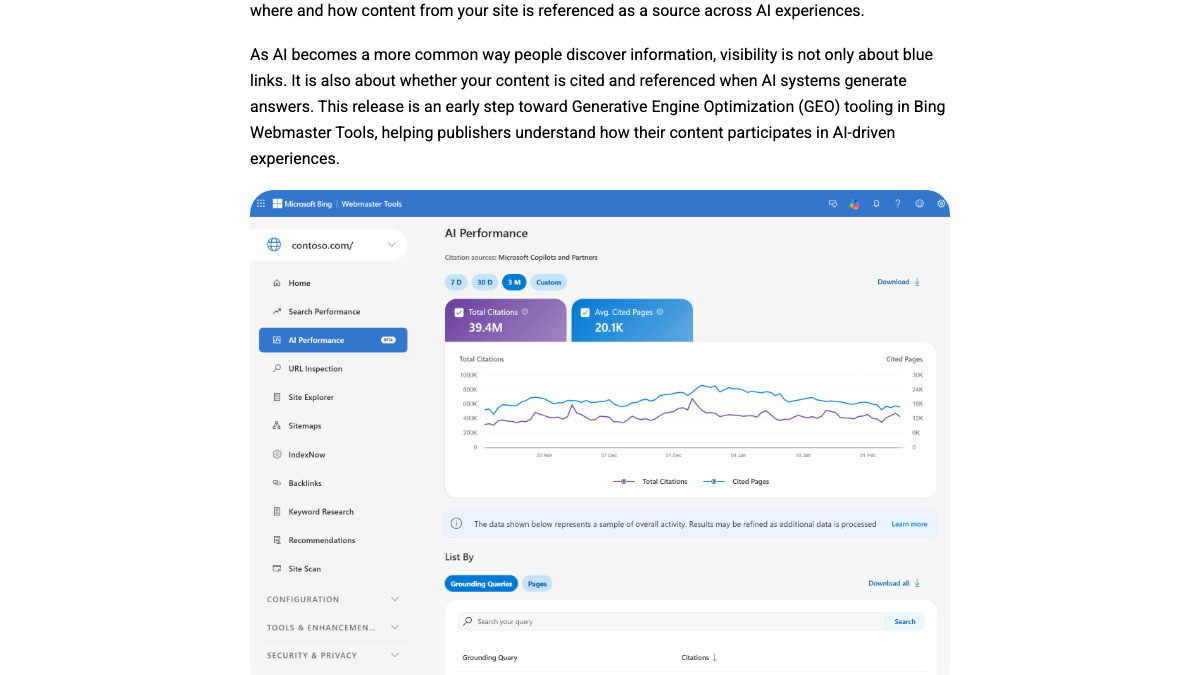
The June 16 update added intents, topics, compare and citation share, which shows your percentage of the citations for a query rather than a raw count. It covers Microsoft's surfaces only, so it tells you nothing about ChatGPT or Perplexity.
3. Semrush AI Search Visibility Checker
Semrush gives you three free checks a day without an account. Enter a domain and you get an AI visibility score and a count of brand mentions, split across ChatGPT, Gemini and Google's AI results. The report also lists the pages on your site cited most and the topics where you show up.
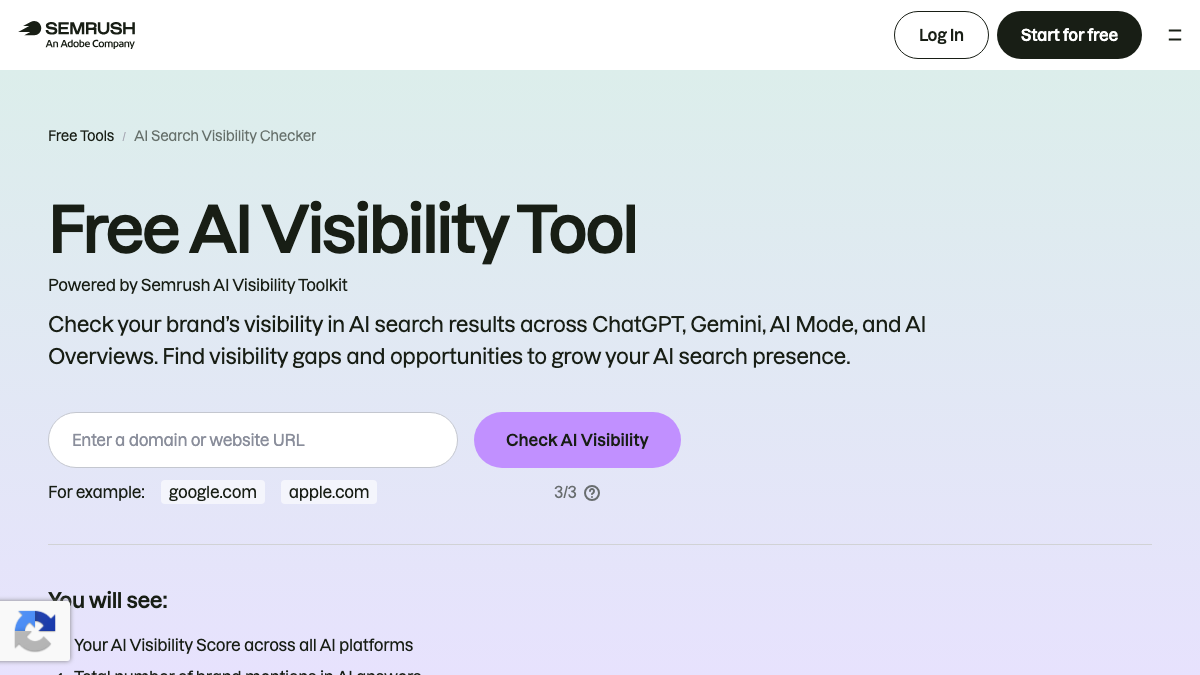
The numbers come from Semrush's own prompt database, which is the tool's strength and its limit. You get a broad reading without writing any questions, but you can't choose the questions. When we ran it from an automated test browser, it stopped with "We couldn't verify that you're human," so run it from your own browser. Daily prompt tracking needs the paid AI Visibility Toolkit.
4. Ahrefs AI Visibility Checker
Ahrefs checks the widest set of engines for free. Its report covers ChatGPT, Gemini, Perplexity and Copilot plus Google's AI Overviews, and a separate tab tracks AI Mode. There's no signup, though it put a Cloudflare "verify you are human" box in front of us before running.
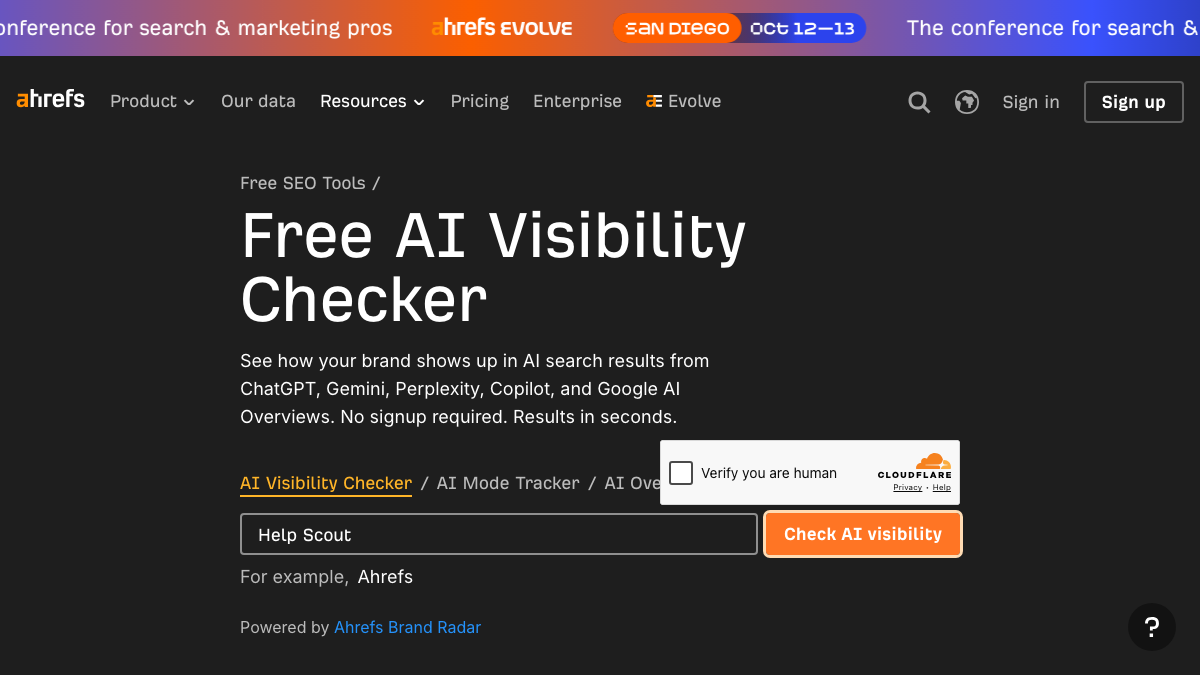
The free report shows total mentions and a split by platform. It also lists the top five topics, cited domains and cited pages, and that last list is the most useful part, because it shows which third-party pages carry your brand into answers. Ahrefs says the data comes from an index of more than 449 million prompts a month derived from real searches, and the full data sits in its paid Brand Radar.
5. RankControl free AI visibility check
Our own free AI visibility check takes a different route from the database checkers. The check pulls your live search footprint, counts your mentions across AI answers, then asks ChatGPT three real buyer questions from your market and shows who gets cited. There's no signup, and a run takes about a minute.
Three questions is a small sample, and one run can't show how answers vary. We built the checker to answer one question fast: when a buyer asks ChatGPT about your category today, whose pages does it link to? For a full picture you'd still want the weekly tracking described below.

Your competitors are getting cited by AI. You're not.
Every day without citation tracking is a day your competitors pull ahead in ChatGPT, Perplexity, and Claude.
6. HubSpot AI Search Grader
HubSpot's grader needs no account and asks four things: company name, location, product and industry. It then grades how ChatGPT, Perplexity and Gemini describe you across five dimensions, with sentiment worth up to 40 points of the 100.
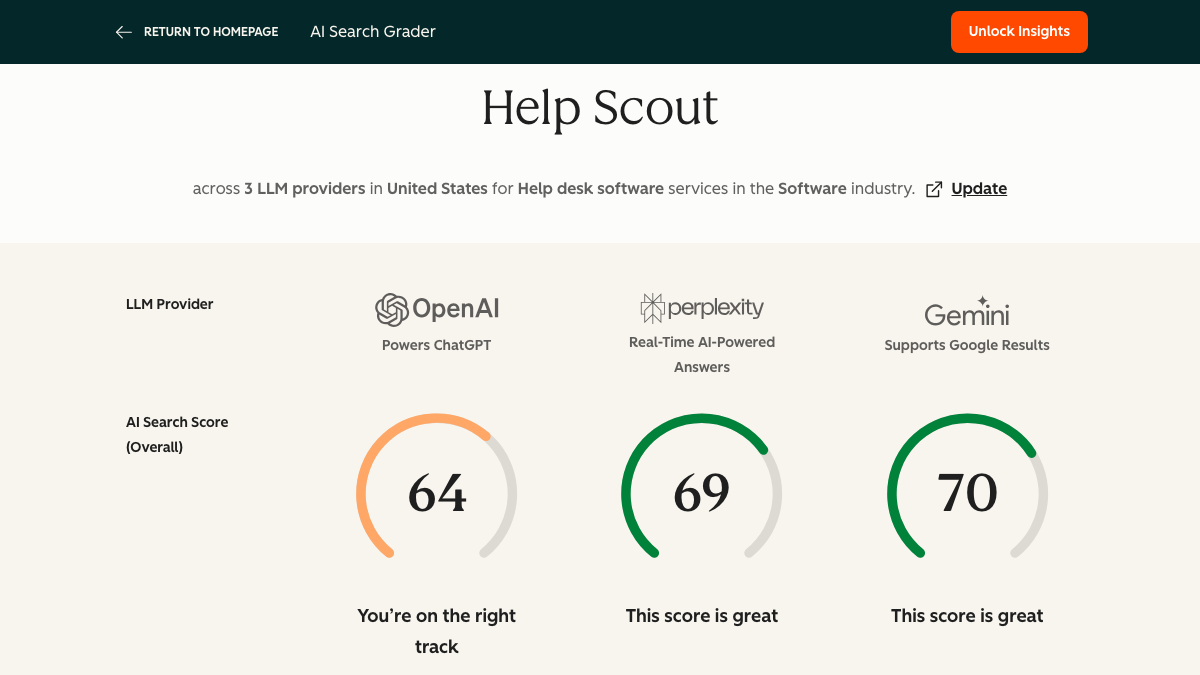
Help Scout scored 64, 69 and 70. Positive sentiment carried most of that, while market score sat at 3 out of 10 on every engine and share of voice never beat 4 out of 10.
HubSpot says the grades come from the models' training data, not live search. That explains a gap we noticed. When we asked live search engines about help desk software for our look at why answers name so few brands, Help Scout was named in 20 of 25 answers. The full report asks for an email, and our piece on HubSpot's AEO tools covers the $50-a-month paid version.
7. GA4 AI Assistant channel
GA4 now has a default channel called AI Assistant. Google's definition covers visits from assistants such as ChatGPT and Gemini, and it excludes AI Overviews and AI Mode, which still count as Google traffic.
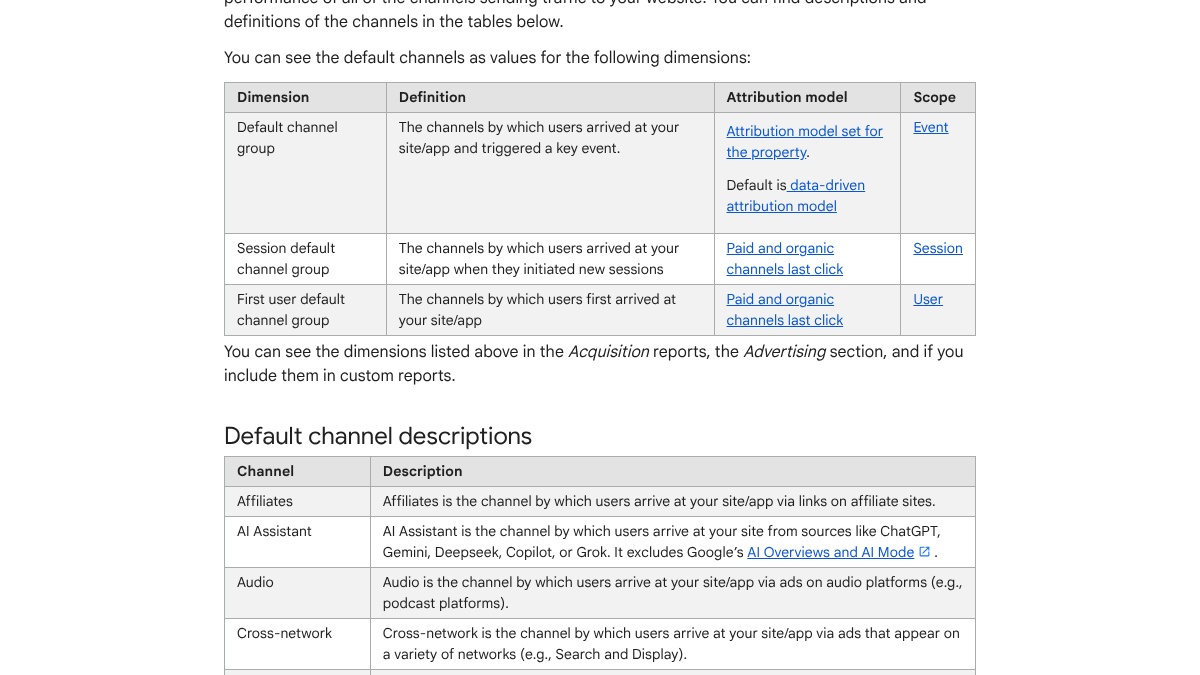
GA4 is the simplest free way to tie AI visits to conversions. It only sees clicks, though, and most AI answers don't produce one. Our guide to measuring ChatGPT search against Google shows how to read these visits alongside branded search.
8. Microsoft Clarity
Clarity is free and adds two things GA4 doesn't. Its AI Platform channel groups referrals from the main assistants, ChatGPT and Perplexity among them, so you can watch session recordings of people who arrived from an AI answer.
Since January 2026 it also has AI Bot Activity, which shows which AI crawlers read your site and which pages they fetch most. That part needs a connected CDN, and Microsoft lists Fastly, Amazon CloudFront and Cloudflare as supported.
9. Cloudflare AI Crawl Control
If your site already runs on Cloudflare, AI Crawl Control is on every plan, including Free. It shows which AI crawlers request your pages, how often and whether they follow your robots.txt rules, and it lets you allow or block each one.
It answers the question that comes before all the others: can the engines reach you at all? A blocked search crawler makes every other number on this list meaningless. Our AI crawler list explains which bots to allow.
10. The engines themselves
The most honest free tool is still a logged-out ChatGPT, Perplexity or Gemini session and a spreadsheet. It's the only method where you choose the questions, which matters because every checker above uses questions someone else picked.
Write 20 questions your buyers ask, run each in a fresh session, and log who's named and which sources are linked. Run each one more than once. Our guide to tracking AI citations for free found a single run's mention rate sat about nine points away from a three-run average.
200+ SaaS teams already track their AI citations.
They know exactly when ChatGPT mentions their brand, and when it stops. Do you?

Why the free scores disagree
Run your brand through four free checkers and you'll get four different pictures. That isn't a bug in any of them. Each one asks a different set of questions, and some don't search the web at all.
HubSpot grades what the models already believe from training data. Semrush and Ahrefs report from their own prompt databases, built from real searches, so the questions are broad and fixed. Our check asks ChatGPT a handful of live buyer questions for your market. Search Console and Bing report on your own pages, with no competitors in view.
We call the question set behind any score its prompt source, and it's the first thing to find out before you trust a number. Help Scout's 70 from HubSpot and its 20 out of 25 in live answers aren't in conflict. They describe two different things: how a model talks about the brand, and whether live search puts the brand in front of a buyer.
Which free tool to start with
If you've never checked at all, start with one of the brand checkers for a five-minute baseline, then open Search Console to see which pages Google already uses in AI answers. If you sell to companies that run on Microsoft 365, set up Bing Webmaster Tools next, since Copilot data is the only free citation count any engine gives you.
If traffic is the question, GA4's AI Assistant channel and Clarity answer it. If you suspect the engines can't reach you, check Cloudflare or your CDN logs before anything else. And once you know which questions matter, the manual log is where the real answers are.
The 10 free tools side by side
| Tool | What it checks | Engines | Account needed |
|---|---|---|---|
| Google Search Console | Impressions for your pages | AI Overviews, AI Mode | Yes, verified site |
| Bing Webmaster Tools | Citations, grounding queries, citation share | Copilot, Bing | Yes, verified site |
| Semrush checker | Score, mentions, cited pages | ChatGPT, Gemini, Google AI | No, 3 checks a day |
| Ahrefs checker | Mentions, topics, cited domains and pages | Five engines | No |
| RankControl check | Mentions and who ChatGPT cites | ChatGPT and more | No |
| HubSpot grader | How models describe your brand | ChatGPT, Perplexity, Gemini | No, email for full report |
| GA4 | AI referral visits and conversions | ChatGPT, Gemini, Copilot and others | Yes |
| Microsoft Clarity | AI referrals and AI bot activity | Five assistants | Yes |
| Cloudflare AI Crawl Control | AI crawler requests and rules | All major crawlers | Yes, Cloudflare site |
| Manual checks | Exact answers to your questions | Any | No |
What free tools can't tell you
Put the ten together and one gap stays open. None of them tracks your own questions on several engines every week and compares the results over time. The checkers give a snapshot on their own question sets, while the first-party reports each cover a single company's engines and analytics sees only clicks.
That gap matters because answers move. Engines change their sources, and a competitor can win a citation you held last month. A one-time score can't show that, and neither can a report that counts impressions without names.
Setting up the free stack takes an afternoon. Verify your site in Search Console and Bing, check crawler access in Cloudflare or Clarity, and confirm the AI Assistant channel in GA4. The manual checks are the expensive part. Done by hand, checking 50 questions on seven engines takes about six hours a week, and publishing eight solid articles a month takes 16 to 24 hours more. Those are rough estimates.
RankControl's AI visibility tracking runs your 50 questions every week on seven engines, marks each one as mentioned, cited or both, and records which competitors and sources each engine used. The content engine writes each article against the pages already ranking for its keyword and publishes it on your own domain.
You can run the free stack yourself, and for a lot of teams that's the right start. Or RankControl's agents can run the weekly checks and publishing once the manual log starts eating your Mondays.
How often does ChatGPT mention your brand?
Most founders have no idea. The answer might surprise you.