"Our blog lost 5 million visits in a thirty-day period." HubSpot's CMO, Kipp Bodnar, wrote that in a Fortune piece published on September 22, co-written with Kieran Flanagan, about rebuilding HubSpot's marketing after AI search changed how people find answers. If any company had a reason to build an AEO tool, it was the one that made inbound marketing a category.
So yes, HubSpot has an AEO tool. It has three things that people call by that name, and they do quite different jobs. Two are free, one is paid, and the paid one is still labeled beta. Here's what each one checks, what it costs, and where it stops.
HubSpot's three AEO tools at a glance
| Tool | What it does | Price | Engines |
|---|---|---|---|
| AI Search Grader | One-time score of how AI engines see a brand | Free, no email | ChatGPT, Perplexity, Gemini |
| AI Search Sensor | Industry-wide dashboard of AI search trends | Free | ChatGPT, Perplexity, Gemini |
| HubSpot AEO (beta) | Daily prompt tracking, citations, share of voice, recommendations | $50/mo standalone, or included in Marketing Hub Pro and Enterprise | ChatGPT, Perplexity, Gemini |
The names cause most of the confusion. When someone says "HubSpot's AEO grader," they usually mean the free AI Search Grader. When a Marketing Hub admin says "we turned on AEO," they mean the paid tracker.
The free AI Search Grader
The grader asks for four things: company name, location, product or service, and industry. There's no email field. HubSpot describes it as "a free, one-time check that reveals what ChatGPT, Perplexity, and Gemini say about you based on their training data," and it returns a score out of 100 for each engine.
We ran it on Salesforce on September 26. It came back with 85 for ChatGPT, 80 for Perplexity and 91 for Gemini, each labeled "This score is great," in well under two minutes.
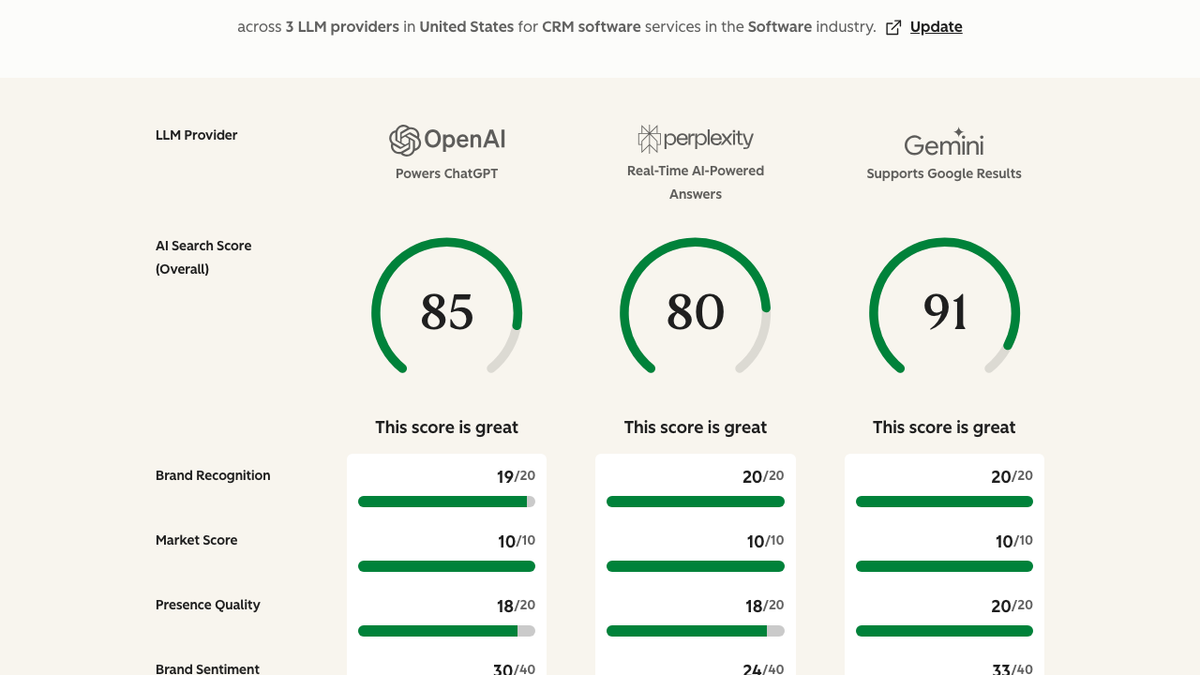
The score is built from five parts, and sentiment carries 40 of the 100 points, twice as much as brand recognition or presence quality. Share of voice against competitors gets 10. Below the scorecards, a blurred panel offers the full report behind an "Unlock Insights" button.
Two limits are worth knowing before you share the number with your boss. HubSpot's own wording says the score reflects training data, so it measures what the models remember about you more than what they find when they search today. We'd call it a memory score. And HubSpot's page adds that the recommendations "are generated by an AI tool and have not been reviewed by a human being."
The free AI Search Sensor
The Sensor is a different product that sounds like the same one. It's a free industry dashboard that HubSpot says tracks how answer engines "cite brands, surface content, and send traffic." It tracks day-to-day volatility in AI answers and weekly AI-referred traffic.
It won't show your brand, and HubSpot says so plainly: "AI Search Sensor won't show your brand's visibility." It's useful context when an AI traffic dip might be industry-wide, and that's about it.
Your competitors are building backlinks while you read this.
Organic outreach, social mentions, and citations from Editorial Circle member sites, with managed backlinks available as an add-on. Grow your domain authority without running the campaign yourself.

HubSpot AEO, the paid tracker
HubSpot AEO launched in April 2026, and the product page still carries a "BETA" badge next to the name. The pitch is short: "Track your AI visibility. Get recommendations to improve it."
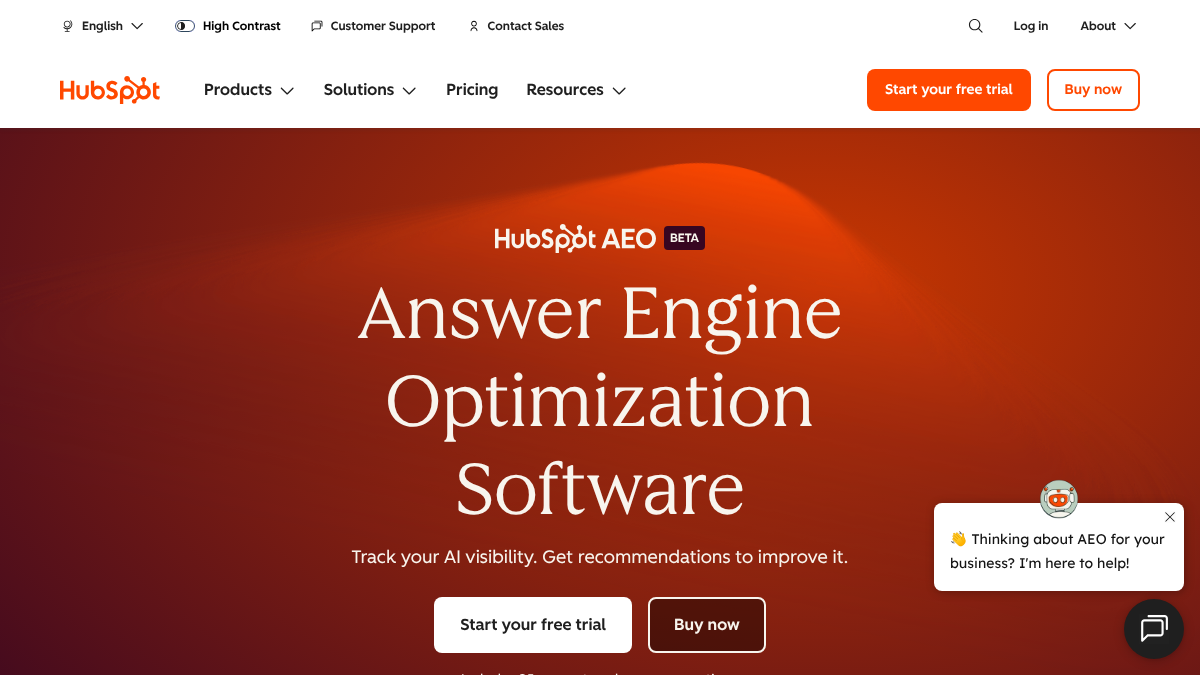
It costs $50 a month, or $45 billed yearly, and it doesn't require any other HubSpot subscription. There's a 28-day free trial with no card. It's also included with Marketing Hub Professional, which starts at $800 a month, and Marketing Hub Enterprise at $3,600 a month.
The limits come from HubSpot's knowledge base:
| Plan | Prompts per day | Answers per month | Engines |
|---|---|---|---|
| HubSpot AEO (trial or paid) | 25 | 2,500 | 3 |
| Marketing Hub Professional | 25 | 2,500 | 3 |
| Marketing Hub Enterprise | 50 | 5,000 | 3 |
Inside, you get a visibility score that refreshes daily and share of voice against competitors. There's also a citation view of which domains and pages the engines cite, plus suggested prompts and a list of recommendations. Part of it came from outside. HubSpot announced on October 31, 2025 that it was buying XFunnel, an AEO monitoring startup, and the deal closed in December.
Adoption is moving fast, at least by HubSpot's count. On the Q2 2026 earnings call, CEO Yamini Rangan said 32% of Marketing Hub Pro+ customers had activated AEO and nearly 16,000 customers had started a standalone trial. Activating a feature isn't the same as using it every week, and an earnings call is where a company puts its best number forward, so read that as a strong start rather than proof of results.
What early users say
The reviews so far are lukewarm. SaaStr's Jason Lemkin tried it the week it launched and called it "maybe 60% as good as top AI point solutions." He got a 70% brand visibility score, a 0% sentiment score for his content, and in his words, no recommendations at all.
Ok HubSpot has many great products I'm not sure the new AEO tool that just dropped is one of them yet. I think it's like many AI tools that is ... maybe 60% as good as top AI point solutions. And I wouldn't pay for a 60% AI Solution in almost any category today. 👉What I got: https://t.co/HnzLyvoydO
 Jason ✨👾SaaStr.Ai✨ Lemkin@jasonlkApr 14, 2026

In r/hubspot, the most upvoted reply in a thread asking what the tool is like called it "a little rote," mostly a prompt tracker capped at 25 or 50 prompts, and said the prompt suggestions were "total AI slop." Another user pushed back: for the average Marketing Hub customer it's basic, inexpensive prompt tracking, and it lets them report on AI visibility for the first time. A third said the data they got was often conflicting.
Has anyone tried the new hubspot AEO tool? What it is like?
Hubspot acquired xfunnels and launched their own AEO tool last week, has anyone tried it? Any pros/cons? Also heard that it starts at 50 USD which is pretty cheap. The cheapest full stack tool in the market with AEO capabilities was Writeso...
Where HubSpot AEO stops
Coverage is the first limit. HubSpot tracks three engines, and its pages don't mention Claude, Grok or Google's AI Mode. If your buyers use Claude at work or search Google in AI Mode, those answers never show up in your score.
The second limit is the one every tracker shares. HubSpot AEO tells you where you're missing and suggests what to fix. Someone still has to write the comparison page, update the pricing page or publish the answer the engines are looking for, and that work is most of the job. Our AEO audit walkthrough shows how much of it sits outside any dashboard. If your blog runs on HubSpot's CMS, our guide to publishing AI-optimized content to HubSpot covers how to get new pages onto it automatically.
HubSpot AEO does two things well. It checks every day, where RankControl and some other trackers check weekly, and it sits inside the CRM, next to the contact and deal data a Marketing Hub team already reports on.
You're getting AI traffic. But do you know where it comes from?
RankControl credits every visit to the assistant that sent it: ChatGPT, Perplexity, Claude, Gemini, Copilot, or Grok. Full source attribution, next to your Google traffic.
Do the engines describe HubSpot AEO correctly?
We asked OpenAI's model with web search and Perplexity, "Does HubSpot have an AEO tool?" Both answered accurately. They named the $50 standalone price, the Marketing Hub bundling and the three engines, and both cited HubSpot's own knowledge base.
That's the pattern we keep seeing: whoever owns the answer gets cited. HubSpot's help article has a plain table of plans, prompts and engines, and it became the source both engines quoted.
There's one more wrinkle with the HubSpot-specific keywords themselves. Phrases like "HubSpot AEO" and "AEO grader" don't register search volume in Google's keyword data yet, because the product is only a few months old. Most of the demand still sits under broader terms, like "HubSpot SEO tools," which gets about 140 US searches a month.
How to get a useful read from the 28-day trial
Twenty-five prompts go quickly, so choose them before you start the trial. Pull real questions from sales calls and support tickets instead of accepting the suggested prompts, which drew the harshest review in that r/hubspot thread. Include a handful where you expect to win, a handful where a competitor usually gets named, and at least one pricing question.
Then leave the prompts alone for two weeks. Daily scores move around, and one Reddit user said the data they got was often conflicting, so look at the trend across 14 days instead of any single day. At the end, open the citation view and list the five domains cited most often. That list tells you more than the score does, because it shows which pages you'd need to beat or get onto.
What to do with HubSpot's AEO tools
If you already pay for Marketing Hub Professional, turn AEO on, since it costs nothing extra. Run the free grader once on your brand and two competitors to get a feel for where you stand. Don't treat either score as the full picture.
If you need more engines, or someone to do the work the recommendations point to, you'll need more than a tracker. You can run the checks and write the fixes yourself: pick your 25 to 50 buyer questions, ask them across engines, and turn each gap into a page. Budget a few hours a month for the checks and far more for the writing.
Or RankControl can take both. AI visibility tracking checks up to 50 buyer questions every week on seven engines, including Claude, Grok, Google AI Mode and Google AI Overviews, and shows which competitors got named instead of you. The content engine then plans and writes articles from those questions and publishes them on your own site, all for $400 a month with a 7-day free trial.
For a quick look first, run a free check of your brand in AI answers, or see how the wider field compares in our AEO tools roundup.
We'll show you exactly where your brand stands in AI search.
No commitment. $0 due today, cancel anytime. See how ChatGPT, Perplexity, Claude, Gemini, Grok, Google AI Mode, and Google AI Overviews talk about your brand today.