
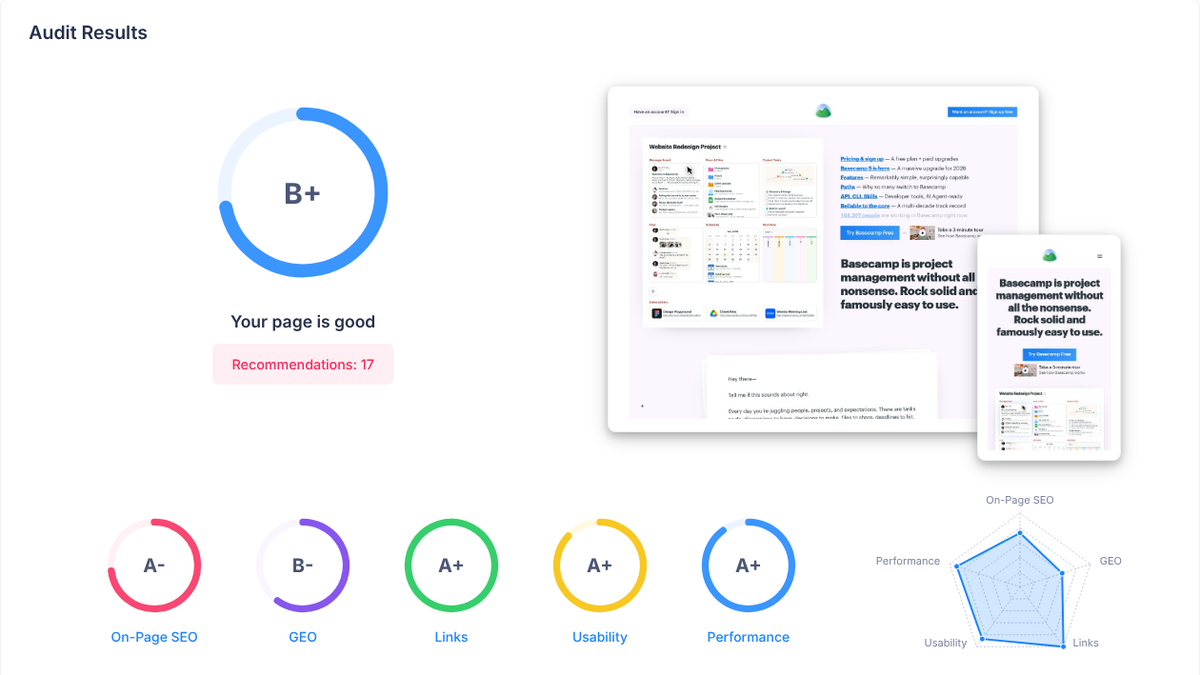
On September 25 we pasted basecamp.com into SEOptimer's free audit while researching this RankControl vs SEOptimer comparison, and got back a B+ with 17 recommendations. There's a newer GEO sub-grade on the report too, and Basecamp scored a B- there.
The first fix it asked for was the title tag. Basecamp's is the single word "Basecamp," and SEOptimer wanted it stretched to 50 or 60 characters. The two GEO items sat lower down, both marked low priority: add identity schema, and add an llms.txt file.
Parts of it we liked. You can read it in a minute, and it's specific about the one page it checked. What it won't do is make those changes for you, and a month from now it has no way to tell you whether ChatGPT started naming Basecamp because of them.
That's where the two products split. SEOptimer's product is the report, and more recently a GEO Audit that asks AI models about your brand. RankControl is ours, so read with that bias in mind: we skip the grade, write and publish the pages, then check each week whether AI engines cite you. SEOptimer's prices and features below come from its own site, checked on September 25, 2026.
RankControl vs SEOptimer: the short answer
Which one wins AI search visibility? We'd pick RankControl, because of what happens after the grade. An audit tells you what one page lacks on the day you run it, and someone on your team still has to fix it. We'd rather do the work the audit would list, then keep asking the same questions every week so you can see whether any engine starts quoting you.
SEOptimer's homepage now calls it an "SEO Audit & AI Visibility Tool," and the core plans run from $29 to $59 a month. The audits come with a site crawler, rank tracking and backlink research, and the two pricier plans add white-label PDFs. Most of the AI side lives in a separately sold GEO product with its own monthly allowance of AI visibility audits.
RankControl costs more, $400 a month, and it's built around one job: getting you cited in AI answers and ranked on Google. We find the questions your buyers ask and answer them in articles written in your brand's voice, published as ordinary posts on your own site. Every week the same 50 queries go to six AI engines, and we record who got cited.
Side by side
Here's how the two compare on what matters for AI search, going by each vendor's own site in late September 2026.
| SEOptimer | RankControl | |
|---|---|---|
| What it is | SEO audit and reporting tool with a GEO audit add-on | Pipeline for AI search visibility and Google rankings |
| Price | $29, $39 or $59/mo; GEO product $29 to $79/mo extra | $400/mo or $4,000/yr, one plan |
| Free trial | 14 days on core plans; the GEO product bills at once | 7 days on the full plan |
| AI engines | ChatGPT, Claude, Gemini, Perplexity, plus Google AI Overview citations | ChatGPT, Perplexity, Claude, Gemini, Grok, Google AI Mode |
| How AI visibility is measured | GEO Audits from a monthly allowance, 40+ prompts per run | 50 tracked queries checked weekly, citation history per engine |
| Rank tracking | 20 to 250 keywords on Google, Bing and mobile | Google and Bing positions for every page it publishes |
| Content | AI Writer drafts, 20 to 80/mo, exported as files | 100 pages/mo across 26 formats, published for you |
| Publishing | Paste the export into your CMS | WordPress, Webflow, Shopify, Ghost, Notion, Wix, Framer, webhooks, headless via API |
| Links | Research and monitoring of your own backlinks | Prospects and outreach drafted from your mailbox; managed links add-on |
| Site checks | Page audits with 100+ checks; 4 to 50 site crawls/mo | Quotability score and fix list on every article it writes; daily AI crawler access check |
| Client reporting | White-label PDFs, embeddable audit form, bulk reports | Dashboard, reports screen and a weekly email brief |
| Seats | 1, 3 or 6 users | 5 seats |
| API and MCP | Audit and rank-tracking APIs sold separately | MCP server and CLI with 80+ tools, included |

Built by the team that got cited in 48 hours.
Content generation, backlink building, AI visibility tracking, and Google rankings. One platform, zero guesswork.
What SEOptimer is in 2026
SEOptimer is older than most tools in this space. Paweł Rabinek started it in 2012 as a free on-page checker, and Adam Krzywda bought it four years later. These days it claims more than 2,000 customers and 90,000-plus users, and the audit is still the first thing you meet. Paste in a URL, wait the 20 or so seconds SEOptimer quotes, and you get a letter grade over a prioritized fix list.
Pay for a plan and you get the usual toolkit around that audit, all of it metered. The cheapest plan includes four site crawls and 20 tracked keywords a month, which covers one small site and little more. Backlink monitoring emails you when links appear or drop off. There's even an AI Writer now that drafts articles with a content score, then hands you a Word, HTML or Markdown file to paste into your CMS yourself.
Where SEOptimer is clearly ahead of us is agency packaging, since RankControl has no white-label reports and no embeddable audit. Its branded PDFs carry your logo and colors, can be served from your own domain and translate into about 29 languages. On the $59 plan you also get an audit form to embed on your site, so visitors can request one of those reports.
The GEO audit gives you one reading
SEOptimer's answer to AI search is the GEO Audit. Its feature page says each run sends more than 40 "realistic discovery prompts" to ChatGPT, Claude, Gemini and Perplexity. The report shows which rival brands those models name more often than you, and which queries already cite your site in Google's AI Overviews. Then it grades five areas, crawler access and prompt visibility among them.
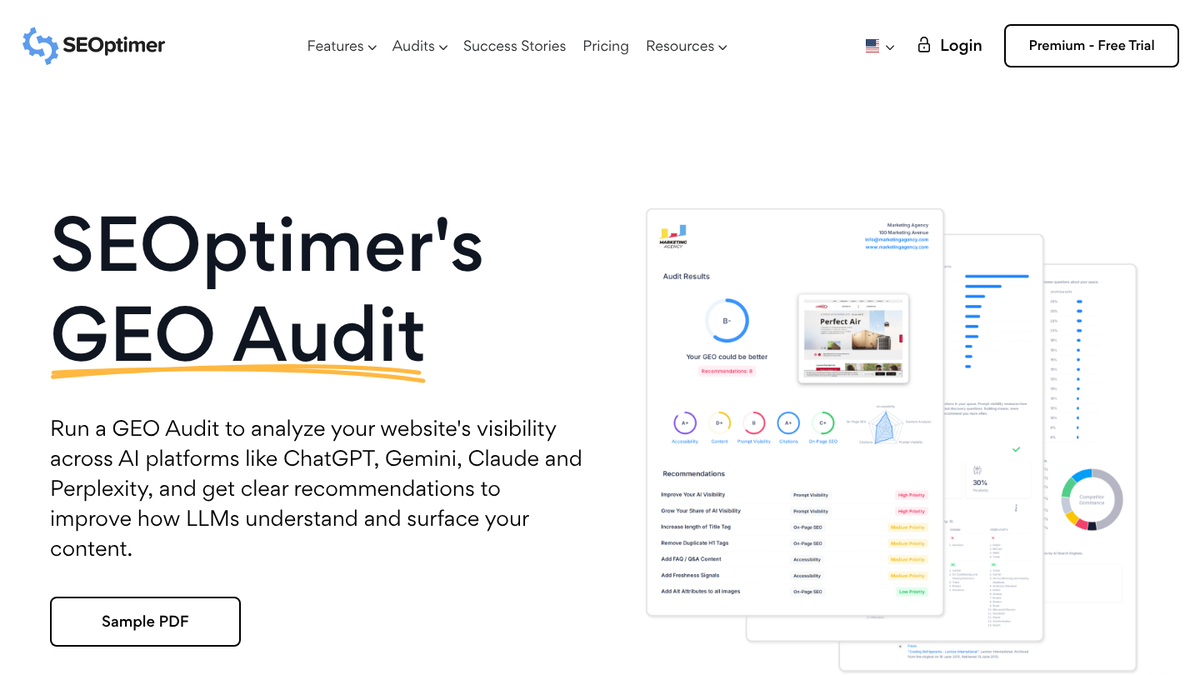
Each run spends one audit from a monthly allowance. White Label and Lead Generation include 10 a month, and beyond that there's the standalone GEO product, which bills right away, outside the free trial:
| GEO audits a month | Price |
|---|---|
| 50 | $29/mo |
| 100 | $49/mo |
| 250 | $79/mo |
We found nothing on the GEO page or the pricing page about asking the same prompts again on a schedule, so what you buy is a reading taken the day you press the button.
Why isn't one reading enough? On September 23, Glen Allsopp published a study at Detailed, the SEO blog Ahrefs bought last year. It asked ChatGPT and Google's AI Overviews the same 1,300-plus prompts every day for 28 days. That's just over 70,000 responses, and when you compare any two days of ChatGPT's answers to one prompt, the set of brands was identical only 0.3% of the time.
The churn followed a pattern, which is the useful part. On ChatGPT, brands that appeared on most days changed only about 13% of the time, while the occasional names turned over at 78%. We've started calling this the one-draw problem. One audit can't separate those two groups. If an engine names you once, you can't tell whether you're a regular or a lucky draw until the same prompt has been asked many more times.
Ian Nuttall picked out the key numbers in a post on X:
AEO is still very early! @viperchill tracked 70k AI responses in Google/ChatGPT and found: - 0.3% chance of the same brand list repeating next day - Core brands only changed 11-13% of the time - Long tail brands changed 65-78% of the time ChatGPT returned ~6 brands per prompt,
 Ian Nuttall@iannuttallSep 24, 2026
The study admits one limit of its own. Every prompt started a fresh chat, while real buyers tend to ask follow-ups inside a running conversation. What they see live is probably even harder to pin down than the study's figures suggest.
Who asks the same questions next week?
We built RankControl's AI visibility tracking around repetition. The same 50 queries go out to six engines every week, Grok and Google AI Mode among them. The dashboard keeps a citation history for each engine and each query. A month in, your cited rate comes from four weekly rounds rather than one PDF, and you can see your share of voice against up to 10 competitors.
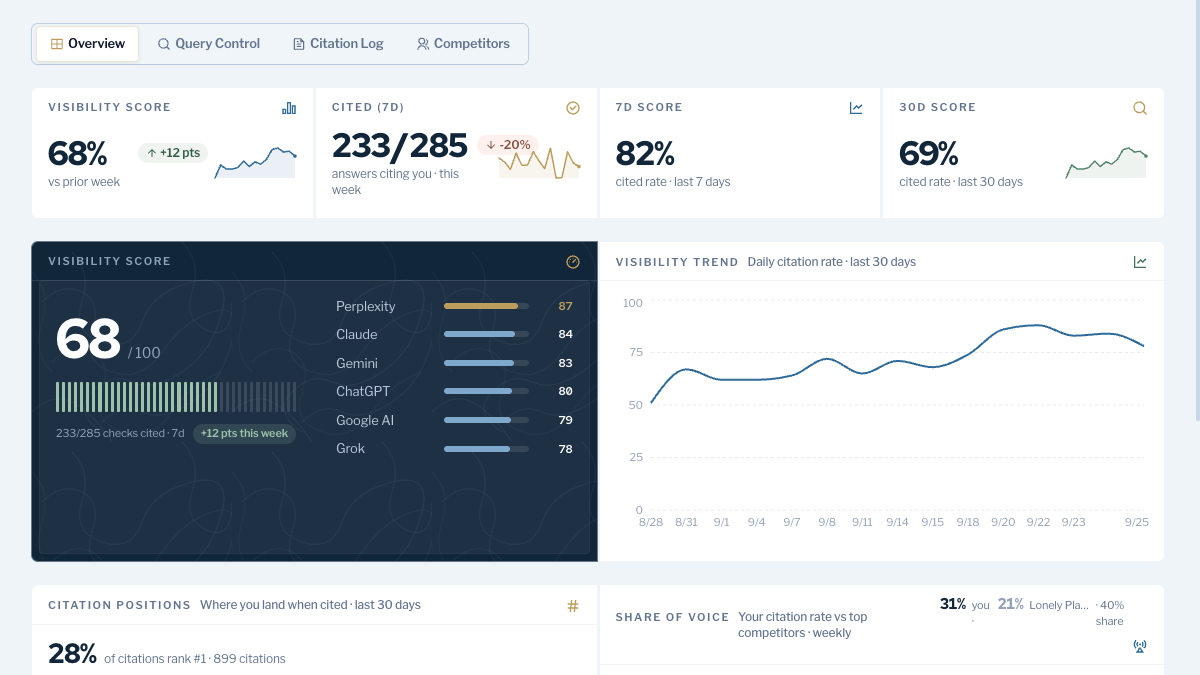
Doing it by hand adds up fast. Fifty queries on six engines is 300 answers a week. At a minute an answer, that's five hours every week before you've built a spreadsheet to spot a trend.
The harder part tends to show up around month three. A page that was cited in week two can slip out of the answer by week nine, and nobody rereads 300 answers to catch that. When a new citation lands, RankControl sends a notification. A lost one shows up in the dashboard's citation history, so you see the drop the next time you open it instead of at the next audit.
See your first AI citation report in under 5 minutes.
No setup calls. No onboarding meetings. Connect your domain and see where AI mentions your brand right now.

An audit lists the work, and someone still has to do it
Reddit threads about audit tools keep circling one complaint, which is that the list is too long. A late-August r/TechSEO thread asked what a good audit should deliver. Several replies wanted issues grouped and ranked, because a dump of hundreds of findings buries the few that matter. A May thread on r/SEO_Xpert called most audits theater for the same reason.
The grade can mislead you in a different way. In an r/SEO thread from late 2024, one commenter ran a homepage through SEOptimer. It belongs to a 25-year-old domain that gets about 2.2 million visits a month, and it got a B, so the commenter gave the tool a D back.
We saw a milder version with Basecamp, where the report asked a software company's homepage for a business address and local business schema. None of this touches the question you're paying to answer, which is whether ChatGPT names you when a buyer asks.
Rankings won't work as a stand-in either. Ahrefs has twice checked whether the pages cited in AI Overviews also rank in Google's top 10 for the same query, and the share halved between runs:
| Ahrefs run | Cited pages ranking in Google's top 10 |
|---|---|
| July 2025 | Roughly 76% |
| March 2026 (863,000 keyword results, 4 million AI Overview links) | About 38% |
The Ahrefs write-up puts the shift down to Gemini 3 and Google's fan-out searches. Ahrefs also improved its citation parsing between the runs, so part of that drop is method. Either way, it's one more reason ranking first on Google doesn't guarantee a ChatGPT citation.
Then there's that llms.txt item from Basecamp's report. Google's own AI features documentation says there are "no additional requirements to appear in AI Overviews or AI Mode, nor other special optimizations necessary." And when we added llms.txt to 12 sites and tracked them for 90 days, the major AI crawlers barely requested the file. So half of Basecamp's GEO fix list was a file Google says its AI features don't need.
Now suppose the audit gets everything right. For AI search, the biggest fix is usually content, meaning pages that answer your buyers' questions in a form an engine can quote. SEOptimer's AI Writer gets you a draft. Here's what we estimate it still needs before it goes live:
| Still to do | Time |
|---|---|
| Edit and fact-check it against your product | 45 to 90 minutes |
| Link it to your existing pages and cite a couple of outside sources | 20 to 30 minutes |
| Make images and write the meta tags and FAQ | About 30 minutes |
| Format it in your CMS and publish | 15 to 20 minutes |
Add that up and it's two to three hours an article. Twenty articles a month makes it 40 to 60 hours of work, and every one of those hours starts after the drafts exist.
RankControl's content engine is built for that stretch. Each article gets written against the pages already ranking for its keyword, in the voice of the brand profile we build from your site. It arrives with images and with links into pages you already have. It carries a score for how easily AI engines can quote it, plus a fix list, and then goes out through the publishing destination you connect. Auto-publish starts off, so you read and approve each article until you trust what it writes.
RankControl vs SEOptimer pricing, job by job
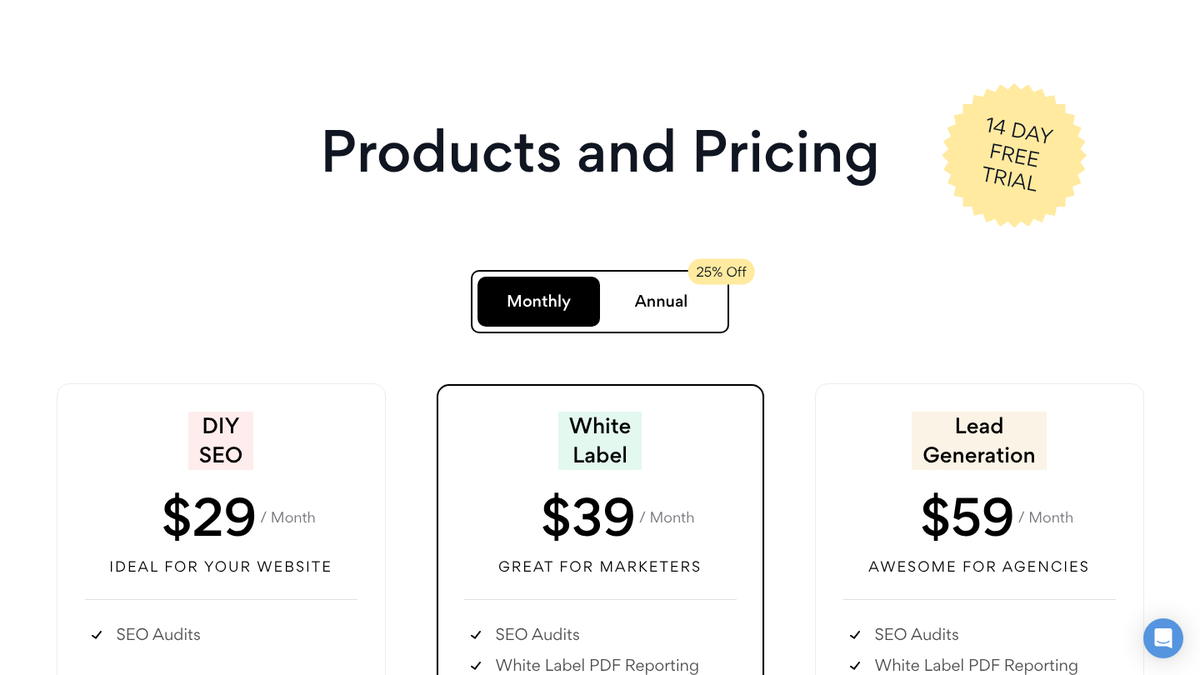
SEOptimer is far cheaper, and we won't pretend the gap is small. Its core plans come with a 14-day trial and a quarter off when you pay annually. The $29 plan has no GEO Audits at all, though, so on SEOptimer your AI search work begins at $39.
Here's where the money goes, job by job:
| The job | SEOptimer | RankControl |
|---|---|---|
| Check AI answers for your brand | 10 GEO Audits/mo on the $39 and $59 plans, or 50 to 250 on the GEO product | 50 queries on 6 engines, every week, included |
| Track Google and Bing rankings | 20 to 250 keywords by plan | Every page it publishes, weekly |
| Write articles | AI Writer drafts, exported as files | 100 pages/mo, written and published |
| Get articles live on your site | Copy and paste | Native posts on 9 destinations |
| Earn links and mentions | Research and monitoring of your own profile | Outreach drafted from your mailbox; Managed Backlinks $350/mo |
| Seats | 1 to 6 | 5 |
| Trial | 14 days; GEO product bills at once | 7 days on the full plan |
If we were buying SEOptimer for AI work, we'd take the Lead Generation plan and add the 100-audit GEO tier, which comes to $108 a month. The work itself sits outside that $108. Writing and publishing alone is the 40 to 60 hours from the estimate above, and nobody has sent a pitch yet.
RankControl's $400 a month covers five seats and the work, and paying $4,000 for the year works out to two months free. If you want people on top of the software, there are two add-ons you can skip: a Dedicated Strategist at $1,500 a month and Managed Backlinks at $350. The MCP server and CLI for Claude or Cursor come in the same plan, while SEOptimer sells its audit API separately, from $100 a month.
Links and mentions, the part an audit can only measure
SEOptimer's backlink tools report on the links you already have, from referring domains and anchors to page strength, and email you when one disappears. Nothing in the product looks for new sites or writes to them.
That gap matters more for AI search than it did for classic SEO. Ahrefs studied 75,000 brands and found that branded web mentions tracked AI Overview visibility about three times as closely as backlinks did. That's why mentions now sit next to backlinks in any plan for getting cited.
Link Control is the part of RankControl that picks up where an audit stops. For every article RankControl publishes, it looks for sites that might link to it and the person there to email, then drafts a note that goes out from your own mailbox. Follow-ups only go out when nobody replies. And if you'd rather hand off the whole job, Managed Backlinks adds five links a month from DR 25+ sites.
Point tool or pipeline: the verdict
If AI search visibility on your own domain is the goal, our verdict is RankControl.
SEOptimer is good at the job it was built for, grading a page quickly and cheaply, and the GEO Audit adds a snapshot of four AI models on top. Once you have that snapshot, the new pages and the outreach are still on you, and so is running the next audit to see whether anything moved.
RankControl is narrower on purpose. It runs the whole loop for you, from picking the questions through publishing the pages and drafting the outreach. Then it checks six engines every week, so each reading lands on a trend line instead of in a folder of PDFs.
Here's what a first month looks like. Your calendar fills with titles planned from your tracked queries, and articles go live in your CMS on whatever schedule you set, while outreach drafts wait for your approval. By the end you have four weekly readings across six engines showing where you stand, and your hours went into approving the plan instead of producing it.
You can run all of this yourself with an audit tool and your own time: run the GEO Audit, write and publish the pages, pitch the sites, then audit again every week. Or let RankControl's agents handle it every month while you get back to your product.
If you're already on SEOptimer, our guide to switching from SEOptimer walks through what exports, what doesn't, and how to cancel cleanly. If you don't know where you stand yet, start with a free check of your brand in AI answers. Then use the seven-day trial, and count what's live on your site when it ends.
Your competitors are building backlinks while you read this.
Organic outreach, social mentions, and link exchanges, with managed backlinks available as an add-on. Grow your domain authority without running the campaign yourself.