
Semrush has two pages that explain its AI share of voice, and they don't describe the same metric. Its help page calls share of voice the percentage of mentions your brand gets in AI answers compared to competitors. Its blog post on how to measure AI share of voice says the Brand Performance report works it out from how many times you're mentioned and how high you appear.
Two pages from one vendor drifted apart, and that gap shows the real problem with AI share of voice tools. The label is the same everywhere, and the math under it isn't. So this list ranks nine tools and puts the math first.
The nine are Semrush AI Visibility Toolkit, Ahrefs Brand Radar, RankControl, Profound, Peec AI, Otterly.AI, AthenaHQ, Scrunch and Rankscale. I read each vendor's pricing page, help docs and methodology pages on October 19, 2026. Nothing here comes from a trial account.
AI share of voice tools at a glance
Checked on October 19, 2026 against each vendor's own pricing page and docs. "Not published" means I couldn't find it on the vendor's public site, not that the vendor hides it.
| Tool | What counts | Weighting | Competitor set | Engines | Check frequency | Cheapest plan |
|---|---|---|---|---|---|---|
| Semrush AI Visibility Toolkit | Mentions (help page) | None on the help page; the blog adds position | Size not published | 5 in Brand Performance | Weekly, daily for Prompt Tracking | $99/mo, 25 prompts |
| Ahrefs Brand Radar | Mentions or citations, blended | Impressions estimate uses Google search volume | Size not published | 6 on the Index, Claude on Custom Prompts | Monthly for chatbots on the Index | Custom Prompts from $50/mo |
| RankControl | An answer that names or cites you | Each answer counts once | Up to 10 you track | 7 | Weekly | $400/mo, 7-day trial |
| Profound | Mentions; citations in a separate report | Headline score weighted by prompt volume per day | Size not published | 3 on trial, up to 9 on Enterprise | Daily | Free 7-day trial, then a quote |
| Peec AI | Not published | Not published | Size not published | Pick 3 of 6 | Daily | $95/mo, 50 prompts |
| Otterly.AI | Citations | Not published | Size not published | 4, plus paid add-ons | Daily | $29/mo, 15 prompts |
| AthenaHQ | Not published | Not published | Size not published | 5 free, 11 on Starter | You choose, by credits | Free tier; Starter $295/mo |
| Scrunch | Not published | Not published | Size not published | 4 on Core | Daily for 14 days, then every 72 hours | $250/mo, 125 prompts |
| Rankscale | Not published | Not published | Size not published | 12+ | Hourly to monthly | $20/mo, credits |
Four of the eight other vendors put a formula on a public page, and those four use three different ones. If engine coverage matters more to you than the formula, our engine-by-engine comparison breaks that column out plan by plan.
Why one share of voice reading tells you little
AI answers move around a lot. In SparkToro's January 2026 study, 600 volunteers ran 12 prompts through three AI tools, 2,961 times in all. The study found that there was less than a 1 in 100 chance of getting the same list of brands twice, and about a 1 in 1,000 chance of the same order.
That's why a share of voice figure only means something as a trend. One check is a sample of one. Fifty prompts, read every week for two months, start to show you a real direction.
The second weak spot is the bottom of the fraction. When a tool divides your mentions by those of the competitors you chose, a short list makes you look bigger. Waikay, which sells an AI visibility tool itself, makes this point in its guide and argues for counting every brand an engine names instead. Most tools here, RankControl included, compare you against brands you pick, so keep that set the same from month to month.
I call this the denominator check. Before you report a share of voice number, write down which brands sit in the bottom of the fraction. Our explainer on visibility scores vs citation tracking covers how the same label hides different math, so I won't repeat it here.
Your competitors are getting cited by AI. You're not.
Every day without citation tracking is a day your competitors pull ahead in ChatGPT, Perplexity, and Claude.
The 9 best AI share of voice tools, ranked
1. Semrush AI Visibility Toolkit
Semrush is first because the toolkit sits inside a suite many SEO teams already pay for, next to data they use every day. The standalone toolkit is $99 a month for 25 prompts, or it comes inside Semrush One Starter at $199.
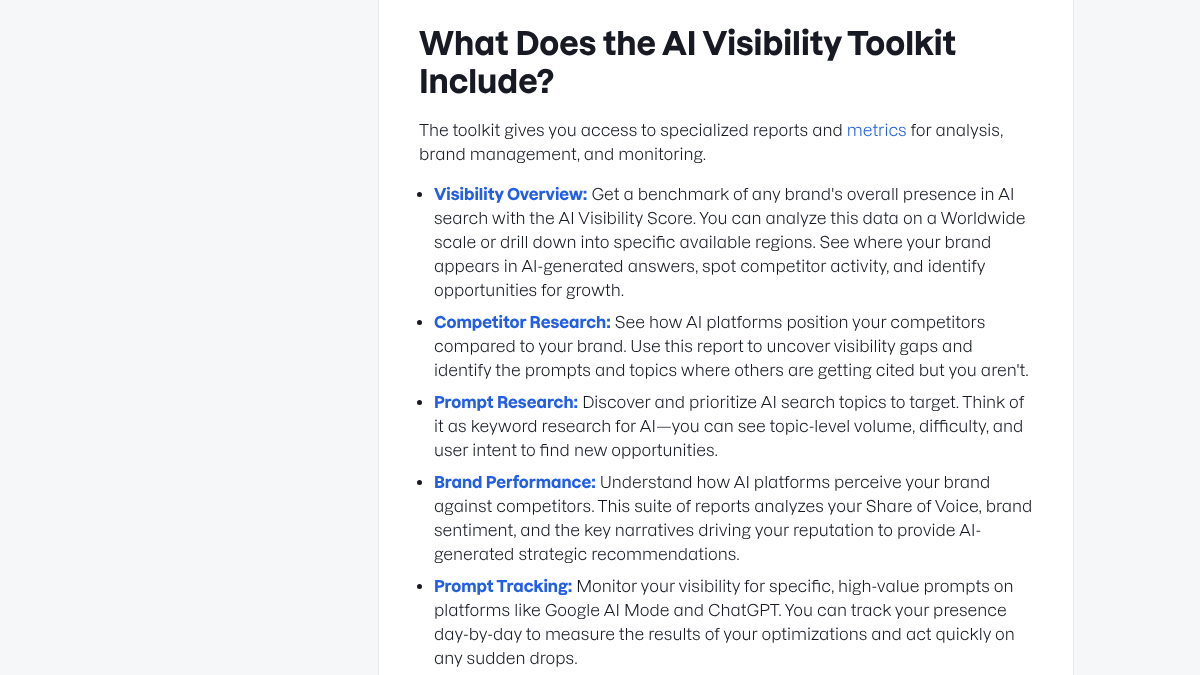
Its help page defines share of voice as "percentage of mentions your brand receives in AI-generated answers compared to competitors." Citations sit in their own metric, the number of AI answers that cite your domain. Semrush's blog post gives the same mentions formula, then says the Brand Performance report also factors in how high you appear. Ask support which version your dashboard uses before you put the number in a board deck.
Brand Performance runs weekly on ChatGPT, Perplexity, Gemini and both Google AI surfaces. Prompt Tracking runs daily, which is the one place Semrush checks more often than RankControl, though only on ChatGPT Search, AI Mode and Gemini.
2. Ahrefs Brand Radar
Of the other eight vendors, Ahrefs is the only one that blends both signals into its headline number and says so. According to its methodology page, it "calculates AI Share of Voice (SOV) based on how often brands are mentioned or cited."
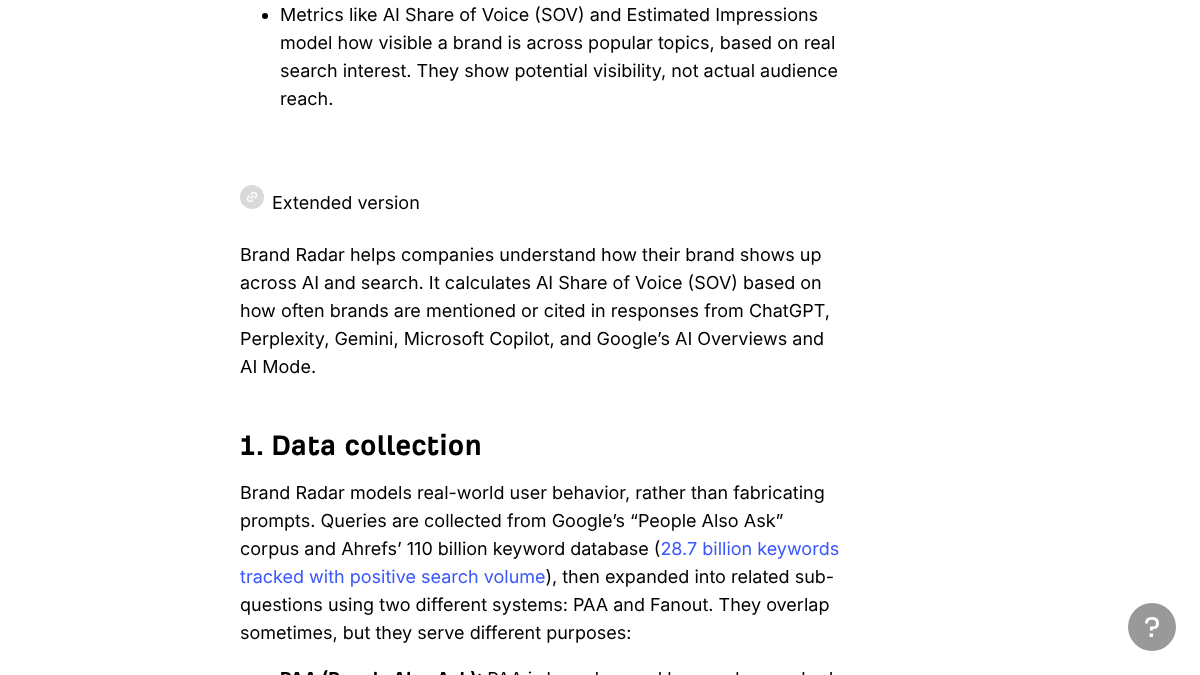
There's a second layer. Its estimated impressions weight mentions by Google search volume, and the same page calls that "a modeling choice, not a measured relationship." I like that sentence, because it tells you which part of the number is an estimate.
Custom Prompts start at $50 a month. The AI Visibility Index costs $199 a month per platform, or $699 for all six, and it refreshes the chatbots monthly over a 90-day window.
3. RankControl
RankControl counts an answer for a brand when the engine names it or cites it. Your share is set against the up to 10 competitors you track, so the number answers a plain question about how often AI answers pick you over the brands you compete with.
We check 50 questions every week on ChatGPT, Perplexity, Claude, Gemini, Grok, Google AI Mode and Google AI Overviews. Each engine shows on its own as well as in the total, and a new citation sends you a notification. Our AI visibility tracking page shows what that weekly report looks like.
The difference from the two above is what happens next. The same $400 a month plan writes and publishes articles on your site, then keeps checking whether the engines name or cite you. We don't track Copilot, and there's a 7-day free trial.
4. Profound
Profound's developer docs are the clearest in the group. They define the visibility score as the "fraction of answers the asset appeared in" and share of voice as the "fraction of all mentions the asset accounts for." Citations live in a separate Citation Share report.
The headline score is weighted by volume across days. In the docs' own words, "a day with 10,000 prompts moves the headline more than a day with 100." That's useful to know before you average a chart by hand.
There's a free 7-day trial with 50 prompts a day on ChatGPT, Gemini and AI Overviews. Paid use is an Enterprise quote with up to nine engines and daily checks. Our RankControl vs Profound comparison covers the rest.
5. Peec AI
Peec shows three numbers side by side for every brand, with visibility as a percentage next to average position and a sentiment score. The demo dashboard on its site ranks five brands against each other, and puts Attio, the demo brand, third of five at 47%.
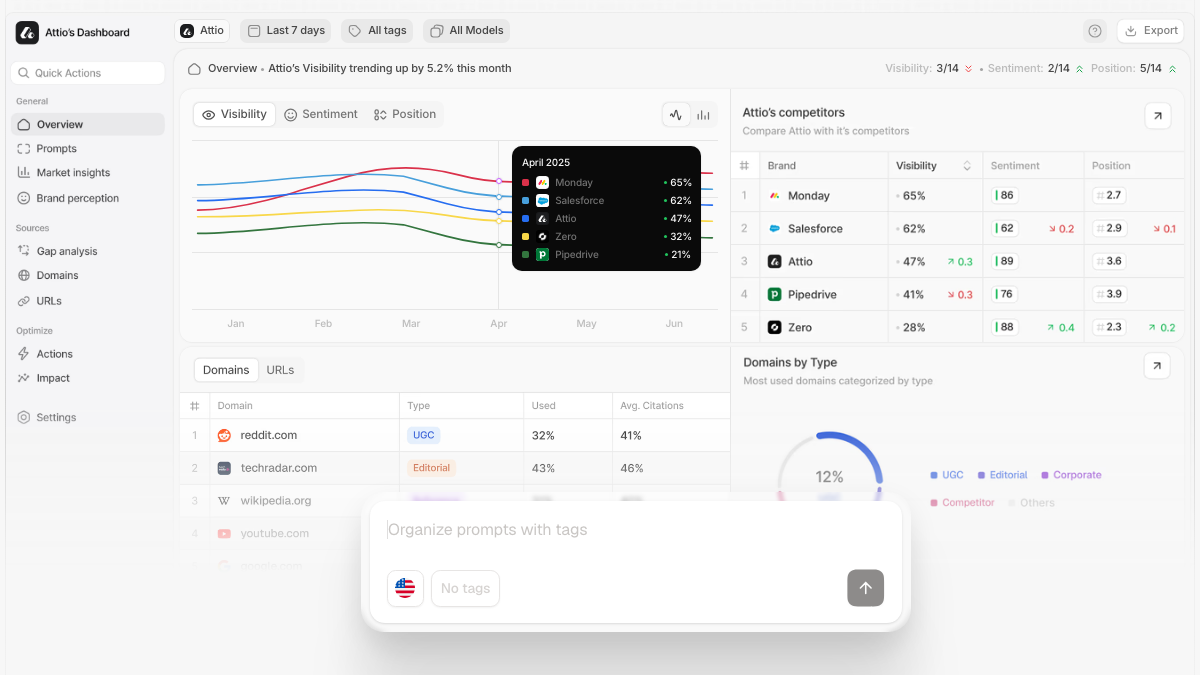
What I couldn't find is how visibility is worked out, or whether position feeds into it. Starter is $95 a month for 50 prompts on three models you pick from six, checked daily. Peec's pricing page also lists Perplexity as both an add-on and an Enterprise model, and it did that on three separate checks. Our Peec AI alternatives list compares its plans in more depth.
200+ SaaS teams already track their AI citations.
They know exactly when ChatGPT mentions their brand, and when it stops. Do you?
6. Otterly.AI
Otterly takes the opposite side from Semrush's help page. According to its homepage, your Share of AI Voice is "the percentage of citations you own versus competitors." So a brand that's named often but never linked scores low here and high at Semrush.
Lite costs $29 a month for 15 prompts, checked daily on ChatGPT, Perplexity, AI Overviews and Copilot. AI Mode and Gemini are $9 add-ons on Lite, Claude is $29, and Grok isn't offered. Fifteen prompts is a small sample for a share of voice trend. The RankControl vs Otterly.AI comparison runs the add-on math.
7. AthenaHQ
AthenaHQ uses the words visibility and share of voice across its site but doesn't say how either is built. It runs on credits, and one credit buys about one AI answer.
The free Essential tier gives you 300 credits on five engines. Starter at $295 a month opens 11 models, which is one of the widest self-serve lists here. You choose which models to scan and when, so your check frequency is whatever your credits cover. See our RankControl vs AthenaHQ comparison for the full plan list.
8. Scrunch
Scrunch Core costs $250 a month for 125 prompts on ChatGPT, Perplexity, AI Overviews and Copilot. New prompts run daily for their first 14 days, then every 72 hours. Claude, Gemini and Grok wait for Enterprise.
Its public pages talk about visibility and position but give no formula for share of voice. Still, 125 prompts is more than twice what most cheapest plans here include, and a bigger sample steadies the trend line.
9. Rankscale
Rankscale has the cheapest paid plan here, from $20 a month on its Essentials credits. Pro costs $99 for 1,200 credits. Every paid plan reaches 12+ engines, Claude and Grok among them, and you can set checks anywhere from hourly to monthly.
The catch is in the credits. Claude and Grok answers cost more credits than ChatGPT ones, so the engines you switch on change how many answers you get. Like Peec, it shows visibility and position but doesn't publish how share of voice is worked out. Our RankControl vs Rankscale comparison goes through the credit costs.
Mentions, citations or both, and what to report
The three published formulas answer three different questions. A mentions number tells you how often AI answers bring up your brand. A citations number tells you how often they use your pages as a source. A blend gives you one line for the trend, but you need the two counts under it when you decide what to fix.
A poster on r/DigitalMarketing looked at five tools, Semrush, Ahrefs and Profound among them, and got numbers all over the place. One reply in the thread put it down to what each tool counts, since some count your name in the answer and some count your domain in the source list. Another reply said some score how high you appear.
AI search brand visibility tools are giving me very different numbers
Been checking our brand visibility in ChatGPT, Gemini and Perplexity and the numbers are all over the place. Looking at Similarweb, Semrush, Profound, peec ai and Ahrefs, but idk which metrics are worth trusting rn. thanks in advance
My pick is to report mentions and citations as two lines, even if your tool also gives you a blend. If mentions rise and citations stay flat, the engines know your name but quote other people's pages about you. In that case, look at which pages the engines quote instead, since they show you the page you're missing.
A rising share of voice still needs a second number
A B2B marketer on r/b2bmarketing wrote about the trap. Their brand got mentioned in ChatGPT and Perplexity far more this year, but they couldn't link any of it to a sales conversation. They asked whether any tool really connects the two, and whether it held up once you looked at how it was calculated.
We got mentioned by ChatGPT and Perplexity a lot more this year. Still can't tell you if it mattered.
Replies pointed to old fixes, like asking "how did you hear about us" on the signup form. Share of voice is a leading number. Pair it with visits from AI answers and sign-ups, the way our GEO KPI scorecard lays out. For the basics of the metric itself, our AI share of voice explainer has the formula.
Which AI share of voice tool fits your team
For SEO teams that already work in Semrush, the best pick is the Semrush AI Visibility Toolkit, because $99 a month adds five engines to data you already use.
For teams that want mentions and citations in one figure, the best pick is Ahrefs Brand Radar, because its methodology page documents the blend and the raw mentions and citations sit beside it.
For teams that want the number and the work that moves it, the best pick is RankControl, because one $400 plan tracks seven engines weekly and writes and publishes the articles too.
For large brands with a procurement team, the best pick is Profound, because its docs define each headline number and how the days are weighted.
For the smallest budgets, the best pick is Otterly.AI, because $29 buys a citation-based share of voice with a published definition.
Tracking it yourself or handing it off
You can do this with a spreadsheet. Pick 50 buyer questions, run each one on seven engines every week, and log who was named and who was cited. That's 350 answers a week, or at least five and a half hours of reading before you write a single page to fix what you find.
The real problem isn't checking once. It's knowing when your share starts to slip. You can keep that sheet going yourself, or RankControl can run the checks every week and write and publish the articles while you work on your product.
How often does ChatGPT mention your brand?
Most founders have no idea. The answer might surprise you.