
Three million impressions in three months, and then a "Major spam problems" manual action on everything under /blog/. A junior SEO described exactly that on r/SEO in September 2026. Their boss had pushed a big batch of auto generated content live on the company blog, asking for 10 to 50 articles a week with as little editing as possible.
Does Google punish a page because a machine wrote it? Going by Google's own wording, no, and the wording has said so for years. The line is about why a page exists and what it gives the reader. I read every page cited below on October 19, 2026, and pulled the older versions from the Wayback Machine.
Google's wording on auto generated content, by date
Here's the paper trail in order, with the key line from each page.
| Date | Page | The key wording |
|---|---|---|
| Apr 14, 2021 (page date) | "Automatically generated content" guideline | Google "may take actions" on content "generated programmatically" when it is "intended to manipulate search rankings and not help users" |
| Feb 8, 2023 | Blog post on AI-generated content | "Rewarding high-quality content, however it is produced" |
| Mar 5, 2024 | Blog post on the March 2024 core update and spam policies | Scaled content abuse "builds on our previous spam policy about automatically-generated content" |
| Sep 11, 2025 | Search Quality Rater Guidelines | Scaled pages with no original content or added value "should be rated Lowest, no matter how they are created" |
| Aug 28, 2026 | Spam policies page (last update) | Lists "using generative AI tools or other similar tools to generate many pages without adding value for users" |
| Oct 1, 2026 | Guidance on generative AI content | "It is critical to manually factcheck and review all AI-generated content" |
| Oct 5, 2026 | Helpful content guidance (last update) | Automation used "for the primary purpose of manipulating search rankings" is a spam violation |
2021 and the old automatically generated content rule
Google's 2021 guideline reads like a catalog of old spam tricks. It gave text "generated through automated processes, such as Markov chains" as an example. It also named synonym swapping, scraped RSS feeds and stitched pages.
The September 2023 version of the spam policies page had renamed the rule "spammy automatically-generated content." Markov chains had given way to "automated processes without regard for quality or user experience."
February 2023, when ChatGPT made it urgent
Automation used "with the primary purpose of manipulating ranking in search results is a violation of our spam policies." That sentence comes from Google's AI content post, which Danny Sullivan and Chris Nelson wrote on February 8, 2023. The same post says "not all use of automation, including AI generation, is spam."
It named sports scores, weather forecasts and transcripts as helpful automation. It also recalled a wave of mass-produced human writing about ten years earlier, when nobody thought a ban on human content made sense.
March 2024, when the tool dropped out of the rule
Google's March 5, 2024 post gave the problem a new name. Scaled content abuse now applies "no matter whether content is produced through automation, human efforts, or some combination of human and automated processes." Google called the new rule "in the same spirit" as the old one. It widened the rule for methods where it "isn't always clear" whether automation made the low-quality pages. Glenn Gabe flagged the change the same day.
Even more: And beyond all of that, Google is also rolling out March 2024 spam updates with spam policy updates too. These will yield both algorithmic and manual actions. First, there's "scaled content abuse search spam", which is an update to the "spammy automatically-generated https://t.co/gyUS5W8gcd
 Glenn Gabe@glenngabeMar 5, 2024

His summary was that producing content at scale to boost rankings is against the rules whether machines, people or both made it.
Your competitors are building backlinks while you read this.
Organic outreach, social mentions, and citations from Editorial Circle member sites, with managed backlinks available as an add-on. Grow your domain authority without running the campaign yourself.

The current spam policies page
Almost nothing on today's list is new compared with 2021. The live spam policies page, last updated August 28, 2026, defines scaled content abuse as "when many pages are generated for the primary purpose of manipulating search rankings and not helping users." Five examples follow.
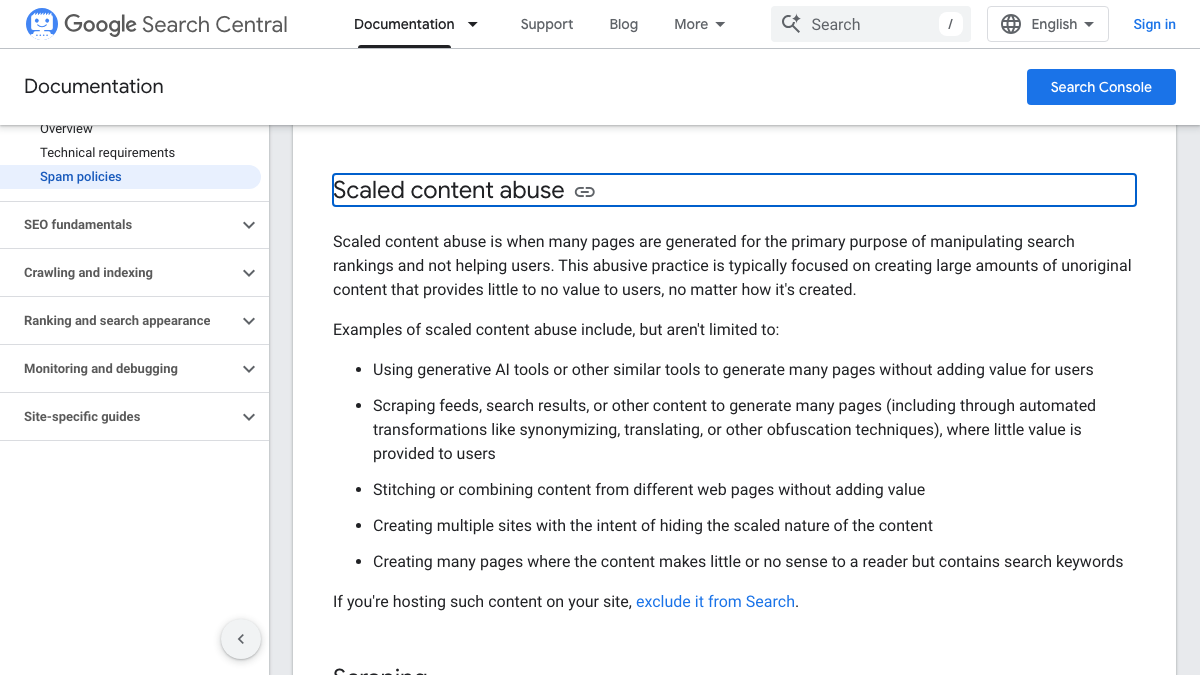
Scraped feeds, synonym swapping, stitched pages and keyword-stuffed nonsense are all still there. Two items are new, one naming generative AI and one covering pages spread over many sites to hide the scale.
I call it the five-year list, because the named tricks hold steady while the tool changes. Generative AI got a line of its own, and it still has to clear the same bar, "without adding value for users."
The October 2026 updates and the rater guidelines
Google's October 1 update to its guidance on generative AI content drew 134 upvotes and 81 comments on r/SEO. Many grumbled that Google wants publishers to check facts for free.
Google updates "critical" guidance for AI Content for SEO
Google: Manually Factcheck & Review AI-Generated Content For Accuracy Google has updated Google Search's "guidance on using generative AI content on your website" document to tell those who use AI-generated content to "manually factcheck an...
What the update added is that it's "critical to manually factcheck and review all AI-generated content for accuracy and trustworthiness before publishing." The same goes for title tags and meta descriptions.
On October 5, the helpful content guidance got its latest update. The page frames everything as "Who, How, and Why," and calls "Why" "perhaps the most important question." If automation produces pages mainly to rank, that's spam.
The rater guidelines (the September 11, 2025 version) are the bluntest of the set. Section 4.6.6 gives the Lowest rating when nearly all of a page is "copied, paraphrased, embedded, auto or AI generated, or reposted" with little effort, originality or added value. Section 4.6.5 tells raters to use Lowest for scaled abuse even when they can't tell if AI made the page.
The same document adds that no single rating can directly change how a page shows up in Search.
Where the spam line really sits
Google never asks which tool made the page. Every document above asks why the page was made and what it adds. The six questions below use only Google's own wording, and a yes on the first three or a no on the last three puts you near the line.
- Is the page "primarily made to attract visits from search engines"? (helpful content guidance)
- Are you "producing lots of content on many different topics in hopes that some of it might perform well"? (same page)
- Would a reader "need to search again to get better information from other sources"? (same page)
- Does the page add value "as compared to other pages on the web on the same topic"? (rater guidelines, 4.6.5)
- Did someone "manually factcheck and review" it before it went live, title and meta description included? (generative AI guidance)
- If a reader might wonder "How was this created?", do you say so? (helpful content guidance)
An r/SEO commenter on a thread about programmatic pages offered a test. Strip the template off a page and check whether the data left over is unique and useful for that one query.
How scaled content abuse shows up in Search Console
The notice the junior SEO received named scaled content abuse, cloaking and scraping, and it covered every URL under /blog/.
[pls help]nForced by management to publish scaled AI content -> Got a Manual Action. Need help recovering a site with 3M impressions (Junior SEO)
Major spam problems Description Pages on this site appear to use aggressive spam techniques such as scaled content abuse, cloaking, scraping content from other websites, and/or repeated or egregious violations of Google's spam policies for...
Search Console has no manual action called scaled content abuse. Its manual actions help page lists it inside "Major spam problems," next to cloaking and "repeated or egregious violations."
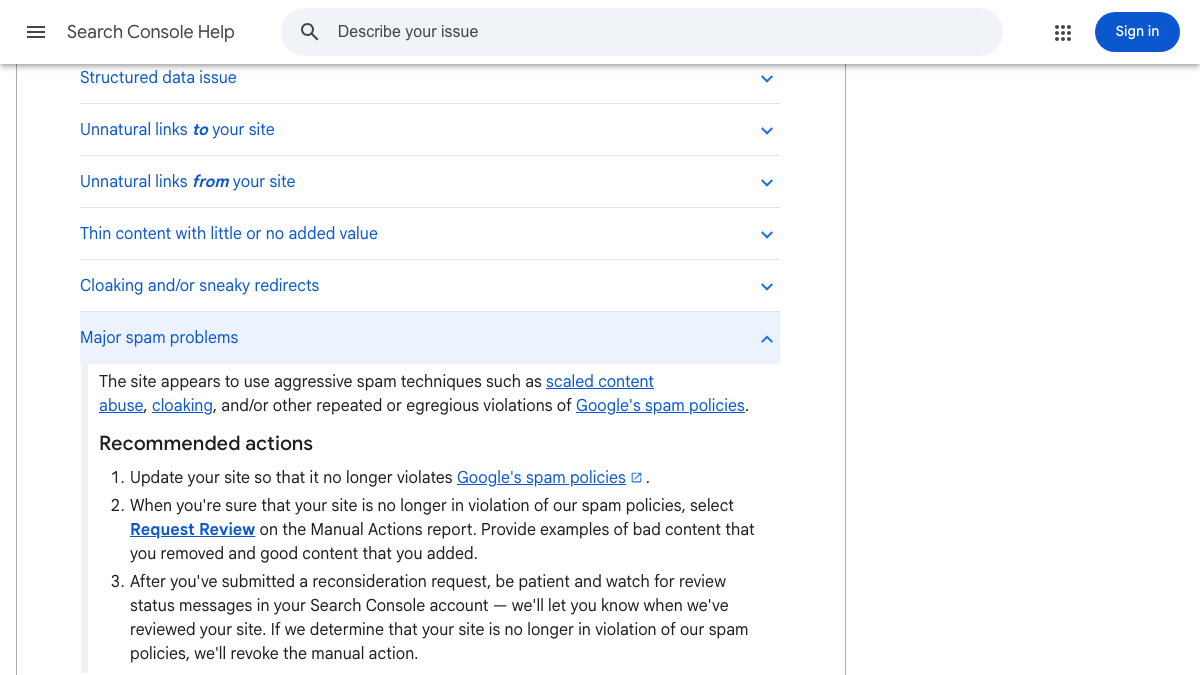
Read the recommended actions closely. When you click Request Review, Google asks you to "provide examples of bad content that you removed and good content that you added."

You're getting AI traffic. But do you know where it comes from?
RankControl credits every visit to the assistant that sent it: ChatGPT, Perplexity, Claude, Gemini, Copilot, or Grok. Full source attribution, next to your Google traffic.
What enforcement looked like in 2026
One of the sites in Glenn Gabe's four case studies lost rankings for over 200,000 queries. It had programmatic pages across countries, padded with fully AI text, in an ultra-YMYL niche. Gabe published the four cases on August 31, from sites he saw drop. He blinded all four, so treat them as one analyst's reports and not a survey.
| Case | What Gabe found | Reported loss |
|---|---|---|
| 1 | Programmatic pages across countries, padded with fully AI text, in an ultra-YMYL niche | Rankings for over 200,000 queries gone |
| 2 | Turn-key Amazon affiliate site, with AI text at the bottom of pages scoring 97%+ likely AI | Over 14,000 queries gone |
| 3 | 1.5 million indexed URLs, about 85% programmatic, with some real user content | Site-wide drop |
| 4 | Over 250,000 URLs in a risky niche, with links that sent users to other sites | Close to 25,000 queries down or gone |
Most hits like these come from spam updates and not from manual actions. Google started one on August 18, 2026, and it finished in a little over two days. None of the four sites was hit for AI alone. Each mixed scale with something else, like thin affiliate pages or bad redirects. Our August 2026 spam update breakdown covers how to tell if it caused your drop.
The Reddit reports are smaller, and each is one unchecked account. In August, a site owner on r/DoSEO asked why Google had de-indexed their pages. Commenters reading the screenshot pointed to about 24,000 pages submitted in under a month, with roughly 17,200 dropped.
In April, an r/SEO thread shared a scaled content abuse notice from an X user, who said they'd put 900+ AI blog posts on an idle domain a year before. For the two big named 2026 cases, National Today and Brown Brothers Media, see our post on AI content penalties and what the data shows.
Recovery usually means removing pages
Delete the mass-made pages instead of polishing them. That advice kept coming back in the manual action threads.
On the April thread, one person who'd been handed a penalized site said removing everything was the only way they got the action lifted. On the September thread, a commenter said to take pages down with a 410 or 404, not a noindex. A noindex leaves the content live and reads as hiding it. The same commenter would keep and rewrite only the posts that had real clicks or links before the AI push.
Not everyone agreed. Another reply warned against swapping "publish everything" for "delete everything" without checking each page first.
I think a split explains the disagreement. A manual action goes to a reviewer who reads your request, so removal is the proof Google asks for. An algorithmic drop has no reviewer, and pages that earn clicks can be worth saving. Our guide to Google spam updates and AI SEO content covers that second case.
Recovery is slow either way. Gabe wrote that Google needs to see a clean site "over an extended period of time," usually months.
Publishing at a pace you can review
You can still use AI. Each page just needs a reason to exist and a person who checked it. That's why "is AI content penalized" is the wrong question, as our piece on whether Google targets AI content or low quality argues. AI text is now common across the web (see how much of the web is AI-written), so a human byline alone won't set a page apart.
RankControl's content engine writes each article against the pages already ranking for its keyword and publishes it on your own site. Auto-publish is off by default, so you can review each article before it goes live, and the plan tops out at 100 pages a month. Our AI visibility tracking checks how seven AI engines answer your buyers' questions every week. The plan is $400 a month with a 7-day free trial.
You can run the self-check on every page by hand and set your own pace. Or RankControl's agents can do the drafting and weekly tracking while you do the reviewing.
We'll show you exactly where your brand stands in AI search.
No commitment. $0 due today, cancel anytime. See how ChatGPT, Perplexity, Claude, Gemini, Grok, Google AI Mode, and Google AI Overviews talk about your brand today.