
Most people can spot AI writing before they can say why. A paragraph feels smooth, agreeable and somehow empty, and a word like delve shows up where nobody would normally use it.
Some of those hunches are backed by real studies. Others are folklore. This guide covers the patterns researchers have measured, what the big detector companies say their tools look for, how often those tools get it wrong, and what we found when we checked one large marketing blog's posts from before and after ChatGPT.
The patterns researchers have measured
The strongest evidence comes from studies that counted words across millions of documents.
The best-known is by Kobak and colleagues, published in Science Advances on July 2, 2025. The team looked at 15.1 million biomedical abstracts from PubMed, from 2010 to 2024. For each word, they compared how often it appeared in 2024 against how often the earlier trend predicted it would.
Some words jumped far past their expected use. The study found delves appeared 28 times more often than predicted, underscores 13.8 times and showcasing 10.7 times. Common words like potential, findings and crucial rose too, by smaller margins but across far more text.
The researchers concluded that "at least 13.5% of 2024 abstracts were processed with LLMs." They called that a lower bound, since some edited abstracts won't contain any of the telltale words.
For scale, they noted that from 2013 to 2019, no single word ever showed an excess anywhere near that size. The only earlier spike was COVID vocabulary in 2020.
A 2024 study of AI conference peer reviews found a similar pattern. Weixin Liang and colleagues estimated that between 6.5% and 16.9% of text submitted as reviews to four major AI conferences in 2023 and 2024 "likely underwent substantial LLM modification beyond minor editing." Use was higher in reviews submitted close to the deadline.
The structural tells
Words are only part of it. Wikipedia's volunteer editors keep a field guide called "Signs of AI writing," used to clean up machine-written articles. It lists patterns beyond vocabulary.
| Pattern | What it looks like |
|---|---|
| Inflated vocabulary | Additionally, crucial, pivotal, intricate, tapestry |
| Avoiding plain verbs | "Serves as" or "stands as" where "is" would do |
| Negative parallels | "It's not a tool, it's a movement" |
| Rule of three | Lists of three adjectives or three clauses, again and again |
| Title Case Headings | Every word capitalized in every heading |
| Heavy formatting | Lots of bold, emoji bullets, leftover markdown symbols |
| Vague praise | Claims about importance with no specific fact behind them |
The guide also has a section on signs that don't reliably work, which is worth reading before accusing anyone.
We'll show you exactly where your brand stands in AI search.
No commitment. $0 due today, cancel anytime. See how ChatGPT, Perplexity, Claude, Gemini, Grok, Google AI Mode, and Google AI Overviews talk about your brand today.
What readers notice first
Readers rarely count words. They notice when writing says nothing specific.
A post with more than 70,000 upvotes on r/mildlyinfuriating showed a printed travel guide that still had the AI prompt in its introduction. The buyer's complaint went past the prompt itself. The poster wrote that the whole book was generalities with no specifics, so you could change the name and it could be any city anywhere.
Book I bought didn't edit out the AI prompt
Absolutely worthless book. Didn't even remove the prompt in the introduction. The whole book, a travel guide, was generalities and no specifics. You could change the name and have it be any city anywhere.
That's the pattern most readers react to. A missed prompt is rare. Writing that could describe any product, any city or any company is everywhere, and readers have learned to skim past it.
On X, one poster summed up the uneasy part, saying they couldn't tell whether almost everyone was using ChatGPT to write, or everyone now sounds like ChatGPT.
it's either almost everyone is using chatgpt to write; or everyone sounds like chatgpt now, and I can't figure out which it is.
 ST@seyitaylorNov 26, 2025
What detectors say they measure
The detector companies explain their methods in broad terms.
GPTZero's homepage says AI detectors generally look at three things. "Perplexity: Is the writing obviously predictable? Burstiness: How much variation is there in the sentence length and style? Style: Is the tone and writing style overly generic or repetitive?" It adds that its own model "takes hundreds of factors into consideration."
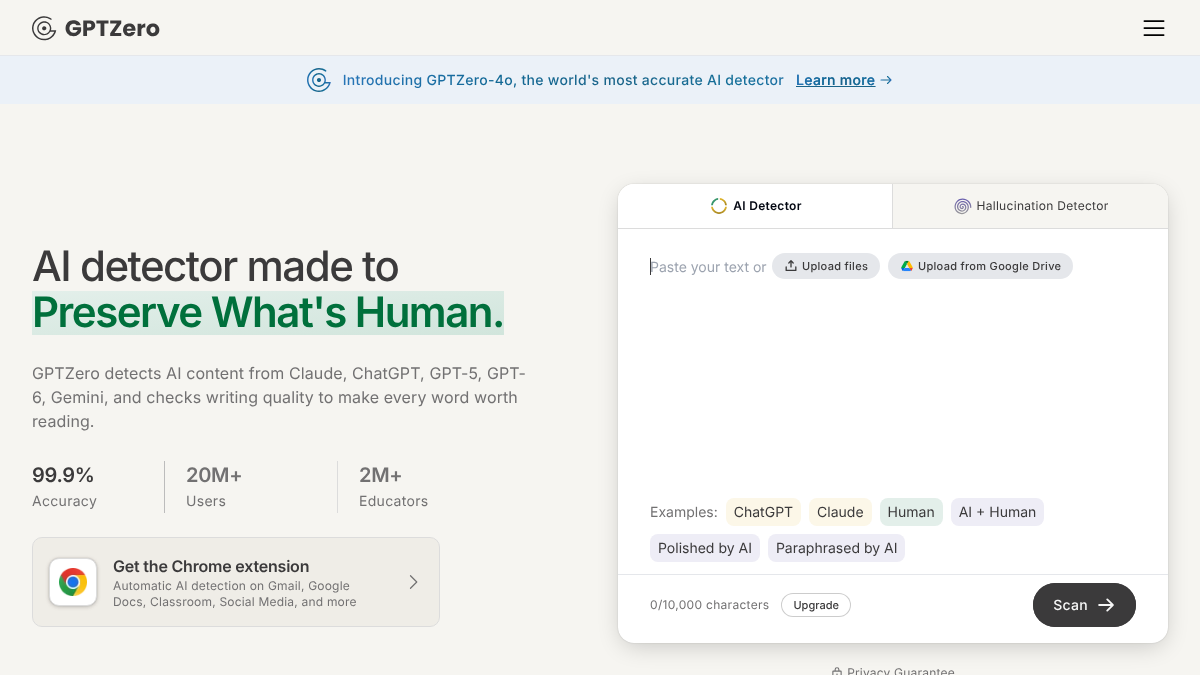
The vendors' own accuracy claims are high.
| Vendor | What it reports | Source and date |
|---|---|---|
| GPTZero | False positives kept to "no more than 1%" | Its own site, checked Oct 19, 2026 |
| Turnitin | "Less than 1% false positive rate" | Company blog, March 16, 2023 |
| Originality.ai | 99.4% accuracy at its recommended 15% AI allowance | Company blog, updated 2026 |
These are self-reported numbers from companies that sell the detectors. None is an independent audit, and Turnitin's figure is from 2023.
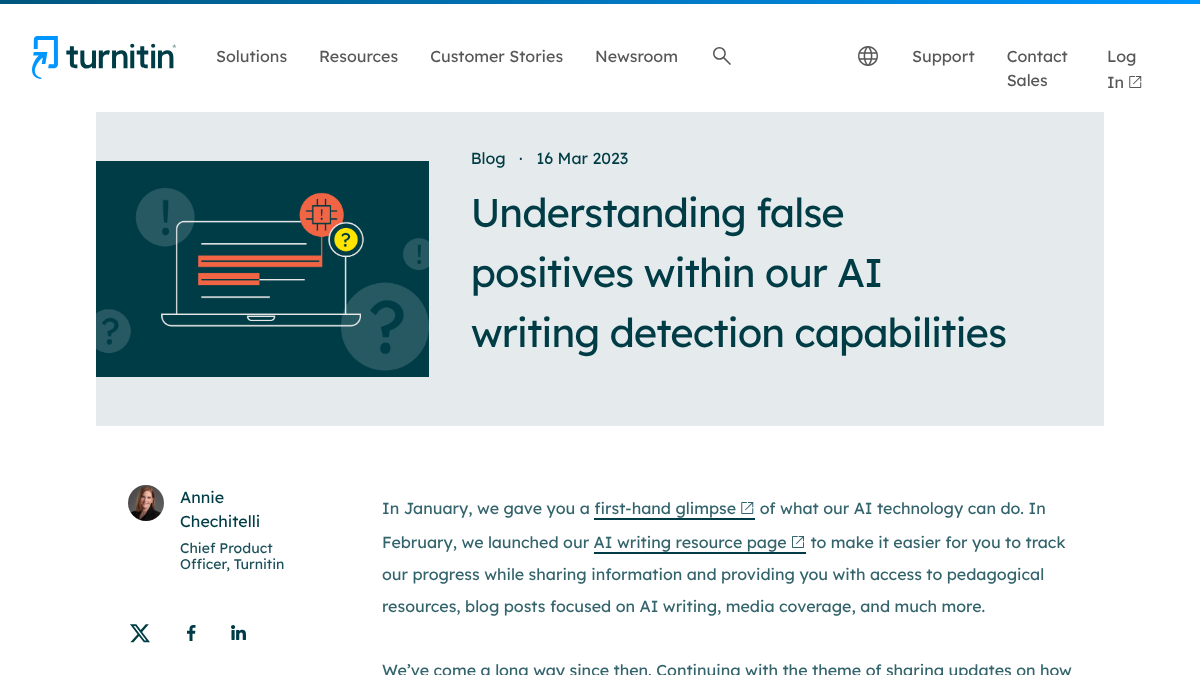
Turnitin's post said there is "still a small risk of false positives," and the company tells instructors its tool "does not make a determination of misconduct." Originality.ai now lets users pick how much AI they'll tolerate before a flag, from 0% to 40%. At a 5% setting, it says the tool will "flag even minor AI edits."
How often detectors disagree
A Reddit thread from September shows the problem in one comment. Someone had posted a screenshot of a detector flagging a passage as AI. A commenter recognized the passage as text from Frankenstein, published in 1818, and ran it through nine detectors.
How dare she use AI!
According to that commenter, seven tools called it 100% human. Two did not. ZeroGPT scored it 61.9% AI and Originality.ai 80% AI. One reader's test isn't a study, but it matches what the vendors admit. False positives happen, and different tools disagree on the same text.
The em dash is the clearest example of a tell that misfires. Author Sophia Benoit posted on X asking whether nobody read things before ChatGPT, since every writer the poster knew loved the em dash. The post drew more than 269,000 likes.
did no one read things before chatGPT? Because every writer I know loooooves the em dash
 Sophia Benoit@1followernodadApr 13, 2025
What we found on one marketing blog
The word studies above looked at academic writing. We wanted to see whether the same words show up in marketing content.
On October 19, 2026, we took one large, long-running marketing blog and built two samples from the Wayback Machine. The first was 21 posts first captured in 2018 and 2019, before ChatGPT existed. The second was 22 posts first captured in 2025 and 2026. We then counted 40 words drawn from the Kobak study and the Wikipedia guide.
| Sample | Words | Tell-word hits | Per 1,000 words |
|---|---|---|---|
| 2018 to 2019 posts | 40,478 | 60 | 1.48 |
| 2025 to 2026 posts | 44,874 | 46 | 1.03 |
The older posts used the "AI words" more often, not less. And the academic tells barely appeared at all. Delve, underscore, realm, tapestry and notably didn't show up once in either sample.
The most common words in both eras were marketing words. Unlock appeared 22 times in the old posts and 20 times in the new ones. Leverage, comprehensive and seamlessly were steady too.
This is one blog, and we don't know how much AI help any post had, if any. But it points to something the word lists miss. Marketing writing had its own stock phrases long before language models arrived, and the academic tells don't carry over.
We call this the baseline problem. A tell only means something against a writer's normal style. Delve in a biomedical abstract is a signal. Unlock on a marketing blog is just how marketing blogs have always sounded.
Know exactly what AI says about your competitors.
RankControl's Recon Agent monitors competitor citations across ChatGPT, Perplexity, Claude, Gemini, Grok, Google AI Mode, and Google AI Overviews. See where they show up and you don't.

What this means for your own content
If you publish content, AI-assisted or not, a few things follow.
- Specifics beat any word list. Names, numbers, dates, places and first-hand details are the strongest sign a person who knows the subject was involved.
- Read for empty praise. Sentences about how important or exciting something is, with no fact behind them, are what readers skim past.
- Watch the structure. Endless lists of three, "it's not X, it's Y" and heavy bolding are easier to spot than any single word.
- Don't trust a single detector score. Vendors admit false positives, tools disagree, and none of them is proof.
- Know your house style. Compare new writing with your own older writing, not with a generic list.
Google has said it rewards "high-quality content, however it is produced." Our post on whether Google targets AI content or low-quality content covers the policy side. And our guide on why "make it sound more human" is a bad prompt covers why chasing a human-sounding style misses the point.
The bigger lever is the input. Writing built from real facts about your product and customers reads like it came from someone who knows them. Our post on better AI content from context covers how. For how AI-written posts actually perform, see whether AI-written blog posts can rank in AI search.
Doing it yourself or handing it off
Writing that holds up starts with specific facts, a clear view and an editor who cuts the filler. That takes time for every article.
RankControl handles the drafting. We write each article from your brand's own facts and the pages already ranking for the topic, with its sources cited, and you review it before it goes live, since auto-publish is off by default. Our AI visibility tracking checks up to 50 buyer questions every week across seven AI engines. Expect traffic from Google first, with AI citations following more slowly as links and mentions build up.
26 content formats. Published on your domain. Matched to your brand.
Guides, comparisons, listicles, case studies, and more. RankControl generates content that gets cited by ChatGPT, Perplexity, Claude, Gemini, Grok, Google AI Mode, and Google AI Overviews.