
Search "seo friendly blog post" and Google's AI Overview hands you a tidy checklist. Pick a focus keyword, use H2s, keep paragraphs short and write a meta description. None of it is wrong, but neither the Overview nor the pages ranking under it ever shows a draft getting better.
So this post shows one. I wrote a weak draft of "How to write a return policy for a small online store," and below I rewrite it piece by piece, with a short before and after for each part. Each pair gets a reason, backed by a dated source. Sources were checked on October 19, 2026.
If you want the full list of checks instead, our SEO copywriting checklist has 12 of them, and the blog post outline template gives you the skeleton to fill. Neither is repeated here.
Fix the title and intro first
Every example below is a draft I wrote for this post, not a quote from a real store. The weak version is friendly and vague, like a lot of first drafts. Here's how it opened.
BEFORE
Title: Return Policies 101: Everything You Need to Know

In today's world of online shopping, customer expectations are
higher than ever. Returns can make or break your business. In this
post, we'll take a look at everything you need to think about.
AFTER
Title: How to Write a Return Policy for a Small Online Store

A return policy for a small online store needs four rules: how many
days customers get, what condition items must be in, who pays for
return shipping and which items are final sale. Write each rule in
one plain sentence, then put the policy in your footer and on every
product page.
The new title says what the page is, in the words a store owner would type. Google's title links documentation, updated December 10, 2025, says the blue link in results can come from the title tag, the H1, other big text on the page or the anchor text of links pointing at it. It also says a fix can take a few days to a few weeks to show up after Google crawls the page again.
The new intro answers the question before anyone scrolls. In Kevin Indig's study of 18,012 ChatGPT citations, reported by Search Engine Land in February 2026, 44.2% came from the first 30% of a page.
Turn a vague heading into the question people ask
BEFORE
## Policy Considerations

AFTER
## How many days should customers have to return an item?
"Policy Considerations" could sit on top of a section in any article about anything. The new heading is a question a store owner would type, and that's the kind of heading AI engines seem to match. In the Fan-Out Effect report that AirOps published with Kevin Indig on April 13, 2026, covering 16,851 queries, pages whose headings closely matched the search were cited 41% of the time, against about 30% for weak matches.
That's a link the study saw, not proof of cause. Still, the Shopify page I use in the steps section below does the same thing. Shopify's return policy guide lists "What is a return policy?" and "Why have a return policy?" in its table of contents before it gets to setup.
We'll show you exactly where your brand stands in AI search.
No commitment. $0 due today, cancel anytime. See how ChatGPT, Perplexity, Claude, Gemini, Grok, Google AI Mode, and Google AI Overviews talk about your brand today.

Write a definition that works when it's quoted alone
BEFORE
Basically, it's all about how you handle stuff coming back. Every
store does it a bit differently, and that's totally fine.

AFTER
A return policy is the set of rules a store uses to decide how
customers can return an item, swap it or get their money back.
The before version only makes sense next to the sentence above it, since "it" and "stuff" point at nothing. On October 19, Google's AI Overview for "what is a return policy" opened with a one-sentence definition built like the after version, sourced to Wikipedia's product return page and a returns software site. The shape is simple. Put the term first, then "is," then a plain description that needs nothing around it.
Give the stat a name and a year
This is the pair most drafts get wrong, and the real example is worse than anything I'd make up.
BEFORE
Studies show that most shoppers check the return policy before
they buy.

AFTER
In a 2012 survey by Demery, 63% of online shoppers reviewed a
store's return policy before buying. That's an old number, so check
for a newer one before you build a pitch on it.
Ask Google "what percentage of shoppers check return policy before buying" and, as of October 19, its AI Overview says "about 53% to 63%." The 63% is labelled only as "Demery survey data," with no year. Its sources are a 2021 ReturnPro report and a 2016 academic paper, and the survey under both dates back to 2012.
A store owner reading that answer in 2026 can't tell the figure is 14 years old. The Overview also folds it into one range with an undated "State of Returns" number, as if the two were measured in the same year.
I call this the birth-year test. Before a number goes in your draft, find the year it was first measured, not the year of the page that repeated it, and put that year in the sentence. An old figure is fine to use if the reader can see how old it is.
Write the steps the way Shopify writes its settings
BEFORE
You'll want to think about your return window, and maybe shipping
costs too. Some stores also have fees or exclusions, so it's worth
thinking about those as well.

AFTER
1. Pick a return window of 14, 30 or 60 days, and say whether it
   starts at purchase or at delivery.
2. Say what condition items must be in, such as unused, with tags
   on and in the original box.
3. Say who pays for return shipping and whether you charge a
   restocking fee.
4. Name the items that are final sale, like clearance stock or
   custom orders.
5. Tell customers how to start a return and how many business days
   the refund takes.
I based the after list on a real sentence that AI answers lift. On October 19, Google's AI Overview for "how to write a return policy for a small business" cited Shopify's guide, How To Write a Return Policy (+ Free Template) (2026). Its setup steps each open with a verb and name the exact screen.
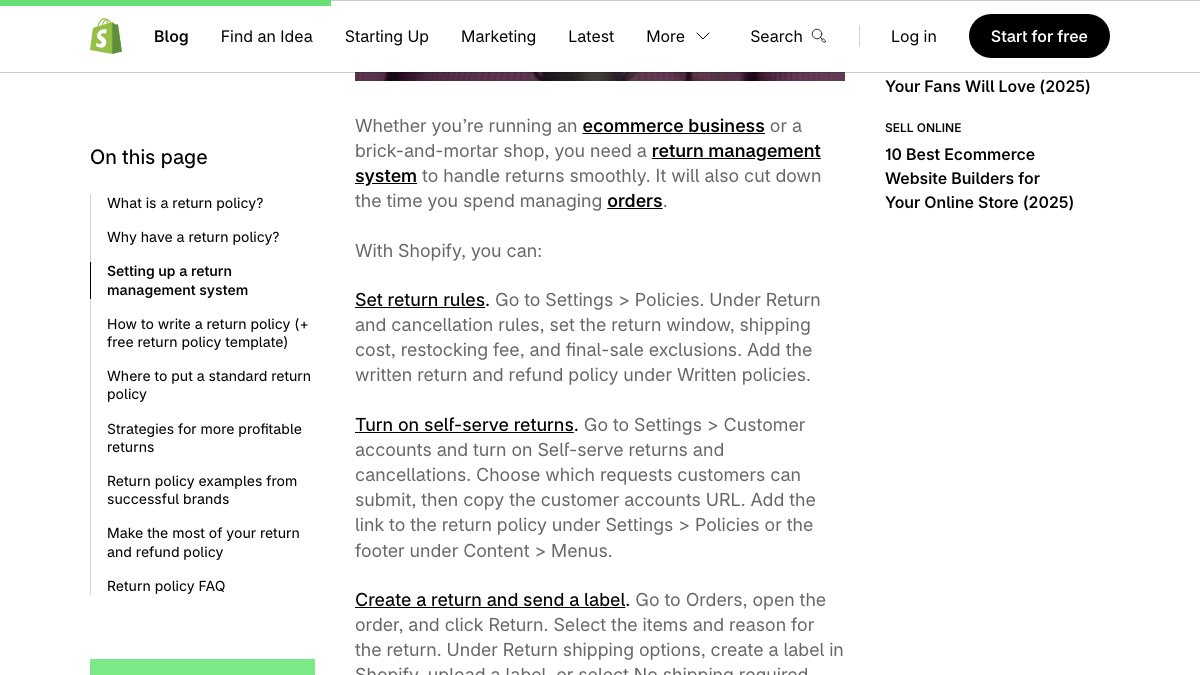
The first step reads "Go to Settings > Policies. Under Return and cancellation rules, set the return window, shipping cost, restocking fee, and final-sale exclusions." It tells you where to click and what to fill in, so it still works with the rest of the page cut away.
I'd add two caveats. Shopify is a huge site, and in an r/DigitalMarketing thread on getting cited in ChatGPT, one commenter argued that models lean toward well-known domains, so some of that pull is the name and not the sentence. The second caveat is more useful. Every step names a Shopify screen, so the quoted answer also sells Shopify.
One r/SEO_LLM user split this into being cited and being recommended, and Shopify's steps get both at once. If your product really does a step, name it in that step.
Know exactly what AI says about your competitors.
RankControl's Recon Agent monitors competitor citations across ChatGPT, Perplexity, Claude, Gemini, Grok, Google AI Mode, and Google AI Overviews. See where they show up and you don't.

Answer the FAQ in its first sentence
BEFORE
Q: How long should a return window be?
A: Great question! This really depends on a lot of factors, and
every business is different. It's best to think about what works
for you and your customers.

AFTER
Q: How long should a return window be?
A: Most stores give 14, 30 or 60 days. Say whether the clock starts
at purchase or at delivery, and give a shorter window for items
that lose value fast, like holiday stock.
The same October 19 AI Overview for the small business query answered this one with numbers, "commonly 14, 30, or 60 days from purchase or delivery," and cited Sendcloud's return policy guide for it. An answer that opens with "it depends" gives an engine nothing to lift, so lead with the number and put the conditions after. Our guide to FAQ pages for AEO covers how many questions to add and where they go.
The byline and date that finish an SEO friendly blog post
The weak draft said "Posted by admin" and had no date. The fix is a real name and the day it went live, both printed on the page.
The AI Overview for "seo friendly blog post" itself shows why. On October 19 it cited three sources, two YouTube Shorts and a University of Illinois Urbana-Champaign post dated July 28, 2025, with its author and publish date visible on the page. Google's helpful content guidance, updated October 5, 2026, asks whether it's self-evident to visitors who wrote your content, and it warns against made-up AI author profiles.
That byline is a username, "sifuhotman," not a full name, so the university domain and the visible date were probably doing more of the work. Our deep dive on author schema and bylines covers the markup side.
What the rewrite still can't fix
A clean rewrite makes each piece easy to quote once an engine finds the page, but it doesn't decide whether the engine finds it. In an October 2026 study of 158,099 AI answers, University of Toronto researchers found page-level copy explained only about 2.8% of the citation gap between pages on one site. The engine's own search step explained roughly 32%.
The other limit is what the draft says. In an r/WebsiteSEO thread on whether AI-written content hurts rankings, one commenter offered a blunt test. If an AI could write it in 20 seconds, it's commodity content.
Every after version above is still fairly generic, because I don't run a store. Yours should carry your real return window, your real restocking fee and the return case that lands in your inbox most weeks. If you draft with AI, our guide to writing SEO friendly blog posts with AI covers which facts to give the model before it starts.
Doing it yourself or handing it off
As a rough estimate, rewriting a 1,500-word draft piece by piece like this takes one to two hours. Tracing each stat back to the year it was first measured adds 30 to 60 minutes, more when the trail runs through two or three reports, as the return policy one did. At eight posts a month, that's about 12 to 24 hours of editing.
RankControl's content engine writes each article against the pages already ranking for its keyword, then publishes it on your own site. Auto-publish is off by default, so every post waits for your review. Once posts are live, AI visibility tracking checks your buyer questions every week on seven AI engines. We offer one flat plan at $400 a month with a 7-day free trial. Expect traffic from Google first, with citations coming slowly as other sites link to and mention you.
You can run each rewrite above by hand, one pair at a time. Or RankControl can write and publish the posts every month while you add the store details only you know.
26 content formats. Published on your domain. Matched to your brand.
Guides, comparisons, listicles, case studies, and more. RankControl generates content that gets cited by ChatGPT, Perplexity, Claude, Gemini, Grok, Google AI Mode, and Google AI Overviews.