
Every programmatic SEO pitch sounds the same: one template, one database, thousands of pages overnight. The growth screenshots make the rounds on X. What rarely circulates is the indexing report six months later, which is where most of these projects actually get judged.
So this piece sticks to that part. What Google's policy says about pages like these, what large-scale data shows about who gets indexed, what four well-known programmatic page sets look like in Google today, and what site owners posted in 2026 after watching their own pages get indexed, dropped or quietly buried.
The short version
| Question | What the data shows |
|---|---|
| Does Google allow programmatic pages? | Yes, if they help users. Its policy targets pages made mainly to manipulate rankings |
| How many programmatic pages get indexed? | Anywhere from most to under half, depending on uniqueness |
| Do famous page sets still hold up? | Yes. Google estimates 52,000 to 2.2 million results for the four we checked |
| What happens to thin sets? | Field reports in 2026 show 60% deindexed, 92% to 95% traffic losses |
| What separates survivors? | Unique data per page, links from real articles, a distinct intent |
Most case studies about programmatic SEO skip the one number that actually tells you whether the project worked: how many pages, out of everything published, are still indexed and still earning an impression months later. We'll call that the survival rate for the rest of this piece, since it's what separates a real win from a launch screenshot.
What Google's policy says
Google put a name to this in March 2024. "Today, we're announcing three new spam policies against bad practices we've seen grow in popularity: expired domain abuse, scaled content abuse, and site reputation abuse."
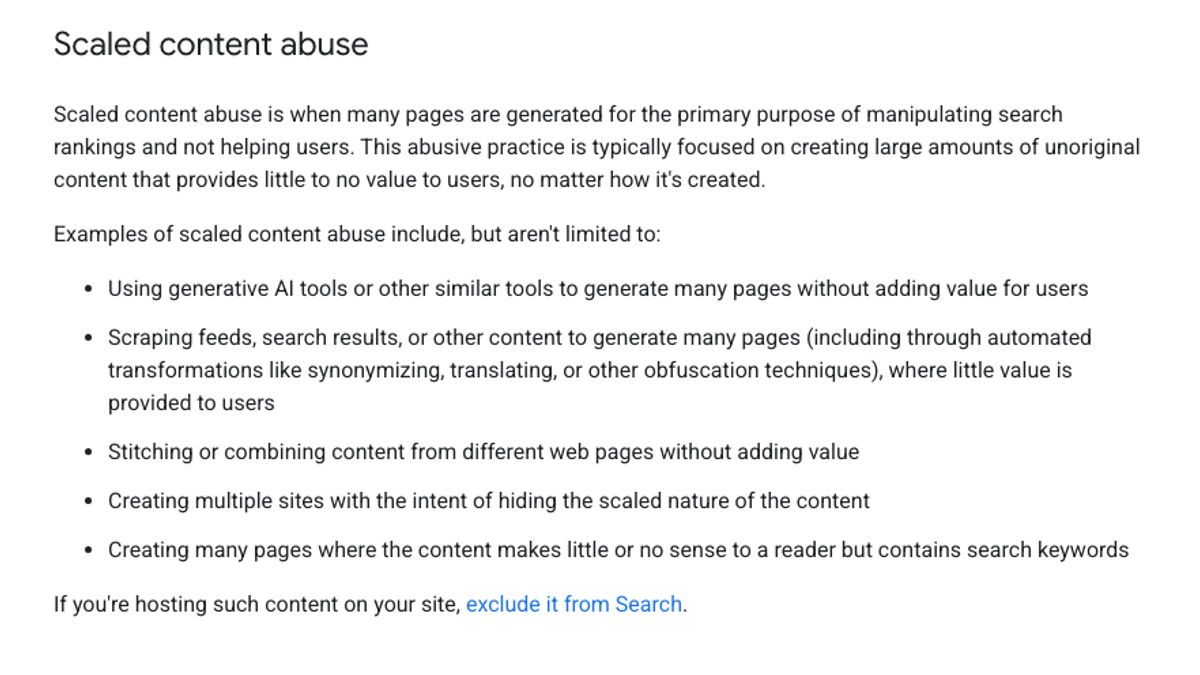
The second of those three is the one that matters here. Scaled content abuse, in Google's own words, "is when many pages are generated for the primary purpose of manipulating Search rankings and not helping users." The policy doesn't care how the pages got made, either: it applies "no matter whether content is produced through automation, human efforts, or some combination of human and automated processes."
That's the actual line. A template isn't the violation. A page with nothing new to say is.
Google later claimed credit for cleaning some of it up, reporting that the March 2024 changes left "45% less low-quality, unoriginal content in search results." We go deeper on the policy itself and its enforcement cases in our post on scaled AI content and Google penalties.
What large-scale data shows about indexing
Ahrefs ran the largest indexing study we've seen on this, published in July 2026 by Ryan Law. The team sampled one million pages from its crawler, one page per domain, and checked which ones made it into Google's index.
The headline number drops as AI involvement rises: indexation "drops from 49.28% for low-AI-content pages to 40.35% for very-high-AI-content pages." A page counted as indexed if it had a ranking keyword, a Search Console impression since January 2026, or showed up on an exact Google site search.
Two things temper that number before you lean on it too hard. Even the low-AI group only cleared about half, which says most pages on the entire web never make the index regardless of how they were written. And this study measured AI-written content specifically, not templated pages. Programmatic SEO tends to be heavily automated, so the pattern likely transfers, but Ahrefs wasn't studying programmatic SEO directly.
Worth flagging too: Ahrefs sells SEO tools, including an AI content detector, which doesn't make the data wrong but is worth knowing going in.
15 hours a week manually. Or 15 minutes with RankControl.
Track citations, monitor competitors, and fix content gaps across every AI search engine. Automatically.

Four famous page sets, checked in October
Nearly every programmatic SEO write-up cites the same handful of famous examples, so we went and looked at what those sets actually look like in Google right now.
On October 18, 2026, we ran a US Google site search for four of the usual suspects and recorded Google's estimated result count for each, then read the first ten result snippets per set to see what Google actually shows a searcher.
| Page set | What each page is | Google's estimated results |
|---|---|---|
| Zapier app integration pages | One page per app and integration | 72,500 |
| Wise currency converter | One page per currency pair | 126,000 |
| Nomads.com (formerly Nomad List) | One page per city or country | 52,400 |
| TripAdvisor hotel reviews | One page per hotel | 2,200,000 |
Treat those numbers as a floor rather than a precise count, since Google's site search is an estimate, not an index audit. They also won't match older programmatic SEO write-ups you may have seen, including our own programmatic AEO playbook, which quoted vendor-reported totals rather than Google's own count. What got built and what Google reports back are two different numbers.
What the snippets showed
| Page set | Snippets with page-specific detail (of 10) | What that detail was |
|---|---|---|
| TripAdvisor | 10 | Review quotes, ratings and review counts for each hotel |
| Nomads.com | 5 | Monthly cost of living, internet speed or a description of each place |
| Wise | 3 | Live exchange-rate changes or details for the specific currency |
| Zapier | 2 | Six of the ten used the same sentence with only the app name swapped |
That Zapier row is the interesting one. Six of its ten snippets read identically except for one word: "Instantly connect [App] with the apps you use everyday. [App] integrates with 9000 other apps on Zapier." The pages underneath actually list real, unique triggers and actions for each app, genuinely distinct data. Google just chose to surface the boilerplate instead.

TripAdvisor sat at the opposite end. Every single snippet pulled from guest reviews specific to that one property, in several different languages.
This is a small sample, and how big each set can even get depends on how many real-world things exist to write about; there are simply far more hotels on earth than currency pairs. Even so, the pattern lines up with the policy itself. The sets showing the most visible, unique detail per page are exactly the ones Google chooses to surface with that detail front and center. Our post on programmatic SEO vs answer engine optimization covers how AI engines treat Zapier's and Wise's pages specifically.
What site owners reported in 2026
Big, established brands almost never publish their own indexing numbers. Smaller operators do, usually on Reddit, and the dated reports below all came from 2026.
| Report | Date | What happened |
|---|---|---|
| A 960,000-page games directory | October 2026 | About 40% of pages indexed |
| A skincare ingredient site | September 2026 | Impressions fell from about 1,400 a day to 18, no manual action |
| A home-services cost-guide site | September 2026 | Clicks fell from 207 a day to 13 over three days |
| A template-and-database site of about 800 pages | May 2026 | About 60% deindexed by month four |
40% indexed on a 960,000-page site
An operator on r/TechSEO described, in October, running roughly 960,000 programmatic pages built around about 120,000 games, split across two page types and four languages. The site pulled in around 1,000 clicks in its first month. Only about 40% of all those pages ever made it into the index.
SEO, AEO and GEO on a 960K-page programmatic site: what I've learned so far
I run IndieDex.gg, a game discovery site. It has ~120K games × 2 page types (detail + "games like X") × 4 languages, so roughly 960K programmatic pages. It's Next.js on Vercel, so pages that aren't cached cost compute. Some context on where...
The same post buried a second finding that matters just as much. Google happily rendered and ranked pages whose content loaded through JavaScript, but AI crawlers like GPTBot, ClaudeBot and PerplexityBot didn't render JavaScript at all. The operator also found that 94% of the URLs GPTBot actually fetched weren't in the sitemap, reaching them instead through internal links.
A site-wide drop with no manual action
A skincare ingredient site on r/SEO described scaling from roughly 1,500 pages to 3,300 in just ten weeks. About half of the new pages were thin "X vs Y" comparison templates that never once earned an impression.
Programmatic pages got suppressed site-wide (−92% impressions, no manual action). Did noindexing the zero-impression pages ever bring the good pages back for you?
Skincare ingredient site. We grew from 1.5K to 3.3K static pages in 10 weeks; about half were pairwise “X vs Y / can you mix X and Y” pages that mostly never earned an impression. On Sept 16 impressions went from ~1,400/day to 18 overnight....
On September 16, impressions collapsed from about 1,400 a day down to 18, with no manual action attached to it anywhere. The owner's fix was to noindex every zero-impression page, which cut the indexable total from 3,300 down to 493, merge the obvious duplicates and clean up stale sitemap dates. Twenty-eight days on, impressions were still badly down, 2,406 against 29,072 in the equivalent prior period, with clicks at 22 against a previous 264.
74,876 URLs cut to 9,311
A home-services company employee posted a postmortem on r/TechSEO in September, describing what Google's August 2026 spam update did to their site. Search Console clicks dropped from 207 a day to 13 over three days, and impressions fell from 65,355 to 4,595.
About 62,000 of the site's 74,876 sitemap URLs sat inside three programmatic sections: cost guides, customer-specific cost guides and contractor profiles. Before the crash, those three sections alone drove 97% of all clicks, but at a thin 0.3% click rate sitting around position 18. The team's response was to cut the sitemap down to 9,311 URLs total, removing the customer-specific guides entirely and trimming the cost guides to 120 national-level pages. (Source)
60% deindexed by month four
A site owner on r/bigseo described, back in May, generating about 800 pages off a template and a database. Roughly 60% were pulled from the index by the fourth month. The pages that died, in the poster's own words, were "too close to existing comparison content," and dropped out within 90 to 120 days. (Source)
The pages that lived shared three things, according to that same post. Each one had "one piece of data that wasn't on any other page on the open web." Each had internal links from at least two hand-written editorial pages. And each one targeted an intent that wasn't already crowded out by near-identical results.
AI search traffic grew 835% this year. Is your content ready?
RankControl generates 26 content formats optimized for ChatGPT, Claude, and Perplexity. Published on your domain, matched to your brand.

A timeline of programmatic SEO enforcement
Lined up by date, the policy and the field reports together show just how fast a thin page set can turn on its owner.
| Date | What happened |
|---|---|
| March 2024 | Google announces the scaled content abuse policy |
| April 2024 | Google reports 45% less low-quality, unoriginal content in results |
| May 2026 | A site owner reports about 60% of 800 template pages deindexed by month four |
| July 2026 | Ahrefs publishes indexation rates by AI content level |
| August 2026 | Google's spam update rolls out; one cost-guide site loses 94% of daily clicks in three days |
| September 16, 2026 | A skincare site's impressions fall from about 1,400 a day to 18 |
| October 2026 | A 960,000-page directory reports about 40% of pages indexed |
Two years out from the original policy, nothing about the pattern has really changed. Pages that add nothing new eventually get dropped, and that drop tends to arrive all at once rather than drift down gradually.
What the survivors have in common
Line up the policy, the four famous page sets and the field reports side by side, and the same handful of traits keep repeating.
| Trait | Survivors | Pages that dropped |
|---|---|---|
| Data per page | Unique, like live rates, reviews or local costs | The same text with a word swapped |
| Search intent | Distinct, not already crowded | Overlaps existing comparison pages |
| Internal links | Linked from real articles | Only reachable through the sitemap |
| Page count | Grown in stages | Thousands launched at once |
| Rendering | Content in the HTML | Content hidden behind JavaScript |
None of this is a secret trick. It's just what Google's policy was asking for from the start: a reason for each page to exist on its own.
The label problem
Programmatic SEO is carrying a reputation problem these days. On X in September, indie developer Ian Nuttall shared a new data-driven app already sitting on over 100 indexed pages, and wrote that "this is what I'm calling programmatic SEO sites now because so many people think pSEO means spam."
I built and launched a new data-driven app* today from my phone using @AmpCode - one thread to research and compile data - one thread to build the site - one thread to set up Cloudflare Worker - one thread for testing Over 100 pages already indexed. I’ll share more as this
 Ian Nuttall@iannuttallSep 16, 2026
At the other end of the scale, a small SaaS founder posted in April that Google had indexed only a single page of their site for months, after what they believed was a programmatic SEO misstep. Getting to three indexed pages was, by their own account, a win worth posting about.
Small win of the day, but means a lot: 3 pages indexed. Actually, we've been struggled with @feedbask_com SEO for months. Google indexed only one page. I think we made a mistake with programmatic SEO a few months ago and Google punished us. So now I see we have three pages https://t.co/ktWTHo5jW7
 Pauline Cx@Pauline_CxApr 13, 2026

Both stories point at the same conclusion. The method itself is fine. What decides the outcome is whether each page actually earns its place.
What this means if you're planning programmatic pages
- Start with the data, not the template. If you can't name the one unique fact each page will carry, don't build the set yet.
- Launch in batches. A few hundred pages first, and watch how Search Console treats them before adding more.
- Link from real content. Every programmatic page should be reachable from at least one hand-written article somewhere on the site.
- Put content in the HTML. Don't lean on JavaScript to load the part of the page that makes it unique.
- Prune early. Pages sitting at zero impressions after a few months are a signal, not something to wait out. Noindex them or merge them.
- Track the survival rate. Pages indexed and earning impressions, divided by pages published, checked month by month.
- Check AI crawlers separately. Server logs will show whether GPTBot, ClaudeBot and PerplexityBot are even fetching the pages, and whether they can see the unique part. Google indexing a page says nothing about whether an AI crawler can read it.
How to measure your own survival rate
None of this needs a third-party tool. Search Console already has everything required.
First, count what you actually published: the number of programmatic URLs sitting in the sitemap for that specific page set. Then open the Page indexing report, filter down to that set's folder where you can, and note how many of those pages show as indexed. Read the reasons behind the rest while you're there, since "Crawled, currently not indexed" means Google looked and chose not to keep the page, while "Discovered, currently not indexed" usually just means Google hasn't spent the crawl budget on it yet. Next, check impressions in the Performance report, filtered to the same folder, and count how many pages picked up at least one impression in the last three months. Divide that by what you published, and that result is your survival rate.
Track it every month. A falling rate is the earliest warning that a page set is losing Google's trust, and it usually shows up well before the traffic actually drops. A set where most pages sit stuck in "crawled, currently not indexed" is telling you, plainly, that the pages look too much alike.
Here's what that can look like on an illustrative set of 1,000 pages.
| Measure | Healthy set | Struggling set |
|---|---|---|
| Pages published | 1,000 | 1,000 |
| Indexed | 850 | 380 |
| With impressions in 3 months | 700 | 120 |
| Survival rate | 70% | 12% |
A struggling set can still be pulling in some traffic, which is exactly why it's easy to miss for months. The survival rate is what makes the problem impossible to ignore.
What the data doesn't show
A few honest gaps are worth naming before you treat any of this as settled. Google's own site search figures are estimates rather than exact index counts, and the big brands behind these page sets don't publish their real numbers either. The field reports describe what happened to each site, not the reasoning behind Google's decision, so cause and effect here is inferred, not confirmed. Most of those reports also only cover the weeks or months right after a drop, with no long-term recovery story attached. And the clearest signal on AI crawler behavior, that they miss JavaScript-rendered content, comes from one 960,000-page site, not a broader study.
Doing it yourself or handing it off
Programmatic pages are one route to covering a lot of searches at once. Articles that each answer one real buyer question, backed by their own facts and sources, are another route entirely, and they don't carry the same indexing risk.
RankControl takes the second path. We find the questions your buyers actually search, write each article against the pages already ranking for it, and publish up to 100 pages a month to your site once you approve them. Every one links to your related pages, so nothing ends up orphaned in a sitemap somewhere. We track your Google and Bing rankings, plus up to 50 buyer questions every week across seven AI engines. Expect traffic from Google first, with AI citations following more slowly as links and mentions build up.

Built by the team that got cited in 48 hours.
Content generation, backlink building, AI visibility tracking, and Google rankings. One platform, zero guesswork.