
A local SEO consultant posted on X in January that he keeps finding contractor sites with titles like "Best Plumber Near Me | 24/7 Emergency Plumber Near Me | Call Now." That title is built for near me keywords, and it gets them wrong. When someone types "plumber near me," Google isn't hunting for pages that contain "near me." It's looking at where the searcher is.
This guide covers how Google ranks those searches, in its own words, and why putting "near me" or a place in your business name can get your profile suspended. It also covers how ChatGPT and Google's AI answers deal with the same questions. I checked every Google page quoted here on October 19, 2026.
If you want the research side, finding the searches and mapping them to pages, our guide to local keyword research covers that workflow.
How Google reads near me keywords
Google's help page, "Tips to improve your local ranking on Google," opens with an example that settles most of the debate. It says a customer "might find local places near them if they search for 'Italian restaurant' on their phone." There's no "near me" in that search at all. The phone already told Google where the person is.
The same page names three factors, and each one reacts to "near me" in its own way.
| Factor | Google's words | What "near me" changes |
|---|---|---|
| Relevance | "how well a Business Profile matches what someone is searching for" | Nothing, since "plumber" is the part Google matches |
| Distance | "how far each business is from the customer who's searching" | It points Google at the searcher's location |
| Prominence | "how well-known a business is" | Nothing, since reviews and links count the same |
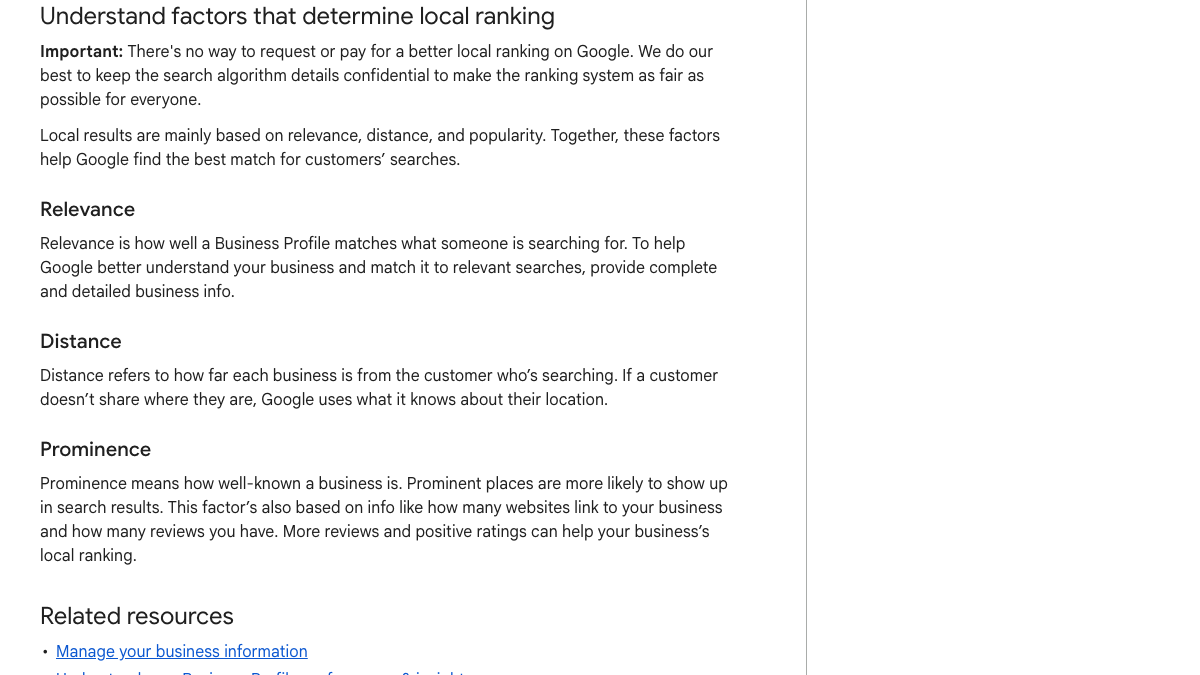
I noticed one small slip while reading it. The intro line says local results are "mainly based on relevance, distance, and popularity," and then the heading below calls the third factor prominence. It's the same idea under two names, and the rest of the page sticks with prominence.
I think of "near me" as a blank in the search. The searcher leaves it empty and Google fills it in with their location, so the only words on your side that count are the service and the place. Our guide to getting into the Google local pack turns the three factors into steps.
Do you need "near me" on your pages?
No. In an r/localseo thread asking how to target near me keywords, several people gave the same answer without copying each other. One said you don't actually rank for the words, because Google uses the searcher's location and shows the businesses with the strongest local signals. Another called it a location signal you don't target at all.
Search Engine Journal made the same point back in 2023 with a blunt example. A San Diego restaurant can't rank for "best restaurant near me" in Philadelphia, whatever it calls itself.
So what goes on the page? Name the service in the words customers use, name the city and the areas you serve, and show your address or service area. Give each main service its own page.
A local SEO practitioner posted on X in October that splitting services into their own pages took one cleaning business from #100 to #3 for "maid service" and from #14 to #2 for "house cleaning service near me." That's one account's claim with no control group, but the page-per-service idea matches what Google's relevance factor rewards.
One natural mention of "near me" won't hurt you. Repeating it in the title, the H1 and the meta description gives Google nothing it needs, and it reads like spam to the person deciding whether to call.
The business-name myth
The bigger temptation is the profile name. People still argue that a name like "Rapid Plumbing Near Me" or "Best Dentist Austin" ranks better, and some practitioners swear it does. One poster on r/localseo described filing a DBA so the legal name carries the service and the city.
Google's guidelines for representing your business are plain about it. "Including unnecessary information in your business name isn't permitted, and could result in the suspension of your Business Profile." The page then lists what your name must not include, with examples in two columns.
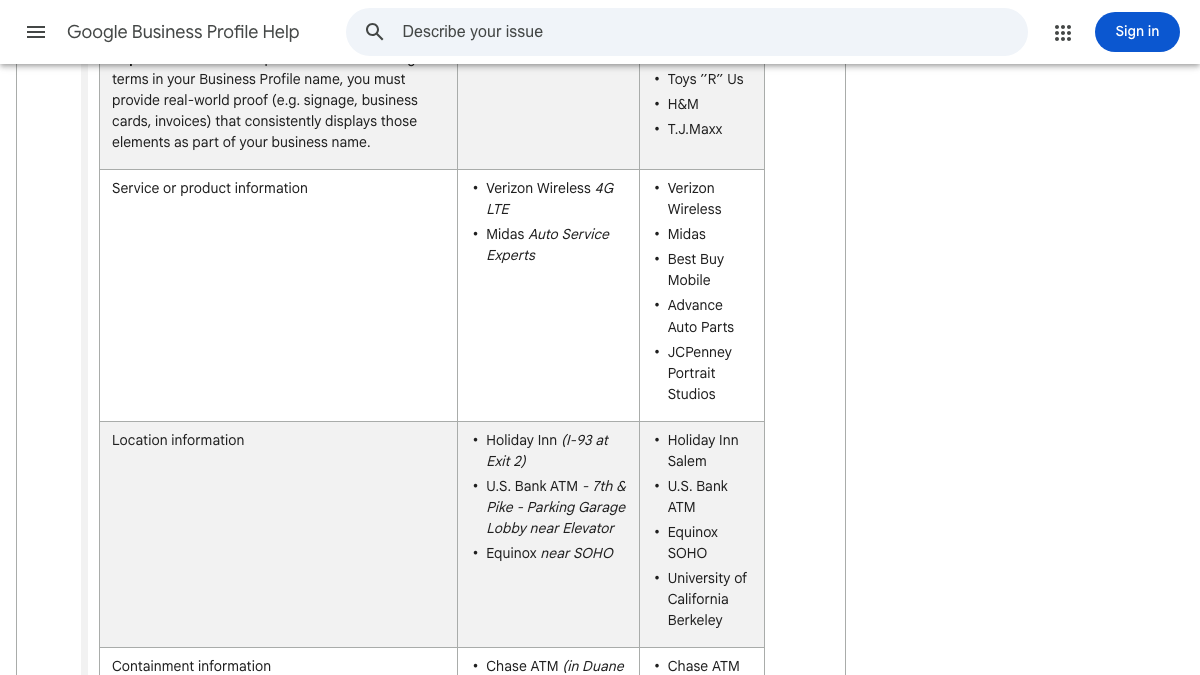
Look at the location row. "Holiday Inn (I-93 at Exit 2)" isn't allowed, while "Holiday Inn Salem" is. And Google's own banned example is "Equinox near SOHO," with the word "near" right there in it. The service row bans "Midas Auto Service Experts" and keeps "Midas."
By my reading, a name with "near me" in it breaks two rows at once. It's a location claim, and it's a marketing line. It also makes no sense as a name, because "me" is a different place for every person who searches.
"Equinox SOHO" passes because that's what the branch is really called. That's the only clean route for a place or service in your name. It has to be the name on your sign, your site and your invoices, which is why the DBA move only holds up if you truly trade under that name. Our rundown of local SEO tactics covers why stuffed names sometimes survive for a while, and why that's a bad bet.
See your first AI citation report in under 5 minutes.
No setup calls. No onboarding meetings. Connect your domain and see where AI mentions your brand right now.
The near me stats nobody can source
Most of the near me guides ranking today repeat the same block of numbers. There's a claim that near me searches grew 900%, plus a monthly search count, a mobile share and figures on how fast people visit or buy. I won't repeat the rest, because none of them come with a date or a link.
The block seems to trace back to an old Think with Google page. When I tried that page's address on October 19, it redirected to a general Google Business page, so the source is gone. Even Google's own AI Overview for "near me search ranking factors" cited SEO company blogs in mid-October, not Google's help page.
My rule for this topic is simple. If a near me stat has no date and no link, it isn't evidence, however many sites print it. The rest of this guide sticks to Google's help pages and one dated study.
How AI engines answer near me questions
That dated study comes from BrightLocal, published September 16, 2026. It ran 200,085 local searches with no brand names in them, across about 1,300 business locations, on ChatGPT, Google AI Mode and Google's AI Overviews. Over 60 days, that came to nearly 2 million citations.
A caveat before the numbers. BrightLocal sells local SEO tools, and the study ran on its own Local AI Visibility Tracker, so it has a product in this race, and its main finding happens to argue for that kind of tracker. The method is laid out on the page, so you can judge it yourself.
The main finding is that a strong Maps listing doesn't carry over cleanly.
| Where the search ran | Share of searches naming a tracked business |
|---|---|
| Google Maps | 66% |
| Google AI Overviews | 38% |
| ChatGPT | 33% |
| Google AI Mode | 32% |
Distance still matters in AI answers, and BrightLocal's own words were that "near me" is "still alive and well." Just over half of ChatGPT's picks sat within 5 km of the searcher, about the same as AI Mode, while AI Overviews reached 59.3%. Past that range, ChatGPT spreads out. The radius holding 90% of its picks stretched to 287 km, against roughly 38 to 64 km for the two Google AI surfaces.
The engines also disagree with each other. AI Mode and AI Overviews shared only 29% of the businesses they named, and ChatGPT overlapped with either one by about a fifth. Moving the searcher across the same town changed things too, with ChatGPT's picks overlapping just 36% between points. That's the same block-by-block effect a local search grid shows for Maps.
Where do the answers come from? Business websites made up 42% of all citations and 93% of the unique domains cited. Google Business Profile pages added another 28.63%.
Owners are seeing it too. In an r/smallbusiness thread about customers finding businesses through ChatGPT, a home inspector said he asks every client how they found him, and a few said ChatGPT this year. He has plenty of Google reviews, plus listings on Yelp and HomeAdvisor. Another reply guessed that ChatGPT had searched the web and found him there. Our guide to local SEO for AI search covers which listings these engines lean on.
Your competitors are building backlinks while you read this.
Organic outreach, social mentions, and citations from Editorial Circle member sites, with managed backlinks available as an add-on. Grow your domain authority without running the campaign yourself.

What moves rankings for near me keywords
None of this asks you to chase the phrase. It asks you to make the service and the place easy to match.
- Pick the right primary category. Google's category help page says that with "Pizza restaurant" as your primary category, it "might show your business in someone's local search result when they search for Restaurants, Italian Restaurants, or Pizza." That's the relevance half of a near me search.
- Make your location easy to find. Distance needs a point to measure from. Put your address or service area on your profile and your site, and keep your name, address and phone the same everywhere, as BrightLocal's study also advises.
- Earn reviews at a steady pace. Google's ranking page says "more reviews and positive ratings can help your business's local ranking."
- Give each service a page that names the city. This is the page-per-service move from earlier, written for the person, not the phrase.
- Answer local questions on your own site. With business websites at 42% of AI citations in BrightLocal's data, a page that answers "who fixes X in Y" gives the engines something to quote.
By my rough estimate, setting up the profile side takes a day. Writing a page per service and a few question pages takes 15 to 25 hours for a small business, then a few hours a month to keep up.
Checking where you show up
For Maps, search your main services from a few spots in your area, or use a grid tool if you serve a wide area. Rankings shift by block, so one search from your desk tells you little.
For AI answers, ask ChatGPT, Gemini and Google AI Mode the questions your customers ask, like "who's the best emergency plumber near me" or "a good dentist open Saturday in Austin." Do it from your area and repeat it over a few weeks. BrightLocal found a business that shows up once comes back in only about half of later runs, so one answer proves nothing either way.
If you want a quick first look, our free AI visibility checker runs three buyer questions on ChatGPT and shows whether your business comes up.
Doing it yourself or handing it off
You can do all of this by hand, with your profile, a spreadsheet and a weekly round of searches. Or RankControl's agents can take over the parts that eat the hours, while you look after the profile and the reviews.
RankControl doesn't manage Google Business Profiles. Our AI visibility tracking checks every week whether seven AI engines name your business for your local questions, and our analytics track where your pages rank on Google and Bing. We also write articles for those questions and publish them on your own site, for $400/mo with a 7-day free trial.
You're getting AI traffic. But do you know where it comes from?
RankControl credits every visit to the assistant that sent it: ChatGPT, Perplexity, Claude, Gemini, Copilot, or Grok. Full source attribution, next to your Google traffic.