
You open Google Maps at your shop's front counter, type "nail salon" and see your business in the first slot. A customer six blocks north types the same words and gets three other salons. Both of you are right. A local search grid shows both answers at once, as a map of where you actually win.
Here's how a grid works, what its numbers mean, why rank moves block by block and where the picture stops being true. I checked every source and price below on October 19, 2026.
What a local search grid is
A local search grid runs the same Google Maps search from many points laid over your area and records where your business ranks at each one. Each point stands in for a person on that spot with a phone. Pins are usually green for the top three, yellow for the middle and red for buried or missing.
Three settings shape every scan.
| Setting | What it means | Example |
|---|---|---|
| Grid size | How many points across and down | A 7x7 grid is 49 searches |
| Spacing | The gap between two points | Half a mile |
| Coverage | Size times spacing | A 7x7 at half a mile spans 3 miles |
The trade-off is cost. Most tools sell credits, and Whitespark's Local Ranking Grids page says one credit buys one grid point per scan. Its $10 plan comes with 2,000 credits, which works out to about 40 scans of a 7x7 grid. Push the same keyword to 15x15 and each scan eats 225 credits.
Spacing matters more than people expect. Points packed tight around a downtown shop all come back green. Points spread too wide jump from green to red with no middle, so you can't see where the drop starts. Center the first scan on the business and space it so the outer ring sits about where your customers live.
The numbers on a grid report
Every grid tool turns the pins into a few summary scores. They look alike but answer different questions.
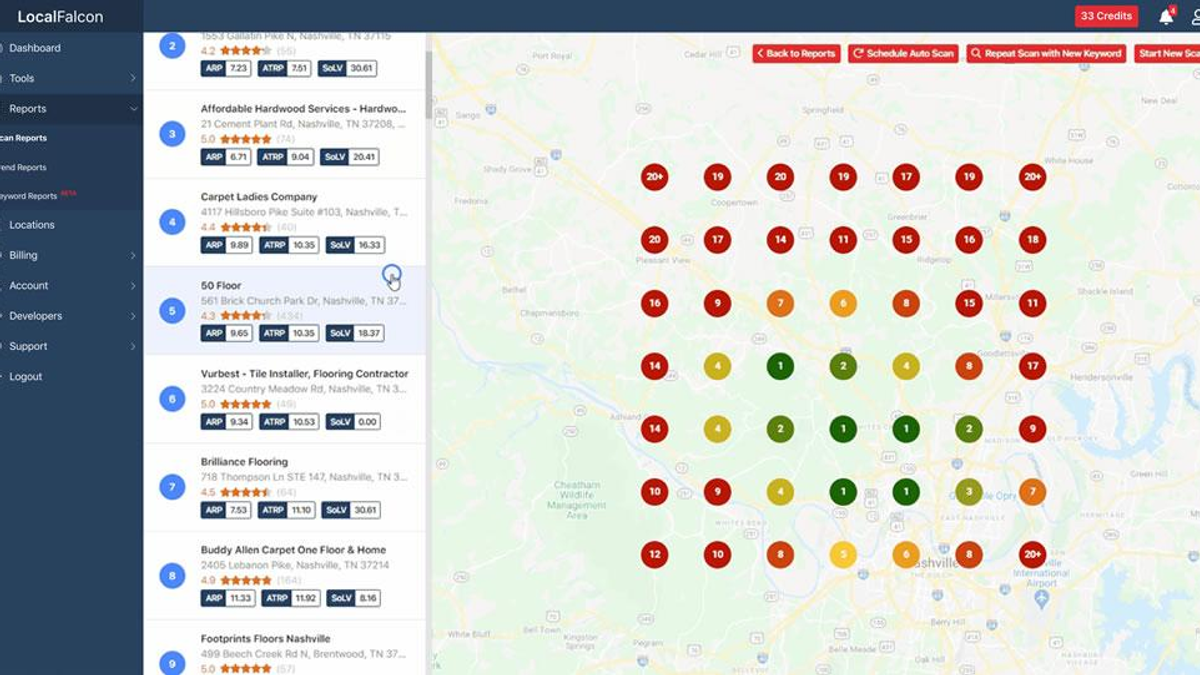
In the Local Falcon scan above, each flooring business in the sidebar carries three scores. Local Falcon's FAQ defines them this way.
- ARP, or average rank position, is "an average of only the pins that actually have a result." Points where you don't show up are left out.
- ATRP, or average total rank position, "averages all the pins, even when a business is not found," and counts a miss as 20+.
- SoLV, or share of local voice, is "how often a business ranks in the top three positions" across the grid.
ARP flatters. A shop that ranks first at four central points and doesn't appear anywhere else has an ARP of 1, which sounds perfect. ATRP shows the same shop missing across most of the grid. SoLV answers the money question, which is how much of the map sees you in the three-pack.
Share scores have a blind spot too. One r/localseo commenter pointed out that a location climbing from 15th to 5th still shows 0% top-three share, so report an average next to it. Other tools blend their own visibility scores, so read each definition before you compare vendors.
We'll show you exactly where your brand stands in AI search.
No commitment. $0 due today, cancel anytime. See how ChatGPT, Perplexity, Claude, Gemini, Grok, Google AI Mode, and Google AI Overviews talk about your brand today.

Why your rank changes block by block
Google explains local ranking on its Business Profile help page, "Tips to improve your local ranking on Google," with three factors. Relevance is "how well a Business Profile matches what someone is searching for." Distance "refers to how far each business is from the customer who's searching." Prominence "means how well-known a business is."
A grid makes the middle factor visible. Your categories and reviews don't change as the searcher walks, so relevance and prominence stay about the same. Distance changes at every pin, and as a point moves toward a rival, the result tilts their way.
Practitioners put distance near the top too. Whitespark's 2026 Local Search Ranking Factors report, published November 6, 2025, asked 47 local search experts to score 187 factors. It's expert opinion rather than measured data, but the order is telling.
| Local pack factor | Whitespark 2026 score |
|---|---|
| Primary Business Profile category | 227 |
| Proximity of address to the point of search | 225 |
| Keywords in the Business Profile title | 223 |
| Physical address in the city of search | 213 |
| Business open at time of search | 189 |
These are relative weights, not shares of the algorithm. Still, two of the top five are about where the searcher stands and a third is about the clock, which is why a grid can shift while you change nothing. Our rundown of local SEO tactics that work in 2026 covers which ones you can move.
How to read common grid patterns
Most grids fall into a few shapes. A heatmap guide from GeoRankland names five, and the first is common enough that a commenter on a salon's grid in r/localseo used the same name for it.
| Pattern | What it looks like | What it usually means |
|---|---|---|
| Proximity wall | Green around your address, fading to red at the edges | Normal, since rivals are closer to the outer points |
| Competitor dominance | One rival holds most points, even near you | A relevance or prominence gap |
| Donut hole | Red in the middle, green or yellow around it | A tight cluster of rivals right next to you |
| Directional bias | Strong on one side, weak on the other | Rivals, roads or a city line on the weak side |
| Complete invisibility | Red everywhere | The keyword may not match your categories |
People panic about the proximity wall most. In that same thread, the top reply said distance is the one factor you can't change, and the 4s and 5s at the edges were probably spots where a rival sat closer. Every business has a wall, so compare where yours starts with where your top rival's starts on the same keyword.
Competitor dominance is the one worth fixing, since a rival beats you even where distance favors you. Complete invisibility is often a setup problem, and our guide to getting into the Google local pack covers those basics.
Comparing two businesses on the same grid
To see relevance and prominence at work, scan two businesses for the same keyword at the same moment.
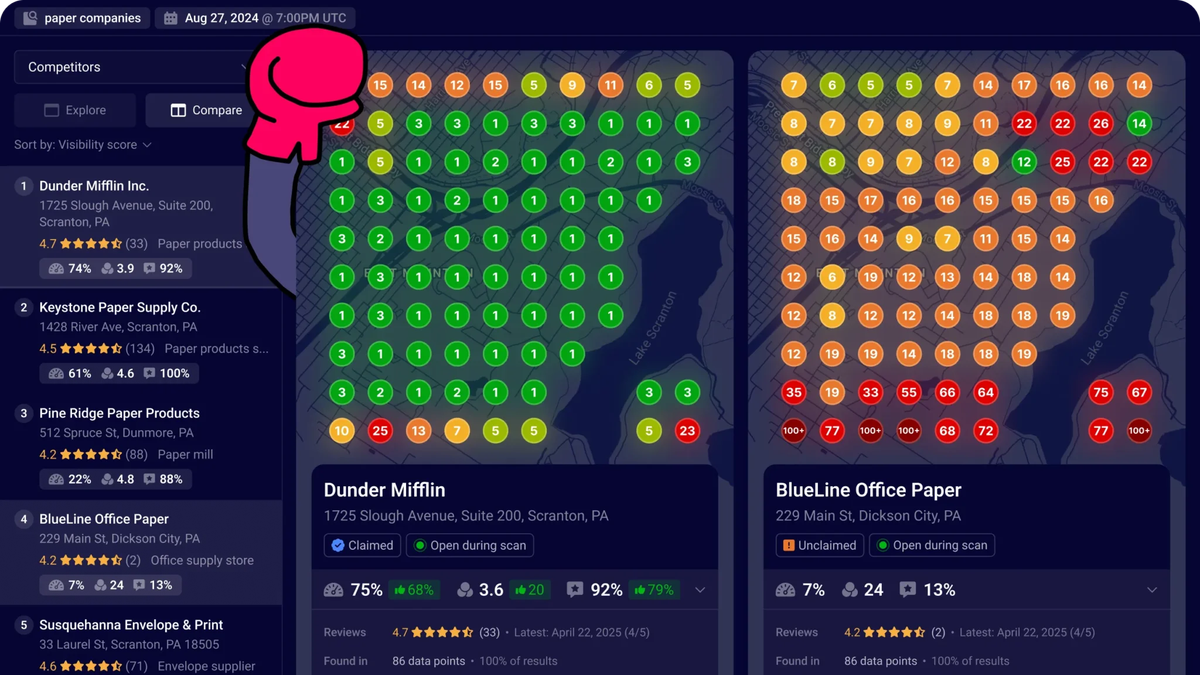
That's Whitespark's compare view, using its own demo businesses. Both scans ran for "paper companies" on the same date, and both shops were open during the scan. Dunder Mifflin is almost solid green, and its headline score reads 75%. BlueLine Office Paper is mostly orange and red, and its score reads 7%.
The details under each grid explain the gap better than distance does. Dunder Mifflin's listing is claimed, with 33 reviews and 146 photos. BlueLine's is unclaimed, with two reviews and 12 photos. Distance shapes the edges of a grid, but a gap that big in profile basics colors the whole thing.
So before you decide what to fix, scan your strongest rival on the same grid and day as your own listing.
Know exactly what AI says about your competitors.
RankControl's Recon Agent monitors competitor citations across ChatGPT, Perplexity, Claude, Gemini, Grok, Google AI Mode, and Google AI Overviews. See where they show up and you don't.

Grid tools and what they cost
I checked these five against each tool's own pricing or product page on October 19, 2026. Prices are the lowest public plan.
| Tool | Starting price | Grid size | Tracks AI answers, per its own pages |
|---|---|---|---|
| Local Falcon | $24.99/mo (Starter) | 3x3 to 21x21 on every plan | Yes, for ChatGPT, Gemini, AI Overviews, AI Mode and Grok |
| BrightLocal | $31/mo (Track, billed yearly, 1 location) | Up to 15x15 | Through a separate Local AI Visibility Tracker |
| LocalOptics (formerly Local Viking) | $39/mo (Single, 1 listing, 7,500 credits) | Not stated on its pricing page | Not mentioned |
| Whitespark Local Ranking Grids | $10/mo (2,000 credits) | 4 to 225 points | Not mentioned on the grid page |
| Grid My Business | $24 to $29/mo (Growth, 7,500 credits) | Not stated on its homepage | Yes, for ChatGPT, Gemini, AI Mode and AI Overviews |
GMB Everywhere comes up in these lists too, but it's a Chrome extension for profile audits with a manual location switch, not an automated grid tracker.
For one location and a few keywords, I'd start with Whitespark's $10 credits. If your service area is wide, Local Falcon's 21x21 limit gives you room. Watch for quiet caps, like BrightLocal's Track plan limiting the grid to five keywords.
What a grid can't tell you
Each pin is one pretend searcher, a single search from a fixed spot with no history, at one moment. I think of it as the pin-drop searcher. Real customers bring their own history, and Google's help page doesn't say how much that shapes what they see. The grid shows what a stranger on that corner would see, not the person who searched your name last week.
Re-scans move. In an r/localseo thread about client reporting, one practitioner noted that the same grid run twice doesn't give the same numbers, and that the main rival was being picked again each month, so the trend compared different businesses. Lock your rival set, and treat a one or two place shift at a single pin as noise.
The clock matters too. One home-services marketer on X warned that scanning after hours, when the listing shows as closed, makes a grid look worse than it is. That fits the open-at-time-of-search score in the Whitespark survey. Run every scan at the same hour on the same weekday, inside your opening hours.
Clients misread them. In an r/localseo thread asking whether map grids cause more anxiety than value, the top reply said grids raise more questions than they answer, with few levers for ranking far from your address. Another warned that one noisy square can end up driving the whole plan. With a boss or client, lead with the monthly ATRP and SoLV trend and show the map second.
How often to scan, and the AI side of local search
Weekly suits most single locations, with the same keywords, grid, hour and rivals every time. Judge movement over four weeks. Ten keywords on a 7x7 grid each week is 490 points, so do the credit math before a yearly plan.
A grid also has a growing blind spot. AI engines now answer local questions by naming businesses, and a Maps grid can't show whether ChatGPT or Perplexity names yours. Our guide to local SEO for AI search covers what those answers pull from.
RankControl doesn't run map grids. Our AI visibility tracking checks every week whether seven AI engines name your business for your local questions, and our analytics track where your pages rank on Google and Bing. We also write articles for those questions and publish them on your own site, for $400/mo with a 7-day free trial.
By my rough estimate, running grids and checking AI answers by hand takes a couple of hours a week per location. You can do it all with a grid tool and a spreadsheet. Or pair a grid tool for Maps with RankControl's agents for the AI checks, rankings and articles, while you fix the profile.
26 content formats. Published on your domain. Matched to your brand.
Guides, comparisons, listicles, case studies, and more. RankControl generates content that gets cited by ChatGPT, Perplexity, Claude, Gemini, Grok, Google AI Mode, and Google AI Overviews.