
You spend twenty minutes on a title, publish it, and a week later Google shows a different one in the results. A recent r/SEO thread asked exactly that, why Google kept swapping an updated page title back to the old one. If you want to know how to write SEO titles that survive, the first step is knowing how often Google ignores them.
Most checklists, including our SEO copywriting checklist, give the title one line. This post is only about the title. Every rule below comes with a dated source, and I checked each one on October 19, 2026.
What Google does with your title tag
Google writes the blue link itself. Its title links documentation, last updated December 10, 2025, calls the process "completely automated" and lists the places it can pull the text from.
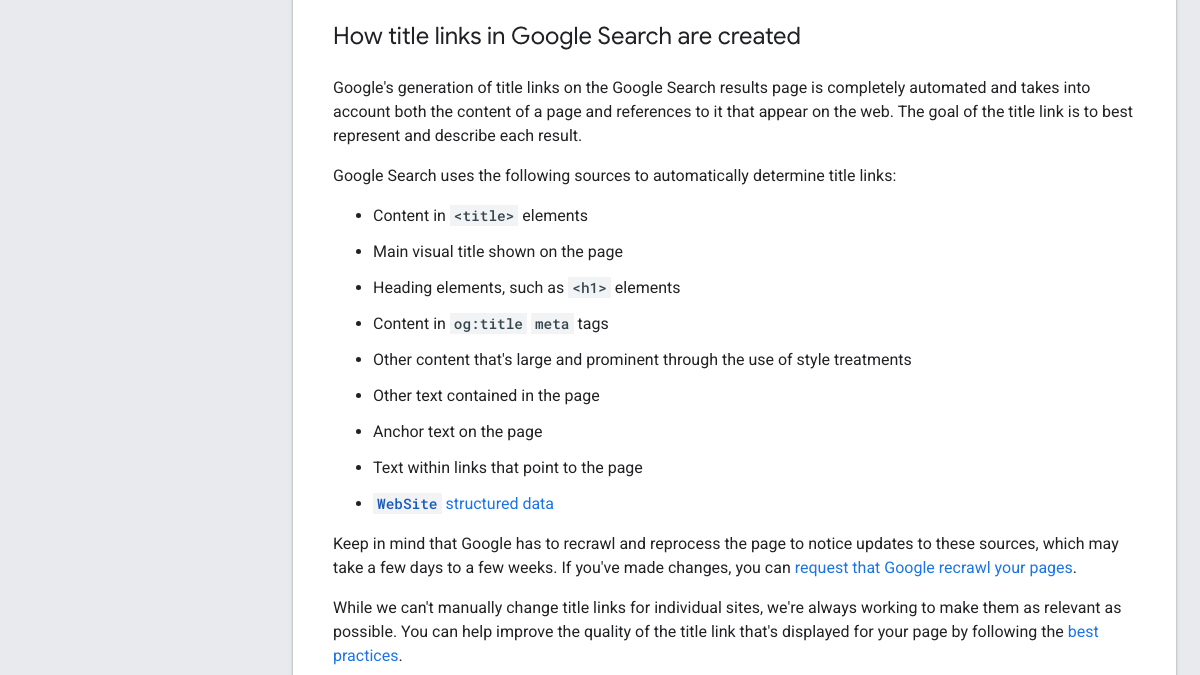
So your title tag is a strong suggestion, and your H1, your big on-page text and the anchor text of links to the page all compete with it. The same page also says Google needs to recrawl the page before it notices a change, which takes a few days to a few weeks.
The doc names the cases where Google tends to replace a title. A title that's half empty, like a lone site name, gets filled in. An old year gets swapped for the one the page shows. Identical boilerplate across many pages gets extra detail added, and an English title on a Hindi page gets rewritten in Hindi.
How often Google rewrites SEO titles, and why length matters
The best dated number comes from Zyppy's title rewrite study. It looked at 80,959 title tags across 2,370 sites in early 2022, and Google had rewritten 61.6% of them.
Length was the clearest pattern in the data.
| Title length | Share Google rewrote |
|---|---|
| 1 to 5 characters | 96.6% |
| 20 characters or less | over 50% |
| 51 to 60 characters | 39% to 42% (the lowest) |
| Over 60 characters | over 76% |
| Over 70 characters | 99.9% |
Punctuation mattered too. Titles with square brackets were rewritten 77.6% of the time, and Google cut the bracketed text out entirely in about a third of cases. Parentheses fared better at 61.9%. Pipe separators were dropped or replaced 41% of the time, about twice the rate for dashes.
There's one caveat that the study's update date can hide. The page was refreshed on October 6, 2026, but the sample is from 2022, and Google has changed its results pages since then. Still, it's a real sample with a real method. One of the top-ranking guides for this keyword says Google rewrites titles "less than 20%" of the time and cites nothing for it, so I'd trust the 2022 data over that.
See your first AI citation report in under 5 minutes.
No setup calls. No onboarding meetings. Connect your domain and see where AI mentions your brand right now.

How to write SEO titles in six steps
Here's the order I'd work in. Each step is there because a study or Google's own doc backs it.
- Start with the words people type. If the searcher types "how to write a title tag," those words should open your title, in that order. Our post on matching titles to the questions AI engines answer covers why the literal phrasing wins with machines too.
- Say what the page is, then make the H1 agree. Zyppy found that when a number appeared in both the title and the H1, Google kept the number in the shown title 97.3% of the time, against 74.2% when only the title had it. Your H1 backs up your title, and our outline template shows where it sits on the page.
- Keep it to about 50 to 60 characters. That's the band Zyppy found Google rewrote least. Google sets no hard limit, but it cuts titles to fit the screen, so put the words that matter first.
- Use a dash, and skip square brackets. If you need an aside, parentheses survive better than brackets.
- Put your brand at the end, once. Google's doc suggests the site name at the start or end with a delimiter like a hyphen, and warns against the same boilerplate on every page.
- Only add a date the page has earned. A stale "2025" in a 2026 title is one of the triggers Google lists.
Step 6 is the one that breaks later. A year in the title feels like free freshness until the page sits untouched for twelve months.
What the A/B tests say about click-worthy titles
Rewrite studies tell you what Google keeps. Split tests tell you what people click. SearchPilot publishes SEO A/B tests where half of a site's pages get the new title and half don't, and three of them are about titles.
| Change | Site | Result | Published |
|---|---|---|---|
| First keyword set in capitals | Ecommerce retailer, product listing pages | +8.5% organic traffic | February 2024 |
| "Book now" at the start | Local appointment-booking pages | +18% organic traffic | October 2021 |
| Month and year added | Listings site with seasonal peaks | +5% organic traffic | December 2020 |
The "book now" test is the one to read twice. SearchPilot says an earlier travel client added the same words to flight pages, and that test lowered organic traffic. People booking a haircut are ready to act, while people pricing flights are still comparing.
I call this the transfer problem. Every one of these tests ran on one unnamed client in one vertical, so a lift on someone else's pages is a hint, never a promise for yours. Test your own titles, or at least change them in batches you can compare.
The month-and-year test held up better than most. SearchPilot reran it in other months and the freshness lift kept showing up, which is why step 6 says "earned" and not "never."
SEO title myths the CTR data doesn't support
Backlinko's CTR study, last updated April 16, 2025, covers 12,166,560 search queries. The top result got 27.6% of clicks, which is why rank still does most of the work. Our breakdown of CTR by position in 2026 shows how far that number has dropped since AI Overviews arrived.
The same study punctures a few title myths.
The first is "always phrase it as a question." Backlinko compared titles with and without a question and found a gap of under one point, which it called not significant. Use a question when the searcher asks one.
The second is that length only matters to Google. Titles of 6 to 9 words had the best CTR, and titles of 40 to 60 characters beat those outside that range. That lines up with the Zyppy band almost exactly.
Tone did matter a little. Titles with a positive tone ("best", "healthiest") got a 4.1-point higher CTR than negative ones.
The last myth runs the other way, that any repeat of a keyword hurts you. In a busy r/SEO thread on whether stuffing still hurts in 2026, the top answer said there's no magic density and Google doesn't punish a word for appearing often. Google's doc still says repeated keywords in a title look spammy, so use the term once and write the rest for a person.
Your competitors are building backlinks while you read this.
Organic outreach, social mentions, and citations from Editorial Circle member sites, with managed backlinks available as an add-on. Grow your domain authority without running the campaign yourself.

Do SEO titles affect AI citations?
They do, mostly in two ways that the sections above already cover. ChatGPT, Perplexity and Google's AI Mode all run searches before they answer, then pick sources from what comes back. Our guide to how AI engines choose sources covers that step engine by engine.
The first is rank. A Kevin Indig analysis of more than 1 million AI answers, summarized by AirOps in August 2026, found that pages ranking first earned 58% of citations for fan-out queries, four times as many as pages ranking tenth. A title that wins the click and the rank also puts the page in the pool the engine picks from.
The second is query match. A title that repeats the question's exact words is easier for the engine to match to one of its sub-searches. A clever pun matches nothing.
One reply in an r/SEO thread about raising click-through rates added a useful twist. On questions where an AI Overview already answers, the commenter said a title has to promise something the summary can't replace, like a template, a tool or data. If your page has a template, a tool or its own data, put that word in the title.
None of this guarantees a citation. Engines cite pages other sites link to and mention, and that part grows slowly.
Check your titles after you publish
A good title is still a guess until Search Console says otherwise. Two commenters in that same r/SEO thread made the point that CTR is only useful by query and next to average position, never as one sitewide number.
So pick one query per page, write down its CTR and position, change the title, and wait. Google's doc says a recrawl can take a few weeks, so don't judge a title on day three.
If Google keeps reverting to your old title, look at the rest of the page. In that revert thread, one commenter gave the same fix twice. Update the H1 and the anchor text of your internal links to match the new title, then ask Google to recrawl, and give it those few weeks again.
Doing this for every page
By my rough estimate, one title takes about 15 minutes to write with the data above, and checking it in Search Console a month later takes another 10. Across 20 new articles a month plus the older pages you retest, that's a working day or two of title work alone. If you want the whole page done this way, our before and after rewrite shows the same method from title to FAQ.
You can do all of this by hand with a spreadsheet and Search Console. Or RankControl's agents can write and publish the articles, titles included, every month. The content engine writes each article against the pages already ranking for its keyword and publishes it on your own site, and AI visibility tracking checks your questions weekly on seven AI engines.
You're getting AI traffic. But do you know where it comes from?
RankControl credits every visit to the assistant that sent it: ChatGPT, Perplexity, Claude, Gemini, Copilot, or Grok. Full source attribution, next to your Google traffic.