
You open Search Console, filter to a post you published in March, and the clicks column says 0 for all seven months it has been live. Blog posts with zero traffic are the normal result on the web, and most teams react the same way, by rewriting the post or giving up on it.
Both moves skip a step. A post can get nothing for four very different reasons, and each one has its own fix. This post covers how common zero is, what the main study can and can't tell you, and how to work out which zero a post has. It's about posts that never got traffic. Posts that had traffic and lost it are a different problem, covered in our guide to content decay.
How many blog posts get zero traffic?
If you go by the one large study that exists, almost all of them get none. In December 2023, Ahrefs published a search traffic study that checked about 14 billion pages and found 96.55% got no traffic from Google at all. Another 1.94% got between one and ten visits a month.
That's the number you'll see everywhere, and it deserves a few caveats before you put it on a slide.
- It counts every kind of page, so tag pages, product pages and old press releases sit next to blog posts.
- The pages came from Ahrefs' Content Explorer, a slice of its index that leans toward sites it already crawls well.
- Its keyword list, about 651 million terms, can't see every long-tail search, so some "zero" pages get real visits it can't count.
- It's from December 2023, before AI answers took a much bigger share of clicks.
I looked for a newer study that repeats the method and didn't find one. As of October 2026, the most-quoted figure on this topic is close to three years old, and no one has rerun it since AI Overviews spread.
You'll also see a rounder version. Undated pages say "90% of web pages get zero organic traffic" and credit it to "an Ahrefs study," with no link, date or sample size. A 2018 MarketingProfs chart write-up used the same "nine in ten" line. I couldn't trace that 90% figure to an original study with a date and a sample, so it fails the two-click test we use in our blogging statistics roundup. Quote the dated 96.55% with its caveats, or don't quote either.
One more thing the headline hides. The 96.55% counts pages. The other famous "zero" numbers, like the share of searches that end without a click, count searches. They measure different things, and they belong to different causes, which is where the rest of this post goes.
The four kinds of zero
A post with no traffic has one of four problems. I think of them as a ladder, since you check them in order and each rung only matters once the one below it is clear. Call it the zero ladder.
| Kind of zero | What's going on | Where to look | The sign |
|---|---|---|---|
| Not indexed | Google doesn't have the post | Page indexing report, URL Inspection | Not on Google, no impressions |
| No demand | Indexed, but nobody searches for its topic | Performance report, a keyword tool | Few or no impressions for months |
| Outranked | It shows up, but too far down | Performance report, average position | Impressions, position past 10, no clicks |
| Click taken | It ranks well, but something above it answers first | A signed-out search, CTR | Good position, plenty of impressions, tiny CTR |
The order matters because the fixes don't overlap. A rewrite can't fix an indexing problem, and building links won't help a post nobody searches for. So start at the bottom rung and stop at the first one that fails.
Each section below covers one rung, with the evidence for it and a way to check your own posts.
Zero one: the post isn't indexed
If Google never added the post to its index, nothing else matters. It can't rank, and it can't appear in an AI Overview either.
The check takes a minute. In Search Console, open Indexing, then Pages, and look at the "Why pages aren't indexed" table. For one post, paste its URL into URL Inspection at the top of the screen.
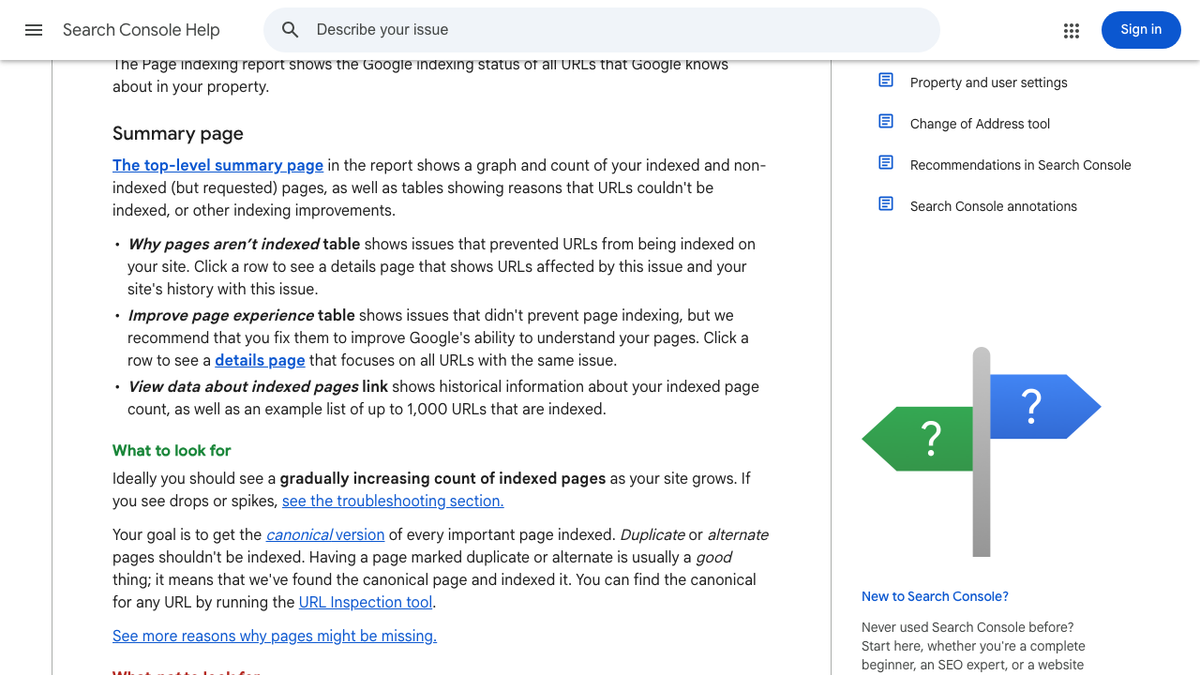
Google's Page indexing report help explains each status. Our full guide to Google indexing issues goes through them one by one, with the fix for each, so I won't repeat them here.
I couldn't find a sound public study, with a date and a sample size, of what share of blog posts never get indexed. So treat this rung as something to check, not something to estimate.
What the field reports do show is which posts tend to get stuck. In an r/DoSEO thread on pages that sat in "discovered, currently not indexed," several replies made the same point. When many pages share a template and only the service name changes, Google has little reason to index each one. Pages that get few links from the rest of the site also wait longer for a crawl.
There's a trap here too. In an r/SEO thread about pages that were indexed but got no impressions, one reply pointed out that a page can show as indexed while Google has picked a different URL as the main version. That page will never show for any search, even though the report looks green. URL Inspection shows the canonical Google chose, so check it on any post that looks indexed but never appears.
The sign of this zero is simple. URL Inspection says the post isn't on Google, or it's on Google under someone else's URL.
15 hours a week manually. Or 15 minutes with RankControl.
Track citations, monitor competitors, and fix content gaps across every AI search engine. Automatically.

Zero two: nobody searches for it
This one hurts more, because the post did everything right except pick a topic people look for. It's indexed and it may even rank first, but nobody types the query, so first place sends no one.
The r/Blogging thread that captures this best came from a blogger 11 months in, with 183 posts and very little Google traffic. A commenter looked the site up in a backlink tool and found it ranked for two keywords in total. Of 183 posts, two were in the race at all. Other replies called it the same thing in different words, too much volume and not enough focus on what people search.
In the r/SEO thread on indexed pages with no impressions, the top reply described the same trap from the other side. That person had once ranked on page one for their own name, but nobody searched for it, so there was nothing to click.
To check, open the Performance report, filter to the post, and set the dates to the last three months. A post that's indexed but has fewer than a handful of impressions in that time has a demand problem. Then put its main query into a keyword tool and see what volume it shows.
A keyword tool showing zero doesn't mean nobody searches, though. Google said in February 2022 that 15% of its daily searches have never been searched before. In March 2025, at Search Central Live in New York, John Mueller said that share "is always around 15%," even after the rise of AI chat, as Search Engine Journal reported. It's Google's own number and can't be checked from outside, but it fits what anyone who reads Search Console sees, which is long queries no tool lists.
I ran into this while researching this post. The phrase it targets, "blog posts zero traffic," came back with no measurable search volume in Google's ad data, and so did 13 close variants. Only "is blogging still worth it" registered, at about 10 searches a month. People clearly ask this question, just in too many wordings for any single one to show up in a tool.
So the rule I'd use is this. Zero in a keyword tool plus zero impressions after three months means no demand. Zero in a keyword tool plus a steady trickle of impressions for related long queries means the demand is real and scattered, and the post may only need its headings to match how people phrase it. Our guide to long tail keywords covers how to find the wordings buyers really use.
Zero three: it shows up, but too far down
The third rung is where a lot of small sites get stuck. Google shows the post, so it has impressions, but it sits on page two or three where almost nobody scrolls.
Ahrefs' study has a figure that fits here. Of the pages it checked with no referring domains, meaning no other sites linking to them, only about 2,997 got more than 1,000 visits a month from Google. The study shows a strong link between referring domains and traffic, though it doesn't prove the links caused it.
The sign is in the Performance report. Turn on average position and impressions, then look for posts with dozens or hundreds of impressions, an average position past 10, and no clicks. The post is in the race. It just isn't near the front.
A pattern worth knowing came up in that same r/SEO thread. One reply said a page that gets two days of impressions on page one and then drops off a cliff usually means Google tested it on a query and decided it wasn't the best result. They warned that rewriting the copy just to force impressions back is how you lose the test. If you see that shape, look at what beat you before changing anything.
Whether the gap is the post or the site is its own question. Our guide to thin content vs authority covers how to tell a weak page from a weak domain, so I'll leave that diagnosis there.
AI search traffic grew 835% this year. Is your content ready?
RankControl generates 26 content formats optimized for ChatGPT, Claude, and Perplexity. Published on your domain, matched to your brand.

Zero four: the click went to the answer
The last rung is new, and it's the one that confuses people most. The post is indexed, people search for it, and it ranks near the top. It still gets almost no clicks, because the search results page answered the question before anyone scrolled to it.
This is where the search-level numbers come in. SparkToro's June 2026 study, built on Similarweb's clickstream panel, found 68.01% of US Google searches in January to April 2026 ended without a click to any site. On the same data, the figure for 2024 was 60.45%.
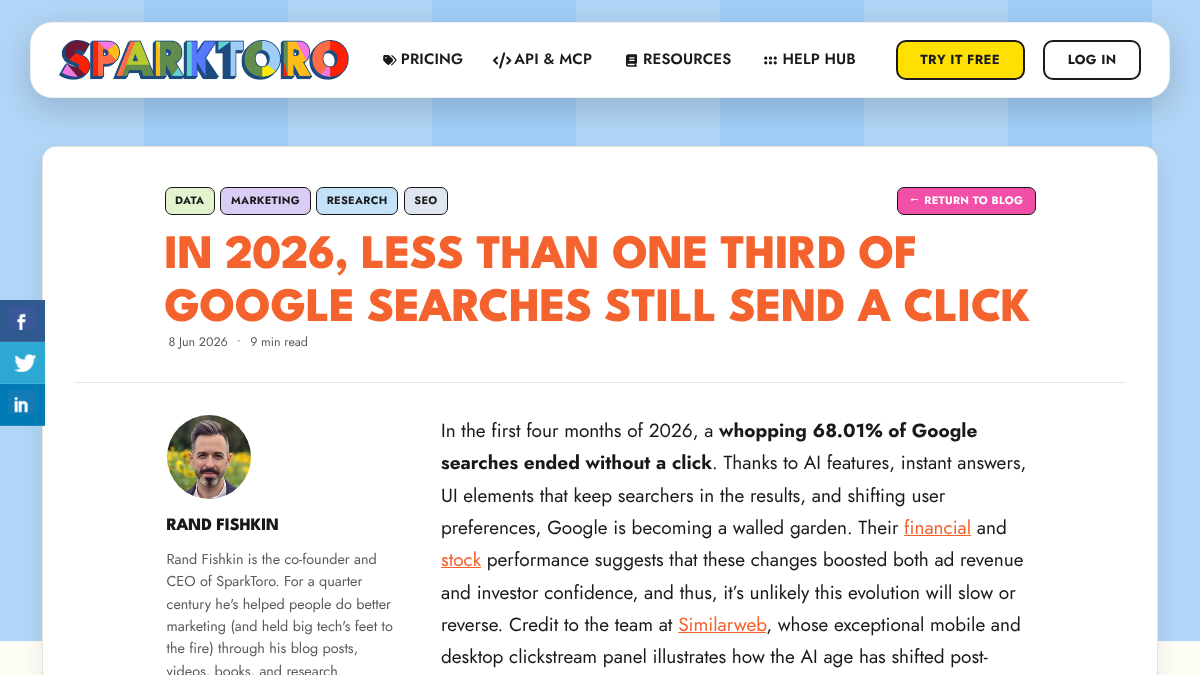
Remember the unit. That figure counts searches, not pages. It says two in three searches send nobody anywhere, which is a different claim from "96.55% of pages get nothing." A page can rank first for a query where most searches end on the results page, and that's the zero this rung describes.
The AI Overview is the big cause now. In a Pew Research Center study of 900 US adults' real browsing in March 2025, people clicked a normal result in 8% of visits when an AI summary appeared. Without one, they clicked in 15%. Links inside the summary itself got a click in just 1% of visits.
Google's AI Mode goes further. Semrush's clickstream study of about 69 million US desktop sessions, from May to early July 2025, found 92% to 94% of AI Mode sessions ended without a click to another site. It's desktop only and from before AI Mode's wider rollout, so read it as a snapshot. The full set of click studies, with what each one measures, is in our zero-click search statistics.
The sign of this zero is a good average position, often top five, with lots of impressions and a click rate far below what that position usually gets. To confirm it, search the post's main query in a signed-out browser window and look at what sits above the first blue link. If an AI Overview or a featured answer covers the question, the click went there.
There's an upside, though it's slow. A post that loses the click can still be the source an AI answer cites, and that puts your name in front of the reader even when no visit arrives. If your posts were written with AI, our piece on why AI-published articles get zero clicks covers how this rung gets decided at planning time, before a word is written.
The bright side: some posts keep growing
All of this makes blogging sound grim, and for the default post it is. But the posts that do work tend to keep working, and that's what makes the rest worth checking.
HubSpot looked at about 20,000 posts on its customers' blogs and split them into two kinds. Decaying posts get a burst of traffic at launch and then fade. Compounding posts get more search traffic over time. In its report, updated in November 2023, one compounding post brought in as much traffic as six decaying posts combined.
Two caveats apply. The sample is HubSpot customers, who already do inbound marketing and are probably better at SEO than the average site. And the report gives the six-to-one ratio but not the share of posts that compound, so it can't tell you how many of yours will. A widely shared repost puts a percentage on it, but I couldn't confirm that figure in HubSpot's own report, so I've left it out.
Still, the ratio is the useful part. One post that compounds is worth six that don't, which argues for fewer posts that each have a real reason to be found. Compounding posts usually target questions people keep asking, the kind that survive all four rungs. Our guide to cornerstone content covers how to pick the pages worth that investment.
What to do with each zero
Once you know which rung broke, the next step is usually short. Here's how I'd sort a list of dead posts.
| You found | Next step | Don't bother with |
|---|---|---|
| Not indexed | Fix the status, link to the post from indexed pages | Rewriting it for keywords |
| Indexed, wrong canonical | Point links and the sitemap at one URL | Requesting indexing again and again |
| No demand at all | Merge it into a related post, or let it go | Building links to it |
| Scattered long-tail demand | Rework headings to match the real queries | A full rewrite |
| Outranked | Compare it with what ranks, then improve or merge | Forcing impressions with small copy changes |
| Click taken | Aim to be the cited source, and weigh other channels | Treating it as a ranking problem |
A few of these end with deleting or merging. If you're working through a whole blog, our content audit template has the decision rules for keep, update, merge or delete, and a sheet to track it.
One more note on the last row. A post that loses its click to an AI answer may still be doing its job. If it's cited in the answer, you get the name recognition without the visit. You can't see that in Search Console, so it's worth checking the AI answers for your main topics directly, either by hand or with AI visibility tracking.
How long the check takes
The zero ladder is quick per post. I'd budget about 10 to 15 minutes each, as a rough estimate, for URL Inspection, a look at impressions and position, a keyword check and one signed-out search. A blog with 60 posts is a day or two of work, before any fixes.
It's also worth doing again. A post that clears every rung this quarter can lose its click to a new AI Overview next quarter, so the harder part is noticing when a post that worked stops working. I'd put the check on the calendar once a quarter.
Doing it yourself or handing it off
You can run every check above with Search Console, a keyword tool and a signed-out browser. Most of the time goes into the posts that fail, and into writing the next ones so they don't.
Or RankControl can do the writing side. Our content engine picks topics from the questions buyers actually search, writes each article against the pages already ranking for its keyword, and publishes it as a native post on your own site. Our analytics track each article's Google and Bing rankings, and we check your buyer questions on seven AI engines every week. We offer one flat plan at $400/mo with a 7-day free trial, so you can see which of your topics are worth the effort before you write the next batch.

Built by the team that got cited in 48 hours.
Content generation, backlink building, AI visibility tracking, and Google rankings. One platform, zero guesswork.