
When did you last search your brand plus "coupon code" and read the AI Overview? Google's AI answers about your company are mostly built from pages you don't control, and for a brand, that's what AI search spam usually looks like. An obvious spam site is the rarer case.
In September, a reply in an r/google thread described a small crisis at someone's workplace. The AI Overview gave another person's phone number as the organization's contact number, and that person started getting the company's calls. The team found the page the wrong number came from, had it taken down and asked Google to refresh, and the overview fixed itself faster than they expected.
To see how much your answers depend on other people's pages, we checked Google's AI Overviews and AI Mode on September 27 for 60 brand searches. We took 15 well-known SaaS brands and searched each one with "review," "is it legit," "pricing" and "coupon code." This guide shows you what those answers cited, where the junk got in and how to protect your citations.
Your site is a small share of your own brand answers
How much of the answer about your brand comes from your own site? In our check, about 12%. The 53 AI Overviews that listed sources cited 397 in total. Of those, 49 were the brand's own website, and the share changed a lot with the search type:
| Search type | Sources cited | Brand's own site | YouTube |
|---|---|---|---|
| [brand] review | 125 | 3 | 56 |
| is [brand] legit | 107 | 6 | 29 |
| [brand] pricing | 89 | 22 | 20 |
| [brand] coupon code | 76 | 18 | 2 |
If you count on your own pages to shape review answers, look at the first row. Review answers barely touched the brand's site: nearly half of their sources were YouTube videos, and review platforms, publications and other companies' blogs supplied the rest. Your pricing page gets more of a look, which makes sense, but even pricing answers took three quarters of their sources from someone else.
Plenty of those outside sources are fine. The trouble is how little of your brand story you get to write, and a few of the sources were clearly bad.
Coupon searches are where the junk gets in
Take the "monday.com coupon code" answer from our check. Of its nine sources, three were coupon pages with almost no search traffic. One promised a "verified" 20% sitewide promo code, and its date said October 2026 when we looked at it in September. The other two sat on unrelated domains, one with "gadget" in its name and one about startups, and used an identical page template, category menus included.
Those pages were the exception, going by the traffic estimate we ran on every cited domain:
| Estimated monthly organic visits | Cited domains |
|---|---|
| 10,000 or more | 157 of 194 |
| Fewer than 100 | 9, all of them coupon pages |
Eight of those nine sat on subdomains named after the brand, like monday. followed by an unrelated domain.
Later that morning we ran the monday.com search again in a browser, and the AI Overview got it even more wrong:
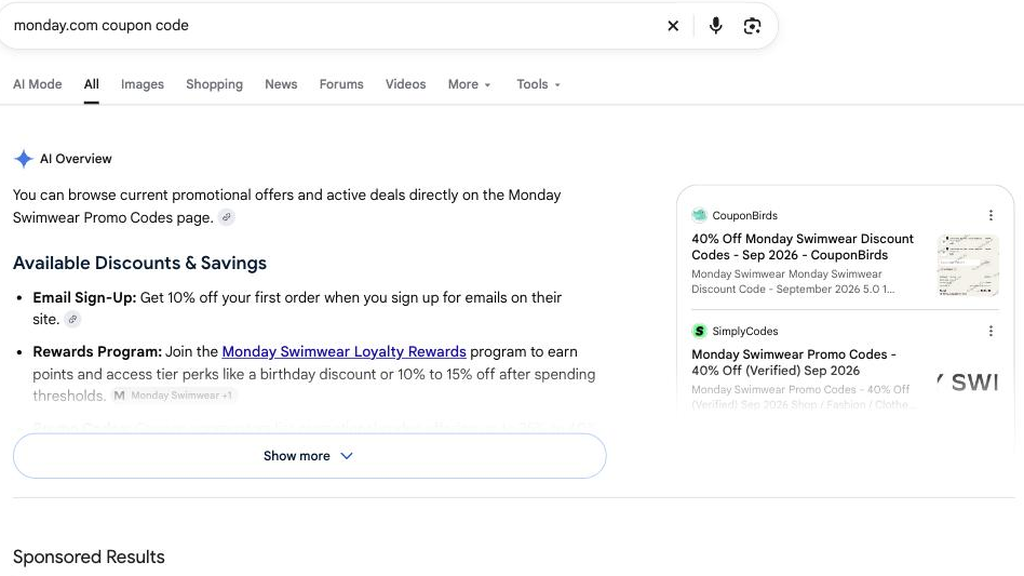
It answered about Monday Swimwear, a different company, using two coupon sites. If you were shopping for a discount on the work-management software, you got a swimwear promotion. AI Mode had the same issue in four of its coupon answers, for monday.com, Gusto, Calendly and Zendesk, which cited brand-named subdomains on coupon sites.
Shoppers already know coupon sites often don't deliver. An r/answers thread asked whether coupon code websites are all fake, and the replies went from a 50% success rate to people who'd stopped bothering.
Are coupon code websites all fake?
There are numerous coupon websites. They all give promo codes that never work. Is the coupon code just for one unknown location somewhere on Earth, and no where else? Why do they sometimes say the coupon is expired, when it says the coupon...
Brands with a discounts page kept their coupon answers
Do you publish a page about your own discounts? In our check, that one thing tracked the coupon results closely:
| Brand | Brand's own sources in its coupon answer |
|---|---|
| Asana | 4 of 5, covering startup, nonprofit and student offers |
| Webflow | 3 of 5 from its help center, including a discounts overview |
| Airtable | 2 of 3 from its support site |
| Pipedrive, ClickUp, Freshdesk, Gusto, Grammarly | None |
Where the brand had nothing of its own, coupon sites moved in.
We call this the brand-query blind spot. It's the searches that only your prospects and customers make, like "[brand] coupon code," so nobody on your team ever looks at the answer.
You won't spot it in the big picture either, because Google's broader numbers look clean. In August, Ahrefs' marketing chief shared an analysis by Glen Allsopp, based on Ahrefs data, of the 1,000 sites each AI platform cited most over six months. It counted 80 spammy sites with no search traffic among ChatGPT's and 122 among Copilot's, with none among Google's AI Overviews. But a top-1,000 view can't see the long tail, and that's where the coupon subdomains in our check sit.
AI search traffic grew 835% this year. Is your content ready?
RankControl generates 26 content formats optimized for ChatGPT, Claude, and Perplexity. Published on your domain, matched to your brand.

Competitors are writing your reviews
When a buyer asks Google whether you're legit, a competitor may do some of the answering. In our check, "is [brand] legit" and "[brand] review" answers leaned on other software companies' blogs. SmartSuite, which sells work-management software, was cited in six answers about ClickUp, monday.com, Asana and Airtable. A help desk vendor's post showed up in the Zendesk review answer, and software blogs and review sites supplied most of the "is Freshdesk legit" answer.
You can't call those pages spam, and some are fair. Still, the companies that wrote them benefit when your reader picks something else, and their pages sit next to your name in an answer your reader trusts.
Trustpilot got cited more than any other review platform, 20 times across the review and legit searches. If your Trustpilot page has few or old reviews, it can shape your "legit" answer more than your security page does.
Six ways to protect your brand's citations
1. Publish the discounts page the answer needs
Your coupon answer needs a page to quote. Write one page that says plainly which discounts you offer, such as annual billing, startup programs, or nonprofit or student pricing. Say whether you issue public promo codes at all. If you don't, saying so hands the engine a true sentence in place of a coupon farm's guess. Link the page from your pricing page and help center so it gets crawled.
2. Keep pricing in plain text
Your pricing page is where you're strongest, since pricing was the one search type where brands held a quarter of the citations. Keep your plan names, prices and billing terms in HTML text, and don't rely on images or a calculator alone. Date the page when prices change. Spend-management vendors and competitors publish their own versions of your pricing, and if yours is hard to read, their out-of-date copy can win.
3. Answer "is it legit" on your own site
Give buyers a trust page with your company details, security certifications, data handling and support contacts. Keep your review profiles current on the platforms that got cited, especially Trustpilot, G2 and Capterra. For what makes a review page citable, see our guide to review pages that get cited.
4. Put your product on video
For review searches, YouTube supplied 56 of the 125 sources. A clear walkthrough on your own channel, plus reviews from customers or creators you work with, gives the engine better source material than some stranger's ten-minute rant. Our guide to YouTube descriptions AI answers use covers the text you should get right.
5. Fix facts at the source
Remember the phone number story from the start? It shows you the order that works. Find the page the wrong fact came from and get it corrected or removed, then send feedback on the AI Overview. Check your Google Business Profile and major directories for old contact details too. Our response plan for wrong AI answers walks you through the steps, and our guide to correcting AI Overviews covers Google's feedback options.
6. Report what breaks the rules
If a page breaks Google's spam policies, report it with Google's spam report form. If it impersonates your company or copies your content, use Google's legal removal requests. Don't expect a spam report to fix things quickly, though. Google says reports help it improve its spam detection and may lead to manual action, and it doesn't promise that any single report will. If it does act, it sends your report text to the site owner, so leave your personal details out.

Built by the team that got cited in 48 hours.
Content generation, backlink building, AI visibility tracking, and Google rankings. One platform, zero guesswork.
What not to do
You may be tempted to fight coupon farms with coupon pages of your own. Don't build brand-named coupon pages, and don't buy placements on coupon networks. Google's site reputation policy covers third-party pages hosted mainly to borrow a site's ranking signals, and those networks are a poor place for your name.
Treat reviews the same way. If you buy them or only ask your happy customers for them, you can break platform rules, and in the US the FTC's rule on fake reviews too. For a "legit" answer, you'll get more from a small number of honest reviews than from a large number of suspicious ones.
Check your brand searches monthly
You can run every search in this guide in a few minutes. Once a month, search your brand in Google with "review," "legit," "pricing" and "coupon code," then check AI Mode and the other engines your buyers use. Write down every source you see cited, and open any new domain that appears.
Our guide to why AI search engines cite the wrong sources goes deeper into the retrieval side.
By hand, checking 50 questions on seven engines takes you about six hours a week. Publishing eight solid articles a month adds another 16 to 24 hours. Both are rough estimates.
RankControl's AI visibility tracking runs your 50 questions every week on seven engines. Our tracking marks each one as mentioned, cited or both, and records which competitors and sources each engine used. The content engine writes each article against the pages already ranking for its keyword and publishes it on your own domain.
A spreadsheet and a monthly reminder are enough to run the brand checks yourself. Or RankControl's agents can track the sources weekly and publish the pages your brand answers are missing, while your team handles the takedowns.
See your first AI citation report in under 5 minutes.
No setup calls. No onboarding meetings. Connect your domain and see where AI mentions your brand right now.