Link tools aren't built for small niches. Plug a specialist B2B company into one and you get a few hundred "prospects," most of them irrelevant, and a handful of real ones buried somewhere in the list.
The upside of a small niche is that the list of sites that matter is short. You can find nearly all of them in an afternoon, and the same names come up again and again. On September 27, we tested this by searching two specialist B2B markets the way a buyer would and writing down every site that wasn't a competitor.
What two small niches looked like
We picked veterinary practice management software, a niche of a few dozen vendors, and lab software for cannabis testing labs, which is far smaller. For each, we searched four buyer questions in Google and recorded the top 20 results plus the sources cited in Google's AI Overview.
| Veterinary practice software | Cannabis testing lab software | |
|---|---|---|
| Searches | 4 | 4 |
| Different sites in the top 20 | 37 | 26 |
| Sites that weren't vendors | About 18 | About 13 |
| Non-vendor sites cited in AI Overviews | An association, a trade publication, a review hub, a practice owners' community, a pharmacy | A trade journal, a consultancy, a state tracking system, an instrument maker |
About half of each list was vendors. The other half is the opportunity list, and it's short enough to work through by hand.
The two niches differed in one telling way. In the veterinary searches, Google's AI Overviews cited the American Animal Hospital Association and the trade publication Today's Veterinary Business. In the lab software searches, the AI Overviews mostly cited vendors' own pages, and there was far less independent coverage to draw from. The smaller the niche, the more your own pages matter, and the more each independent mention stands out.
Step 1: Search like your buyer
Start with 5 to 10 questions your buyers type, taken from sales calls rather than keyword tools. Search each in Google, then go through the top 20 results and the sources listed in the AI Overview. Write down every domain that isn't a direct competitor.
Don't skip page two. In both niches, several useful sites sat between positions 11 and 20. Cannabis Industry Journal ranked between 14th and 17th in all four lab searches, and two of the veterinary neighbor vendors sat at 14th and 18th.
Step 2: Sort the sites into six kinds
Every non-competitor site we found fit one of six kinds, and each one needs a different ask. A few examples, like the forums, came from an earlier pull of the same searches that day, since results shift a little between pulls.
| Kind | Veterinary example | Lab software example | What to ask for |
|---|---|---|---|
| Associations and standards bodies | AAHA | NIST, ASTM's cannabis standards group | Member resources, speaking slots, directory listings |
| Trade publications | Today's Veterinary Business, dvm360 | Cannabis Science and Technology, Cannabis Industry Journal | Buyer guide listings, expert comment, data they can use |
| Review hubs and directories | VetSoftwareHub, Capterra | LabCompare | A complete profile and real customer reviews |
| Neighbor vendors | A compounding pharmacy, a payments company, a financing company | An instrument maker, a state tracking system | Integration pages, co-written guides, a place in their roundups |
| Communities and forums | Reddit, a practice owners' community | Chromatography Forum, an open-source LIMS forum | Useful answers from a named person at your company |
| Comparison sites | A site with dozens of "X vs Y" vet software pages | None found | Accurate data about your product |
The neighbor vendors are the kind most teams miss. We call them that because they sell to the same buyer without competing with you. In the veterinary searches, a compounding pharmacy, a check-payments company and a consumer financing company had all published articles comparing veterinary software, and the pharmacy's article was cited in an AI Overview. They write for your buyer, they need content, and they have no reason to leave you out.
26 content formats. Published on your domain. Matched to your brand.
Guides, comparisons, listicles, case studies, and more. RankControl generates content that gets cited by ChatGPT, Perplexity, Claude, Gemini, Grok, Google AI Mode, and Google AI Overviews.

A worked example: the lab software list
In the cannabis lab niche, the whole independent list fit on one page, and a few names carried most of the weight. Cannabis Science and Technology was cited in the AI Overviews for three of the four searches and ranked between third and seventh in three of them. Cannabis Industry Journal had two feature articles on running testing labs with lab software. American Laboratory had an application note on the same subject.
Two entries on the list weren't publications at all. NIST runs a program of quality tools for cannabis testing labs, and Metrc, the state track-and-trace system many labs report into, was cited in an AI Overview. For a lab software vendor, those are the obvious places to be mentioned, through integration documentation, compliance guides and resource listings rather than pitches.
That's the pattern to look for in your own niche: two or three publications that cover the category, one or two official bodies, and the systems your product connects to.
Step 3: Check who's already mentioned
Before you pitch, look at who each site already covers. Search each site for your competitors' names, for example with a site: search in Google. A publication that has covered three of your competitors is a warmer lead than one that has covered none, and its old articles tell you what format it likes.
Do the same in reverse to find unlinked mentions of your own brand: search your company name in quotes and leave out your own domain. In a small niche these are often trade articles or event pages that name you without linking, and a short note to the editor fixes most of them. Our guide to digital PR for unlinked mentions covers that follow-up in detail.
Step 4: Pitch each kind differently
A single outreach template fails in a small niche because everyone knows everyone. Pitch to what each kind of site needs.
Trade publications want information they can't get elsewhere. The veterinary "Who's Who" list that ranked for our searches is a good example. It lists 25 practice management systems with prices, practice counts and migration fees, and it dates from the publication's August/September 2021 issue. It still ranked in September 2026.
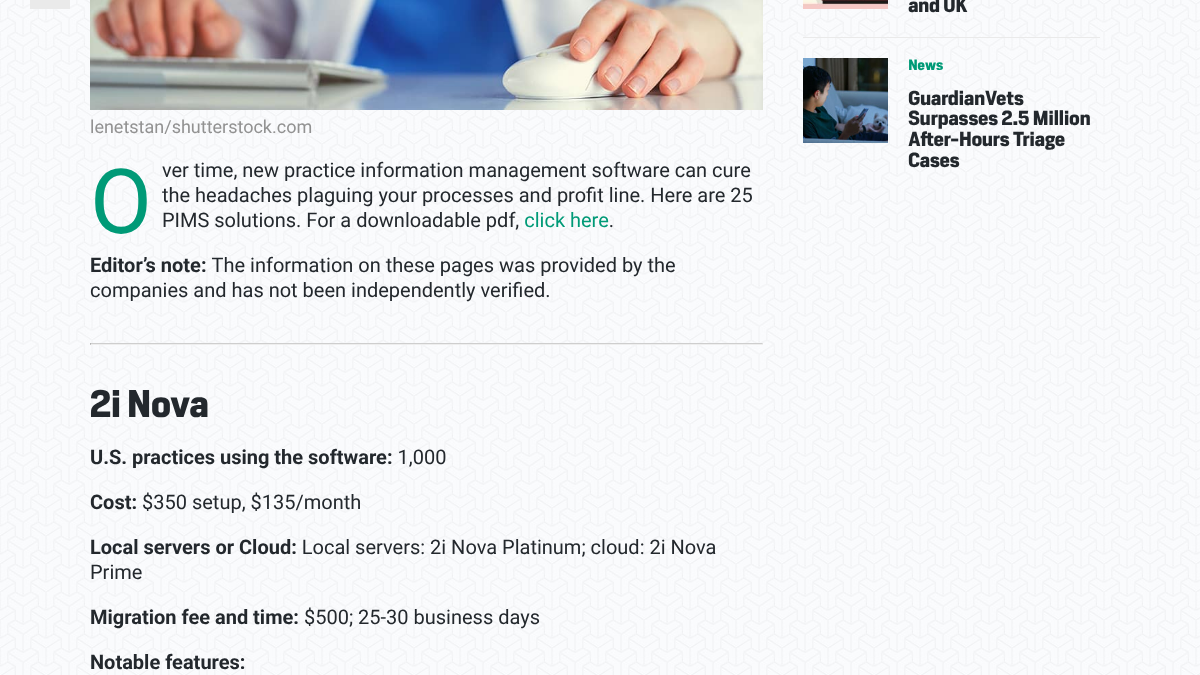
Look at the editor's note: "The information on these pages was provided by the companies." Vendors got onto that list by sending their details. When a niche publication runs a buyer guide like this, the pitch is simple: ask how to be included in the next edition, and send the same fields everyone else sent.
Associations respond to members and speakers more than to pitches. Review hubs need a complete profile and a few real reviews. Neighbor vendors respond to something useful for their own customers, like a joint guide or an integration page that helps both of you. On forums, the only thing that works is a person answering questions well under their own name, over months.
What not to do
Small niches make shortcuts tempting, because the same few people run everything. Google's link spam policy lists the ones that backfire, including "exchanging goods or services for links," "sending someone a product in exchange for them writing about it and including a link," and "excessive link exchanges."
That matters most with neighbor vendors. Co-writing a useful guide is fine. Swapping links on a "partners" page that exists only to cross-link isn't. If money or free product changes hands, the link should be marked as sponsored.

Your competitors are getting cited by AI. You're not.
Every day without citation tracking is a day your competitors pull ahead in ChatGPT, Perplexity, and Claude.
Where AI answers fit in
Mentions from these sites help in two ways. Some of them, like the association and trade publication in the veterinary niche, are what Google's AI Overviews cite directly. And the rest shape what AI models learn about your category over time.
In the smallest niche we checked, though, independent coverage was so thin that AI Overviews leaned on vendors' own pages. If that's your market, your own site has to carry more of the weight: a clear pricing page, integration pages and plain answers to the questions buyers ask. Our guide to building AI search visibility without chasing listicles covers those pages, and brand mentions vs backlinks explains how the two signals work together.
Doing it yourself or handing it off
By hand, this is a spreadsheet: 5 to 10 buyer searches, a column for each of the six kinds, and a note on who covers your competitors. Plan an afternoon to build it and a few hours a month to work through it.
Or RankControl can take on part of the work. We monitor your backlinks, find link prospects for your published articles and draft the outreach emails, which are sent only with your approval. If you'd rather hand links off completely, the Managed Backlinks add-on places 5 links a month from DR 25+ sites for $350 a month. To see where you stand in AI answers first, run the free AI visibility check.
200+ SaaS teams already track their AI citations.
They know exactly when ChatGPT mentions their brand, and when it stops. Do you?