
A draft lands in the shared doc at 4pm. It quotes a price, names a rival and mentions a customer by name, and the only person who has read it is the one who pressed generate. Nobody has said who gets to approve it, so it goes live on the strength of a skim.
That gap is what a content governance framework fixes. You don't need a 40-page policy for it.
You need four roles, one table that says who signs off on what by risk, and a few rules everyone follows. This guide is about who approves and how. Our piece on what small marketing teams can automate and what they should review covers the task-level side. I read each source cited below on October 19, 2026.
Why AI drafts need a content governance framework now
The rules got sharper this year. On October 1, 2026, Google's guidance on using generative AI content added that it's "critical to manually factcheck and review all AI-generated content for accuracy and trustworthiness before publishing." The same line covers title tags and meta descriptions. Our post on where Google draws the spam line on auto generated content traces how that wording changed.
Most teams already review, at least on paper.
Ahrefs surveyed 879 marketers in 2025 and found 97% edit and review AI content, while only 4% publish "pure" AI-generated content. The catch is how good that review is. A separate HubSpot survey found 46% of marketers were only somewhat confident they'd spot inaccurate AI output.
Process also seems to pay. Orbit Media's 2026 blogging survey of 1,042 content marketers found 92.4% now use AI. Bloggers with a "more formal approach with human oversight" reported strong results at nearly twice the survey's benchmark, and those who let AI do the editing did worse than it.
It's a self-reported survey, so read it as a link between process and results, not proof that one causes the other.
The four roles in the framework
Each role answers a different question about the draft. On a small team one person can hold two of them, but never both the writing and the approving.
- The owner is the one name answerable for the page once it's live. They pick the risk tier and give the final yes.
- The editor reads every line against the brief and the style rules, and checks each number against its source.
- The subject expert confirms the claims a generalist can't judge, like a dosage, a tax rule or how your product really works.
- Legal or compliance checks claims, reviews, customer names and anything in a regulated topic.
The owner role is the one teams skip. In an r/antiai thread, a writer said a chief of staff ran their work through AI without asking, then handed it back to be cleaned up.
One r/editors commenter called the wider pattern "cognitive surrender," where a manager hands small calls to the model, then bigger ones, because nobody owns the sign-off.
I call the fix the one-name rule. Every claim on a live page should trace back to a named person who said yes to it.
The approval matrix by risk tier
Here is the table to copy. Sort every draft into a tier before anyone edits it, and let the tier decide who signs.
| Risk tier | What's in it | Who signs off | What gets checked |
|---|---|---|---|
| Low | How-tos, definitions, process guides with no numbers | Editor, then owner | Accuracy against docs, style rules, links work |
| Medium | Numbers, stats, prices, competitor mentions | Editor, subject expert, owner | Every number traced to a source page, prices dated, competitor claims fair and current |
| High | Health, finance, legal and other YMYL topics, customer names, reviews | Editor, subject expert, legal or compliance, owner | Every claim sourced, expert sign-off on advice, written permission for customer names, claims checked against FTC rules |
The high tier comes straight from Google's Search Quality Rater Guidelines, dated September 11, 2025. They call topics that could hurt people's health, money or safety "Your Money or Your Life," and split them into health or safety, financial security, government and civics, and other harms. The guide says pages on clear YMYL topics "require the most scrutiny." Our guide to healthcare content marketing shows what that looks like in one field.
A medium-tier draft can move up a tier. A pricing post that quotes a customer's savings is high tier, because the customer's name is on it.
15 hours a week manually. Or 15 minutes with RankControl.
Track citations, monitor competitors, and fix content gaps across every AI search engine. Automatically.

Rule one is to fact-check every number at its source
Google's October line is plain about whose job this is, and it's yours. In practice that means the editor opens the page each number came from and finds the figure there. A model saying "I checked it" doesn't count.
A thread in r/PromptEngineering made the same point well. The poster made the AI give a page number and a word-for-word quote for every answer, and said "the checker not being the thing being checked is the part that held up." Ask your editors for a source link next to every stat in the draft, and reject any number without one.
CNET is the case everyone remembers. In January 2023, Futurism found errors in AI-written CNET explainers, including a claim that $10,000 at 3% interest would earn $10,300 in the first year. The real interest is $300. CNET added notes saying it was "currently reviewing this story for accuracy."
A money topic like that belongs in the high tier above, where a subject expert signs off on every figure.
Rule two is to know when you must disclose AI use
Disclosure is now partly law, at least in the EU. Article 50(4) of the EU AI Act applies from August 2, 2026. It says anyone using an AI system to make text "published with the purpose of informing the public on matters of public interest" has to disclose that it's AI-made.
The exemption is the part content teams should read twice. The duty falls away where the content "has undergone a process of human review or editorial control" and a person or company "holds editorial responsibility for the publication of the content."
In plain terms, a real review step with a named owner is what the Act asks for in place of a label. Whether your product how-to counts as "public interest" at all is a separate question. This isn't legal advice, so ask a lawyer about your own pages.
One academic journal has landed in a similar place. In October, the cardiology journal JACC said it won't require labels for AI used only in writing, and that what counts is whether authors checked every claim and reference and own every word:
Human/AI collaboration in academic writing. A top cardiology journal just said it won't require AI writing labels— what do you think peer review should focus on instead? 4 key insights; full @JACCJournals article: https://t.co/wGhFimrsET. 1⃣🕵️ The Great AI Disclosure Gap: Only
 Tyson Lester, MBA, ChHC®, REBC®, RHU®@TysonLesterOct 7, 2026
Readers don't all agree. A sentencing researcher wrote that he now reads a paper's AI disclosure first and declines to peer review it if the work was largely written by AI:
No to reviewing AI-assisted written papers. Next time I receive an article for review, I first check AI disclosure section. If it suggests the article was largely written by AI (e.g. "transforming notes into an article"), I will right away decline. Part of my review: https://t.co/UN4DMqhGas
 Jakub Drapal@DrapalJakubOct 15, 2026
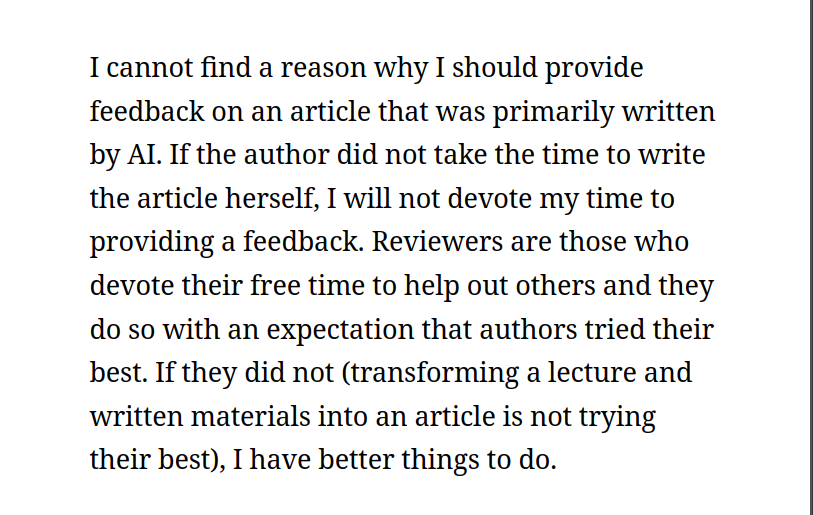
Writers are split too. In an r/AIWritingLounge thread with 92 comments, one reply asked whether people should also disclose spellcheck and Grammarly, and where the line sits. My view is to label where the law or your readers expect it, and to make the owner's name visible on every article either way.
AI search traffic grew 835% this year. Is your content ready?
RankControl generates 26 content formats optimized for ChatGPT, Claude, and Perplexity. Published on your domain, matched to your brand.

Rule three is that claims and reviews go through compliance
The FTC has been clear that AI changes nothing about the rules on claims. On September 25, 2024, it announced Operation AI Comply, five cases against deceptive AI schemes. One was Rytr, charged over a service that generated fake consumer reviews. DoNotPay agreed to pay $193,000 over claims about its "AI lawyer." Then-Chair Lina Khan said "there is no AI exemption from the laws on the books."
For a content team, reviews and claims about customer results go in the high tier. So does any page that names a real customer, with their written OK saved in the log.
Bylines belong here too. On November 27, 2023, Futurism reported that Sports Illustrated ran product reviews under fake authors with AI-generated headshots. The publisher blamed a third-party vendor. Brown Brothers Media repeated the pattern at scale, with "more than 50" fake writer personas across its sites, as our write-up of scaled AI content penalties covers. So every byline should belong to a real person who read the piece.
Rule four is to write style and brand rules down
Editors can't enforce a voice that lives in someone's head. Write the brand rules as pairs, a phrase to avoid and what to say instead, plus a few past articles you want new drafts to sound like.
Pairs are easy to check line by line, and they're easy to hand to the AI writer too.
Keep the list short enough that an editor can hold it in mind, and update it when you catch the same fix twice. Our guide to using AI to edit SEO content without losing brand voice has more on building the rules.
Rule five is to keep an audit trail in one place
When a page turns out to be wrong six months later, you'll want to know who approved it and what they checked. In an r/SocialMediaManagers thread about messy approvals, the advice that kept coming up was one place for approvals and one deadline in writing.
Log the same fields for every article. A spreadsheet works fine at first.
- The article, its risk tier and its owner.
- Each approver, with the date they said yes.
- The source link behind every number and quote.
- What changed between draft and publish, and why.
- For high-tier pieces, the expert's and legal's notes, plus any customer permission.
Notice what this log doesn't record, which is whether a detector thinks the text is AI. Google has never said it checks for that either, as our post on whether Google can detect AI content explains.
How long this takes to set up
Writing the matrix, the role list and the brand pairs takes a day or so for most teams. After that, a low-tier review runs maybe 20 to 30 minutes per article. A medium-tier piece needs an hour or more once the editor checks every number. A high-tier piece can take days while the expert and legal fit it into their week. Those are rough estimates, but at eight articles a month the review time adds up fast.
Software can take the drafting and the brand context off your plate. RankControl's content engine writes each article against the pages already ranking for its keyword and publishes it on your own domain. Auto-publish is off by default, so articles wait for someone on your team to approve them. In Brand Kit you add up to three style reference articles and brand rules written as avoid and instead pairs. The writer also works from your buyer profiles and products. The plan includes 5 seats and costs $400/mo, with a 7-day free trial. Who signs off on which tier stays your call.
You can run this whole framework by hand with a shared doc and a spreadsheet. Or RankControl can draft and publish the articles while your owner, editor and experts spend their time on the checks only people can do.

Built by the team that got cited in 48 hours.
Content generation, backlink building, AI visibility tracking, and Google rankings. One platform, zero guesswork.