
HubSpot sells an AI content agent, and its own blog tells readers to automate only the first 60% of a draft. The research and the structure go to the machine. The last 40%, which HubSpot lists as style, anecdotes and verification, goes to a person.
That split is more useful than most product pages. An AI content agent can now do anything from pulling keyword data to pushing a post live, and the sales copy rarely says which steps you can leave alone. This guide maps eight content tasks and marks where agents run them well today and where a human still has to look. Sources were checked on October 19, 2026.
What an AI content agent actually does
A writing assistant answers one prompt at a time. An AI content agent takes a goal and runs a chain of steps toward it, using tools along the way. Creatio's glossary puts the line in a useful place, describing agents as software that plans and acts with tools, where a chatbot follows set rules or only writes text.
The tools part is what changed this year. HubSpot's remote MCP server lets an agent draft a blog post inside HubSpot for a marketer to review, according to its listing on Spojit. Webflow shipped MCP 2.0 in July, which a nocode.tech write-up describes as governed agent access to a site's CMS. Our MCP and CLI page shows what that kind of connection looks like.
Once an agent can write to your CMS, the real question is which steps you can trust it with. I sort them with a test I call the one-minute check. Can a person or a script tell in about a minute whether the agent got it right? A link loads or it doesn't, and a heading matches the outline or it doesn't. A claim about a rival's price needs a real search to confirm, and that's where agents slip.
In an r/AI_Agents thread asking for workflows people had really automated, the replies that held up were narrow jobs with a fixed output, like pulling invoice data into a set JSON format.
The map: eight content tasks, rated
Here's how the eight tasks sort under the one-minute check, based on what vendors say their agents do and where their own docs put a person.
| Task | What agents run well | Where a human stays | Rating |
|---|---|---|---|
| Research | Keyword data, SERP pulls, question mining, summaries of top pages | Which topics matter to the business | Runs it |
| Outline and brief | Headings from what ranks, questions to answer, length targets | The angle and what to leave out | Runs it, quick review |
| Draft | A full first draft in your brand voice | Stories, opinions, high-stakes pages | Runs it, human edit |
| Fact-check | A list of every claim and number with its source | Confirming each one | Human owns it |
| Links | Internal links to live pages, broken-link checks | Picking outside sources | Runs it, spot check |
| Images | Hero images, alt text, sizes | Brand fit and odd details | Runs it, spot check |
| Publish | Pushing to the CMS, slugs, scheduling | Turning auto-publish on | Your permission call |
| Refresh | Weekly rank and citation checks, flags on drops | What to rewrite and why | Agent watches, you decide |
Research and outlines are where agents earn their keep
The first two rows are the easiest handoff, and the vendors' own pages agree on them. Jasper's agents page, as of October 2026, puts a Research Agent and a Query Planner in their own research group, apart from the agents that write.
Research passes the one-minute check because its inputs are public. Search volumes come from Google keyword data, rankings come from a SERP pull, and a summary of the top five pages can be checked against the pages themselves. You can see at a glance whether a brief skipped a question the top pages all answer.
BCG's June 2026 survey of 300 CMOs found that content work was where early pilots most often showed real gains, which fits, since research and briefs are the dull part of a content week.
What an agent can't tell you is which topics your sales team needs this quarter. Keep the topic list in your hands and let the agent fill in everything under it.
We'll show you exactly where your brand stands in AI search.
No commitment. $0 due today, cancel anytime. See how ChatGPT, Perplexity, Claude, Gemini, Grok, Google AI Mode, and Google AI Overviews talk about your brand today.

Drafting runs fine, but the last 40% is still yours
Drafting is the step where vendor pages disagree the most. Writer's agents page pitches an agent you delegate to rather than prompt, with review "only for edge cases." Copy.ai's homepage talks about drafts delivered in seconds and never mentions review. HubSpot's split puts the person back at the end.
My read is that a solid first draft is now cheap, and the cost moved to the edit. One reply in an r/DigitalMarketing thread about swapping writers for AI said AI repeats the average of what it learned from, while good copy has to stand out. The edit is where the customer story and the detail only your team knows get added.
A solo builder on Reddit who automated a content pipeline for under $20 a month said the review step was the part most people skip, and the one that kept quality steady as volume grew.
Fact-checking is the step no agent signs off on
This is the one row where the agent helps but can't finish the job. "LLMs can hallucinate. All statistics and claims must be verified by a person," says HubSpot's content automation guide.
The classic case is still CNET. In January 2023, Futurism reported that an AI-written CNET explainer claimed $10,000 at 3% interest compounded yearly would earn $10,300 in a year, when the interest is $300. CNET said it was reviewing all of its AI-assisted pieces.
Better models haven't fixed it. A widely upvoted r/AI_Agents post described a sales agent that made up pricing tiers because they "seemed logical," and twelve prospects saw them before anyone noticed. Atlan co-founder Prukalpa Sankar framed the risk well in October. An agent that fails the same way every run can be fixed, she wrote, but one that's right 97% of the time can't run a process, since nobody knows which 3% a customer will see.
I'd rather have an AI agent that's always wrong than one that's right 97% of the time. Half joking. An agent that fails the same way every run, you can fix. The 97% one can't run a business process, because you never know which 3% a customer will see. https://t.co/FdLYZHFELg
 Prukalpa ✨@prukalpaOct 15, 2026
Google spelled this out on its guidance page for AI-generated content, which carries an October 1, 2026 update stamp. "It is critical to manually factcheck and review all AI-generated content for accuracy and trustworthiness before publishing," the page says. Aleyda Solís flagged it two days later, along with a new warning against fake author profiles, and pointed to Barry Schwartz's coverage.
🚨 Another critical Google Guidance update: Stop using deceptive authorship information, fabricating creator profiles (to make it look that the content is created by experts with it’s not the case). These make the page untrustworthy and a signal of a low quality page. This was https://t.co/nlfTlOQOan
 Aleyda Solis 🕊️@aleydaOct 3, 2026
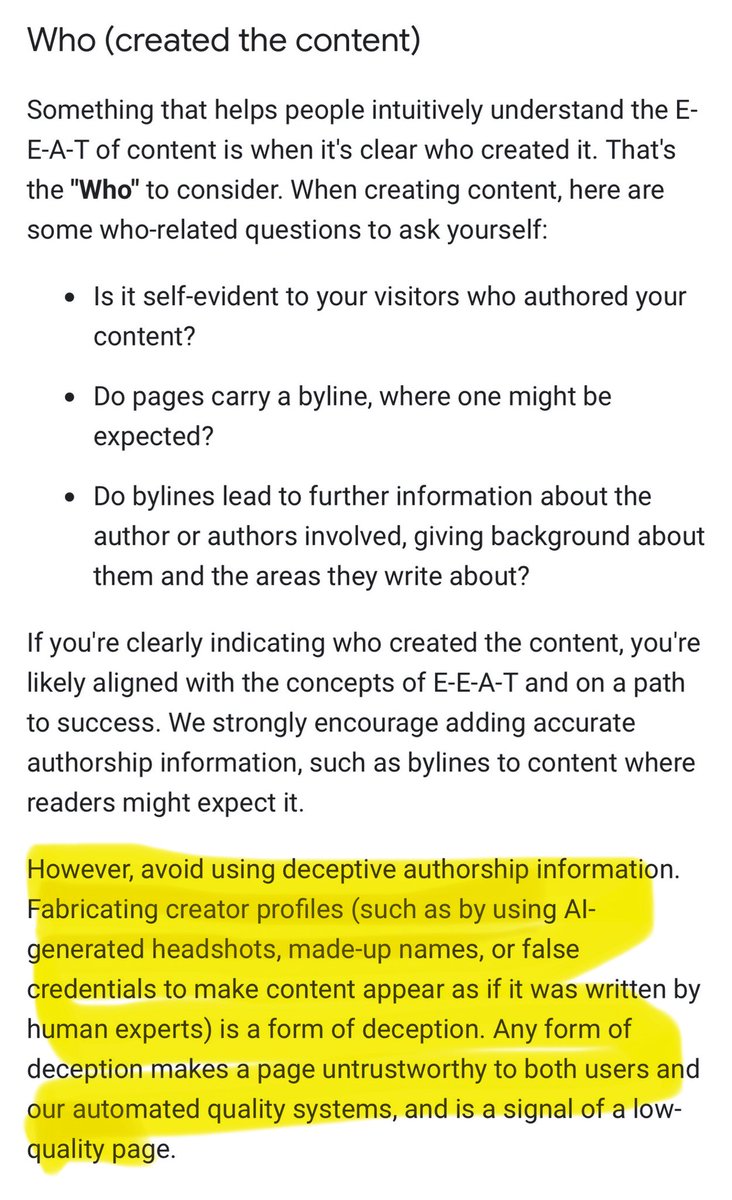
The same Google page says the review covers metadata too, naming title elements, meta descriptions, structured data and image alt text. That's the part I'd expect most teams to miss, because an agent writes those fields and nobody reads them before they ship. Google's people-first content page adds the stakes, saying content on health, money and legal topics must be highly accurate and match expert consensus.
So use the agent for the part it can do. Have it list every number, name, price and quote with its source, so a person checks a short list instead of the whole post. Who checks which claims is a governance question, and our content governance guide answers it with an approval matrix.
Links and images have a mechanical half and a judgment half
Internal links pass the one-minute check easily. The agent knows which pages are live, can match a phrase to the right one and can confirm the URL loads. Outside links are harder, because an agent doesn't know your rules about rival sites or that a study came from a vendor selling the fix.
Some agent setups stop before this point. ZBrain's content creation page lists five agents running from topic ideas to social posts, and none of them makes images or publishes.
Images are mostly safe to hand off. Jasper even lists an Alt Text Generator among its agents. A person should still scan each image for warped text and anything that looks like a real logo, and read the alt text, since Google's review rule covers it.
Know exactly what AI says about your competitors.
RankControl's Recon Agent monitors competitor citations across ChatGPT, Perplexity, Claude, Gemini, Grok, Google AI Mode, and Google AI Overviews. See where they show up and you don't.

Publishing comes down to one permission setting
The mechanics of publishing are solved. An agent can push a post into WordPress, Webflow or Shopify through an API or an MCP server and schedule it. What matters is whether it waits for you, which is why our list of AI SEO agents sorts tools by what each may change without asking.
Keep auto-publish off at first. Turn it on for low-risk formats once your edits on the agent's drafts are mostly small, and keep it off for pages about health, money or legal topics. RankControl publishes as native posts to the CMS you already use, and auto-publish is off by default, so each draft waits for your OK until you switch it on.
The top reply to that $20 pipeline post put it in one line. Writing is no longer the slow part, the commenter said, and review and distribution are.
Refresh is where agents watch and people decide
After a post goes live, agents are good at watching it. They can check rankings and AI citations every week and flag a drop the week it happens. RankControl's AI visibility tracking does the second part, checking your questions every week on seven engines.
Deciding what to do about a drop is a person's job. A page can slip because a rival published something better or because its facts went stale, and each cause needs a different fix. Our piece on which signals trigger re-indexing covers what to change once you know the cause.
Most teams still keep a human in the loop
The surveys back up the map. In the BCG study, 42% of CMOs said they use generative AI only to help people with set tasks, and just under a third had moved to agent-led workflows. Only 8% run campaigns where several agents work on their own.
Supermetrics found a similar gap in its 2026 Marketing Data Report, which surveyed 435 marketers. Over 80% feel pressure to adopt AI, yet only 6% have it fully built into their work, and 37% say they lack a clear AI plan. Both firms sell to the teams they surveyed, so read the figures as direction rather than exact counts.
How to hand tasks to an AI content agent, in order
The safest order follows the map from the top, one row at a time.
- Start with research and briefs. For two weeks, compare the agent's outlines with your team's.
- Add drafting, and ask for a claim list with every draft so the fact-check stays fast.
- Let the agent add links and images, and spot check them before each post goes out.
- Keep auto-publish off until your edits are mostly small, then turn it on for low-risk formats only.
- Let the agent watch rankings and citations weekly, and keep the rewrite call for yourself.
If you're still picking tools for each step, our roundup of content marketing automation tools maps ten of them to the workflow.
You can build all of this yourself with a keyword tool, a writing model, a CMS connection and a spreadsheet of claims. Or RankControl's content engine can run the research, writing, links, images and publishing every month, with auto-publish off until you turn it on, while your team keeps the edit and the fact-check.
26 content formats. Published on your domain. Matched to your brand.
Guides, comparisons, listicles, case studies, and more. RankControl generates content that gets cited by ChatGPT, Perplexity, Claude, Gemini, Grok, Google AI Mode, and Google AI Overviews.