Most website copy is written to sound impressive. "The all-in-one platform that helps teams unlock their full potential." It reads fine in a pitch meeting. Then a buyer lands on the page, scans it for four seconds and still doesn't know what you sell.
That same vagueness costs you twice now. Google ranks pages on what they actually say, and AI answers quote a sentence or two from a page. A sentence that says nothing gives neither of them anything to work with.
This guide covers website copywriting for the pages that matter most: the homepage, product pages, the pricing page and the about page. The aim is copy a person can scan, Google can rank and an AI answer can quote without changing a word.
Readers scan, so write for scanning
This part isn't new. In 1997, Jakob Nielsen wrote that "79 percent of our test users always scanned any new page they came across; only 16 percent read word-by-word."
The same year, John Morkes and Jakob Nielsen rewrote a sample site in three ways and measured the result. It scored 58% higher in usability when written concisely, 47% higher when scannable and 27% higher when written in an objective style instead of a promotional one. All three together scored 124% higher.
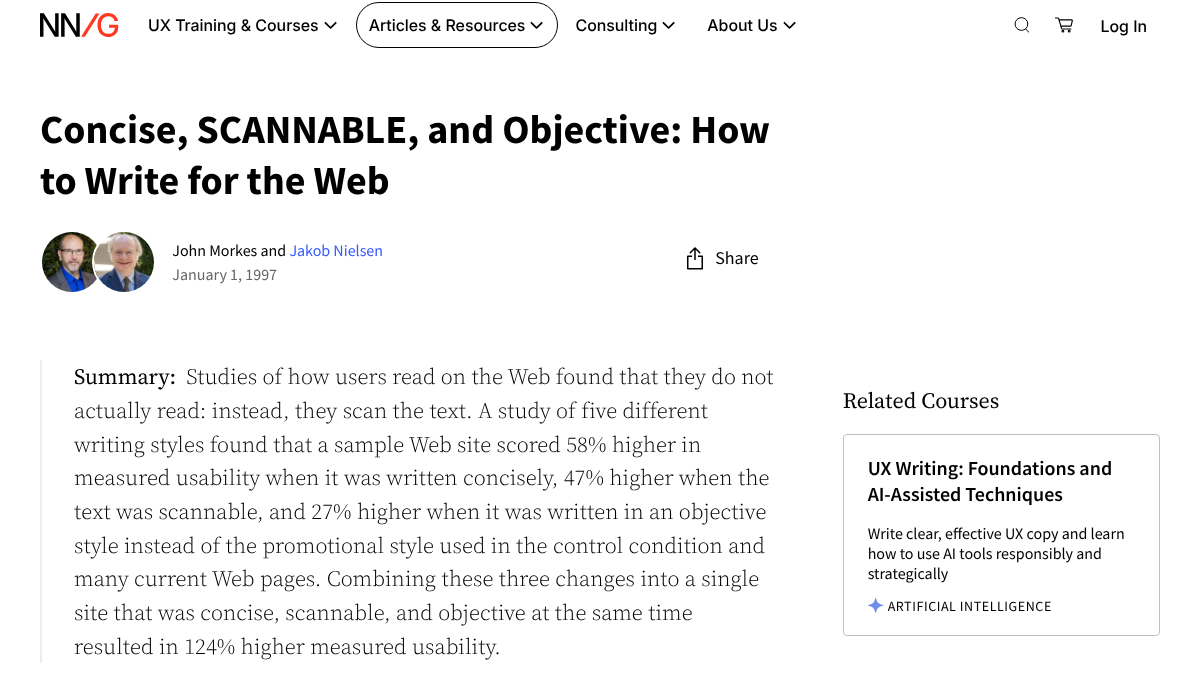
The study is old, but the finding has aged well, and objective beat promotional by a wide margin. That's the habit most marketing copy still fights against.
What Google and AI answers want from copy
Google's guidance on creating helpful content, updated October 5, 2026, puts it plainly. "People-first content means content that's created primarily for people, and not to manipulate search engine rankings."
Its guide to optimizing for generative AI features says the same thing for AI answers. "Write content for your human audience and make sure the content is well written and easy to follow." It also warns against content that just recycles what others have already said, or "could easily be produced by a generative AI model."
So there's no separate AI copy to write. Clear copy for people is what both systems are built to reward. If you draft with AI, our list of AI copywriting tools compares the options.
There's one practical difference, though. An AI answer lifts a sentence or two and puts it next to someone else's. That sentence has to stand alone.
We call this the lift test. Copy any key sentence off your page and paste it somewhere else. Does it still say who you are, what you do and something specific? "We help teams do more" fails. "Acme is a $12-a-month scheduling tool for dental clinics" passes.
26 content formats. Published on your domain. Matched to your brand.
Guides, comparisons, listicles, case studies, and more. RankControl generates content that gets cited by ChatGPT, Perplexity, Claude, Gemini, Grok, Google AI Mode, and Google AI Overviews.

Homepage copy: say what it is in one sentence
The homepage has one job above all others. Within a few seconds, a visitor should know what you sell, who it's for and why it's different.
Here's a made-up example of the same headline written two ways.
| Vague | Specific |
|---|---|
| The future of team productivity | Shared to-do lists for construction crews, on any phone |
| Supercharge your business with AI | Answers customer emails in your tone, in under a minute |
| Built for scale | Used by stores doing up to 50,000 orders a month |
The specific versions are less exciting to write. They're far more useful to a buyer, and they pass the lift test.
The best phrasing often comes from your customers, not your marketing team. One homepage copywriter on X put it bluntly: the best homepage copy they'd ever seen was taken straight from a customer support ticket.
The best homepage copy I've ever seen was stolen from a customer support ticket
 Blake Emal@heyblakeJul 18, 2026
Support tickets, sales calls and reviews show how buyers describe the problem in their own words. Those words are also what they type into Google and AI chats.
Product pages: claims you can check
Product page copy tends to drift into adjectives. Powerful, intuitive, flexible, next-generation. None of them can be checked, so readers skip them and AI answers have nothing to quote.
Swap each adjective for a fact.
- "Fast setup" becomes "Most teams are set up in 20 minutes."
- "Integrates with your tools" becomes "Connects to Shopify, HubSpot and Slack."
- "Trusted by businesses" becomes a named customer, with their permission, and what changed for them.
Then give each feature its own heading and a short paragraph that answers one question. A buyer scanning for "does it work with Shopify?" finds the answer in a second. So does a crawler.
Google also says there's "no requirement to break your content into tiny pieces for AI to better understand it." Write normal sections with clear headings. Don't chop a page into fragments for the machines.
Pricing pages: show the price
This is where plenty of sites lose the trust they built on the homepage.
Nielsen Norman Group's Hoa Loranger wrote that "business customers report pricing as the top most needed piece of information online." In NN/g's usability studies, they also watched people "getting frustrated and leaving sites that don't show prices."
We checked the pricing pages of nine well-known software companies on October 19, 2026: Stripe, Linear, Basecamp, Ahrefs, Notion, Webflow, Intercom, Vercel and Asana. All nine showed an exact price for their main paid plan, with no form and no click. The only plans hidden behind "contact us" were the top enterprise tiers.
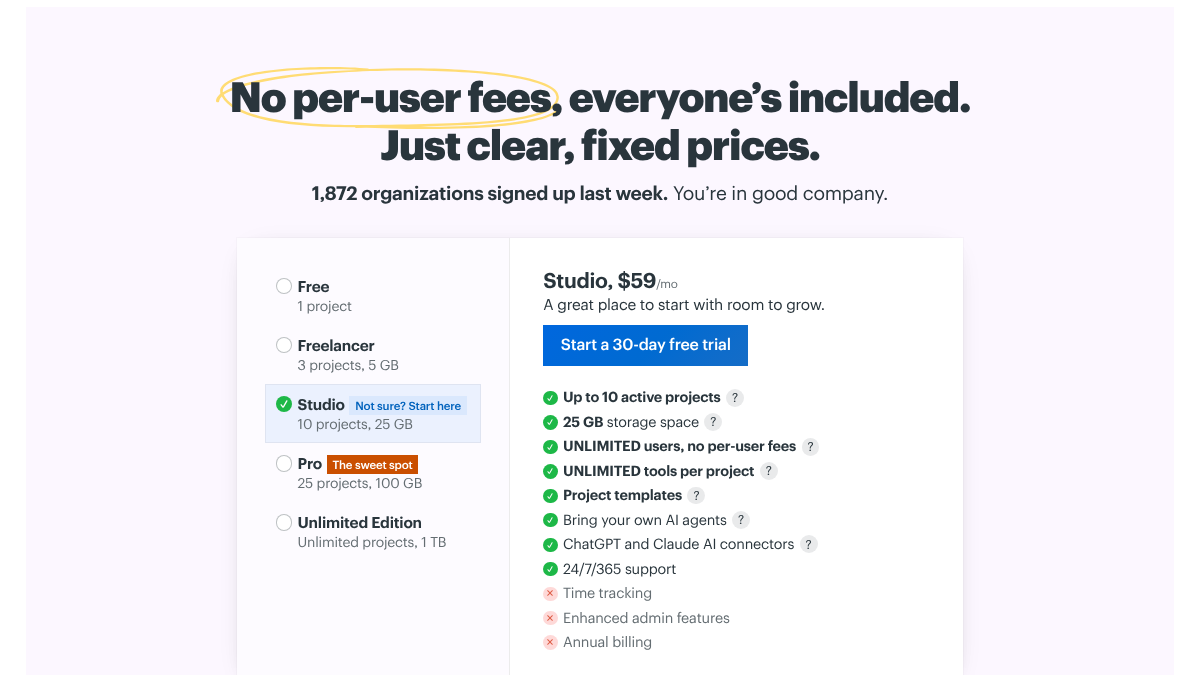
Basecamp's pricing page leads with a headline that is itself a plain promise: "No per-user fees, everyone's included. Just clear, fixed prices." Stripe puts its card fee right on the page, with "No setup fees, monthly fees, or hidden fees" underneath.
Buyers notice when you don't. A post on r/smallbusinessindia asking sellers to drop "price in DM" drew almost 1,000 upvotes. The top reply read hidden prices as a lack of confidence, a sign the seller knows the price is too high. In a separate thread on r/Adulting, one commenter said that when a site says "call for pricing," they will never call.
Transparent Pricing > 'Price in DM' - Can We Normalize This?!!!!!
Does anyone else get irritated when sellers don’t mention prices in their posts? As a customer, it just makes things harder..you have to ask for the price, wait for a reply, and sometimes it turns out to be out of budget anyway. It would be...
A shown price is also something an AI answer can repeat. When a buyer asks a chatbot what your tool costs, a plain number on your pricing page gives it something to quote. For the machine-readable side of pricing pages, our post on what agent ready means for websites goes further.

Your competitors are getting cited by AI. You're not.
Every day without citation tracking is a day your competitors pull ahead in ChatGPT, Perplexity, and Claude.
About page: the facts about you
The about page is where the plain facts live. Search engines and AI answers use them to understand who you are.
Put these near the top, in plain sentences:
- Your company name and what it does, in one line.
- When you started and where you're based.
- Who runs it, with real names and roles.
- Who you serve, and roughly how many.
- Anything you can prove, like awards, certifications or published research.
A founding story is fine below that. Just don't make visitors read three paragraphs of it before they learn what you do. Our guide to Google E-E-A-T covers the trust signals Google looks for, and our structured data blueprint shows how to mark the same facts up in code.
Words to cut
Some words almost never earn their place on a business website. Here's a quick swap list.
| Cut | Write instead |
|---|---|
| Solutions | What the product actually does |
| Leading, world-class | A number, a customer or an award |
| Easy, effortless | How long setup takes |
| Unlock, transform, supercharge | The specific result |
| Affordable | The price |
| Contact us for pricing | The price, at least for the main plan |
Read each page aloud after you edit. If a sentence could appear on a competitor's site without changing a word, rewrite it.
A one-day rewrite plan
If you have one day, here's the order we'd use.
- Homepage headline and first paragraph. Make them say what you sell, who it's for and what makes it different.
- Pricing page. Show the price of your main plan, in numbers.
- Top product page. Swap every adjective for a fact.
- About page. Put the core facts in the first few lines.
- Lift test. Copy the opening sentence of each page into a blank document. If it doesn't make sense alone, fix it.
For a wider view of how page structure and outside sources fit with your copy, our guide to optimizing your website for AI search covers the rest.
How to tell if it worked
Copy changes show up in a few places.
In Search Console, compare clicks and click-through rate for each page in the weeks before and after the change. A clearer title and opening often lift CTR first, and our analysis of CTR by position shows what's normal for each spot.
For AI answers, ask ChatGPT, Perplexity or Gemini a few buyer questions about your category, like "what does [your product] cost?" or "what's a good [category] tool for [audience]?" If the answer now repeats your plain facts correctly, the copy is doing its job. Expect this part to move slowly, since AI answers also lean on what other sites say about you.
Doing it yourself or handing it off
Rewriting your core pages is a job worth doing yourself, or with a copywriter who knows your customers. It's a few pages, and you know your business better than anyone.
The harder part is the steady flow of articles that brings new buyers to those pages. RankControl writes those articles against the pages already ranking for each keyword, with the answer near the top, and scores every one for how easily AI engines can quote it, with a list of fixes. It publishes them to your site. Its AI visibility tracking then checks up to 50 buyer questions every week across seven AI engines. Expect traffic from Google first, with citations following more slowly as other sites link to and mention you.
200+ SaaS teams already track their AI citations.
They know exactly when ChatGPT mentions their brand, and when it stops. Do you?