
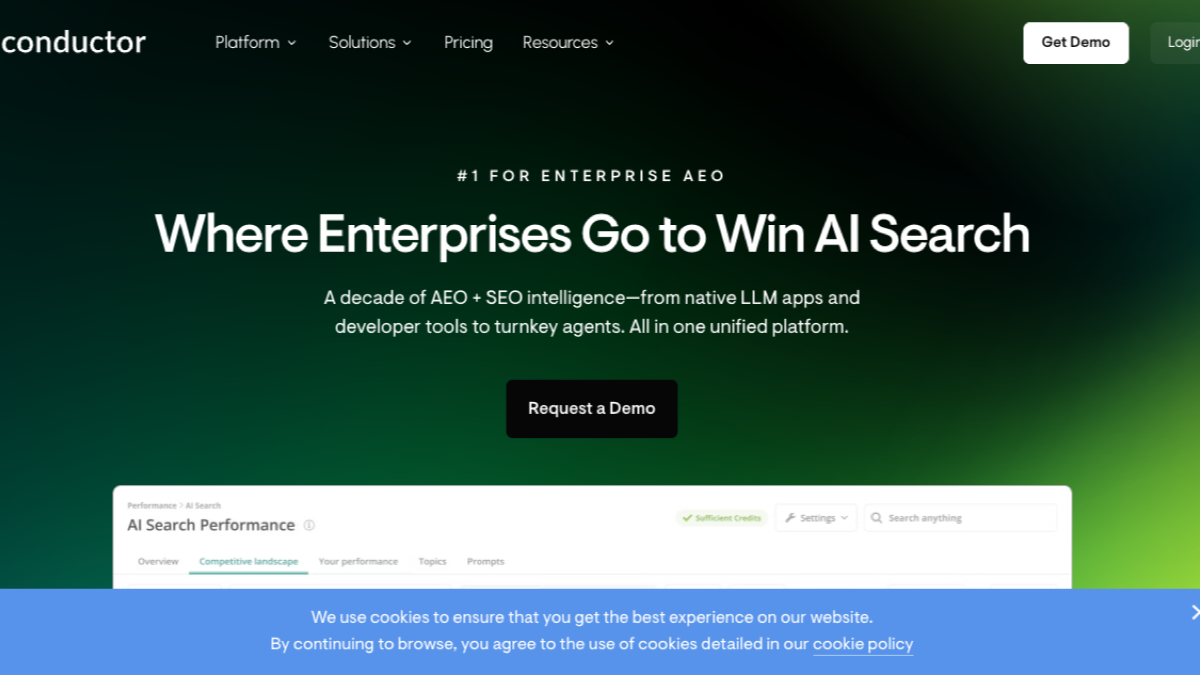
Switching from Conductor to RankControl is a move between weight classes, and pretending otherwise would produce a useless guide. Conductor is where enterprises go for AEO, their words and a fair claim: a decade of intelligence, a unified platform spanning visibility tracking, content creation, site monitoring, and agent tooling, sold and serviced the way enterprises buy. RankControl is a flat-fee pipeline a team operates itself. The migration makes sense for a specific and growing cohort, teams paying enterprise prices for mid-market usage, and this guide covers it honestly: what to export before access ends, what maps to what, and what genuinely changes when you drop three commas from the line item.
What You're Actually Switching
Conductor's current platform bundles four wings: Intelligence for AI and search visibility across ChatGPT, Gemini, Copilot, Claude, and classic search, tied to traffic and revenue; Creator for enterprise content generation; Monitoring for always-on site health and AI-crawler tracking; and AgentStack for LLM apps and turnkey agents, all under enterprise security and governance.
RankControl covers the operating core of that footprint at self-serve scale: 50 tracked buyer queries checked weekly across ChatGPT, Perplexity, Claude, Gemini, Grok, and Google's AI surfaces with per-engine citation history and share of voice, a content engine that plans from real queries and publishes natively to your CMS, backlink outreach drafted from your own mailbox, and competitor monitoring feeding the plan. One flat $400/month, no contract cycle, 7-day trial.
| Conductor | RankControl | |
|---|---|---|
| Model | Enterprise contract, account teams | Self-serve flat fee |
| Visibility tracking | Enterprise intelligence, revenue-tied | 50 queries weekly, 6 engines, per-engine history |
| Content | Creator, enterprise workflows | Planned, generated, published to your CMS |
| Site monitoring | Always-on health and crawl monitoring | Crawler-access checks; no real-time monitoring wing |
| Agents/apps | AgentStack ecosystem | The pipeline itself, dashboard, API, CLI |
| Links | Within workflows | Outreach agent + managed add-on |
The Export List, Before the Renewal Call
Enterprise platforms are punctual about access cutoffs, so the exports happen while the contract breathes, ideally a month before renewal.
- Tracked keywords and prompts. The full lists, with tags and groupings. This is the distilled knowledge of what matters in your category, and it transfers as live input.
- Ranking and AI-visibility history. Export the reports that show your trend lines. In-platform history ends with the login, and citation baselines can't be reconstructed later.
- Unexecuted briefs and recommendations. Creator briefs and optimization recommendations sitting in queues, out to documents. They're the measure of the execution gap, and the new system's first assignments.
- Competitor configurations. The named-competitor sets per market, straight across into monitoring.
- Monitoring baselines. Site-health reports and crawl summaries worth keeping as reference, especially anything documenting AI-bot access, since you'll re-verify that on the other side.
Your competitors are building backlinks while you read this.
Organic outreach, social mentions, and link exchanges, with managed backlinks available as an add-on. Grow your domain authority without running the campaign yourself.

What Maps, and What Honestly Doesn't
The mapping table, with the gaps stated plainly.
| If you used Conductor for... | On RankControl |
|---|---|
| AI visibility intelligence | Weekly per-engine tracking, share of voice, description language |
| Creator content workflows | The content engine: planned, generated, published, interlinked |
| Competitor tracking | Continuous monitoring feeding the plan |
| Monitoring's site health | Not replaced: pair a dedicated monitoring tool if this was load-bearing |
| AgentStack workflows | The pipeline plus API and CLI; no app ecosystem |
| Account team and onboarding | Your team, the docs, and email support |
Three honest rows there. Live site monitoring is a genuine Conductor strength with no RankControl equivalent, and teams that leaned on it should budget a monitoring tool alongside; the combined bill still lands far below an enterprise contract. AgentStack's ecosystem maps to our API and CLI for teams that build, and to nothing for teams that wanted turnkey apps. And the account team disappears entirely, which is either liberation or loss depending on how your last QBR felt. The optional Dedicated Strategist add-on exists for teams that want a human running point, and it's a strategist rather than a CSM.
The Before-Picture That Survives the Login
Beyond the platform exports, spend one extra hour building the baseline no vendor holds. Ask each engine your ten most commercial questions, signed out, and save the answers verbatim: who gets named, who gets cited, how your brand is described. Screenshot the revenue-tied dashboards you'll want to reference in six months, since those views are the ones stakeholders remember. And note your current answer-share against the two competitors that matter, because that comparison is what the next quarter's progress gets judged against.
The enterprise twist on all this: do the exporting before renewal politics begin. Once a non-renewal is in the air, access questions acquire process, approvals appear, and the person who owns the vendor relationship starts managing optics. Exports gathered a month early are just diligence; the same exports requested during a cancellation are a negotiation. Boring calendar discipline here saves genuinely awkward email threads later.
Reading Two Instruments in the Overlap Month
The parallel-running fortnight will show you two instruments disagreeing, and knowing why keeps the comparison useful. Enterprise intelligence platforms and weekly query panels differ in prompt phrasing, engine coverage, check frequency, and aggregation, so absolute numbers won't match, and chasing parity by re-tuning queries measures your fiddling rather than your visibility. What should agree is direction: pages both instruments call strong, competitors both flag as rising, engines where both show you absent. Where direction itself disagrees, investigate before trusting either, since the discrepancy usually teaches you something about prompt sensitivity in your category. By week four you'll trust the new trend line for the same reason you trusted the old one: it moves when you ship and holds when you don't.
The Budget Conversation
The switch usually surfaces in a budget review, so here's the framing that keeps it accurate. The line item drops from an enterprise contract to $400 a month, plus a monitoring tool if site health was load-bearing, plus the $1,500 strategist add-on if a human on point matters, and even the fully loaded version leaves most of the old line item on the table. Present it as scope-fit rather than downgrade: the company was buying enterprise governance it didn't use, and it's now buying the operating loop it does. The freed budget has obvious homes, the earned-media motion, the one proof-content piece per quarter, the retention work, and naming those homes in the same slide is what turns a tool decision into a strategy one.
The Cutover, Step by Step
Right, the one scheduling note that makes all of this painless: run the sequence with a month of overlap, and the switch never feels like a leap. Week one: exports above, then connect RankControl to your CMS, load the distilled 50 queries from your keyword lists, and seed the competitor sets. Let the first weekly checks land while Conductor still runs, which gives you a two-instrument fortnight to compare readings; expect differences in coverage and methodology rather than contradictions, and judge on trend rather than snapshot. Weeks two and three: route the unexecuted briefs into the calendar, watch the first pipeline articles publish, and re-verify AI-crawler access directly since the monitoring wing is retiring. Week four: final report exports, the renewal conversation you're now having from strength, and the cutover.

You're getting AI traffic. But do you know where it comes from?
RankControl credits every visit to the assistant that sent it: ChatGPT, Perplexity, Claude, Gemini, Copilot, or Grok. Full source attribution, next to your Google traffic.
Who Should Stay on Conductor
Should anyone stay? Absolutely, and the list is worth stating without hedging. Global enterprises running brand portfolios across markets, teams whose procurement, security review, legal, and governance requirements are the point, organizations where the account team does genuine strategic lifting, and anyone for whom the Monitoring wing is operationally load-bearing. Conductor built a decade of enterprise muscle, their platform earns its position in that weight class, and a flat-fee pipeline is simply the wrong tool for genuinely enterprise problems. The switch pays when the enterprise footprint was always bigger than your usage: when the seats sat idle, the modules went unopened, the QBRs recycled slides, and what you actually ran was tracking plus content, which is exactly the loop RankControl operates at a price that doesn't need a committee.
The Afternoon, Summarized
Export the lists, the history, the briefs, the competitors, and the baselines while access lives. Connect your CMS, load the queries, seed the watchlist, and run a month of parallel readings. Keep a dedicated monitoring tool if site health was load-bearing on the old platform, add the strategist if you'll miss having a human on point, and walk into the renewal call with your own trend line. Start the free trial a month before the contract turns, run the overlap honestly, and let the two instruments argue it out on your own data, which is the only argument a renewal decision should ever hear.
We'll show you exactly where your brand stands in AI search.
No commitment. $0 due today, cancel anytime. See how ChatGPT, Perplexity, Claude, Gemini, Grok, and Google AI Mode talk about your brand today.