
Rankings have been moving for three weeks and Google hasn't said why. If your traffic charted a strange week in late October, you weren't imagining it, and you also weren't told what caused it. On November 6, the volatility is still real and dated, and Google's own dashboard still doesn't explain it.
Four spikes, three weeks, no announcement
Search Engine Roundtable logged the pattern as it built. A spike on October 16 that felt significant. Another on October 20 and 21, with forum chatter climbing alongside it. A heated stretch on October 24, the biggest of the run. Then October 27, when Semrush Sensor hit 9.5 out of 10 for US desktop results, close to the scale's ceiling.
It didn't stop there. On November 3, Semrush Sensor was still reading 9.4 for UK desktop, and Similarweb's SERP Seismometer jumped from 42 to 225 the same day, according to an SEO consultant tracking both tools. Four distinct spikes in roughly three weeks is already an unusual run. A fifth reading still elevated on November 3 means the unease never really settled.
What Google's own dashboard says
The part that keeps this story open is simpler than any prediction model. Google's Search Status Dashboard doesn't show any of it.
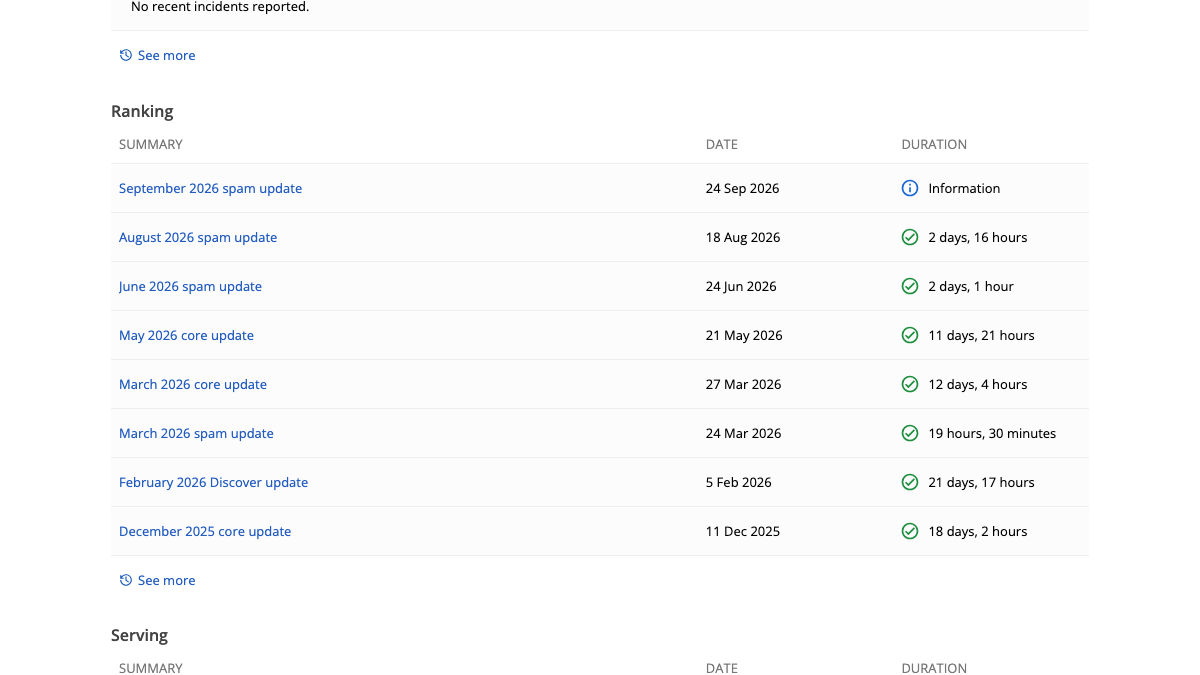
The most recent entry on the ranking list is the September 2026 spam update, dated September 24. Nothing from October appears at all, despite four separate volatility spikes that month. Google's own account confirmed that spam update the day it shipped and hasn't posted a new ranking release since then.
See your first AI citation report in under 5 minutes.
No setup calls. No onboarding meetings. Connect your domain and see where AI mentions your brand right now.

The model that called this window
A week before the spikes started, an SEO consultant named Dan Taylor published a forecast that now reads almost prescient. Writing for Search Engine Journal on October 15, Taylor described a gradient-boosted model trained on decades of Google update history, built to weigh both long-run timing patterns and short-term volatility signals together.
The model put the odds of a major update at 96.8% within 30 days, with the highest-confidence window running from late October into mid-November. December, by contrast, scored only about 15% in the same model, which is why Taylor frames the next ten days as the window that matters most.
Taylor's theory goes further than timing. He argues the target will be scaled, low-effort AI content, a Panda-style sweep rather than a broad quality reshuffle, pointing to Google's own guidance on effort, originality and accuracy as the tell. None of that is confirmation. A probability is a bet, not an announcement, and Taylor says so himself.
Why the wait itself stands out
Google's own update history makes the gap easier to see than any prediction model does. The December 2025 core update started December 11. The next one, in March 2026, began 106 days later. May's core update followed just 55 days after that, the tightest spacing of the three.
Measured from the May 21 start date, Google is now 169 days into the gap before whatever comes next, already well past either of the two previous waits. Long gaps between core updates aren't unheard of, but this one is running longer than anything in Google's own recent release history, right as the trackers start lighting up.
That May update reshuffled a lot of sites, and plenty still hadn't recovered months later. A longer gap this time doesn't mean a gentler update is coming. It just means more has built up since Google last touched the ranking signals everyone's been optimizing around.
Your competitors are building backlinks while you read this.
Organic outreach, social mentions, and citations from Editorial Circle member sites, with managed backlinks available as an add-on. Grow your domain authority without running the campaign yourself.

Telling a core update from everything else
Not every traffic dip this month is a core update, confirmed or not. A separate ranking change and an AI Overview eating your clicks look identical in a weekly traffic chart but need different fixes, so the first move is checking Search Console, not rewriting content.
Pull average position for the pages that moved and compare it against the dated spikes above. If position dropped during one of those windows, you're looking at a ranking change, the kind a core update or a smaller quality update produces. If position held steady but clicks fell, the more likely explanation is an AI Overview or AI Mode answer absorbing the click before anyone reached your page.
This mix-up is common enough that it showed up on r/SEO this week on its own. One site owner posted asking how to tell whether lost clicks came from Google answering the question directly on the results page, or from the content simply attracting the wrong audience, since the fix for each problem is completely different. We covered the August and September run of the same question in detail, including the spam update that gets mistaken for a core update almost every month.
What to do while you wait
Watching a dashboard that says nothing is not a strategy, and neither is guessing at a cause and rewriting pages that didn't actually lose rankings. The useful move right now is separating signal from noise on your own site, then holding that baseline steady until Google actually says something.
You can build that baseline manually, pulling Search Console exports and lining them up against every dated spike yourself. Or you can let RankControl check your Google rankings and your AI citations across all seven engines every week, so a real change shows up against a baseline you already trust instead of a guess made mid-panic. Either way, the fix only starts once you know which problem you actually have.
If nothing from this list matches what you're seeing, the most likely answer is ordinary between-update drift, the kind that happens most weeks and rarely needs a response. Google's dashboard is the one page in this whole story that will actually say so, once there's something to say.
You're getting AI traffic. But do you know where it comes from?
RankControl credits every visit to the assistant that sent it: ChatGPT, Perplexity, Claude, Gemini, Copilot, or Grok. Full source attribution, next to your Google traffic.