Someone on the team has a plan. Take the comparison page that's doing well, turn it into a template, and generate 300 more for every competitor and integration you have. It'll take a week, and every page will be "optimized for AI answers."
Sometimes that works. Sometimes it produces 300 pages that AI answers ignore, and a few that start pulling the rest down. AEO content templates help when they give each page a consistent shape to fill with specific facts, and they hurt when the shape is most of the page. This guide covers where the line falls, with one safe template, one unsafe one and a quick test to run before you scale.
The short answer
| Page type | Templates help when | Templates hurt when |
|---|---|---|
| Comparison pages | Every page answers the same buyer questions with real, specific differences | The feature lists are spliced from each product's site and the verdict is always the same |
| Pricing pages | Plans, limits and prices follow one clear layout | The same page is cloned per region or segment with only a word changed |
| Glossary definitions | Each entry opens with a direct definition in its own words | Entries are one templated sentence with the term swapped in |
| How-to guides | Steps, prerequisites and results appear in the same order | The steps are generic enough to fit any product |
| Integration pages | Each page explains what the pair actually does together | Thousands of pages share the same copy with two app names swapped |
The pattern across all five: a template should fix the order of the sections, never their content.
Why structure helps AI answers
AI answers pull short passages from pages. A page that always puts the answer in the same place, with headings that match the question, is easier to pull from. That's the case for templates, and it's a good one.
What goes into the sections matters more than the sections themselves. The GEO research paper, published at KDD 2024, tested nine ways of rewriting pages for AI answers. Adding quotations lifted a source's visibility by about 41% on its main measure, and adding statistics by about 30%. Keyword stuffing scored below doing nothing at all.
So a good template is a set of slots for specific things: a number, a source, a named difference, a quote from a customer. A template that fills those slots with the same sentence on every page gets the structure and none of the lift.
Google doesn't ask for a special format either. Its guidance on AI features says "you don't need to create new machine readable files, AI text files, or markup to appear in these features," and that there's "no special schema.org structured data that you need to add."
Where templates help
Some page types are built for a consistent shape, because buyers ask the same questions of every page in the set.
Comparison pages are the clearest case. Every "X vs Y" page should answer who each tool is for, what each costs, where they differ in practice and which one fits which buyer. Keeping that order lets readers and AI answers find the verdict quickly. Our guide to comparison pages that get cited covers the structure in detail.
Glossary pages work the same way. A definition in the first sentence, a short explanation and a pointer to a deeper page is a good pattern for every entry, as our post on glossary pages for AEO shows. Pricing pages and how-to guides benefit too, because the facts people look for sit in predictable places.
In each case, the template saves the writer from reinventing the layout. The writing inside each section still has to be about this product, this comparison or this term.
We'll show you exactly where your brand stands in AI search.
No commitment. $0 due today, cancel anytime. See how ChatGPT, Perplexity, Gemini, Google AI Mode, DeepSeek, Google AI Overviews, and Bing AI Summary talk about your brand today. Add Claude and Grok with your own API keys.

Where templates hurt
Templates go wrong in four ways, and they tend to happen together.
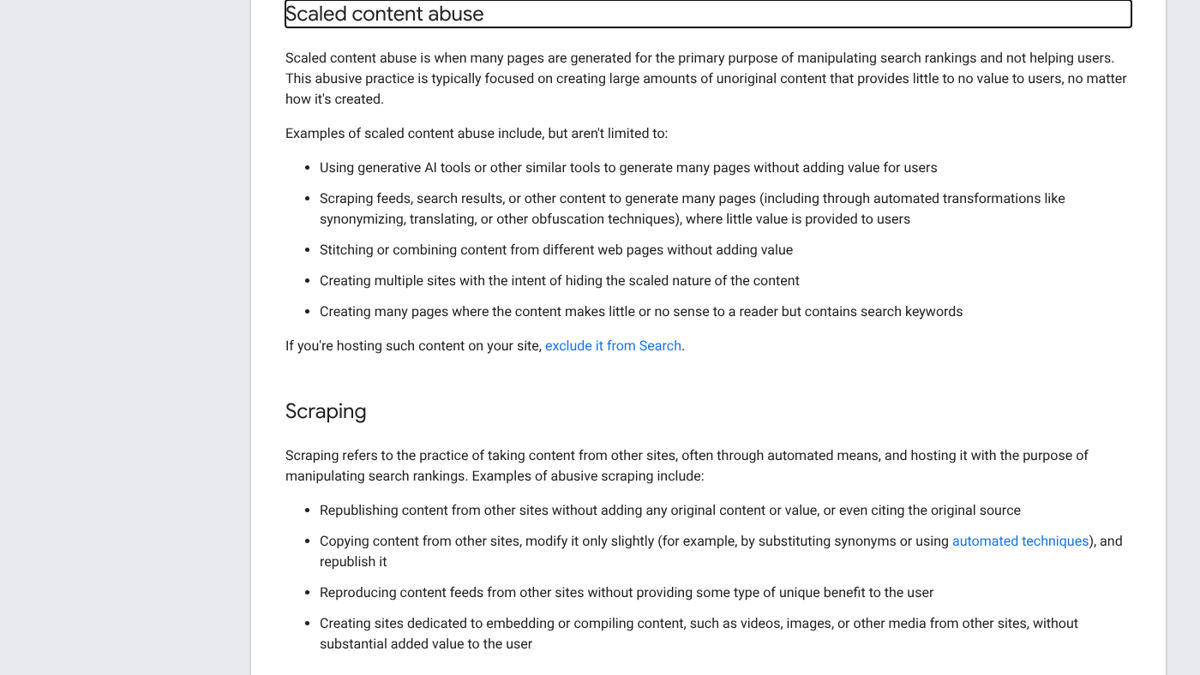
The first is volume without value. Google's spam policies define scaled content abuse as "when many pages are generated for the primary purpose of manipulating search rankings and not helping users," and name "using generative AI tools or other similar tools to generate many pages without adding value for users" as an example.
That's not a theoretical risk. On r/SEO this year, a thread shared a real Search Console manual action for scaled content abuse. The replies were split between people glad they weren't the one getting it and people calling it long overdue.
The Scaled-Content Abuse Spam Manual Action Notification (found on X)
Note this is not for 'AI Content" - this is for scaled content abuse: https://x.com/_Ayu5h/status/2041448649226649754
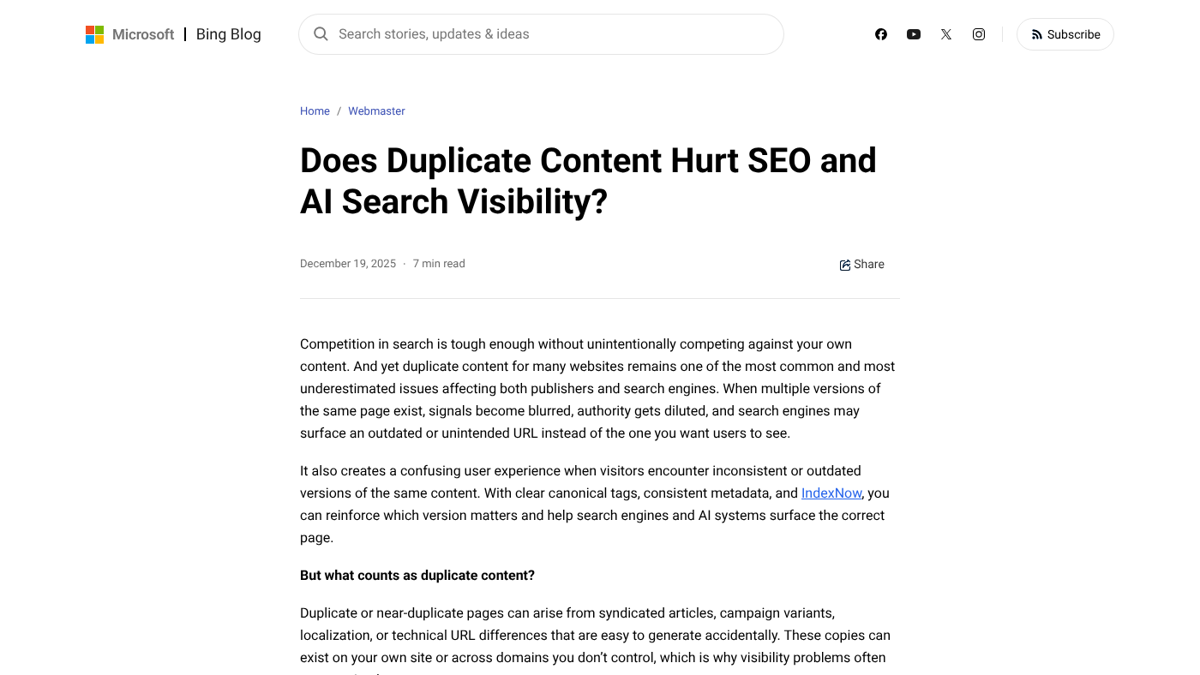
The second is clustering. Bing's webmaster team explained in December 2025 that "LLMs group near-duplicate URLs into a single cluster and then choose one page to represent the set." When your templated pages differ by a word or two, you're asking the AI to pick one and ignore the rest.
The third is boilerplate. The same intro paragraph, the same "40 to 60 word answer" block and the same FAQ on every page gives an AI answer nothing to choose between. It also reads as filler to a person, which is the audience Google's guidance keeps pointing back to.
The fourth is stale facts. A price or feature written into the template once goes out of date on every page at the same time. Bing's post warns about exactly this: "If the differences between pages are minimal, the model may select a version that is outdated."
What one integration query showed
We wanted to see clustering in a real result, so on September 27, 2026 we pulled Google's results for "connect slack and gmail." Integration pages are the classic template: platforms generate a "Connect App A with App B" page for every pair of apps they support.
Two workflow tools had near-identical templated pages for that exact pair, ranking at 8 and 11 in the organic results. Zapier's page was cited in the AI Overview, twice. Make's page, built on the same pattern for the same apps, wasn't cited at all.
One query can't prove a rule, but it shows the mechanism Bing describes. Two pages answer the same question the same way, both rank, and the AI answer picks one. If both of those pages were on your own site, you'd be competing with yourself.
Schema won't rescue a thin template
A common fix for templated pages is to add structured data to all of them. The evidence says that doesn't do much on its own.
Ahrefs tracked 1,885 pages that added JSON-LD between August 2025 and March 2026 and compared them with 4,000 similar pages that didn't. "Adding schema produced no major uplift in citations on any platform," it found. AI Overview citations fell 4.6% relative to the comparison pages, while AI Mode and ChatGPT moved by amounts too small to call a change.
FAQ markup lost its search appearance too. Google stopped showing FAQ rich results on May 7, 2026, and has since removed the documentation. FAQ sections can still help, because AI answers read and quote the questions and answers as plain text. Our structured data blueprint covers which schema is still worth adding.
Know exactly what AI says about your competitors.
RankControl's Recon Agent monitors competitor citations across ChatGPT, Perplexity, Gemini, Google AI Mode, DeepSeek, Google AI Overviews, and Bing AI Summary, plus Claude and Grok on your own API keys. See where they show up and you don't.

A safe template and an unsafe one
Here's the difference in practice, for a comparison page:
| Section | Safe template: what's fixed | Safe template: what changes every page | Unsafe template |
|---|---|---|---|
| Opening | "Short answer" heading | A verdict written for this pair | One intro with product names swapped |
| Who each is for | Two subheadings | Buyer types drawn from reviews and sales calls | "Great for teams of all sizes" on every page |
| Pricing | A table with the same columns | Current prices, with the date checked | Prices copied into the template once |
| Real differences | A heading and a table | Three to five differences you've verified | Feature lists pasted from both vendors' sites |
| FAQ | A section at the end | Questions buyers ask about this pair | The same five questions on every page |
The safe version keeps the order and nothing else. The unsafe version keeps the words. Both are templates, but only one produces pages that are worth citing.
We use a simple check before scaling any template, which we call the swap test. Take a finished page and replace the product or topic name with another one from the set. If the page still reads as true, most of it is boilerplate. Add the specific facts before you generate the next hundred.
Glenn Gabe, who tracks Google's spam updates closely, put the risk bluntly after the August 2026 spam update: chasing AI visibility with risky tactics tends to catch up with sites, sooner or later.
And you can ask site owners hit by the August spam update how 'scaled content abuse' worked out for them... Do not chase AI visibility by implementing risky tactics... It will not end up well. Either soon, or down the line. Beware.
 Glenn Gabe@glenngabeAug 25, 2026
Before you scale a template
Run through five questions first:
- Does every section have a slot for something specific to this page, like a number, a date or a named difference?
- Does the page pass the swap test?
- Would a buyer learn something from page 50 that page 1 didn't tell them?
- Is there a date on the facts most likely to change, and a plan to update them?
- Are there pages in the set so similar that you'd merge them if a person wrote them by hand?
If the answer to the last question is yes, merge them before publishing. Our post on programmatic SEO vs AEO covers how to combine the two without the scale risk.
Doing it yourself or handing it off
A good template takes a day to design and a few hours per page to fill properly. The filling is where most teams cut corners, because it's the part that doesn't scale.
RankControl handles that part differently from a template engine. Our content engine covers 26 content types and writes each article against the pages already ranking for its keyword, so every page is built from what that specific query needs. The engine scores every article for how easily AI engines can quote it, with a fix list, and publishes it on your own site. Our AI visibility tracking then checks up to 50 buyer questions every week across seven AI engines and records which of your pages each answer cites.
26 content formats. Published on your domain. Matched to your brand.
Guides, comparisons, listicles, case studies, and more. RankControl generates content that gets cited by ChatGPT, Perplexity, Claude, Gemini, Grok, Google AI Mode, and Google AI Overviews.