
ADP came up in six of the eight payroll answers we collected, and it wasn't the pick in any of them. Drata came up in all eight SOC 2 answers and was the pick in two, both answers to "Vanta alternatives."
A name in the answer and a pick in the answer are two different results. Many AI visibility reports still count mentions, though, so a brand like ADP can look healthy on a dashboard while losing nearly every buying question it appears in. We ran 24 AI answers to see what separates a mention from a recommendation, and the answer turned out to be one short phrase.
Mentions, citations and recommendations are three different outcomes
A mention names your brand in the answer. A citation links to one of your pages as a source. A recommendation makes you the pick for the person asking. You can have any one of these without the other two.
Semrush's AI Visibility Index for 2026 shows how loosely they're connected. Across 1,200-plus brands, the share of mentioned brands that were also cited ranged from 64% on Google's AI Overviews down to 30% on Gemini. Ahrefs puts it plainly in its own citation research: "pages can receive brand mentions without being cited as sources."
Neither of those numbers measures the last step, the one that pays: being the brand the answer tells the buyer to choose. That's what we went looking for.
The test: 12 buying questions, two engines
We picked three B2B categories: payroll, CRM for small agencies, and SOC 2 compliance software. Each got four questions, from broad ("best payroll software for small business 2026") to specific ("which SOC 2 tool should I choose for an early-stage startup with no dedicated security team"). Every question went to OpenAI's model with web search and to Perplexity, on September 26, 2026.
We sorted every brand in every answer into one of four classes: the pick, a neutral option on the shortlist, a mention with a caveat or a poor-fit label, and a passing mention that only showed up as a source link.
The picks moved around more than we expected. Here's who won each question:
| Question | OpenAI's pick | Perplexity's pick |
|---|---|---|
| Best payroll software for small business | Gusto | Gusto |
| Payroll alternatives to Gusto | OnPay | No single pick |
| Payroll for a 15-person remote team, multi-state | OnPay | Gusto or OnPay |
| Payroll for a restaurant with tipped workers | Toast Payroll | Homebase |
| Best CRM for small marketing agencies | HubSpot | NetHunt or Salesflare |
| HubSpot alternatives for small agencies | HighLevel | HighLevel |
| CRM for a 5-person creative agency | Bonsai | monday CRM |
| CRM for freelancers and solo consultants | Bonsai | HoneyBook or Bonsai |
| Best SOC 2 compliance software | Vanta | Vanta |
| Vanta alternatives | Drata | Drata |
| SOC 2 for a startup with no security team | Vanta | ComplyJet |
| SOC 2 software that also covers HIPAA | Vanta | Vanta or Drata |
The two engines chose the same single pick on four of the twelve questions and overlapped on three more. The SOC 2 startup question is the sharpest split: OpenAI's model picked Vanta, while Perplexity picked ComplyJet, a smaller tool that wasn't the pick anywhere else in the set.

Built by the team that got cited in 48 hours.
Content generation, backlink building, AI visibility tracking, and Google rankings. One platform, zero guesswork.
Three brands named often and picked rarely
ADP: always the bigger, quote-based option
ADP appeared in six of eight payroll answers and was never the pick. Nearly every appearance came with a label. For small businesses, OpenAI's model called it the choice if you "want a bigger-provider feel." For the restaurant question, it ranked ADP last of six and noted it was "usually more sales/quote-driven." Perplexity told the remote team to choose ADP only if they "are comfortable with custom pricing."
One detail stood out. Every time ADP got one of those limiting labels, the source attached was adp.com itself. No bad review, no Reddit thread, no complaint. ADP's own pages say pricing is quote-based, and the engines repeated it as a reason to look elsewhere.
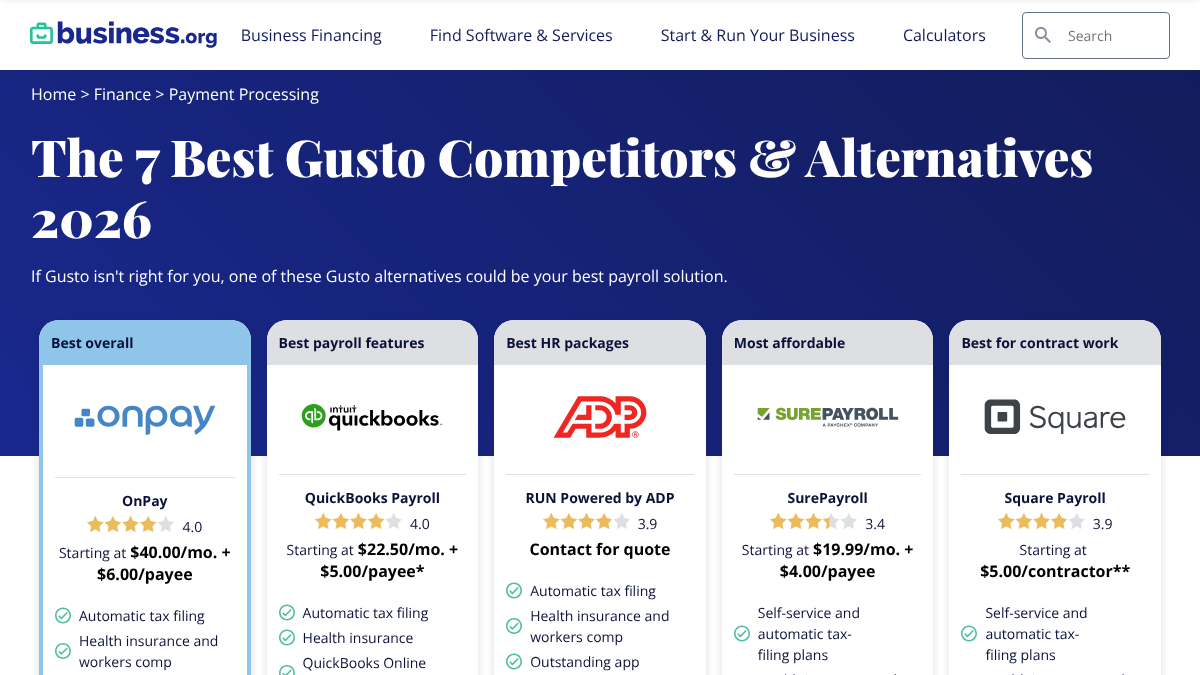
The same label shows up in the comparison pages the engines read. Business.org's list of Gusto alternatives, cited by both engines for the Gusto question, gives OnPay "Best overall" and puts ADP under "Best HR packages," the only card on the row with "Contact for quote" instead of a price.
Drata: the one for technical teams
Drata appeared in all eight SOC 2 answers. It won both answers to "Vanta alternatives," where Perplexity pointed to G2 calling it the "best overall" Vanta alternative.
Everywhere else, it carried the same tag. For the startup with no security team, OpenAI's model said Drata is excellent "if you have a technically strong engineering/ops owner" and steered the buyer toward comparing Vanta and Sprinto first. The citations attached to that framing were Drata's own product pages.
Zoho CRM: the budget option that disappears
Zoho CRM came up in five of the eight CRM answers as the "best budget" or "best value" choice, with one warning that "the UI and setup experience can feel less modern than HubSpot, Pipedrive, or monday." That line carried no citation at all.
The moment the question got specific, Zoho vanished. Neither engine named it for the five-person creative agency managing retainers. Salesforce had it worse. It showed up in two CRM answers, both times as a warning: "usually overkill for small agencies," and "Avoid Salesforce or enterprise CRMs" for freelancers.
The fit label decides
Put the three together and a pattern shows. Every mention comes with a short fit label: "bigger-provider feel," "for technical teams," "budget option," "overkill." We'd call it the fit label, and it decides the recommendation. When the label matches the buyer in the question, you're the pick. When it doesn't, you're named and passed over.
The labels weren't coming from bad press. In none of the demotions we traced was the source a specific complaint, review or forum thread. The engines were repeating category positioning, much of it from the brands' own pages and from roundups that sort every product into a "best for" box. That's good news, since most of those sources are pages a company controls or can pitch.
It also explains why broad questions and specific ones go to different winners. Well-known brands with a general-purpose label win the broad questions. Brands with a sharp label win the narrow ones, like Toast Payroll and Homebase for restaurants, or Bonsai for freelancers. A founder in an r/SEO thread about how ChatGPT describes companies made the same point: established competitors hold the broad discovery prompts, so a startup should aim for the narrow, bottom-of-funnel ones.
Anyone else checking how ChatGPT describes their company?
I’m the head of marketing of a growing startup and recently started asking ChatGPT about our company and our competitors to see what comes up.It got me wondering how other companies are handling this. Do you actually monitor how ChatGPT, Cl...
Recommendations aren't purely a matter of consensus, either. In r/ChatGPT, one user described ChatGPT pushing the same microphone brand across chats even after being told not to, though they could barely find reviews of it online, and the few they found were lukewarm.
ChatGPT keeps recommending the same products across multiple chats despite me telling it NOT to recommend that brand. Am I losing my mind or has ChatGPT become an affiliate to these products?
For context, I was looking for microphones that didn't connect to the internet so I could record meetings without google or some other company harvesting every ounce of my customers data. Despite multiple threads and directions stating that...
Why the labels stick
Answers are short, so every brand gets compressed into a few words. The engines don't invent those words. They take them from the pages they read most, and those pages are organized the same way: roundups that give each product one "best for" box, review sites with category badges, and vendor pages that say who each plan is for.
That makes a label hard to shift with a single page. If ten roundups call you the HR-package option, one new blog post of yours won't outvote them. It also means the label moves slowly once it moves. Semrush's index found that only 36 of its 1,200-plus brands stayed visible across ChatGPT, Gemini and Google's AI results every single month of its study, so most brands drift in and out anyway.
How to turn mentions into recommendations
1. Record your fit label, word for word
Ask ChatGPT and Perplexity your category's buying questions, broad and specific, and copy the exact phrase each answer uses to describe you. Also ask directly: "Who is [your brand] best for?" and "Where did you get that?" The second question often shows the pages behind the label.
Most labels fall into a handful of patterns. Here's what the common ones from our test usually mean and where to start:
| Phrase in the answer | What it usually means | Where to start |
|---|---|---|
| "Quote-based," "custom pricing" | No public price for the engine to repeat | Publish a starting price |
| "Bigger-provider feel," "enterprise" | Your pages read as built for large companies | Add plans and pages for small teams |
| "For technical teams" | Setup reads as hard | Show the setup path for non-technical buyers |
| "Budget option" | You're winning on price alone | Publish pages where you win on fit |
| "Overkill" | Too broad for the buyer asking | Write pages for the smaller buyer's situation |
2. Decide whether the label is one you want
Sometimes the label is right and you're showing up in the wrong questions. ADP's "bigger provider with HR packages" label is an asset for a 150-person company with HR needs. If your label is accurate, stop measuring yourself on the broad questions and track the specific situations where that label wins.
3. If it's wrong, fix it where it comes from
Start with your own site, because that's where many labels trace back to. If the engines call you "quote-based," publish a starting price. If they call you "for technical teams" and you've built for non-technical buyers, say who you're for in your homepage's first line and your pricing page's plan descriptions. Then check the "best for" category each big roundup gives you, and send the editors a specific reason to move you.
4. Publish pages for the buyer situations you want to win
Toast and Homebase won the restaurant question because they're built for that buyer and say so. Write a page for each situation you want to own, like "payroll for restaurants with tipped staff" or "SOC 2 for startups without a security team." Make each one specific enough to answer the question on its own.
5. Track the pick as well as the mention
A mention count hides all of this. Log, for each question, whether you were the pick, on the shortlist, caveated or only cited. That four-way split tells you which lever to pull.
See your first AI citation report in under 5 minutes.
No setup calls. No onboarding meetings. Connect your domain and see where AI mentions your brand right now.
Why your dashboard may be flattering you
If you track only mentions, ADP's payroll result reads as six out of eight, a strong number. The same answers score as zero out of eight on the measure that drives pipeline.
The fix is to review the answer text as well as the brand list. Look at the adjectives next to your name, the buyer each answer says you're for, and whether you made the final pick. It takes about an hour a month by hand for 20 questions on two engines, longer once you add more engines or competitors.
On X, the conversation about this problem is almost entirely people selling tools to fix it, which makes Reddit and your own testing the more reliable places to learn.
Where to go from here
You can do all of this manually: pick your questions, run them monthly, classify each answer, and rewrite the pages behind the labels you don't want.
Or RankControl can take the tracking and much of the writing. AI visibility tracking checks up to 50 buyer questions every week on seven engines and records the sentiment on every mention, the sources each engine quoted, and which competitors got named instead of you. The content engine writes the buyer-situation pages and comparison pages that shift your label, and publishes them on your own site.
For the mechanics of how ChatGPT picks, see how ChatGPT decides which websites to recommend. For the tracking side, our guide to tracking brand mentions in AI search covers the manual setup, and brand mentions vs backlinks covers why mentions matter at all.
For a quick look at how the engines describe you today, run a free check of your brand in AI answers.
Your competitors are building backlinks while you read this.
Organic outreach, social mentions, and citations from Editorial Circle member sites, with managed backlinks available as an add-on. Grow your domain authority without running the campaign yourself.