
A client opens the monthly SEO report, skims the rankings and asks the question you saw coming. Why doesn't ChatGPT mention us? If you sell white label SEO, that question now lands on almost every account, and most of what you buy wholesale was priced before anyone asked it.
In the SEOFOMO State of AI Search Optimization report, which Aleyda Solis shared in August, 98% of the 171 search pros who answered said a client or boss had asked about AI search visibility. A year earlier it was 91%.
🚨 The #SEOFOMO State of AI Search Optimization Report – 2026 Edition is here 👇 The results are in! 171 search professionals from 36 countries answered this year’s SEOFOMO State of AI Search Optimization survey between 17 and 27 August, and there’s a lot in here… including how https://t.co/FIvSXpOmty
 Aleyda Solis 🕊️@aleydaAug 30, 2026

This guide covers what to resell for AI search and the margin left once your own time counts, with a short take on reporting. Prices were checked on October 18, 2026, on each vendor's public pages. Our guide to white label rank tracking covers the report itself.
What white label SEO looks like once AI search is on the menu
White label SEO means you sell the service under your agency's name while another company does the work. The client pays you and you pay the vendor, whose name never shows up in what the client sees.
The classic menu hasn't changed much in years. Vendors sell blog posts, links, local SEO and audits, plus a branded dashboard to report on it all. What's new is a layer clients ask about by name, which is showing up in answers from ChatGPT, Perplexity, Gemini and Google's AI Mode.
That layer is harder to buy wholesale than it sounds. In October, Google's own AI Overview for "white label seo" listed the old services and a reporting tool, with no word on AI search. Top-ranking vendor pages are the same, and a few list "AI SEO" or "LLM SEO" as a line item, but none put a price on tracking it.
If AI search is new to your agency, our guide for agency owners starting with AI search visibility covers the first pilot.
The white label SEO menu, with public wholesale prices
Most white label vendors hide prices behind a sign-up or a quote form. SEOReseller, for one, lists three resold tiers on its white label page, with keyword counts and monthly links, but no dollar figure. So the table leans on the vendors that do publish numbers.
| Service | Public wholesale price | Source | What the client gets |
|---|---|---|---|
| Blog posts | $81 (Basic) or $162 (Pro) per 1,500 words | FATJOE content pricing | Articles under your name |
| Link building | From $72 per outreach or niche edit link | FATJOE link building page | Links, priced by site metrics after sign-up |
| Brand mentions | From $336, about 14 days | FATJOE AI SEO page | Mentions of the brand on other sites |
| Community mentions | $675 for 10, $1,013 for 20, $1,688 for 40 | FATJOE AI SEO page | Reddit and forum posts, per campaign |
| Digital PR | From $4,200, about 90 days | FATJOE AI SEO page | A press campaign |
| Audits and PDF reports | $39 a month, White Label plan | SEOptimer pricing page | Branded audits and reports |
| Client dashboards | $20 per client a month yearly, $25 monthly | AgencyAnalytics pricing page | Branded dashboards on your domain, Agency plan and up |
Blog posts work out to roughly 5 to 11 cents a word wholesale. Link prices start low, but the real price per link depends on the site's metrics, and FATJOE only shows those once you have an account.
What's missing from every row is the thing clients keep asking about. None of these sells a weekly check of whether AI engines name or cite the client. The closest is a campaign report, and it's worth a close look.
AI search traffic grew 835% this year. Is your content ready?
RankControl generates 26 content formats optimized for ChatGPT, Claude, and Perplexity. Published on your domain, matched to your brand.

What to resell in the AI search layer
Start with what AI engines actually cite. Muck Rack's Generative Pulse report from May 2026 looked at more than 25 million links in ChatGPT, Claude and Gemini answers, and 84% of the citations came from earned media.
Muck Rack sells PR software, so a finding that favors earned coverage suits it. Even so, the share has held between 82% and 89% in every edition since July 2025. Paid and advertorial content made up just 0.3% in the same report, which means a post that's clearly labeled as paid does close to nothing here, while a real mention on a site the engines trust keeps working.
That gives the AI layer on your rate card four line items:
- Earned mentions on other sites, from brand mentions to digital PR.
- Content on the client's own site that answers the questions buyers type into AI engines.
- Weekly AI visibility tracking, so you can show whether any of it moved.
- A report the client reads, priced as its own item.
Wholesale vendors are strong on the first two and thin on the third.
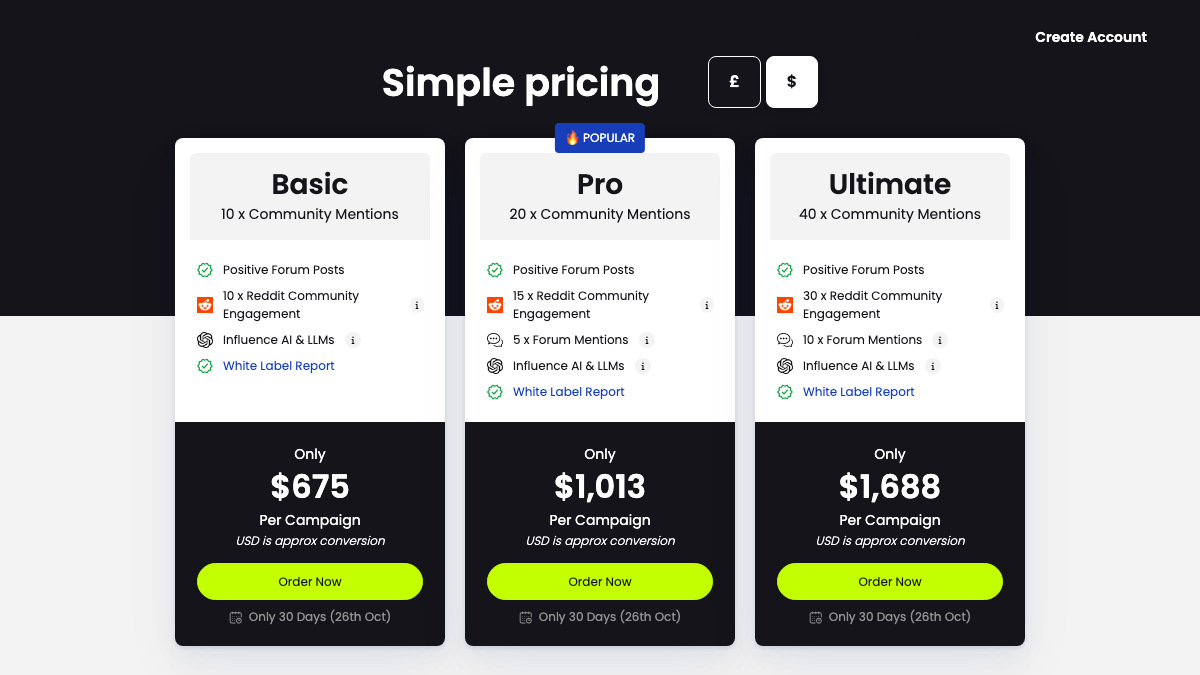
Every FATJOE Community Mentions tier lists "Influence AI & LLMs" and a "White Label Report". That report shows which posts went live. It doesn't track whether ChatGPT or Perplexity now name the client, and FATJOE's AI SEO page says it can't guarantee its services will lead to inclusion in AI responses.
That's a fair line for a vendor to draw. It leaves what I'd call the proof gap. You can buy the work wholesale, but proof that ChatGPT or Perplexity now name the client has to come from your own weekly checks.
Margin math for white label SEO resellers
This is where many white label deals quietly break. In a September r/DigitalMarketing thread about markups on white label retainers, the poster's own number was about 45%. The top reply said the cost missing from that 45% is account management, which lands on your team and never shows on the vendor invoice.
Another reply put hours on it. If the vendor charges $1,000 and you spend three to four more hours on calls and client emails, your real cost is higher than the invoice says.
Run that on a real price. Buy FATJOE's Pro community campaign at $1,013, add a 45% markup and you bill about $1,470. That leaves roughly $455. Spread across four hours of client time it comes to about $115 an hour, or about $150 across three hours. If an hour of your team's time costs more than that, the campaign loses money while the invoice still looks fine.
I think of this as the invoice gap. Wholesale prices are public and easy to compare, so agencies price off them. The hours sit on your side and never appear on a bill. Every client who asks about ChatGPT adds a few more.
Two fixes follow from the math:
- Price account time as its own line, or build it into a monthly fee, instead of hoping the markup covers it.
- Sell the AI layer as a monthly retainer, because a one-off campaign leaves you explaining results for months with nothing billed.
Where a flat tool per site fits
You can also drop parts of the wholesale stack and run software for each client, paying one flat price per site.
RankControl is one example. We charge $400 a month per site with a 7-day trial, and each client site is its own workspace and subscription, with five seats. There, RankControl's AI visibility tracking checks 50 questions every week on seven engines and records whether each answer mentions or cites the brand. The content engine writes up to 100 pages a month and publishes them on the client's own site through its CMS.
For scale, 100 Pro posts from the table above would cost $16,200 wholesale. That gap is the case for moving content to a flat tool and keeping vendors for PR, where earned coverage counts most. RankControl's outreach also finds link prospects for each published article and drafts the emails from the client's own mailbox.
The budgets exist. The same SEOFOMO survey found 69% of respondents now have money set aside for AI search work, up from 38% in 2025. Our breakdown of what SEO costs in 2026 shows what GEO and AEO add to a retail bill, which helps when you set your own prices.

Built by the team that got cited in 48 hours.
Content generation, backlink building, AI visibility tracking, and Google rankings. One platform, zero guesswork.
How to report AI visibility to white label clients
Reporting is where the proof gap shows up first. In a May r/DigitalMarketing thread, a marketer said the tools claiming to track AI search give inconsistent data, and checking prompts by hand doesn't scale past two clients. Our guide to AI visibility reporting walks through the full report. Agency owners in recent threads agree on a few rules.
- Keep a fixed core set of buyer questions plus a smaller set you rotate, so changes from week to week mean something.
- Split every number by engine. One reply in r/MarketingandAI said a blended score hides that a brand can be strong in ChatGPT and almost invisible in Google's AI Overviews.
- Show the count behind each rate. "Recommended in 6 of 20 answers" is easier to read than a visibility score of 30.
- Record two things per answer, whether the client is named and whether one of its pages is cited. Named but not cited is common, and our piece on mention tracking vs citation tracking explains why.
- Mark checks that didn't return a usable answer, so a data problem doesn't look like a drop.
Format matters as much as the metrics. In an r/agency research thread from August, the top reply said fully automated reports barely got opened. What clients did read was a one-page note with the three or four numbers that mattered that month and a couple of lines on what changed and what comes next.
How does client reporting actually work at your agency? (research thread — nothing for sale)
I'm a developer researching how small agencies and freelancers (roughly 5–50 clients) handle monthly reporting and client retention. No product link, nothing to sell — I'm deciding what to build based on real workflows, and I'll share a sum...
Expect pushback as well. A skeptic in an r/DigitalMarketing thread argued that AI answers depend on each user's history, so repeated questions can't show what a real buyer sees. That's partly true, which is why you report rates across many questions and weeks, never one answer.
Price the report as its own line
One owner in the r/agency thread said not to provide reporting unless the client pays for it. For a reseller that's sound advice, because the report is where your hours go.
The software is the cheap part. SEOptimer's White Label plan is $39 a month for branded audits and PDF reports, and AgencyAnalytics charges $20 to $25 per client a month for branded dashboards. The bigger cost is the hour each month someone spends reading results and writing the note the client opens.
The payoff is still early, so set the client's hopes to match. In the SEOFOMO survey, 92% said they track AI visibility, yet only 5% called the business impact significant and 28% hadn't seen any yet. Sell AI reporting as a view of where the client stands, and keep revenue promises out of the pitch. If you're still choosing the tracking tool, our list of SEO software for agencies tracking AI citations compares the options.
Doing it yourself or handing it off
Add up the manual version first. Fifty questions on seven engines is 350 answers to read every week for one client, before anyone writes the report. Add three or four hours of account time for each $1,000 of vendor work, as that markup thread put it, and the AI layer eats the margin fast.
You can build all of this from wholesale parts and a spreadsheet. Or you can run RankControl on each client's site for the weekly checks and the publishing, and spend your hours on the calls that keep the account.
See your first AI citation report in under 5 minutes.
No setup calls. No onboarding meetings. Connect your domain and see where AI mentions your brand right now.