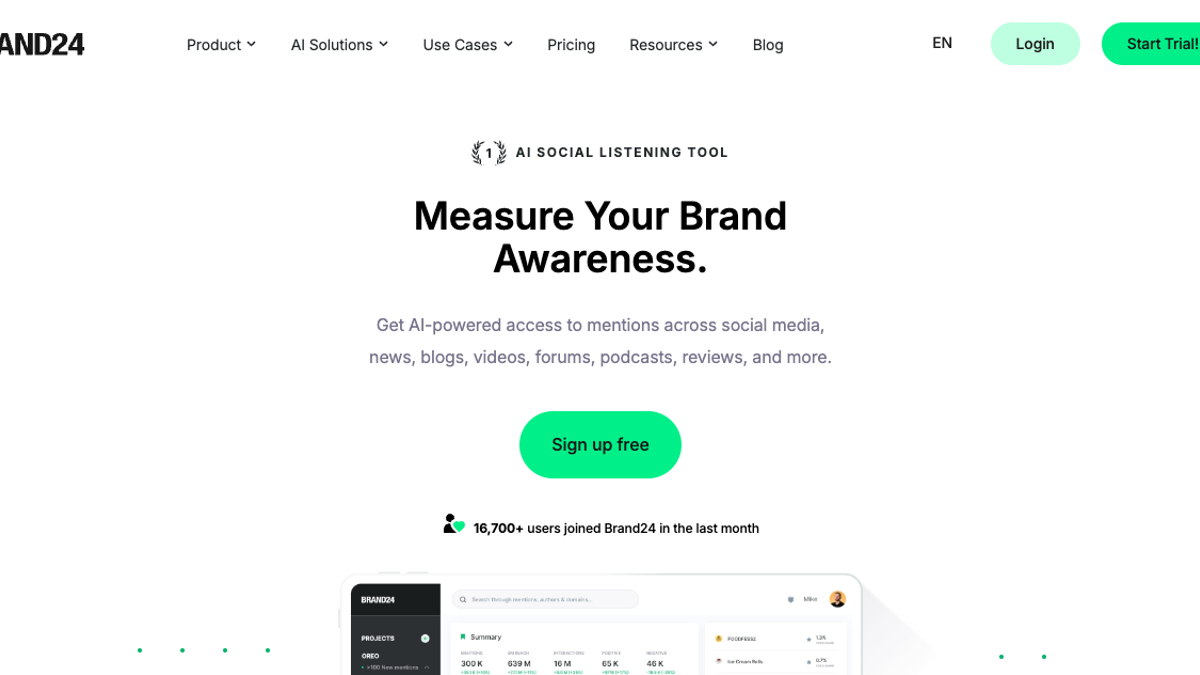
Brand24 is one of the most established names in social listening. It monitors 25 million sources in real time, runs sentiment analysis at industrial scale and produces PR reporting that thousands of brands trust. Lately it has added an AI-visibility wing, Chatbeat, which checks how you show up when buyers ask ChatGPT, Claude, Gemini or Perplexity for recommendations.
That last wing is where our categories converge, and it's the reason this guide exists. The switch it covers is a specific one. Maybe you arrived for listening and stayed for the AI-visibility view, and now you want the loop that changes those AI answers rather than another month of watching them. Below you'll find what to export, what maps and what genuinely doesn't, and who the switch is for. For the head-to-head, see RankControl vs Brand24.
What you're actually switching
Brand24's footprint is wide, so here it is in the company's own positioning:
| Area | What Brand24 offers |
|---|---|
| Mention monitoring | Real time, across social platforms, news, blogs, videos, forums, podcasts, newsletters, and review sites |
| Analysis | Advanced sentiment segmentation, plus reach and engagement metrics |
| PR | Coverage reporting and alerting for critical mentions |
| Packaging | Verticals for agencies, PR teams, marketers, and SaaS |
| AI Solutions | Chatbeat tracks brand appearances in LLM answers and pairs them with the listening data |
| Getting started | Self-serve entry with a free trial; the platform ships in multiple languages |
RankControl sits on the acting side of the same conversation. Every week it checks 50 buyer queries across ChatGPT, Perplexity and Claude, plus Gemini, Grok and Google's AI surfaces, and keeps per-engine citation history and share of voice. A content engine plans from those queries and publishes natively to your CMS, backlink outreach is drafted from your own mailbox, and competitor movement feeds the plan.
It's one flat $400/month with everything included, and there's a 7-day trial. Job by job, the two line up like this:
| Brand24 | RankControl | |
|---|---|---|
| Core job | Listen: mentions across 25M sources | Act: change what AI answers say |
| AI answers | Chatbeat visibility checks | Fixed weekly panel, 6 engines, citations logged |
| Sentiment | Industrial-scale segmentation | Description language on tracked queries only |
| PR reporting | Reach, coverage, crisis alerts | Not covered |
| Content | Insights to inform your team | Written, interlinked, published for you |
| Outreach | Not covered | From your own mailbox, managed add-on |
The export list, while access lives
Do the exports before your subscription ends, because some of this disappears with it. The six that matter:
| Export | Why you want it |
|---|---|
| Project and keyword configurations | The brand terms and competitor names you've tuned, exclusions included. They inform the tracked-query panel even though the formats differ. |
| Mention history and reports | Export the ranges you report on, since in-platform history ends with the subscription and stakeholder decks reference those charts. |
| Sentiment baselines | The positive/negative splits for your reporting periods, as the before-picture. |
| The top-sources list | Which sites and communities drive your mentions. |
| Chatbeat prompts and answer history | Whatever prompt sets and AI-answer records the platform holds; they map directly onto a weekly panel. |
| Alert inventory | Who gets woken up for what, documented before the wiring disappears. |
Keep the top-sources list close. The sources that mention you are exactly the third-party layer AI engines synthesize recommendations from, so yesterday's listening data turns into tomorrow's earned-presence target list.
26 content formats. Published on your domain. Matched to your brand.
Guides, comparisons, listicles, case studies, and more. RankControl generates content that gets cited by ChatGPT, Perplexity, Claude, Gemini, Grok, and Google AI Mode.

What maps, and what honestly doesn't
Squeeze the mapping table above into one sentence and you get this: the AI-answer column maps and almost nothing else does, because the two products do different jobs. Social listening across 25 million sources has no RankControl equivalent. We don't monitor social networks, podcasts, news or review chatter, and if your team depends on that visibility, you should keep a listening tool in the stack.
Sentiment dashboards over web mentions map only to the narrower thing we do track, which is how engines describe you on your panel queries. PR reach reporting and crisis alerting aren't our shape at all. What you gain in trade is the half Brand24 doesn't attempt: the content pipeline that ships answer-ready articles to your own domain, the outreach that builds the mentions listening tools count, and an unmetered weekly cadence on the AI-answer checks themselves.
Keep that trade in mind, but one caveat deserves its own paragraph first. The convergence is real, and it runs both ways. Listening vendors are adding AI-answer views because their customers keep asking what the chatbots say, and we exist because knowing what the chatbots say turns out to be the easy half. Neither direction makes the other product redundant yet. That's why this migration is often a re-weighting rather than a clean swap, with listening kept at a smaller tier and acting added.
Turning listening data into an acting plan
The most valuable part of this migration is the translation step most teams skip. Your listening exports are a ready-made acting plan wearing a reporting costume, and you get it by reading them that way.
Start with the mention history, which tells you which questions and complaints keep recurring in your category. Phrase those as buyer queries and you have the backbone of the 50-query panel. The top-sources list names the communities and publishers that already talk about you. Sort it by how often engines cite them and it becomes the earned-presence shortlist your team works through by hand.
The recurring negatives in your sentiment data are content angles in disguise, since every repeated objection is an honest article that answers it before the engines answer it for you. The Chatbeat gaps, meaning the prompts where competitors get named and you don't, become the first ten articles on the new calendar. They go in priority order, and they're already validated by the fact that buyers keep asking. Run that translation in one working session and the switch stops feeling like abandoning data, because your listening years become the acting plan's research phase.
The three budget shapes
Since the products barely overlap, the money question has three answers rather than one. The simplest is the swap, where you cancel listening entirely and run the flat acting fee. That's only right when the listening genuinely went unread, and last quarter's login history will tell you whether it did.
The stack suits PR-heavy brands where both jobs are load-bearing. You keep full listening and add the pipeline, and the combination is still typically cheaper than one mid-size agency retainer.
Most switchers land on the re-weight. Listening drops to a smaller tier for alerts and baseline awareness, acting gets added at the flat fee, and total spend stays near what listening alone cost while the program gains an execution engine. Pick your shape by which job died last quarter, then let the overlap month's evidence overrule the guess.
The gap that drives the switch
These migrations echo every monitoring-to-acting story, where the dashboards work and the program stalls anyway. Your mentions get counted and your sentiment gets charted. Your reach is graphed, and Chatbeat shows which competitor the engines recommend, then shows you the same thing next month.
The reason is that the bottleneck was execution all along. The content that would change the answers never ships, and the communities driving citations never hear from you. If that's your quarter, the fix is an operator for the loop: articles planned from the questions buyers actually ask and published where engines can cite them, link prospects found for each published article, and the weekly panel confirming what moved. This switch treats one specific problem, which is listening insight that never turns into shipped work.
The cutover, step by step
In week one, run the export list, connect your CMS and build the tracked-query panel. Distill it from your Chatbeat prompts plus the buying questions your mention data shows people asking, and seed competitors from your existing configurations.
Week two is for turning the top-sources export into the earned-presence shortlist and routing the first planned articles into the calendar. It's also when you re-ask your ten most commercial prompts by hand, signed out, saving the answers verbatim as the vendor-neutral baseline.
Weeks three and four are the overlap, with both instruments running. Compare the AI-answer views directionally, since their checks and our fixed panel differ in cadence and phrasing, which makes trend agreement the test. Decide the listening question separately from the acting question. The same overlap discipline that works for tracker migrations works here, with one extra outcome allowed: keeping both.

Your competitors are getting cited by AI. You're not.
Every day without citation tracking is a day your competitors pull ahead in ChatGPT, Perplexity, and Claude.
Who this switch is for
It's for the B2B team that opened Brand24's AI-visibility view six months ago, has watched a competitor's name sit in the answers ever since, and finally wants the machinery that contests the answer rather than a better view of losing it. If Chatbeat is the part of Brand24 you check most, the switch moves that job onto a loop that acts on what it sees.
The loop works like this. Your Chatbeat prompts become tracked queries checked every week across six engines, plus Google and Bing rankings, and the planner turns the gaps into titled articles on a calendar. Each article is written against the pages already ranking for its keyword, scored for how easily AI engines can quote it, and published natively to your CMS. Outreach finds link prospects for each published article and drafts the emails, which wait in your queue for approval. The first reading is your baseline, and by the fourth Monday you can see whether the answers are moving.
So export while the login lives, and put the acting on a flat fee that never asks you to watch anything without doing something about it.
200+ SaaS teams already track their AI citations.
They know exactly when ChatGPT mentions their brand, and when it stops. Do you?