
Category pages will tell you RankControl and Rankability are competitors, and in the loosest sense they are: both live under "AI search visibility," both track how brands appear in AI answers, and both will come up in the same buying conversation this year. Spend ten minutes with each, though, and you find two different species wearing one label. Rankability is a platform agencies use to run client campaigns. RankControl is a pipeline a company runs on its own brand.
That difference decides this comparison more than any feature row, so this post is organized around it: what each product verifiably is, where they genuinely overlap, and the one question that picks your winner faster than a feature grid. Our bias is obvious, we make one of these products, so every claim about Rankability below comes from their own live pages, screenshots included, and the one thing we'd borrow from them is named plainly.
What Rankability Is In 2026
Rankability's homepage says its positioning in four words: built for agencies. The pitch is helping agencies get their clients found in AI search, and everything visible in the product supports that shape: agency-to-client workspace hierarchies, a team structure writers can be invited into, and progress reporting designed to be shown to a client rather than acted on alone.
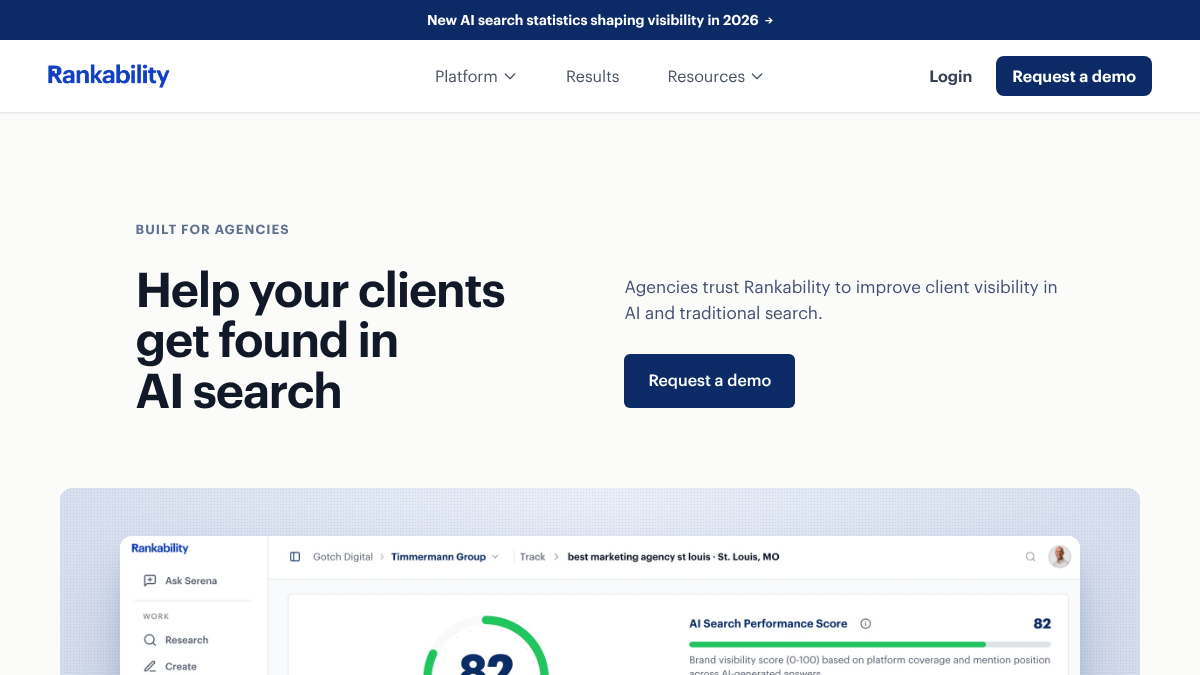
The core loop, per their own framing: see where clients stand via AI search visibility tracking, find website and content gaps, create and improve pages using client knowledge, and show clients what changed. The interface centers an AI Search Performance Score, a 0-100 composite based on platform coverage and mention position across AI-generated answers, alongside an assistant called Ask Serena. Around the platform sit modern plumbing choices: an MCP server for SEO, an agent API, and workflow automation, which is a genuinely current toolkit.
Two more verified facts shape the buying experience. Sales are demo-led, the pricing page is a demo-request form with agency qualification questions, and no public pricing is listed. And the client-logo wall mixes the agencies themselves with the brands they serve, Panasonic and UCLA sitting next to boutique dental-marketing shops, which is exactly what an agency-platform trophy case looks like. Community context adds one origin note: practitioners know it as Nathan Gotch's platform, launched into AI SEO as his agency-education business wound down.
Honest summary: a coherent, well-built agency product with a clear philosophy, one explainable score, campaign structure, and human writers in the loop.
What RankControl Is
RankControl is the other shape: an operating pipeline for a single brand, self-serve, priced flat.
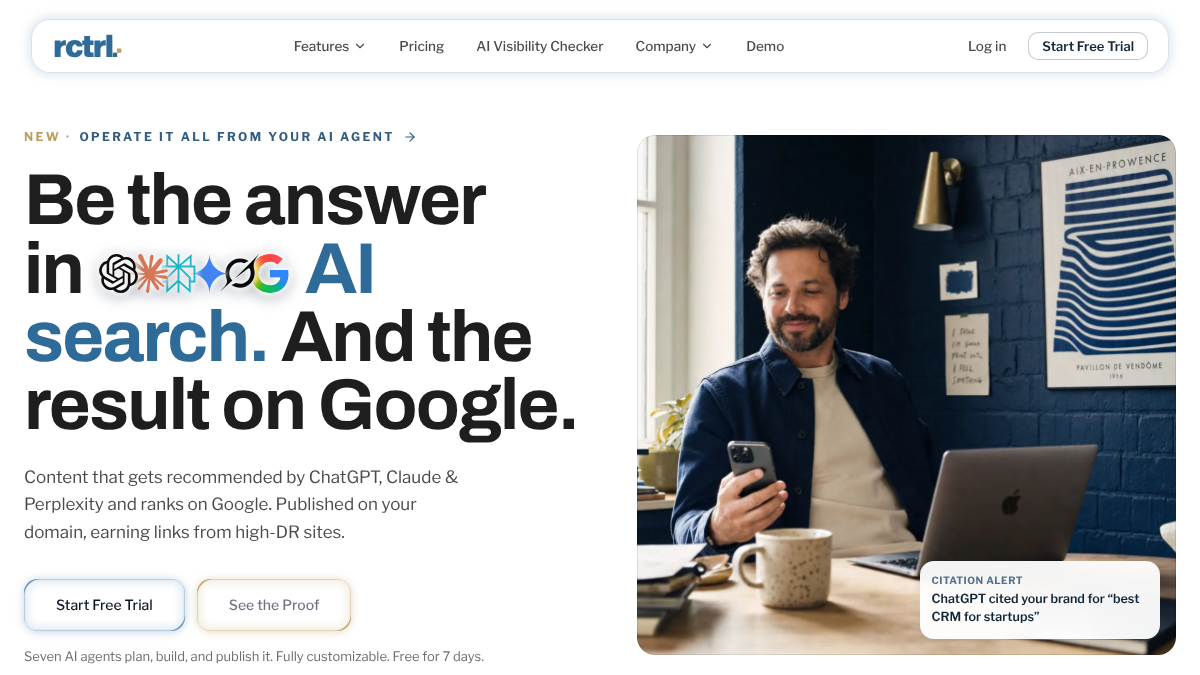
The loop runs end to end: query discovery mines what your buyers actually ask and plans titles onto a calendar; generation writes the articles; publishing pushes them as native posts to your own CMS, WordPress, Webflow, Shopify, Ghost, Notion, Wix, Framer, or a content API for headless; outreach drafts backlink emails from your own mailbox; and measurement checks 50 tracked queries weekly across ChatGPT, Perplexity, Claude, Gemini, Grok, and Google AI Mode, plus Google and Bing rankings. Review modes are the default and automation is the direction; you can approve everything or let it run. The price is $400 a month flat, everything included, 100 pages monthly, with a 7-day self-serve trial and two optional add-ons, a dedicated strategist and managed backlinks.
The philosophical difference from the agency shape: nobody reports to anybody. The citation rows are for the operator who acts on them, the same week, in the same product.
How often does ChatGPT mention your brand?
Most founders have no idea. The answer might surprise you.

Head To Head
| Rankability | RankControl | |
|---|---|---|
| Built for | Agencies running client campaigns | A company running its own brand |
| Buying | Request a demo; no public pricing | Self-serve, $400/mo flat, 7-day trial |
| Visibility measurement | AI Search Performance Score (0-100 composite) | Per-query, per-engine citation rows, weekly |
| Engines watched | AI and traditional search platforms | ChatGPT, Perplexity, Claude, Gemini, Grok, Google AI Mode + Google and Bing rankings |
| Content | Gap analysis; create and improve pages with your writers | 100 pages/mo generated and published natively to your CMS |
| Links | Not the focus | Outreach from your own mailbox; optional managed add-on |
| Team model | Agency seats, writer access, client reporting | Operator dashboard, review or full-auto |
| Automation plumbing | MCP server, agent API, workflow automation | Seven-agent pipeline end to end, plus API/CLI/MCP parity |
The Five Differences That Actually Decide It
The seat you're sitting in. Everything else derives from this. Rankability assumes a person managing someone else's brand, who needs structure for many clients and evidence to show each one. RankControl assumes the person who owns the number, who needs the work done more than the work presented.
How the products think about measurement. A composite score is a communication device: one number a client can watch rise, honest about direction, silent about specifics. Raw citation rows are an operating device: exactly which of fifty queries you won in which engine this week, noisy, specific, actionable. Neither is wrong; they're built for different meetings. If your Monday meeting is with a client, you want the score. If it's with your own roadmap, you want the rows.
Where content ends up. Rankability's content tools produce and improve pages, with your team doing the publishing wherever it publishes. RankControl's pipeline ends past the publish button: articles land as native posts on your domain without a handoff. For an agency with writers, the first model is a feature. For a two-person marketing team, the handoff is precisely the part that never happens on time.
Who does the work between readings. This is the gap the category label hides. Both products can tell you where you stand; only one of them then writes, publishes, and earns toward the gap it found, and grades itself against the same queries next week. An agency fills that gap for Rankability's customers, which is legitimate, and is also a second invoice.
How you buy. Demo-led versus self-serve mirrors everything above. Agencies buy through demos because their needs are configured; operators increasingly won't book a call to see a price. Neither is a moral position, but if pricing transparency matters to your evaluation, one of these products publishes its number and one asks about your client count first.
15 hours a week manually. Or 15 minutes with RankControl.
Track citations, monitor competitors, and fix content gaps across every AI search engine. Automatically.

The Skeptic's Question, Answered Fairly
There's a recurring practitioner question about tools in this whole category, phrased memorably in one thread as: legit tool, or nice UI around a checklist?
Rankability: legit tool or just “nice UI around a checklist”?
I’m looking into Rankability and I can’t tell if it’s genuinely helpful, or if it’s the kind of tool that feels great for beginners but experienced SEOs outgrow fast. If you’ve used it, what did it improve for you? Faster briefs, better on-...
It deserves a straight answer for both products. The checklist critique lands wherever a tool's output is advice, because advice is only worth the execution attached to it. Rankability's defense is the agency: their platform's gap lists become work because an agency is paid to do the work. RankControl's defense is the pipeline: the gap between "knowing" and "done" is the product's whole job, executed by the system itself. The tools most exposed to the critique are the ones that neither execute nor sit inside an execution relationship, and neither of these two is that. What you should actually audit, for any tool here: does last month's insight exist as a published, measurable asset this month? If yes, the UI earned itself.
The Same Ten Queries, Two Philosophies
To make the seat-difference concrete, imagine handing both products the identical assignment: ten buying queries for a mid-market B2B SaaS, things like "best [category] for agencies with client portals" and "[competitor] alternatives."
In Rankability's world, the assignment becomes a campaign. The queries get tracked, the score baselines, the gap analysis produces a prioritized list, briefs, page improvements, entity fixes, and your team or your agency's writers work the list inside the platform, with the score and mention positions moving as evidence for the next client call. Four weeks later you have a documented campaign in motion and a number that explains itself upward.
In RankControl's world, the assignment becomes output. The queries join the tracked set, the planner turns the gaps into titled articles on a calendar, the writer produces them, publishing pushes them live on your domain, outreach drafts the link emails, and the weekly check grades every query per engine against the baseline. Four weeks later you have published pages, sent outreach, and citation rows that moved or didn't, with nobody having briefed anybody.
Same input, both defensible, and the difference is what your month produces: a managed campaign, or shipped assets. Which one your situation needs is the entire decision, and no feature table settles it as fast as that sentence does.
Pricing Math For An In-House Team
We can't quote Rankability's price, because there isn't a public one; the pricing page is a demo form that asks for your agency's client count, which tells you both the audience and the model. What an in-house team should price out is the realistic bundle: an agency platform is usually accompanied by an agency, so the comparison for most companies is platform-plus-retainer against pipeline-flat. Typical content-and-SEO retainers at this level run well into four figures monthly before a word publishes, which is neither a criticism nor a secret, it's what human campaign management costs.
RankControl's math is deliberately boring: $400 a month flat, 100 pages, publishing, outreach drafting, and six-engine weekly tracking included, plus optional add-ons if you want humans in specific loops, a dedicated strategist at $1,500 a month or managed backlinks at $350. The point of publishing the numbers is the point of the product: an operator should be able to price the whole loop from a pricing page, alone, on a Tuesday night.
What We'd Borrow, and What They Can't Build
The one thing we'd borrow from Rankability is the composite score. A single 0-100 number with a clean definition, platform coverage times mention position, is an easy way to explain progress to someone less technical. Our own score works on the page instead: every article gets a citability score with a fix list, which grades how easily AI engines can quote it.
What their customers might envy from the pipeline side: the absence of the handoff. Every agency workflow has a moment where the brief waits for the writer, the draft waits for the client, and the publish waits for the CMS person, and the compounding math of content is brutally sensitive to those waits. Closing that gap in software rather than in project management is the one thing an agency platform structurally can't do, because the gap is where the agency lives.
So, Which Wins?
The title's question, answered without a dodge.
You're a company paying an agency today. Put the agency's last quarter next to what RankControl ships in a month for $400: published pages on your domain, outreach drafted from your mailbox, and per-engine citation rows every week. Compare output, not reports, and let the retainer justify the difference.
You're a company running its own growth. This is where RankControl wins, and where the "versus" was always a little false: you don't need a platform for managing campaigns about your brand, you need the campaign run, published, linked, and measured, weekly, by something that doesn't bill hours. The economics of owned content only compound if the loop actually closes, and closing loops is the entire design. If you're already on Rankability, the switching guide covers the move step by step.
The clean way to settle it for your own case costs a month: book their demo, start our 7-day trial, give both the same ten buying queries, and compare what exists at the end, a plan and a score, or published pages and citation rows. Two different species, one honest test, and your own data gets the final word, which is how every tool decision in this category should end.
AI search traffic grew 835% this year. Is your content ready?
RankControl generates 26 content formats optimized for ChatGPT, Claude, and Perplexity. Published on your domain, matched to your brand.