
This is the closest comparison we've written, and honesty demands saying so up front. Goodie AI sells a full-stack, closed-loop AEO platform starting at $399 a month with a 7-day trial. We sell a closed-loop AI search pipeline at $400 a month with a 7-day trial. The pitches rhyme and the prices nearly match, so a buyer squinting at both homepages could be forgiven for assuming they're interchangeable. They're genuinely different products underneath, and since we make one of them, read this with that bias declared: the criteria are stated, Goodie's wins are real and listed, and the trials both cost nothing, which makes the last section's advice easy to follow.
What Goodie AI Is
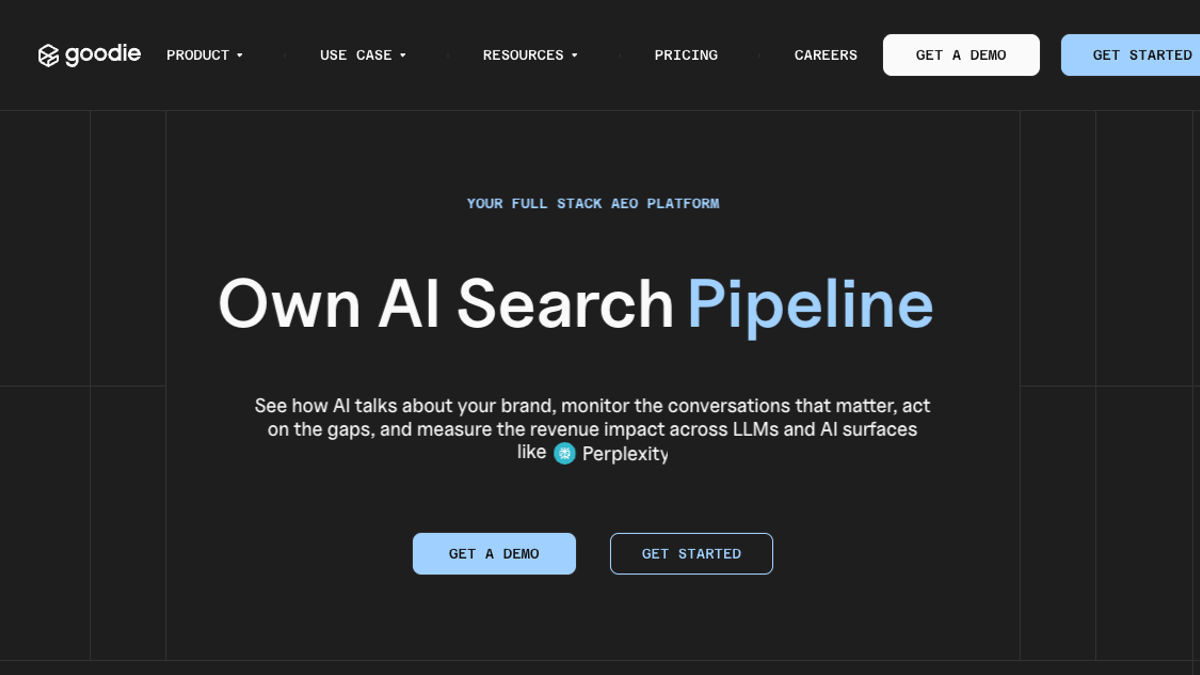
Goodie positions itself as the end-to-end AEO platform, and the module list backs the claim: prompt research with search-volume patterns, visibility monitoring that tracks how AI models describe your brand, an agent experience suite for crawler and agent analytics, optimization actions delivered as prioritized recommendations, analytics and attribution connecting visibility to revenue, a content studio generating brand-voice AEO content, an MCP server for working wherever you work, brand command alerts for when AI gets your brand wrong, and an agentic commerce suite covering AI product discovery. Around the modules: nine industry verticals from fintech to pharma, SOC 2-compliant enterprise posture, agency plans with pitch workspaces, a research lab, and a set of free tools including an agent site audit and an AI visibility index.
The tiering, from their pricing page: Core at $399/month with 120 prompts, five core models and five seats; Pro at $999/month with 250 prompts, eight models and unlimited seats; Enterprise above that with tailored prompt volume, up to 13 models and multi-brand orchestration. Agencies get their own ladder from $275/month, billed quarterly or yearly. Annual billing takes two months off. If you're already on Goodie and weighing a move, our guide to switching from Goodie AI covers the exports and notice terms.
What RankControl Is
RankControl runs the loop rather than instrumenting it: 50 buyer queries checked weekly, every week, across ChatGPT, Perplexity, Claude, Gemini, Grok, and Google's AI surfaces, with per-engine citation history, share of voice, and description language; a content engine that plans from those queries and publishes finished, interlinked articles natively to your CMS; backlink outreach drafted and sent from your own mailbox with reply-gated follow-ups; and competitor monitoring feeding the plan. One flat $400/month with everything included, a dashboard-parity API and CLI, and two optional human add-ons, a dedicated strategist and managed backlinks, priced separately and cancellable independently.
Head to Head
| Goodie AI | RankControl | |
|---|---|---|
| Shape | Nine-module intelligence platform | Operated pipeline |
| Entry price | $399/mo, 120 prompts, 5 seats | $400/mo flat, 50 queries, everything included |
| Prompt research | 30 prompts/mo on Core, 80 on Pro | Query discovery included |
| Content | Studio generates; you publish | Written and published to your CMS |
| Outreach | Listed as an Outreach Agent on every plan; not documented | From your own mailbox, included |
| Crawler analytics | Agent experience suite | AI crawler visits plus daily crawler-access checks |
| Attribution | Revenue attribution module | Analytics views; no revenue attribution wing |
| Commerce | Agentic commerce suite | Not covered |
| Enterprise | SOC 2, multi-brand, verticals | Self-serve, single-brand |
| MCP/API | Goodie MCP | MCP, API, and CLI at full dashboard parity |
| Trial | 7 days | 7 days |
What Happens After an Insight
Both products find the same kinds of gaps: prompts where a competitor gets cited and you don't, pages the engines skip, descriptions that drift. The split is what happens next. In Goodie, an optimization action lands in a queue for your team, and the content studio can draft toward it. In RankControl, the gap becomes a titled article on the calendar, and the pipeline takes it from there.
RankControl writes each article to beat the pages already ranking for its keyword, then gives it a citability score with a fix list. It publishes natively to your CMS, the score runs again after publish, and next week's check across six engines shows whether any of them noticed.
Auto-publish is off by default, so each article waits for your approval until you trust the output. After that, you can switch it on and let the calendar run by itself.
That sequence is the whole argument of this comparison. A recommendation your team never gets to is worth nothing, and a published page the engines can quote keeps working every week after.
26 content formats. Published on your domain. Matched to your brand.
Guides, comparisons, listicles, case studies, and more. RankControl generates content that gets cited by ChatGPT, Perplexity, Claude, Gemini, Grok, and Google AI Mode.

Where RankControl Wins
The loop actually closes with published work. Goodie's studio generates content and its optimization actions tell you what to do; our pipeline writes the article, interlinks it, and publishes it natively to your CMS on schedule. The difference sounds small in a table and decides everything in practice, because the recurring failure of visibility programs is unactioned insight, and a recommendation queue is where programs go to stall. Wondering which shape you need? Count the unexecuted recommendations in whatever tool you run today; that number is your answer.
Outreach you can see working. Mention-building is the strongest correlate of AI visibility in every large dataset, and we ship an outreach agent that drafts from your own mailbox, plus a managed option. Goodie's pricing table now lists an Outreach Agent on every plan, but none of its pages says what it does, so ask for a demo before you count on it.
Nothing is gated uptier. On Goodie, data exports start at the $999 Pro plan, and the API and direct CMS publishing integrations such as WordPress are Enterprise-only. RankControl's publishing, API and MCP server are all in the one price. If you need those Goodie features, price the comparison at the tier that has them.
The cadence is guaranteed. Fixed panel, all six engines, every week, unmetered. Where checking is configurable, checking becomes negotiable, and measurement that samples your calendar reads differently than measurement that samples the world.
Parity tooling. MCP, API, and CLI expose the same capabilities as the dashboard, refusals and all, which matters to teams wiring AEO into their own systems.
The Attribution Question, Handled Fairly
One module deserves a fair-minded caveat that cuts both ways. Goodie's analytics promise attribution connecting visibility to revenue, and it's the module enterprise buyers will circle first, so here's the honest physics every vendor in this category lives under, us included: most AI-referred visits arrive with no referrer, clicks from Google's AI surfaces book as organic, and the whole measurement layer runs on floors and fingerprints rather than totals. Good attribution tooling narrows the fog; nothing eliminates it, and a buyer should ask any vendor, in the demo, which specific joins power the revenue numbers and what share of the channel they can actually see. Their Brand Command concept, alerts when AI describes your brand wrongly, targets a real problem; our equivalent is description-language tracking on the weekly panel, surfaced as trends rather than alerts.
The Same-Fortnight Test, As a Protocol
Since both trials are seven days and free, here's the test we'd run if we were you, written so it's fair to both sides. Before either trial: write down your ten most commercial buying prompts and your three named competitors, so neither product's onboarding shapes the panel. In Goodie's week: load the prompts, read every module against them, and keep two tallies, insights you acted on, and insights that stayed insights. In our week: load the same prompts, connect a staging or real CMS, and keep two tallies, articles actually published, and citation or ranking movement the panel catches. Then the scorecard, one line each: what did each product change in the world during its seven days, and what would month three look like if the trial pace continued? Buyers who run this exact protocol tend to sort themselves cleanly, because the products diverge exactly where the tallies do, and no comparison article, including this one, outranks two weeks of your own evidence.
Two Bets on the Same Future
Zoom out and the products are two different bets on how AEO gets bought, which is worth understanding before picking a side. Goodie's bet: the category matures like enterprise SEO did, won by depth of intelligence, governance, and vertical specialization, with execution staying in-house at companies large enough to staff it. Every module and vertical on their site is consistent with that bet. The one lane where Goodie is clearly ahead is commerce: its agentic commerce suite covers AI product discovery for retail catalogs, which RankControl doesn't serve. Our bet: for the much larger population of mid-market teams, the binding constraint stays execution hours, and the category gets bought like a managed service wearing software pricing, judged on what shipped. Every piece of our shape, publishing, outreach, flat price, follows from that bet. The agent era stresses both bets interestingly: their MCP and agent-experience suite say "instrument the agents," our dashboard-parity MCP and CLI say "let agents operate the loop," and within a year or two the market will have graded both papers. A buyer doesn't have to referee any of this; you just have to know which population you're in, and the tallies from the fortnight test answer that more honestly than either roadmap.
The Price Math, Since the Stickers Tie
At entry the stickers are $1 apart, so the real math is what each dollar buys. Goodie's $399 buys instrumentation breadth: more prompts and more modules to read, with actions to assign your team. RankControl's $400 buys execution: the articles shipped, the interlinks placed, the outreach sent, the checks run weekly, with your team's hours spent steering rather than producing. Step up a tier and the divergence widens: Goodie's Pro at $999 adds prompts, models, exports and unlimited seats for the intelligence program, while RankControl's step-ups are human, a $1,500 strategist or $350 managed backlinks, layered on the same flat product. Neither math is wrong; they price different theories of where your bottleneck is. The two trials run in the same fortnight for $0, and your own funnel will settle in two weeks what this section can only frame.

Your competitors are getting cited by AI. You're not.
Every day without citation tracking is a day your competitors pull ahead in ChatGPT, Perplexity, and Claude.
Five Questions for Either Demo
Whichever direction you lean, the same five questions keep both vendors honest, so take them into both rooms. Which engines get checked on what cadence, and is the cadence guaranteed or configured? Can every visibility number decompose to an actual answer with cited URLs, and can we see one from a real account? What happens to the content the platform produces, who publishes it, where, and can we read three live examples on customer domains? Which features on the pricing page sit behind the tier above the one we're buying? And what does month three look like for a team our size, shown as a real customer's timeline rather than a roadmap slide? We're comfortable answering the first four today, and the module list suggests Goodie would be too, and any vendor in this category who stumbles on them has answered a different question about themselves.
Who RankControl Is For
Operator-shaped teams: a SaaS or services company without spare execution hours, tired of recommendation queues, wanting articles on its own domain and mentions in its category to simply happen, measured per engine weekly, for one flat line item. That's the trial to run if the unexecuted-recommendations count from earlier made you wince.
What the first month produces, concretely: a calendar of titles planned from your tracked prompts, articles publishing to your CMS on the schedule you set, outreach drafts waiting in your queue for approval, and four weekly readings across six engines. Your team's hours go into approving the plan and reviewing what shipped, instead of turning recommendations into work by hand.
If you're still weighing both, run the same-fortnight test above with your ten buying prompts. Grade each product on what actually shipped during its week, and notice which grade your pipeline cares about. That test costs nothing, ends the debate with your own data, and is precisely the kind of buying behavior AI-era buyers now use on all of us anyway, so consider it practice.
200+ SaaS teams already track their AI citations.
They know exactly when ChatGPT mentions their brand, and when it stops. Do you?