
Authoritas has been doing serious SEO software since before AI search had a name: a genuinely full suite, keyword research, rank tracking, big-data market share analytics, crawling, link tools, APIs, now positioned as a complete AI Search plus SEO visibility platform for brands, publishers, and e-commerce. Nobody leaves it for lack of features, and this guide won't pretend otherwise. The migration this guide covers happens for a narrower reason: your team mostly needs the AI-visibility-to-action loop, you're metering that loop through per-model credits, and the suite around it goes largely unopened. If that's you, here's the move: what to export, what maps, what honestly doesn't, and who the switch is for.
What You're Actually Switching
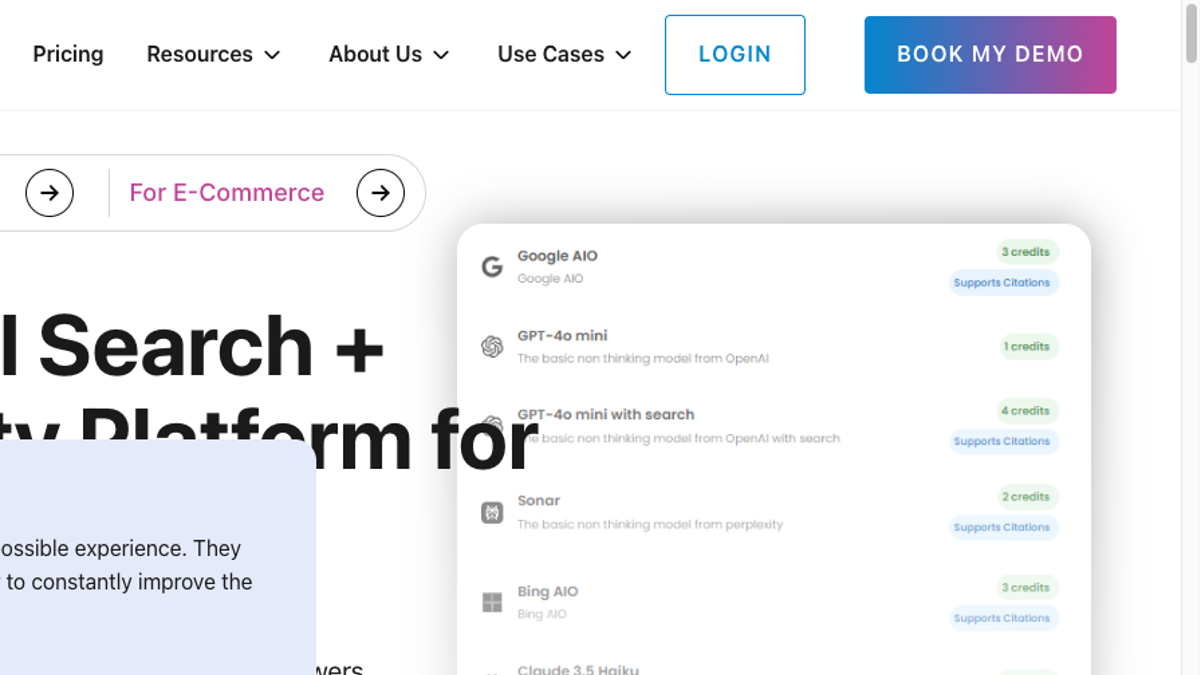
The Authoritas footprint is wide. The classic side covers keyword research and rankings, market share and visibility analytics, content strategy and optimization tooling with an AI writing assistant, a technical crawler with Core Web Vitals, backlink and outreach tools, and reporting that plumbs into Data Studio and BigQuery, plus real APIs and a Sheets plugin. The AI Search side, priced as its own product line, tracks visibility across AI surfaces with citation support, and it meters checks in credits that vary by model, a Google AI Overviews check costing more credits than a basic GPT model, search-enabled model runs costing more than plain ones.
RankControl swaps that shape for an operated loop at a flat fee: 50 buyer queries checked weekly, every week, across ChatGPT, Perplexity, Claude, Gemini, Grok, and Google's AI surfaces, per-engine citation history and share of voice with no credit arithmetic anywhere; a content engine that plans from tracked queries and publishes finished articles natively to your CMS; outreach drafted from your own mailbox; competitor monitoring feeding the plan. $400/month, everything included, 7-day trial.
| Authoritas | RankControl | |
|---|---|---|
| Shape | Full SEO suite + AI tracker product | Flat-fee operated pipeline |
| AI checks | Credit-metered, cost varies by model | Unmetered, 50 queries weekly, 6 engines |
| Classic SEO depth | Keyword research, rank tracking, crawler, market share | Rankings on tracked queries only |
| Content | Briefs and AI writing assistance | Written, interlinked, and published for you |
| APIs | SERPs, platform, and content APIs | API and CLI included, same features as dashboard |
| Entry | Free start and demo | Self-serve trial |
The Export List, While Access Lives
- Keyword lists and rank history. CSV out, wide date ranges. The distilled keyword knowledge becomes your tracked-query input, and the history is your before-picture.
- AI Search prompt sets and responses. Your configured prompts, plus whatever response and citation history the platform holds. These map one-to-one onto a fixed weekly panel.
- The deck reports. Market share and visibility reports stakeholders have seen; those views anchor the "before" in any future comparison.
- Crawl findings. Open technical issues from the crawler worth fixing regardless of tooling.
- Content briefs. Unexecuted briefs from the content tools, out to documents, straight into the new calendar.
- API extracts. Anything your team pulls programmatically, final runs before keys die. Actually, one thing deserves plain praise first: Authoritas ships real APIs, a Sheets plugin, and BigQuery plumbing, and teams that wired those in should budget an hour to inventory what's connected before it quietly breaks on cancellation day.
How often does ChatGPT mention your brand?
Most founders have no idea. The answer might surprise you.

What Maps, and What Honestly Doesn't
| If you used Authoritas for... | On RankControl |
|---|---|
| AI Search visibility tracking | Weekly per-engine checks, unmetered, citations logged |
| Keyword research and rank tracking | Not replaced at suite depth; query-level rankings only |
| Market share analytics | Competitor share of voice on tracked queries |
| Content briefs and AI assistance | The full pipeline: planned, written, published |
| Crawler and Core Web Vitals | Not replaced; keep a technical SEO tool if load-bearing |
| Link tools and outreach | Outreach agent from your mailbox, managed add-on |
Two honest rows deserve expansion. Classic-suite depth is the real trade: Authoritas does keyword research, rank tracking at scale, and technical crawling that we don't replicate, so a team leaning on those daily needs a companion tool alongside us. And their model coverage list includes surfaces like Bing's AI Overviews that our six-engine panel does not check; if per-model breadth matters to your reporting, count the columns you actually use before assuming either tool covers them.
The Credit Conversation
The reason this switch usually starts is the meter. Credit-metered visibility creates a quiet tax on curiosity: every additional prompt or rerun has a marginal cost, so teams check less and ration precisely the monitoring that was the point. We've made the full argument against metered and blended measurement elsewhere; the migration-relevant version is one sentence. A fixed panel on an unmetered weekly cadence is what turns visibility from a budget line you manage into an instrument you trust, and the switch's felt difference, teams tell us, is checking without doing arithmetic first.
Does the flat fee always win the math? No, and honesty here helps you decide: a team running a handful of prompts monthly on cheap models might spend less under credits than $400 flat, and that team probably shouldn't switch for billing reasons alone. The flat fee wins when you want the loop run, weekly cadence, six engines, content shipped, links pursued, rather than a meter to sip from.
15 hours a week manually. Or 15 minutes with RankControl.
Track citations, monitor competitors, and fix content gaps across every AI search engine. Automatically.

Two Instruments That Meter Time Differently
One overlap-month subtlety specific to this migration: the tools don't just differ in what they check, they differ in when. Credit-metered checking clusters in practice, teams spend credits when a report is due or a stakeholder asks, so the old data samples your calendar as much as your visibility, with quiet weeks between bursts. A fixed weekly cadence samples uniformly, which surfaces the ordinary week-to-week churn that burst-checking steps over. The practical consequence: the new instrument will look noisier at first, and the noise is real signal the old cadence never saw, citation drift that was always happening between your credit bursts. Expect it, read trends across four-week windows, and resist the instinct to judge the switch on week two's wobble.
Budgeting the Suite Gap Honestly
For the rows marked "not replaced," the companion-tool math keeps the decision clean. Keyword research and rank tracking at depth: a standalone tracker or a lean suite seat covers most mid-market needs at a two-figure monthly price. Technical crawling: a dedicated crawler, some free at small-site scale, replaces the audit wing for occasional use. Add either or both alongside the flat fee and the combined bill still typically lands below a multi-product platform spend, with each tool doing one job you actually use. The wrong outcome is pretending the gap doesn't exist and discovering in month two that someone misses the crawler; the right one is naming the two jobs the suite really did for you and pricing their replacements before you cancel anything.
The Cutover, Step by Step
Week one: run the export list, connect your CMS, load the distilled 50 queries from your keyword and prompt exports, seed competitors. Let the first weekly checks land while Authoritas still runs; leftover credits are perfect for a two-instrument comparison window. Week two: route the exported briefs into the content calendar, watch the first pipeline articles publish natively to your site, and re-run your ten most commercial prompts manually, signed out, saving the answers verbatim, as the independent baseline no vendor holds. Weeks three and four: compare direction rather than absolutes between the two instruments, since their panels and cadences differ in the ways described above; investigate any outright contradiction before trusting either tool; and make the renewal decision with your history already exported. The same overlap discipline that works for every platform migration works here: a month of parallel readings makes the leap a step.
Who This Switch Is For
Teams whose Authoritas usage collapsed to the AI tracker plus occasional rank checks. If that's you, you're paying suite prices and managing credits for a slice of the product, and the part you still use is the part RankControl runs every week without a meter.
The switch also fits teams whose real gap is execution rather than analysis. In RankControl the tracked queries feed a planner that puts titles on a calendar, and each article is written against the pages already ranking for its keyword, scored for how easily AI engines can quote it, and published natively to your CMS. Outreach drafts wait in your queue for approval, and the Monday check shows which of the six engines picked up the new pages, alongside Google and Bing rankings.
The move itself is an afternoon. Export while the login lives, load your distilled prompts as tracked queries, connect the CMS, and run the whole loop for one flat line item. Then compare the first month's citation rows against your exported history and judge the switch on your own data.
AI search traffic grew 835% this year. Is your content ready?
RankControl generates 26 content formats optimized for ChatGPT, Claude, and Perplexity. Published on your domain, matched to your brand.