
In late September, a Shopify candle shop owner posted in r/ecommercemarketing about something odd. They had typed their own product questions into ChatGPT, and the answers were all over the place. Sometimes the shop was named, most of the time a competitor was, and once ChatGPT described the shop with details a year old.
The owner wasn't asking for a dashboard. They wanted to know whether any of this was worth caring about. That's the question under every RankControl vs AmICited comparison, so this one answers it for a store. Which tool helps get your online store named in ChatGPT, and what does each cost for that job? Every AmICited detail below comes from its pricing page, docs, terms and ecommerce pages, read on November 6, 2026.
RankControl vs AmICited: the short answer
AmICited is an AI visibility platform with a heavy lean toward ecommerce. It tracks how ChatGPT, Perplexity, Gemini and other engines name your products, flags product pages that AI skips, and matches AI-referred visits to Shopify or WooCommerce orders. It's a spinoff of FlowHunt, from the team behind LiveAgent and PostAffiliatePro.
RankControl plans, writes and publishes the articles that answer "best X for Y" questions on your own domain. Then we check seven AI engines every week. We sell one plan at $400 a month.
For a store that wants buying guides and comparison articles written and published without copy-paste, the best pick is RankControl, because we post straight into your Shopify blog.
For tracking Claude and Grok next to ChatGPT on one price, the best pick is also RankControl, because all seven engines come with the plan. AmICited adds Claude and Grok only on its €500 Premium plan.
Side by side
| AmICited | RankControl | |
|---|---|---|
| Price | €50, €120 or €500 a month before VAT, plus custom Enterprise | $400 a month or $4,000 a year, one plan |
| Free trial | 7 days, 1 domain, 3 prompts, card required | 7 days on the full plan, card up front, $0 today |
| Engines | 5 on Starter, 6 on Pro, 9 on Premium | 7 on the one plan |
| Check frequency | Daily on most engines, billed in credits; no daily schedule on Starter | Weekly, 50 queries |
| After tracking | Product copy scoring, content writer, agents, ad and ROI views | Plans, writes and publishes articles; drafts outreach |
| Store connection | Shopify, WooCommerce and three more, from Pro | Shopify blog, through a custom app |
| Publishing | Drafts exported as Markdown, HTML, PDF or DOC | Native posts in your Shopify blog |
| Orders and revenue | AI-assisted sessions matched to store orders, from Pro | AI visitors' key events and revenue from Google Analytics |
| Seats | 1 on Starter, 10 on Pro, 100 on Premium | 5 |
What AmICited is
AmICited's headline promises AI agents that track how models cite your store, ship the fixes that get you quoted and prove the revenue they earned. Under that line sit three jobs. They are prompt tracking across engines, SEO work fed by Search Console and Bing data, and a return view that sets ads, organic search and AI answers side by side. Most of the ads and revenue side starts on the Pro plan.
Pricing runs on credits. One AI answer, meaning one prompt on one engine, costs 0.015 credits, which works out to €15 per 1,000 answers on every plan. The plans differ in how many credits, domains and engines you get.
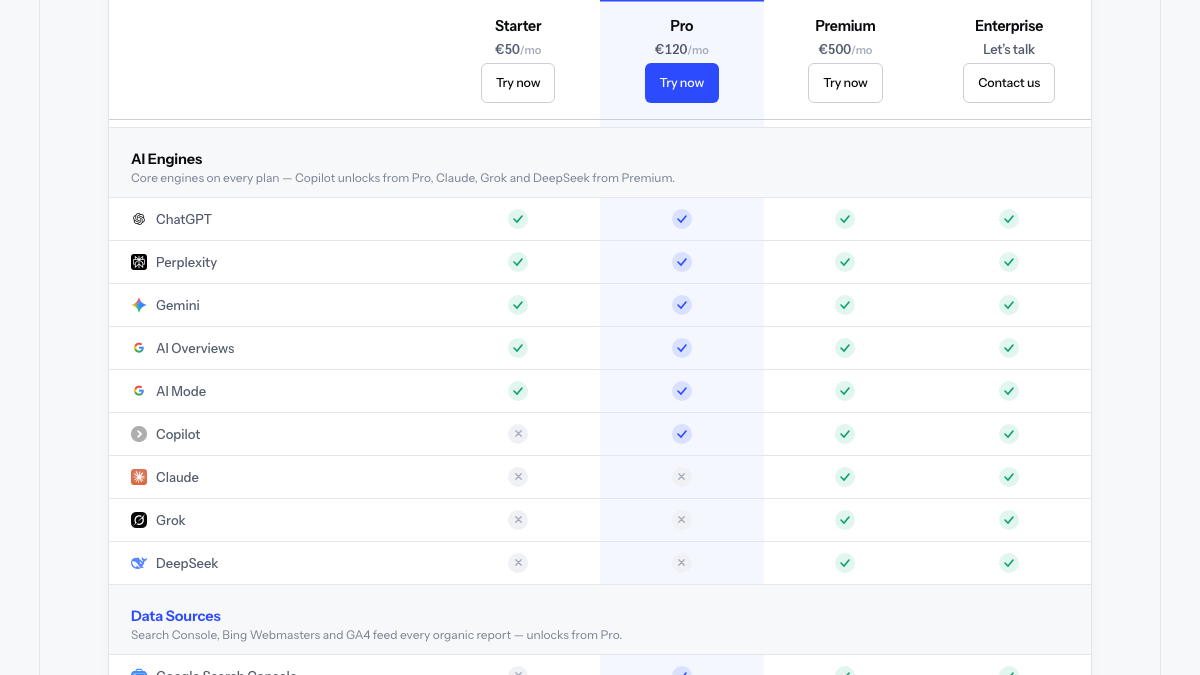
That table holds the detail store owners miss. Claude, Grok and DeepSeek aren't on Starter or Pro. A line on AmICited's homepage says every plan includes the full engine list, but the table says otherwise, so ask support before you pay if one engine matters to you.
How often does ChatGPT mention your brand?
Most founders have no idea. The answer might surprise you.

What gets a store named in ChatGPT
Start with what's at stake. Adobe Analytics reported in late October that September's AI-referred shoppers brought in 83% more revenue per visit than other shoppers, as Search Engine Land covered.
How do stores get named? Our own October test gives one clue. We ran 10 everyday product questions through ChatGPT search and sorted every page it cited by owner. About seven in ten belonged to brands and retailers, mostly product pages with specs in plain text, and our ecommerce AI SEO write-up shows which ones.
Product pages are one lever, and AmICited's tools target them. Adobe's Q1 2026 report found the same weak spot from the other side. Its visibility checker scored retail homepages at 75% readable by AI models and product pages at 66%, according to a trade summary of the report.
Shoppers also ask "best X for Y" before they name a brand, so the guides and comparisons on your own blog matter too, along with mentions on other sites. On Google, store blog posts held about three in ten first-page results when we searched 30 shopping how-to questions on October 19, and our Frase comparison for Shopify has the detail. Replies under the candle owner's post split on this. One said AI answers follow what customers say about you more than your own pages. Another called AEO plain SEO plus PR.
So the guides and comparisons that answer category questions are the other lever, and that's the work we do. Neither tool writes your customer reviews.
Tracking: daily on credits or weekly on a flat plan
AmICited samples your prompts on a fixed daily schedule from clean sessions and stores each full answer. Starter has no daily schedule, so daily checks start on Pro. The catch is that credits meter every answer. AmICited's own pricing FAQ says one prompt checked daily on six engines uses about 180 answers a month, so the 120-credit Pro plan covers about 44 prompts that way.
We check 50 queries once a week on seven engines, and the price doesn't move with the number of answers. Our AI visibility tracking shows which engines named your store, who they named instead and which sources they pulled from.
Daily sounds better. Yet AmICited's FAQ says most brands see movement two to six weeks after shipping a fix, which is slower than a week. AmICited's founder also wrote on X in August that every tool in this space, AmICited included, measures proxies. The clean prompt you track never reaches the model the way a real person's does once memory loads.
That caveat covers our weekly checks too. Read either tool as a trend over a month, not as a score for today.
Who writes the guides, and who gets them live
Both tools write content. They differ in what happens after the draft.
AmICited's content writer drafts product pages, comparisons and buying guides aimed at up to five tracked prompts, and it scores the draft live in red, amber and green bands. Its page is plain about the next step. Nothing publishes automatically, and you export Markdown, HTML, PDF or DOC into whatever process updates your store.
We plan titles from the questions your buyers ask, write each article against the pages already ranking, and score it for how easily AI engines can quote it, with a fix list. Then we publish it. Our content engine writes up to 100 pages a month, and auto-publish is off until you turn it on.
| One buying guide | AmICited | RankControl |
|---|---|---|
| Pick the topic | Losing prompts feed a content plan | Titles planned from your buyers' questions; you approve |
| Draft | Scored live against up to five prompts | Written against what already ranks, scored for quotability |
| Review | Every draft waits for you | You read it first unless auto-publish is on |
| Get it on the store | Export, then paste | Native post in your Shopify blog |
| Links | Not covered | Outreach drafted from your own mailbox |
The Shopify setup is small. You create a custom app in your Shopify admin with two content permissions, paste its credentials into RankControl and pick the blog. After that, articles go live as native posts and an edit revises the same post. The connection reaches blog content only. We don't touch your product pages or your product feed, and our Shopify and ChatGPT product answers guide covers that side.
For product text, AmICited's ecommerce page describes a citation score for each product, a live score while you rewrite, and approved text pushed back to your store.
Orders and revenue
AmICited puts revenue up front. Connect Shopify, WooCommerce, Magento 2, Shoptet or BiznisWeb on Pro or above, and AI-assisted sessions get matched to real orders. It labels the result as directional estimates with the method and confidence shown, which fits how fuzzy this kind of attribution is. Ad accounts for Google, Meta and LinkedIn can sit beside it.
With Google Analytics connected and key events marked, our analytics show what AI visitors did on your site. That means key events, the key event rate and revenue, plus a list of the pages AI visitors land on. We don't match an order to the prompt that sent it, and we have no ad data or per-product margin.
Test your store before you pay for either
You can learn a lot in an afternoon for free. Write 15 questions a shopper would type about your category, in their words and not yours, and run them in ChatGPT and Perplexity from a private window. Open the sources panel on each answer.
Note three things. Does your store appear, which of your pages did the engine read, and is the price or spec on that page current? The candle owner's year-old description is the kind of thing this catches, and the cause is usually an old page still live somewhere.
A camping gear owner in r/ecommerce had a different puzzle. A newer rival with fewer reviews kept showing up ahead of them in ChatGPT. One reply said to open the page ChatGPT cited for that rival and check whether it states the answer in plain text while yours shows it in photos.
AmICited's free trial covers 3 prompts on one domain, so a manual run like this is a bigger sample than the trial gives you. If you'd rather not copy answers into a spreadsheet, our free AI visibility check reads your domain without a signup.
RankControl vs AmICited: what each costs for a store
| What a store needs | AmICited plan | Price a month | RankControl |
|---|---|---|---|
| ChatGPT, Perplexity, Gemini and Google's AI on one domain | Starter | €50 | Included |
| Shopify orders, Search Console and GA4 | Pro | €120 | Search Console and GA4 connect; no store orders |
| Claude, Grok and DeepSeek, plus white-label reports | Premium | €500 | Claude and Grok included; no DeepSeek or white-label reports |
AmICited's Starter allows one domain, 200 prompts, 10 competitors and one team member. Pro raises that to five domains, 800 prompts, 30 competitors and ten members. Prices exclude VAT, and its terms say payments are non-refundable with no credits for partial periods. Our refund policy is similar, with no pro-rated refunds.
Pro is the plan most stores would need, and at €120 it costs well under ours. It also lists up to 120 AI articles a month. Articles and agent runs draw on the same credits as AI answers, and the pricing page doesn't say how many credits an article uses, so ask before you plan around 120 drafts.
Our plan is $400 a month, or $4,000 a year with two months free. The 7-day trial runs the whole plan on your own 50 queries, where AmICited's trial covers 3 prompts, enough to see one or two questions and not a catalog. The plan covers up to 100 pages a month written and published, seven engines, outreach drafts and five seats.
15 hours a week manually. Or 15 minutes with RankControl.
Track citations, monitor competitors, and fix content gaps across every AI search engine. Automatically.

When AmICited fits better
A Shopify or WooCommerce store with a big catalog that wants product descriptions scored and pushed back to the store, and orders tied to AI visits, fits AmICited better. Its Pro plan adds the store connection from €120 a month, per its pricing page checked November 6, 2026.
Which wins for getting a store named in ChatGPT
For a store that wants the work done, RankControl is the pick.
Product pages are one lever, and AmICited is built for them. The other lever is the stream of buying guides and comparisons that answer what shoppers ask before they pick a brand, plus the links and mentions around them. We write those articles, publish them to your Shopify blog, draft the outreach and check seven engines each week. Neither tool can promise a ChatGPT mention, and the answers shift between runs and between people.
In the first month you get a calendar of titles, articles going live on your schedule and four weekly readings of where your store shows up. Already on AmICited? Our guide to switching from AmICited without losing data covers exports, cancelling and what to unplug.
You can do all of this by hand. Write the guides, paste them into Shopify, pitch the sites that list your category, and rerun your buyer questions on seven engines every week. Or RankControl's agents can do it for you every month while you focus on your products.
AI search traffic grew 835% this year. Is your content ready?
RankControl generates 26 content formats optimized for ChatGPT, Claude, and Perplexity. Published on your domain, matched to your brand.