In July, someone on r/SEO asked the question that sits under every guide to natural backlinks. They were helping a relative whose direct rivals had 500 to 1,000 backlinks, while the site had three. Cold email felt pointless, since replies are rare, so they asked how to get 5 to 10 good links a month.
How do you get backlinks?
Hi everyone, I'm helping a relative with their SEO and content, and I'm trying to figure out the best approach to building backlinks. On one hand, the general consensus is that you shouldn't buy links and that it can harm your rankings. But...
The top reply listed four ways to get links. The first was to do nothing and let people link to you, with a short note in brackets saying it works "when you are already on page 1." Most guides on this topic leave that bracket out.
This guide covers the passive side only. It looks at what Google counts as a natural link, how writers find the pages they cite and which content earns links on its own. Then it covers how long it takes and where the idea breaks down. Sources were checked on October 19, 2026.
What a natural backlink is
A natural backlink is a link another site adds because its writer wanted to send readers to your page. Nobody paid for it, nobody swapped for it and you didn't place it yourself. People also call these editorial backlinks.
Google doesn't use the term. When I read its spam policies on October 19, last updated August 28, 2026, the word showed up only as "unnatural," in the section on keyword stuffing. The policy defines the opposite instead. Link spam is "creating links to or from a site primarily for the purpose of manipulating search rankings."
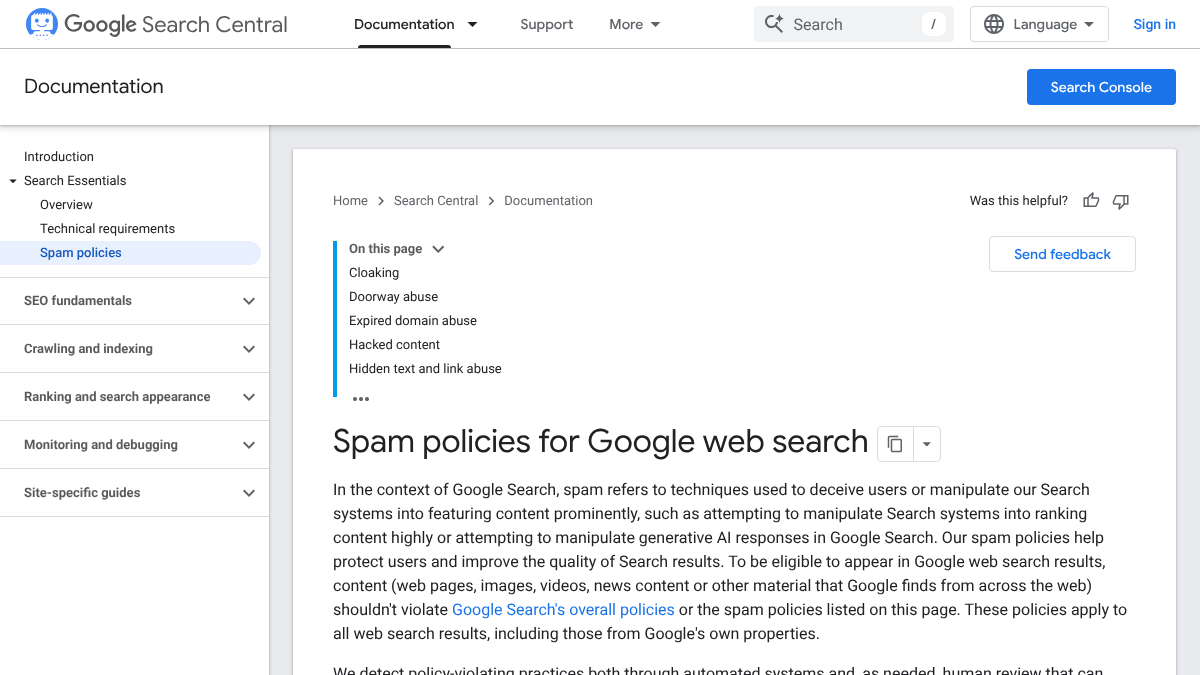
Google's link best practices, last updated December 10, 2025, show the same thing from the side of the person adding the link. They say external links "can help establish trustworthiness (for example, citing your sources)." Paid links should carry rel="sponsored" or rel="nofollow", and links that users add, such as forum posts, should carry ugc.
Read together, the two pages describe a natural link as a citation, added by a writer who needed a source and picked yours.
What Google treats as natural, and what it doesn't
"Natural" and "passive" aren't the same idea, and Google only cares about the first one.
| Link | Natural under Google's policy? | Why |
|---|---|---|
| A reporter cites your survey after finding it in search | Yes | The writer chose it to support a claim |
| A blogger links your study after you emailed them | Yes | Asking is fine, the choice was still theirs |
| A paid post with a followed link | No | Buying links for ranking is link spam |
| A free product sent in exchange for a review with a link | No | The policy lists this by name |
A sponsored link marked rel="sponsored" | Allowed | It's an ad and passes no ranking credit |
| A keyword-stuffed link in your own forum signature | No | Optimized links in comments are link spam |
So outreach doesn't make a link unnatural. Payment and manipulation do, and so does placing the link yourself. Back in 2013, Google's John Mueller said press releases should be treated as advertisements, with their links nofollowed.
The rest of this post sticks to links that arrive with no ask at all. For the asking side, our guide to white hat link building shows where 12 small businesses' real links came from.
How writers find the pages they link to
Writers link when they need proof for a sentence. A reporter writing "most small firms now use AI for X" needs a number and a page that holds it, and they need it before the deadline.
Some of those sources arrive by pitch. Cision's 2026 State of the Media report surveyed 1,899 journalists in January and February and was released on May 13. It found two in three rely on PR content for story ideas, and original research and expert access were what they valued most in a pitch. Cision sells PR software, so keep that bias in mind.
The survey asks about pitches, though. It doesn't ask how a reporter finds a number when nobody sent one, which is the step natural links depend on. For that step, the best evidence comes from people who run these pages.
One SEO on X said they looked at 80 searches for "[industry] statistics [year]" and saw small sites with no links ranking fast, with journalists then linking to those pages. Another person on X shared a client case in the HR niche, where statistics roundup pages earned links from 71 sites without a single outreach email. Both are self-reported, but they point the same way. A writer searches, takes a top result and links to it.
That's why statistics pages come up so often in this topic. Our guide to statistics and data roundup posts covers how to build one that stays worth citing.
See your first AI citation report in under 5 minutes.
No setup calls. No onboarding meetings. Connect your domain and see where AI mentions your brand right now.

Which content earns natural backlinks
The biggest study on this is old. Backlinko and BuzzSumo analyzed 912 million blog posts, published in February 2019, before AI answers changed search. The two Reddit threads in this post say much the same thing.
Almost nothing earns links. The study found 94% of posts had zero external links, and only 2.2% earned links from more than one site. Long posts did better, with pieces over 3,000 words earning about 77% more links than posts under 1,000. "Why" and "what" posts and infographics earned about a quarter more links than how-to posts and video.
Shares didn't help either. The study found "virtually no correlation" between backlinks and social shares. A post can go viral and earn nothing, while a dry data page picks up links for years.
I'd read those numbers with two caveats. The data is seven years old, and it's a correlation, so long posts may earn more links partly because big sites write long posts. Still, the 94% figure is hard to argue with.
Which type of page to build is its own decision. Our guide to linkable assets compares the main types and how to pick one. Here the question is narrower. Will a writer who lands on the page find a fact they can't get elsewhere?
A second r/SEO thread, from September, asked how to get lots of links without paying a few hundred dollars per link.
How to get a ton of backlinks the legal way?
I partnered with a marketing company - didn’t have to pay - and they got me links all over the place. My score went up like a lot. Also got myself submitted to startup directories. That helped. Any other tricks on how to get a bunch of link...
The top reply said the only legal way to get links at scale is to give people a reason to cite you, with data, a useful tool, a strong opinion backed by numbers or real news. It said directories and generic submissions "plateau fast." Further down, one commenter said publishing a real study had earned them 3,200 backlinks, a number nobody can check.
The catch is that rankings come first
Back to that bracket. If writers find sources through search, a page that doesn't rank isn't found, and a page that isn't found earns nothing. I call this the page-one gate. Natural links mostly go to pages that already sit near the top for the term a writer searched.
So I'll say it plainly. A low-authority site rarely earns links with no promotion at all. Publish-and-wait works for sites that already rank for the terms writers search.
The same July thread had a few people who disagreed. One said they'd stopped building links for clients six months earlier and that strong content earned natural links "even for a new site." Another said their agency ranks first for its niche with a hundredth of their rivals' backlinks. Read the whole comment, though, and their plan was writing for niche publications, which is promotion. Neither gave numbers you could check.
There are two ways through the gate. One is to target terms a small site can rank for, which is why narrow statistics pages keep coming up. The other is to push the page up first, so it's there when writers search. For a single post that needs that push, our guide to getting backlinks to blog posts has a fit test for each tactic.
A realistic timeline for natural backlinks
No good study measures the time to a first natural link. One agency guide that ranks for this term says results "typically appear around 3-6 months" but gives no method, so treat any number like that as a guess.
What you can map is the order things happen in.
| Stage | What happens | What it depends on |
|---|---|---|
| Publish | The page is live but nobody finds it | Being indexed and covering a real search |
| Climb | It moves toward page one for a narrow term | Competition, internal links, any early links |
| First citations | Writers searching that term start linking | Having a fact they can't get elsewhere |
| Build | Each link helps it rank, which brings more links | Keeping the data current |
The last row is why patience can pay off. A page in the top three for "[industry] statistics 2026" is the page most writers searching that term will see, and each link helps it hold the spot. The loop breaks when the data goes stale. Once the year in the title is out of date, writers move to a fresher page.
By our rough estimate, a solid statistics page takes 10 to 20 hours to research and write, plus an hour or two a month to keep current.
Your competitors are building backlinks while you read this.
Organic outreach, social mentions, and citations from Editorial Circle member sites, with managed backlinks available as an add-on. Grow your domain authority without running the campaign yourself.

Why a mention can count as much as a link
Some writers will name your brand or your data and skip the link. That used to feel like a lost link. It counts for more now, because AI engines read the article either way.
Muck Rack's Generative Pulse report from May 2026 looked at more than 25 million links in ChatGPT, Claude and Gemini answers. Earned media made up 84% of the citations, and paid content just 0.3%. Muck Rack sells PR software too, so a result that favors earned coverage suits it.
An Ahrefs study of 75,000 brands points the same way. Brand mentions tracked visibility in AI Overviews much more closely than backlinks did, at a correlation of 0.664 against 0.218. Our piece on brand mentions vs backlinks covers what that means for where you spend time.
When to stop waiting and promote
Passive and active link building work best together. Google's policy is about payment and manipulation, not about whether you asked. So the fastest route to natural links is often a short burst of promotion that gets the page onto page one, after which the passive links start.
For a data study, that burst usually means pitching it to the reporters who cover the topic, which our guide to digital PR backlinks walks through. For the wider set of methods and the time each one takes, see how to build backlinks.
Done by hand, this is a lot of work. You research and write pages worth citing and publish them. Then you find the sites that cover each topic and write the emails and follow-ups.
You can do all of it yourself. Or RankControl can take the steady part off your plate. We write articles and publish them on your own site, which gives you pages that can earn links once they rank. Our outreach finds link prospects for each published article and drafts emails from your own mailbox, and follow-ups stop as soon as someone replies. We offer one flat plan at $400/mo with a 7-day free trial.
You're getting AI traffic. But do you know where it comes from?
RankControl credits every visit to the assistant that sent it: ChatGPT, Perplexity, Claude, Gemini, Copilot, or Grok. Full source attribution, next to your Google traffic.