Yes. Since August 14, 2026, Claude has put a watermark in the text it writes. Anthropic announced it that day, saying future Claude models would generate text that contains a watermark, and that it was doing so to comply with the EU AI Act. On November 3, it added the watermark to several older models too. Developers had noticed it earlier. On September 22, a post on r/ClaudeCode warned that Opus 5.5 was watermarking its text for every user worldwide, including outside the EU, and that only a few partners could check it.
The watermark isn't a hidden character or a label, and you can't check for it yourself. On October 30, a post on r/ClaudeAI titled "Claude now watermarks everything it writes, and you're the one who can't check" passed 6,000 upvotes and 1,672 comments.
Claude now watermarks everything it writes, and you're the one who can't check
Starting November 3, Anthropic extends its invisible text watermark to Mythos 5, Opus 4.7, Opus 4.6 and Sonnet 4.6. Every model released since August already has it. It applies worldwide, not just in the EU, and paying users can't opt out....
How does Claude's watermark work?
It changes which words Claude picks, not what Claude says. A model like Claude writes by choosing each next word from a set of likely options. Anthropic's explainer says the watermark only changes the source of the randomness used to make that choice, so the choices follow a pattern that Anthropic's secret key can spot later.
The method is a version of SynthID-Text, which Google DeepMind published in Nature in 2024. Anthropic says readers can't tell watermarked text from text without it, and that it costs no extra tokens. It also carries no identifying information, so it can't be traced to a person, a company or a chat.
The pattern lives in word choice, so it travels with the text when you copy and paste it. It also only covers words Claude chose. Anthropic says that when Claude lightly proofreads a person's writing, there's very little for the watermark to attach to.
Which Claude models have the watermark?
Most current ones. Anthropic's help page lists 12 models with the text watermark, including Opus 5.5, Sonnet 5.5, Haiku 5.5, Opus 4.7 and Sonnet 4.6. Four older models still don't have it.
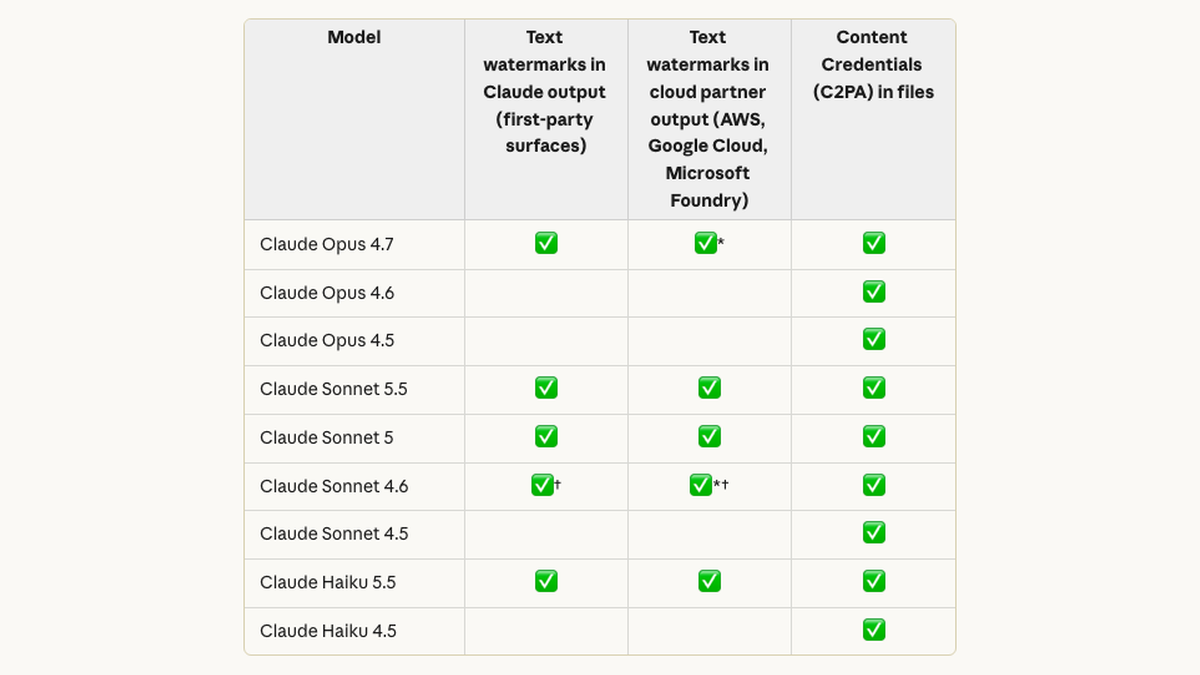
Opus 4.6, Opus 4.5, Sonnet 4.5 and Haiku 4.5 only add Content Credentials to files Claude creates, not a watermark in text. Anthropic says it's still working on those. Sonnet 4.6 has a footnote, since its text may not carry the mark reliably when temperature or other sampling settings are changed from the defaults.
The r/ClaudeAI post listed Opus 4.6 among the November 3 additions, but Anthropic's own table doesn't tick it. The watermark also applies on Claude's apps, the API and the cloud platforms, and Anthropic said its rollout on Amazon Bedrock would finish by November 10.
Does Claude hide characters in its text?
No. Anthropic says there are no hidden characters, and my own test agreed. On November 4, I had two Claude models, a Haiku and a Sonnet, write 16 short pieces of everyday SEO copy, such as meta descriptions, an FAQ and an onboarding email. That came to 3,242 words. Then I checked every character for zero-width spaces, narrow no-break spaces and other invisible marks.
There were none. The only characters outside plain ASCII were 35 em dashes, 7 en dashes and 8 check marks. To make sure the scan worked, I ran it on a file with four invisible characters planted in it, and it caught all four.
The hidden-character idea started with ChatGPT, not Claude. In April 2025, a company called Rumi found OpenAI's o3 and o4-mini models adding narrow no-break spaces to longer answers. OpenAI put it down to a quirk of its training, not a watermark, and it went away within days. A character scan also can't find a word-choice watermark, so a clean result doesn't tell you anything about that.
See your first AI citation report in under 5 minutes.
No setup calls. No onboarding meetings. Connect your domain and see where AI mentions your brand right now.

Can you check whether text has Claude's watermark?
Not yourself. Anthropic's detection tool is a private preview for groups the EU law names, such as regulators, law enforcement, media, fact-checkers, researchers and schools. Some companies with their own compliance duties can apply too. Its free checker reads Content Credentials in files, not text.
Even a positive result only says Claude was likely involved, not how much it wrote. Anthropic also says detection doesn't work well on short passages, and a negative result doesn't prove a person wrote the text.
Third-party AI detectors don't have Anthropic's key, so they can't read the watermark either. They guess from writing style, which has its own problems. In August, a marketer ran blog posts they wrote years before ChatGPT through AI detectors, and almost every one came back as AI.
Houston, we have a serious AI content detector problem. As a quick experiment tonight I ran several blog posts, podcast summaries I published long before generative AI such as ChatGpt or Claude.. Almost every one of them failed the AI detector tests. WHY? Because my blog, https://t.co/40A3e0l640
 Pam Moore@PamMktgNutAug 13, 2026
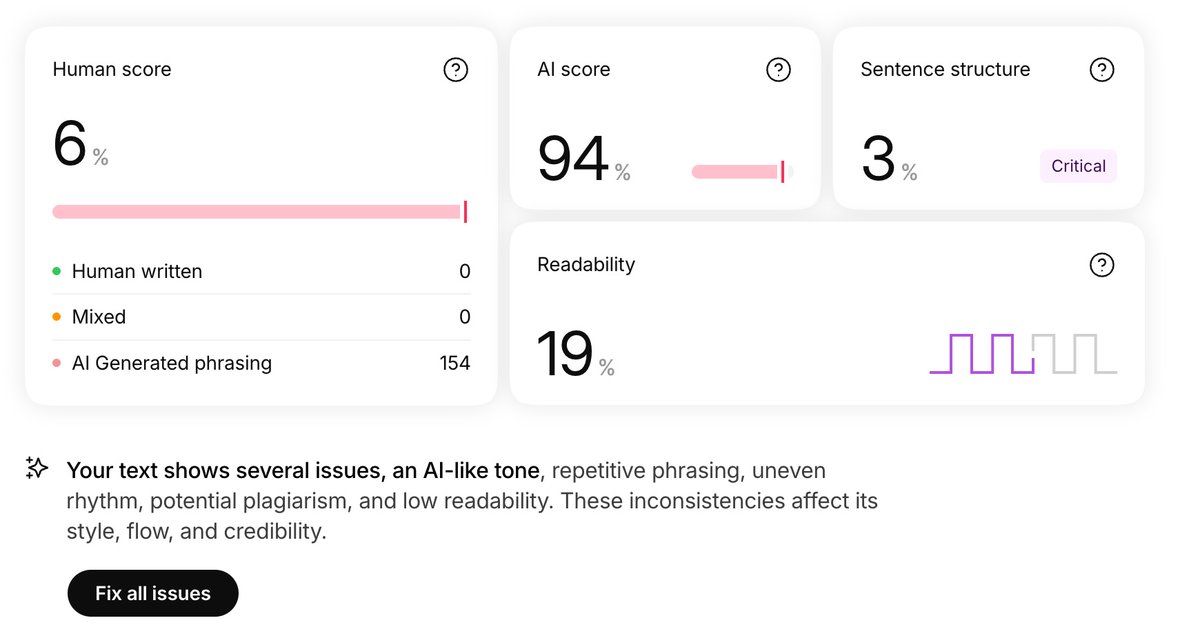
Detectors also disagree with each other. Originality.ai said this fall that it flagged 325 of 327 Claude Opus 5.5 responses, though its test had no human-written samples to check false alarms. When I ran 766 words of my Haiku copy and 833 words of my Sonnet copy through undetectable.ai, it scored them 41% and 39% AI and labelled both "human written." Our post on whether Google can detect AI content covers detector accuracy in more depth.
Why is Claude doing this now?
Because of EU law. Article 50 of the EU AI Act applies from August 2, 2026. It requires AI providers to mark synthetic text, images, audio and video in a machine-readable way. Providers whose systems were on the market before that date have until December 2, 2026 for the marking part.
The European Commission published a voluntary Code of Practice for this in June. Under it, free-form text longer than 200 tokens gets an invisible watermark. Anthropic says it signed in July, along with about 190 other organizations, and that it applies the watermark worldwide because it can't yet limit it by region. The other big providers went their own way.
| Provider | Text watermark | Where it applies | Can you check it yourself? |
|---|---|---|---|
| Anthropic (Claude) | Since August 14, 2026 | Worldwide, apps and API | No, private preview |
| Google (Gemini) | SynthID Text, since 2024 | Gemini app and API | No, Google's public detector covers images, video and audio |
| OpenAI (ChatGPT) | Since October 5, 2026 | ChatGPT and Codex in the EU, API opt-in | Not found |
OpenAI was open about the weak spots. In its own test, swapping 10% of the words for synonyms cut detection from about 92% to about 66%, according to TechCrunch's report.
What does the watermark mean for SEO content?
For Google rankings, probably nothing. Google's guidance on generative AI content, last updated October 1, says using AI is fine. Mass-producing pages without adding value for users may break its scaled content abuse policy, however they were made. Google also says to fact-check and review all AI-generated content before publishing. I found no Google statement saying it reads text watermarks as a ranking signal.
The EU rule matters more for some publishers. Article 50 also says that anyone who publishes AI-generated text to inform the public on matters of public interest has to disclose it. That doesn't apply when the text has had human review or editorial control and a named person or company holds editorial responsibility for it.
The Commission's guidelines draw the line with examples. Ads and product descriptions are outside the rule, unless they make health, safety or sustainability claims. A lifestyle article comparing diets for a disease is inside it. Spell-checks, grammar passes and quick sign-offs don't count as review, and a heavy AI edit after a human signs off cancels the exception. This isn't legal advice, so check with a lawyer if you publish health, finance or policy content in the EU.
For most SEO teams, the practical answer is the same one Google gives. Have a person fact-check and edit every page, name who's responsible for it, and don't run a final AI pass after that review. Rewriting text to strip the watermark doesn't help rankings, since Google says it judges the page, not the tool. The Code of Practice also commits its signatories not to sell or promote tools built to remove these marks, so don't expect that from a mainstream vendor. Our post on scaled AI content and Google penalties looks at what does get sites in trouble.
Your competitors are building backlinks while you read this.
Organic outreach, social mentions, and citations from Editorial Circle member sites, with managed backlinks available as an add-on. Grow your domain authority without running the campaign yourself.

Doing it by hand or with help
My estimate for a real fact-check and edit of a 1,500-word AI draft is 30 to 45 minutes, longer for health or finance topics.
You can do that in any editor. Or RankControl's content engine can write articles in your brand's voice and publish them as native posts on your own site. With auto-publish switched off, each article waits as a draft you can read, edit and fact-check before it goes live. Our guide to the AI content publishing workflow shows the steps from draft to live article.

You're getting AI traffic. But do you know where it comes from?
RankControl credits every visit to the assistant that sent it: ChatGPT, Perplexity, Claude, Gemini, Copilot, or Grok. Full source attribution, next to your Google traffic.