
In a July thread in r/3PL about how warehouses win new clients, a reply from a Tampa 3PL named a channel that barely existed a few years ago. Their main source of leads was organic search and AI results, backed by a well-maintained Google Business Profile, with a few referral partners such as a local trucking company adding more.
How do you get new 3PL clients?
Hi everyone, I'm curious how other 3PL companies consistently bring in new customers. What channels have worked best for you? Cold outreach (email/calls)? Referrals? LinkedIn? Google Ads or SEO? Trade shows? Partnerships? Freight brokers or...
That fits what we found when we looked at AI search for logistics directly. On September 27 we checked Google's AI Overviews and AI Mode for 20 searches that logistics buyers make, from "how much does a 3pl cost" to "drayage companies" and "best transportation management system." An AI Overview appeared on 19 of them. This playbook covers what those answers cited and six plays for getting a 3PL, forwarder, broker, carrier or logistics software company named. It also covers how the plays change by business type and how to measure progress.
What AI answers cite for logistics searches
The 17 AI Overviews that listed sources cited 200 of them. They split into four groups:
| Source type | AI Overviews (200 sources) | AI Mode (56 sources) |
|---|---|---|
| Logistics companies' and logistics software vendors' own pages | 98 | 29 |
| Google's own business listings | 43 | 0 |
| Video and social, mostly YouTube and Reddit | 43 | 8 |
| Industry lists, trade media, directories and government pages | 16 | 19 |
The biggest group is good news for providers. Nearly half the sources were pages that logistics companies wrote themselves: pricing guides, lane pages, service pages and comparison posts. For "flatbed trucking companies," seven of the twelve sources were carriers' own websites, four of them flatbed service pages.
The pricing search showed the pattern most clearly:
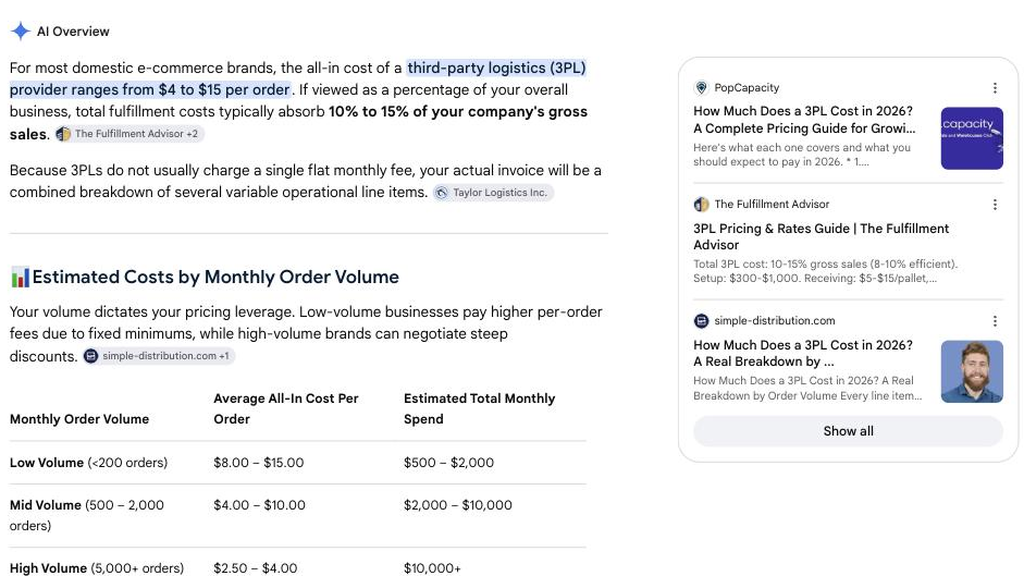
That overview cited 24 sources, and 18 were pricing pages or guides published by logistics providers and logistics software vendors. Three were written for Australian or Canadian prices, even though the search ran from the US, so the ranges a US buyer reads may partly reflect other markets.
Two other groups behave differently. YouTube supplied 26 sources, and only one of those videos ranked in the organic top 10 for the same search. AI Mode leaned on industry lists far more than AI Overviews did: 19 of its 56 sources came from Transport Topics' top 100 rankings, Gartner's review pages, Supply Chain Digital's top-ten lists and similar pages. On AI Overviews that group was just 8%.
Why logistics sites get skipped
Most logistics websites were built to generate phone calls, and that shows in three habits.
Pricing sits behind a quote button. "Request a quote" is the right call to action, but what can an engine cite when a buyer asks what something costs and the site gives no ranges, minimums or fee structure? We call this the quote-button gap: the provider that hides its numbers loses the answer to the one that published a pricing guide.
Capabilities are written as slogans. "End-to-end supply chain solutions" describes every provider on the market. A buyer asking which 3PL handles hazmat, or which forwarder covers a particular port, needs a specific answer, and the engine looks for pages that give one.
Lanes and locations go unnamed. A forwarder that ships from Shenzhen to Los Angeles every week often has no page that says so. Four of the ten sources Google cited for "best freight forwarder from china to usa" were lane pages built for exactly that route.
Worth noting: none of this needs a new website. Each fix is a page or a profile that most companies can add in a week or two.
Your competitors are building backlinks while you read this.
Organic outreach, social mentions, and citations from Editorial Circle member sites, with managed backlinks available as an add-on. Grow your domain authority without running the campaign yourself.

Six plays for logistics AI search, in order
These are ordered by how often the pattern showed up in our check and how quickly a small team can act on it.
1. Publish your numbers
Put typical price ranges on your site, even if every quote is custom. For a 3PL, that means per-order pick and pack ranges, storage per pallet, receiving fees and monthly minimums. For a broker or carrier, it can be what drives a rate up or down on your main lanes.
Buyers want this too. In an r/smallbusiness thread on choosing a 3PL, the most practical reply said to ask for a full rate card and model receiving fees and storage minimums against real order volume. A pricing page that shows those line items answers the question before the sales call, and it's the kind of page the 3PL cost overview quoted.
2. Write capability facts in plain sentences
List the things buyers filter by: certifications, special handling, integrations and cutoffs. Food-grade storage, hazmat handling and bonded space each deserve their own section with the details. The same goes for FDA registration, store integrations and same-day cutoff times.
An r/ecommerce buyer looking for a 3PL in July asked for one that would hand-label thousands of small products without barcodes and ship the same day. That's the level of detail AI answers are built from. Our manufacturer playbook covers the same problem for spec sheets locked in PDFs.
3. Build lane, port and location pages
Give each main lane, port or warehouse location its own page with transit times, modes, the documents involved and who it suits. For drayage, a port-city page did the work: one Houston drayage company's city page was cited for "drayage companies."
Write each page for real. A set of city pages with only the city name swapped is what Google's scaled content abuse policy targets, and it won't give an engine anything new to cite.
4. Treat your Google Business Profile as a source
This one surprised us. On three carrier searches with a map pack, 43 of the 64 AI Overview sources linked to Google's own business listings, not to websites. Those searches were "ltl freight shipping companies," "cold chain logistics companies" and "flatbed trucking companies."
Pick the categories that match each service, list the services, keep hours and service areas current, and ask shippers for reviews that mention the lane or service. Keep your company name the same on your profile and website as it is in FMCSA records and the directories you appear in. Our guide to Google Business Profile signals in AI citations covers which fields matter most.
5. Get onto the lists engines read
For "cold chain logistics companies," the answers cited the Global Cold Chain Alliance's top 25 list and Transport Topics' refrigerated rankings. Drayage answers cited Transport Topics' intermodal lists from three different years. Software searches pulled in Gartner's review pages and Forbes Advisor roundups.
Many of these lists are built from data that companies submit, and review sites depend on customer reviews. Find the three or four that cover your segment, check the deadlines, and submit accurate figures. A place on one of them feeds AI Mode, which leaned on this kind of source about four times as often as AI Overviews did.
6. Explain the work on video
YouTube supplied 26 of the 200 AI Overview sources, and almost none of those videos ranked in the organic top 10. Short explainers do well here: how freight class affects an LTL quote, what happens when a container reaches a 3PL's dock, or how a customs bond works. Our guide to YouTube descriptions that AI answers use covers how to write the text around each one.
You're getting AI traffic. But do you know where it comes from?
RankControl credits every visit to the assistant that sent it: ChatGPT, Perplexity, Claude, Gemini, Copilot, or Grok. Full source attribution, next to your Google traffic.
The playbook by business type
The six plays apply to everyone, but the starting point differs:
| Business type | Start with | What the check showed |
|---|---|---|
| 3PL and fulfillment | Pricing ranges and capability pages | 18 of 24 sources for the 3PL cost search were provider pricing pages |
| Freight forwarder or customs broker | Lane pages and plain explainers | 4 of 10 sources for the China-to-US search were lane pages |
| Freight broker | Service pages and industry lists | A broker's own service page and a top-brokerages list were both cited |
| Asset-based carrier | Google Business Profile and service pages | Carrier searches drew mostly on Google listings and carrier service pages |
| Logistics software (TMS, WMS, fleet) | Review sites and roundups | Answers cited Gartner, Forbes Advisor and vendors' own guides |
Software vendors also sit inside a much bigger research habit. G2's 2026 survey found 71% of B2B software buyers rely on AI chatbots somewhere in their research, so a TMS or WMS vendor's buyers are already asking these questions.
What to skip
A few tactics show up in logistics marketing that we'd avoid. City pages that differ only by name are the most common, and Google treats them as scaled content abuse. Buying placements on low-quality "top 10" lists that no engine cites wastes money you could spend on the industry lists above. Review gating, where only happy customers get asked for a review, breaks Google's review policies.
We'd also check that you aren't blocking AI crawlers by accident. Older firewall and bot-protection rules can shut them out without anyone noticing, and a blocked crawler can't read your pricing page. Our AI crawler list shows which bots to allow.
How to measure AI search visibility in logistics
Start with a fixed list of 30 to 50 questions shaped like your buyers' searches. Mix service questions ("3pl for supplements"), lane questions ("ocean freight from vietnam to savannah"), location questions and brand questions. Keep the wording frozen so week-to-week changes mean something.
Run the list weekly on ChatGPT, Perplexity, Google's AI Overviews and AI Mode, and the other engines your buyers use. Record whether you're named, whether your page is cited, and which competitors and sources appear. Our guide to checking AI visibility walks through doing this by hand.
Logistics sales cycles are long, so a quote request can arrive weeks after the answer that started it. Add "ChatGPT or another AI tool" as an option on your quote form's "how did you hear about us" question, and give it a quarter before judging the results.
Doing it yourself or handing it off
The six plays are mostly pages, profiles and applications, and the weekly checks are what show which ones worked. The time adds up.
Done by hand, checking 50 questions on seven engines takes about six hours a week, and publishing eight solid articles a month takes 16 to 24 hours more. Those are rough estimates.
RankControl's AI visibility tracking runs your 50 questions every week on seven engines, marks each one as mentioned, cited or both, and records which competitors and sources each engine used. The content engine writes each article against the pages already ranking for its keyword and publishes it on your own domain.
You can run this playbook yourself with a question list and a spreadsheet. Or RankControl's agents can run the weekly checks and publish the pricing, capability and lane pages while your team handles quotes and shippers.
We'll show you exactly where your brand stands in AI search.
No commitment. $0 due today, cancel anytime. See how ChatGPT, Perplexity, Claude, Gemini, Grok, Google AI Mode, and Google AI Overviews talk about your brand today.