
Search for "ai content score" on Google and all nine results on the first page are AI detectors, the boxes where you paste text to see how likely a machine wrote it. I checked on November 4, 2026. Our post on whether Google can detect AI content is the place for that kind.
This post is about the other kind, the 0 to 100 number or A to F grade that Surfer, Clearscope, Frase and similar tools show beside a draft while you write. It says how well your page matches the pages already ranking and, lately, how easy an AI engine would find it to quote.
I wanted to know whether that number predicts anything, so I built a simple version and scored 190 pages against live Google results. It found nothing, and the reasons are worth knowing before you spend an afternoon nudging a bar from yellow to green.
How is an AI content score calculated?
Most of these tools start from the pages already ranking for your keyword, pull out the terms and topics those pages share, and grade your draft on how many it covers.
Rank Math and Yoast skip the competitors and run a fixed checklist on your one page instead, with checks like the keyword in the title, links, readability and, in Rank Math's case, length.
| Tool | What you see | What it compares your draft with |
|---|---|---|
| Surfer | 0 to 100 | The top 20 ranking pages, plus an AI Search half that looks at facts and an early answer |
| Clearscope | A letter grade | Terms in competing articles, weighted 1 to 10 |
| MarketMuse | 0 to 100 | A 50-topic list, one point per topic and two at most |
| Frase | Three scores, 0 to 100 | Keywords and headings (SEO), answer-readiness (GEO), authors and sources (EEAT) |
| Rank Math | 0 to 100 | A fixed checklist with a word-count ladder |
I read each vendor's help page on November 4, 2026. Every score comes from comparing your page with other pages or a rulebook.
What do the tools say their own score means?
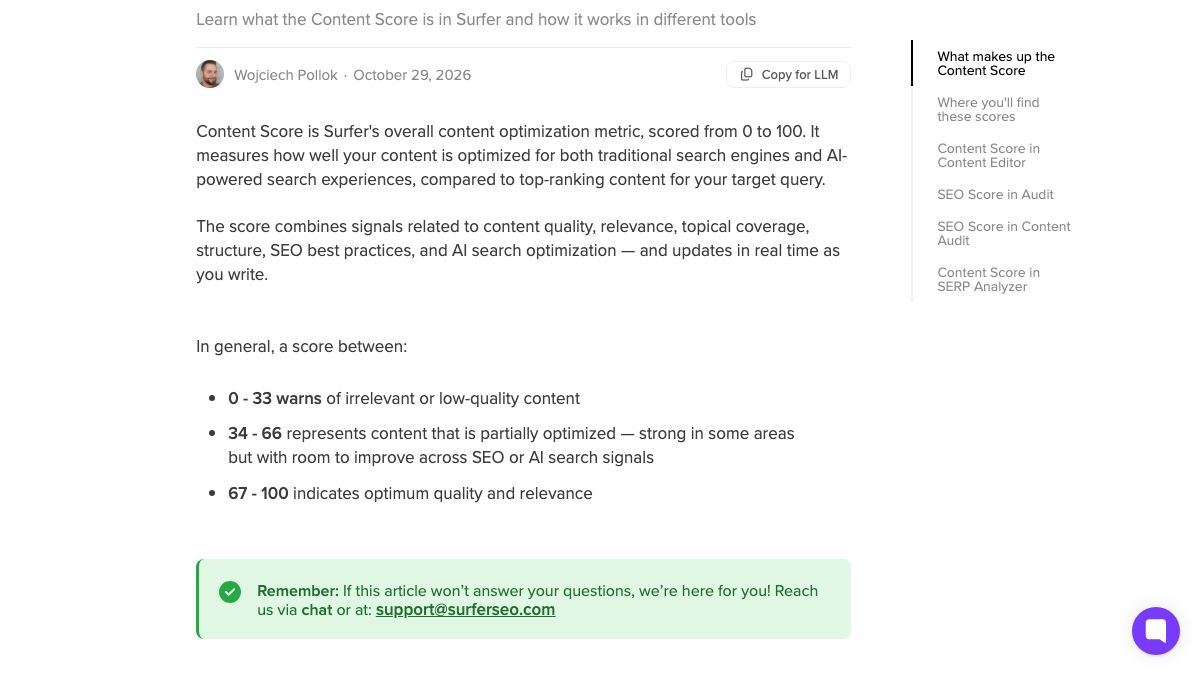
Read the help pages through and a pattern shows up, because the tools warn you off their own numbers. Surfer's FAQ, updated November 3, 2026, says to aim for 10 to 20 points above your main competitors and not to chase 100. Frase says "Don't chase perfect 100s." MarketMuse says "there is no perfect score."
Google is blunter. Its page on third-party SEO tools, updated June 5, 2026, says "Third-party tools don't have access to our internal ranking data" and can't guarantee performance. Another Google page, updated October 5, 2026, asks whether you're writing to a word count "because you've heard or read that Google has a preferred word count," and answers "No, we don't."
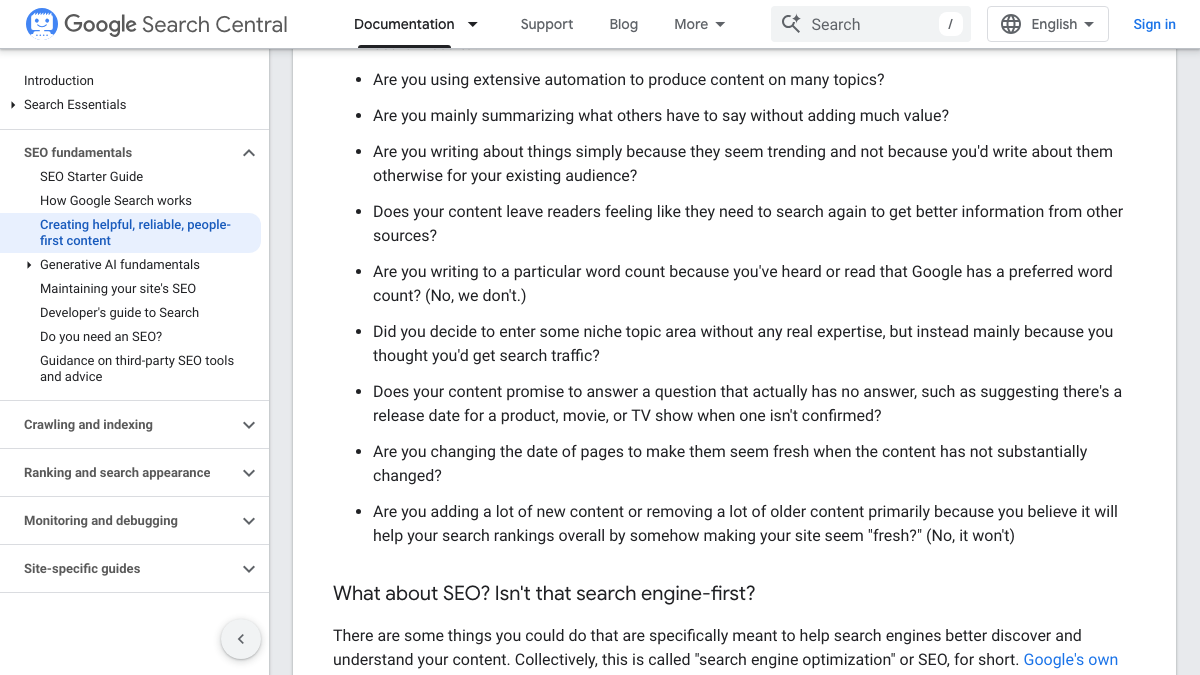
That sits oddly next to Rank Math's SEO score, where one test hands a post over 2,500 words full marks and one under 600 words nothing. The length ladder is the plugin's own rule. Google never asked for it.
Does a higher AI content score mean a higher Google ranking?
The studies I could find are below, and the first thing to notice is who ran them.
| Study | Who ran it | What it found |
|---|---|---|
| Surfer, September 2026 | Surfer, on 10,000 queries | 0.28 correlation between Content Score and position |
| Search Engine Journal, June 2024 | WLDM and ClickStream, with data pulled by Surfer | 0.18 in 2023 and 0.21 in 2024 |
| Backlinko, page updated April 2025 | Brian Dean, using Clearscope grades | One grade up is about one position up in the top 30, with no sample size given |
| Murrough Foley, April 2026 | A solo analyst, 44,000 pages | A weak link, and domain authority explained about half the model |
Two of the three studies that found a link were run by Surfer or used its data, and the third doesn't say how many pages it used.
That's no reason to throw them out, only to look for someone with nothing to sell. The closest I found was Foley's study, which had an AI model rate pages on effort and originality and not term coverage. The better-rated page ranked higher in about 60% of keywords, yet every content score together explained only about 7% of his model.
So I ran my own test, with a handicap I'll state up front. I took 70 searches from our November 4 pull of Google's live US results, fetched the pages ranking for each, and kept the 27 searches with enough readable pages. Then I built a score the way the help pages describe it.
A page's score is the share of terms most of the other ranking pages use that it uses too. It's cruder than any commercial tool and it isn't Surfer's or Clearscope's, so it says nothing about how well they work.
Across 190 pages, the score showed no link to where a page ranked. Reported the way vendors do it, where a positive number means higher scores rank higher, the average came out at -0.03, with a 95% range of -0.13 to +0.08.
Word count and heading count were just as flat. The score mostly turned out to be length, since within a search it moved with word count at 0.85, and with length taken out it still predicted nothing.
| Limit | Why it matters |
|---|---|
| 27 of 70 searches scored | The other 43 left fewer than six readable pages |
| One day, US, desktop | It's a snapshot and not a trend |
| 61% of top-three results readable | Forums, big brands and bot-blocked pages are missing |
| A small link stays hidden | A 0.2 correlation can't show up in 27 searches |
That last row matters most. Surfer's 0.28 comes from a million results, and 27 searches can't show a link that small, so read my result as "a simple version of the idea showed nothing I could measure" and not as "content scores don't work."
Your competitors are building backlinks while you read this.
Organic outreach, social mentions, and citations from Editorial Circle member sites, with managed backlinks available as an add-on. Grow your domain authority without running the campaign yourself.

Does a higher score mean an AI engine will cite you?
This is where the scores picked up new names in 2026. Surfer folded an AI Search Score into its Content Score on May 4, and Frase has a GEO score. Clearscope doesn't grade it, but flags the terms that show up in AI answers for your query.
| Score | What it says it checks | Evidence on the page |
|---|---|---|
| Surfer AI Search Score | Facts coverage and an answer that comes early | A Surfer study, which it calls correlational |
| Frase GEO Score | Direct answers, structure and question coverage | None, and it says to track real citations separately |
| Free readiness checkers | Schema, llms.txt, crawler access and similar | No test against real citations on the ones I read |
Surfer's study, updated September 17, 2026, found that pages which answer the query early were cited 45% of the time in Google's AI Overviews, against 23% for pages that didn't. It covered 10,000 overviews. I found no independent test of these scores against real citations.
Rank is a weak guide to citation anyway. Ahrefs reported in March 2026 that only 38% of the URLs in AI Overviews came from the top 10 results, across 863,000 keywords.
My own numbers are thin but point the same way. In the 25 scored searches where Google's overview listed sources, 27 of 176 pages were cited, too few to test the score itself. By position the cited share was flat, 16% for pages ranked 1 to 3, 14% for 4 to 6 and 16% for 7 to 10.
On r/GEO_optimization, a student team took an AI-search audit score from 34 to 88 in two days by adding an llms.txt file, an About page with authors and question-style headings. ChatGPT and Gemini still named the brand in none of six answers.
Student case study: we took an AI-search (GEO) audit score from 34 to 88 in two days
For a Digital Marketing class we built a microsite about a real jewellery collection (Indriya's Anantara temple jewellery) and optimised it for AI search tools like ChatGPT and Gemini. What moved the score most: - llms.txt and llms-full.txt...
It's a class project with six answers, so take it as a warning and not as proof. It fits Google's guide to AI features, updated July 10, 2026, which says Google Search ignores llms.txt files and that there's "no ideal page length." That covers Google only.
What does a content score miss?
It can't see the links pointing at your page, and domain strength carried about half of Foley's model. It also can't tell whether your page says anything new, since a score built from the current top results can only reward more of the same. A site owner on r/WebsiteSEO put it plainly after eight months on Surfer, saying that lifting a draft from 62 to 88 mostly made it look like the pages they wanted to beat. Some of their pages hit 90 and went nowhere, and a couple at 60 ranked fine.
Is the Surfer content score doing anything, or am I paying to copy the current top 10?
we've had Surfer on the account for about eight months and i still can't tell you if it's doing anything. my hesitation is that the score gets reverse engineered from whatever's already sitting in the top 10, so when a writer pushes a draft...
I'd call that the lookalike problem. It's one person's report and not evidence, but it matches how these scores are built. The benchmark also moves under you. Clearscope's support page says a draft's grade and its inventory grade can differ because "the SERP may have changed," and Surfer says the same page scores differently in its editor and its audit, since the audit reads menus and footer too.
How do you use a content score without chasing it?
Use the number to find gaps, then read the page yourself.
- Treat the score as a gap list. If every ranking page has a section on pricing and yours doesn't, that's worth fixing whatever the bar says.
- Aim above your competitors' average. Surfer and Frase both say so on their own help pages, and neither tells you to chase 100.
- Read your opening paragraph. Does it answer the query in the title? It costs nothing to check, and it's the one habit Surfer's study ties to citations.
- Measure what the score stands in for. Rankings in Search Console, citations across AI engines and AI referral traffic in analytics are the real results, and our posts on visibility score vs citation tracking and AI referral tracking in GA4 cover them.

You're getting AI traffic. But do you know where it comes from?
RankControl credits every visit to the assistant that sent it: ChatGPT, Perplexity, Claude, Gemini, Copilot, or Grok. Full source attribution, next to your Google traffic.
What does RankControl score, and what can't the score see?
We score every article we write for how easily AI engines can quote it, with a fix list. The same score is free for any URL on the GEO checker, and it's built from eight on-page checks.
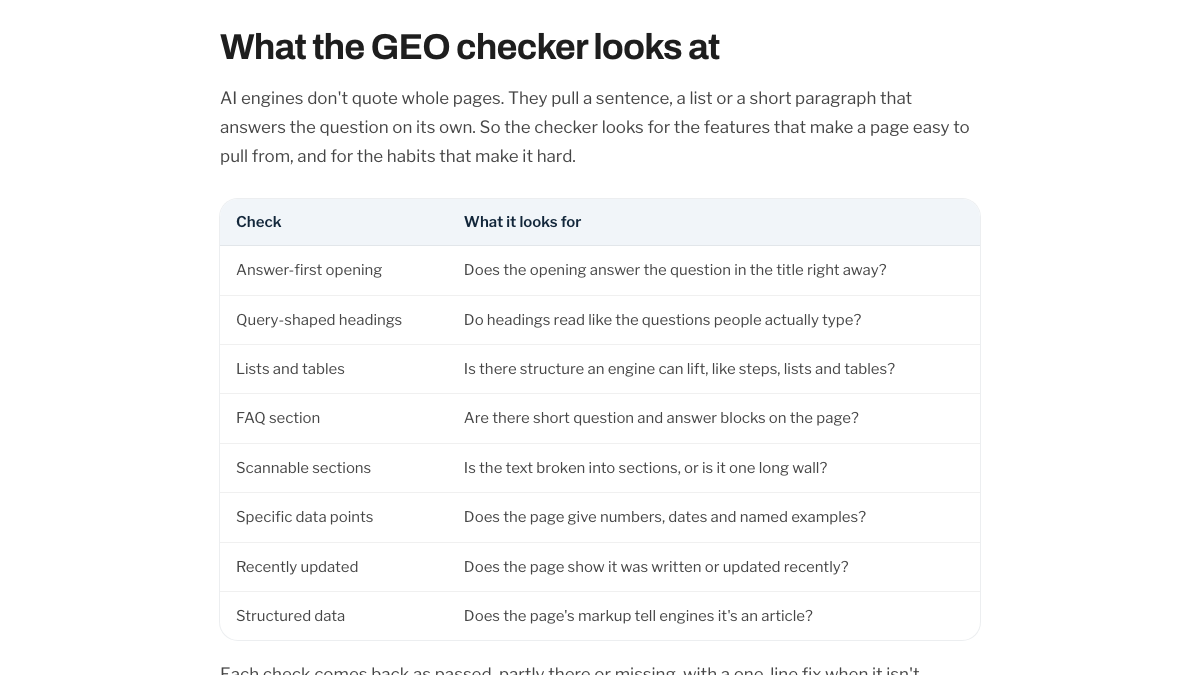
The page itself says the checker doesn't count the links pointing to your page and doesn't know whether AI engines already cite you. A high score also doesn't mean ChatGPT will quote the page. The page reports a test on 39 articles ranking in Google's top ten, where the middle score was 70, 79 for the top three spots and 65 for spots four to ten. It adds that this doesn't prove the score caused the ranking, and with 39 pages it's a hint.
RankControl's agents write each article, publish it on your own domain and then track the citations, rankings and AI-referred traffic that come back, so no page is judged by one number. You can run the free check by hand, or let the agents handle the writing, publishing and tracking while you work on your product.
We'll show you exactly where your brand stands in AI search.
No commitment. $0 due today, cancel anytime. See how ChatGPT, Perplexity, Gemini, Google AI Mode, DeepSeek, Google AI Overviews, and Bing AI Summary talk about your brand today. Add Claude and Grok with your own API keys.