
In early October, a travel agent posted in r/smallbusinessesowners about a client of two years who called about Japan. The client said ChatGPT had already planned most of the trip and asked the agent to just book the hotels. The agent wrote that they went from "the person who plans your trip" to "the person who clicks book."
My client told me ChatGPT planned half her trip before she called me.
So this happened with me last week and I just can’t stop thinking about it. A client I’ve worked for 2 years call me about Japan. Cool. Then she goes “I already had Chatgpt plan most of it, can you just book the hotels?” I said sure. Then s...
That story is the real brief for SEO for a travel agency in 2026. You still need to rank in Google against Expedia, Booking.com and Tripadvisor, and you now also need to show up when a traveler asks an AI to plan the trip. Most guides on this keyword cover one half. Google's own AI Overview for "seo for travel agency" gives AI visibility a single line with no detail.
This guide covers both halves for agencies and tour operators. Sources were checked on October 19, 2026.
What SEO for a travel agency is up against
The big booking sites own the broad terms, and you won't outspend them. In an r/WebsiteSEO thread about whether SEO helps a one-year-old agency, a commenter who runs a travel SEO firm drew the line well.
Pages that match how people search, like "3 day tour from X," reliably work. So does anything that pulls bookings off Viator or GetYourGuide, because the agency keeps the 20 to 30% commission instead of paying it. Generic terms like "best tours in Europe" usually let people down.
The second threat is newer. A site owner in r/localseo wrote that a year of travel content grew, then fell to about half its best daily traffic. Several replies blamed AI answers, since a long guide to "best things to do in Rome" is easy for an AI to sum up without sending the click.
One reply there offered a test I'd use on every page you plan. Is this a question an AI can answer, or does it need real human experience? I call this the "closed Tuesday" test. If your page knows the museum is shut on Tuesdays and the ferry stops running in October, it passes.
Local SEO for a travel agency's storefront
If you have an office, the map pack is the easiest win you'll get. Expedia has no storefront on your high street. Searches like "travel agent near me" or "honeymoon travel agent in Leeds" go to local listings, and those come mostly from your Google Business Profile.
Get the basics right first:
- Pick "Travel agency" or "Tour operator" as the main category, and add the niches you sell as services.
- Keep your name, address and phone the same on your site, the profile and every directory.
- Add photos of the real office and the team, and post when you run a trip or event.
- Ask every returning client for a review, and answer each one with a detail from their trip.
Reviews carry more weight here than anywhere else in this guide. An r/askTO thread asking who still uses a travel agent shows why. One of the most liked complaints described an agent who booked the worst flight times and never called back. Several of the defenses were about strikes, cancelled flights and group logistics. A review that says the agent rebooked a family within hours of a cancelled flight answers that fear better than any page you write.
Our breakdown of Google Business Profile signals that move AI citations covers which profile fields AI engines also read.
How often does ChatGPT mention your brand?
Most founders have no idea. The answer might surprise you.

Niche and itinerary pages the OTAs can't match
Start your content plan from what you sell and know, and check a keyword tool after. Small agencies often win by owning one region, one traveler type or one kind of trip.
There's a money reason too. A commenter in r/EntrepreneurRideAlong, correcting a post about agency profits, pointed out that flights pay agents about 3 to 5% commission, while packages pay far better. So build pages around the packages and tours, and treat flights as part of the package.
| Page type | Example search | What you know that an OTA page doesn't |
|---|---|---|
| Day tour from a hub | "3 day tour from Lisbon" | Real drive times, where lunch fits, which day it rains less |
| Trip for a traveler type | "Japan trip with a wheelchair user" | Which stations have lifts, which hotels have step-free rooms |
| Season and timing | "Iceland in November what's open" | Which roads close, which tours stop, booking windows |
| Group and event trips | "school trip to Rome for 40 students" | Group rates, coach rules, how to split rooms |
| Local departure | "cruise packages from Southampton" | Parking, transfers, the agent who meets you at the port |
Write each page around the question in its title. Answer it in the first two sentences, then add the detail a person only learns by running the trip. Put prices or price ranges in the page text so a person and a crawler can both read them.
Our keyword research method for small businesses shows how to find these searches without paid tools. For links, tourism boards, hotel partners and local press are the natural places to start, and our guide to finding backlink chances in a small niche walks through the search.
Travel agency schema markup, and what it won't do
Schema helps machines read your pages, but much of the travel advice online oversells it. I checked Google's search gallery and its review snippet docs on October 19, 2026, and the picture is plainer than most guides suggest.
| Schema type | Where it goes | What Google does with it |
|---|---|---|
| TravelAgency (a LocalBusiness type) | Home and contact page | Feeds business details like hours and address |
| Product with Offer | Package pages with a set price | Makes price readable; Google decides if a package earns a product result |
| TouristTrip | Itinerary pages | No Google rich result at all |
| Review and AggregateRating | Your own pages | No stars for reviews you collect about your own business |
The TouristTrip row surprises people. It's a real type on schema.org with fields for the stops, the audience and the offer, but Google's search gallery lists no feature for it. Add it anyway, because it hands AI crawlers clean trip data. Just don't sell it to yourself as a way to change your Google listing.
The review row catches agencies too. Google's review snippet guide says pages using LocalBusiness or Organization markup can't get star results for reviews the business controls about itself. Your stars in Google come from your Business Profile.
Our schema blueprint for AI search covers the markup in more depth.
15 hours a week manually. Or 15 minutes with RankControl.
Track citations, monitor competitors, and fix content gaps across every AI search engine. Automatically.

What changed in AI trip planning
AI trip planning is still a minority habit, but it's growing fast. Deloitte's 2026 summer travel survey found a quarter of US travelers used gen AI to plan summer trips, up from 15% a year earlier, with millennials at 36%.
The big platforms moved too. Here is what happened, in order.
In autumn 2025, Expedia and Booking.com were among the first apps inside ChatGPT, with live flight and hotel data in the chat, as PhocusWire reported. Then in March 2026, according to The Silicon Review, OpenAI scaled back its push into checkout inside ChatGPT, after finding that people research in the chat but rarely buy there. Those sales went back to the partner apps.
On August 27, 2026, Google added three travel features to AI Mode in Search. They were flight price tracking in more than 180 countries, rates in points or miles, and hotel booking through Google Pay in the US.
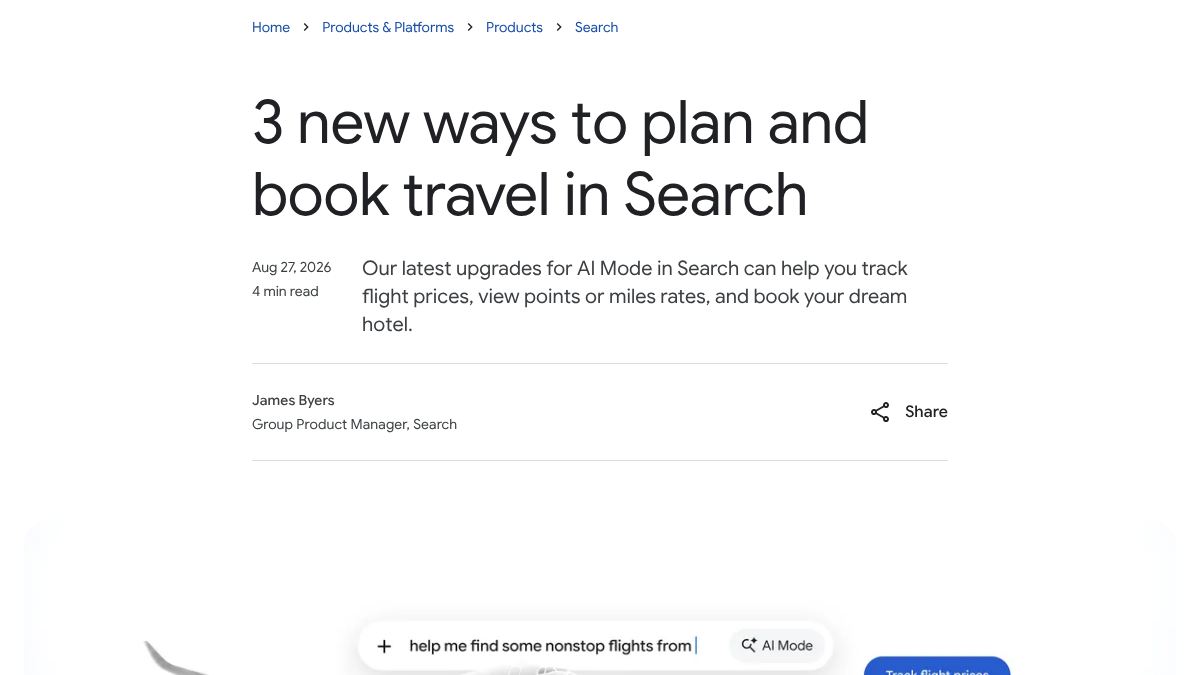
Look at who handles the hotel bookings. Booking.com and Expedia were among the launch partners, next to hotel groups like Hilton and Marriott, so AI Mode takes in the big booking sites rather than replacing them. A small agency won't get booked inside these tools. It can still get named in the answers people read before they book.
Trust is still the missing piece. Expedia Group's own survey of 5,700 travelers, covered by Skift in April, found only 8% are comfortable letting AI handle the booking. An OTA has reasons to like that finding, so weigh it with care. It still matches what OpenAI saw at checkout.
How a small agency wins the AI half
Stop selling the draft itinerary, because the chat gives that away for free. Sell the checking and the fixing.
In the r/smallbusinessesowners thread, the top reply said agents should sell "making sure the plan actually works, then taking responsibility when it doesn't." That reply listed what AI plans miss, like closed days, long transfers, sold out tickets and booking windows that opened months ago.
Another commenter guessed ChatGPT is wrong on the first reply about 40% of the time. That's one person's estimate, not a study, but it points at your pitch.
Put that work on the page where AI engines and travelers can both read it. Add a "what most plans get wrong" section to each itinerary. Name the agent who runs the trip and how long they've done it. Show your disruption policy in plain words, since that's what people in the askTO thread said they pay for.
Then check whether it shows up. Ask ChatGPT, Gemini, Perplexity and Google AI Mode the questions your clients ask, like "is 10 days enough for Japan with kids," and note who gets named. Do it weekly, because the answers move. For the wider method of measuring AI citations for travel brands, our AI search playbook for travel brands covers it. That post spans hotels, DMOs and publishers, while this one stays with agencies and tour operators.
The time it takes, and the shortcut
Here is a rough count for one owner doing it by hand. Setting up the Business Profile and cleaning up directories takes 6 to 10 hours. Each good itinerary page takes 3 to 5 hours, so eight a month is another 24 to 40 hours. Asking AI engines 40 trip questions every week, and logging the answers, adds about 3 hours a week. These are estimates, not measured figures.
RankControl's AI visibility tracking checks your questions every week on seven engines, including ChatGPT, Gemini, Perplexity, Google AI Mode and Google AI Overviews, and shows which agencies and sites each answer named. Our content engine writes each article against the pages already ranking for its keyword and publishes it on your own site. The plan is $400 a month with a 7-day free trial.
You can do all of this yourself with a spreadsheet, a notebook of trip details and a few hours a week. Or RankControl's agents can handle the weekly checks and the publishing while you spend your time on the trips.
AI search traffic grew 835% this year. Is your content ready?
RankControl generates 26 content formats optimized for ChatGPT, Claude, and Perplexity. Published on your domain, matched to your brand.