
Ask Google how to change a cabin air filter and the AI Overview on top will link a few YouTube videos as its sources. Look further down at the ranked results and you'll see videos there as well, but mostly a different set.
How different? I pulled Google's live results on November 4, 2026 and wrote down every YouTube video in them. That covered 336 searches. At least one video was cited in 76% of the AI Overviews, and only 4% of the cited videos also ranked in the blue links for the same search. By cited I mean the overview links the video as a source, which is a different thing from the academic citation that half the results on this topic are about.
How often does Google's AI Overview cite a YouTube video?
Try a few of your own questions and the answer will swing with what you ask. The searches were split evenly across twelve formats, twenty-eight each.
Of the 319 overviews that showed a source list, 243 linked at least one YouTube video, and YouTube took about a quarter of all the distinct links in them.
How I counted changes the totals, so it's worth a minute before you set my numbers next to anyone else's. Google lists some links twice inside one overview, 282 of the 3,008 reference entries in my pull, so I counted each video once per search. A study that counts entries will report more citations than one that counts videos, and a commenter on one vendor's study thread asked exactly that, whether a video cited for forty searches gets counted forty times.
| Search format | Overviews citing a YouTube video | Videos cited per overview |
|---|---|---|
| How-to | 100% | 4.15 |
| Review | 100% | 3.71 |
| Alternatives | 96% | 2.29 |
| Definition | 89% | 2.29 |
| Comparison | 89% | 3.18 |
| Best-of | 85% | 2.19 |
| Template or checklist | 78% | 2.11 |
| Troubleshooting | 78% | 2.63 |
| Pricing or cost | 55% | 1.00 |
| Statistics | 54% | 0.81 |
| Calculator or tool | 46% | 0.73 |
| Brand or login | 37% | 0.56 |
How-to and review searches had a video in every overview, which makes sense when you want to watch something done or judged. Pricing, statistics and calculator searches sit lower, because you're after a number or a tool there and the overviews mostly answered from pages. Format beat topic, since legal questions got a video 64% of the time and tech ones 91%, with ranges that overlapped.
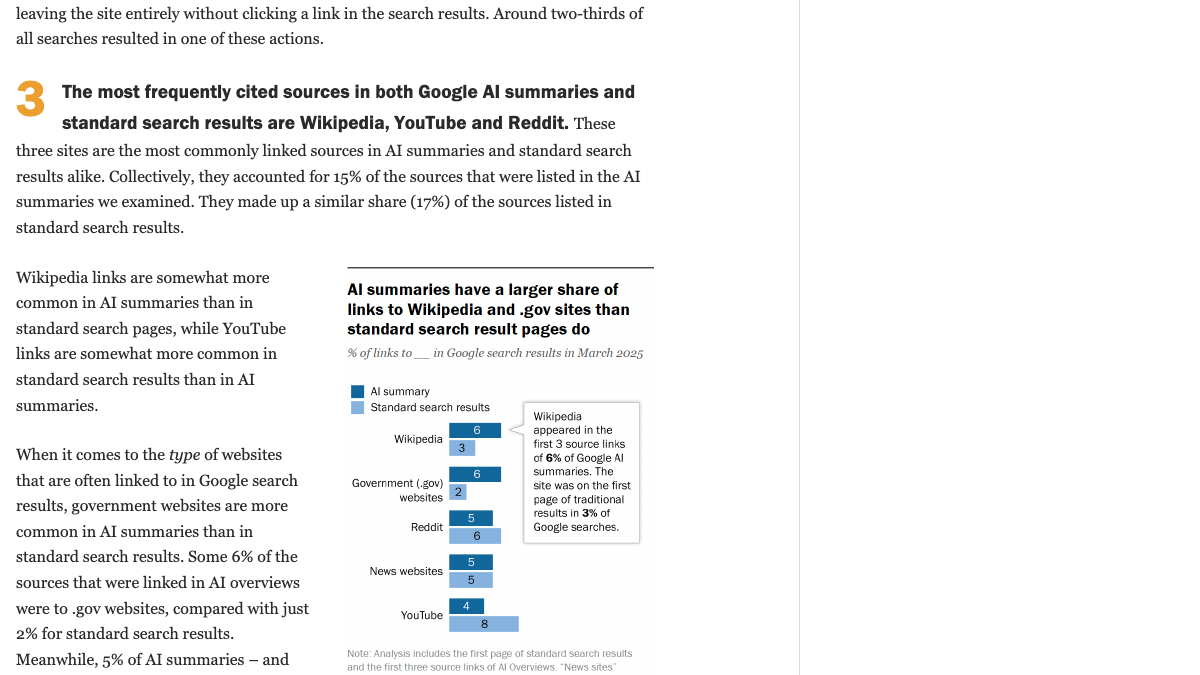
You may have seen a much smaller figure in Pew's March 2025 count. It put YouTube at 4% of links in AI summaries and 8% in standard results, but it covered only the first three source links of each overview and used different searches, so I wouldn't read the gap as growth. Our post on which sources each engine cites compares the engines.
Are the videos Google cites the ones that rank?
Put the AI Overview for one of your questions next to the video results and you'd expect the same videos in both. They mostly aren't, which is the finding I'd have bet against. Of 691 cited video and search pairs, only 29 also appeared in the blue links for that search. Going the other way, 29 of the 189 YouTube results in the blue links were cited.
| Where the cited video appeared | Share of cited pairs |
|---|---|
| In the blue links for the same search | 4% |
| In a video carousel | 16% |
| In neither | 80% |
| Searches | Count |
|---|---|
| With a YouTube video in the blue links | 136 |
| With a YouTube video cited in the overview | 243 |
| With both | 108 |
| With a ranking video but none cited | 28 |
| With a cited video but none ranking | 135 |
In the last two rows, a cited video with nothing ranking happened far more often than the reverse, so the overview and the ranking list are picking from the same site by different rules.
If you rank well and still never appear in the overview, you're in good company. On r/aeo, an owner who ranked first or second for a search and never showed up in the overview got the same answer from several replies, that ranking picks pages while the overview lifts passages.
(GEO & AEO) Anyone having the experiences of what actually works to get cited in Google AI Overviews and ChatGPT/Claude LLM answer?
When I asked a few LLMs how to get cited, they claimed a site must have a verified physical store or Google Maps profile to build enough credibility authority for AI extraction. That sounds like a completely different concept from standard...
It's a small thread and a few replies are agency pitches, but it matches the tables. A video carousel is a third list, and 189 videos appeared only there, a third of them Shorts, with a median length of 5.7 minutes. If you try this yourself, know that the blue links I could see were the six to ten the pull returned per page, so a cited video ranking eleventh or lower counts as not ranking here.
How old are the cited videos?
Check the upload dates next to an overview's videos and the cited ones tend to be newer. The median cited video was about a year old, while the median video that ranked without being cited was about two.
| Age of the video on the day of the pull | Cited | Ranking but not cited |
|---|---|---|
| Median age | 365 days | 725 days |
| Published in the last 12 months | 50% | 24% |
| Published in the last 90 days | 14% | 3% |
| Published over two years earlier | 20% | 48% |
Half the cited videos were under a year old, against just under a quarter of the ranking ones, and that flips once you go back past two years. Within the 86 searches that had both kinds of video, the cited one was newer in 68. I can't tell you why. Google may prefer recent explainers, or channels may just make more videos for the questions people ask now, and one day's snapshot can't separate the two.
AI search traffic grew 835% this year. Is your content ready?
RankControl generates 26 content formats optimized for ChatGPT, Claude, and Perplexity. Published on your domain, matched to your brand.

How long should the video be, and do Shorts get cited?
Before you film anything you'll want to know how long to make it, and here length didn't separate the groups. Cited videos ran a median of 7.2 minutes against 6.0 for the ones that only ranked, and the gap sat inside the noise.
| Video length | Cited | Ranking but not cited |
|---|---|---|
| Median | 7.2 min | 6.0 min |
| Five to 15 minutes | 47% | 44% |
| Ten to 20 minutes | 27% | 21% |
| Over 20 minutes | 5% | 6% |
| A minute or less | 12% | 6% |
| Link is a Short | 21% | 11% |
The groups only part ways in the short rows, where videos of a minute or less were about twice as common among the cited, and so were links that went to a Short. The average also hides how much length depends on the question you typed. A definition search was answered with a median video of under two minutes, and a best-of search with one of nearly ten.
| Search format | Median length of cited videos | Median age in days |
|---|---|---|
| Definition | 1.8 min | 456 |
| Brand or login | 2.1 min | 498 |
| Calculator or tool | 4.5 min | 803 |
| Pricing or cost | 5.5 min | 288 |
| Troubleshooting | 6.4 min | 302 |
| How-to | 7.8 min | 443 |
| Template or checklist | 7.8 min | 463 |
| Comparison | 8.5 min | 336 |
| Review | 8.5 min | 380 |
| Alternatives | 8.5 min | 279 |
| Statistics | 8.5 min | 226 |
| Best-of | 9.8 min | 322 |
Read down the length column and the formats sort themselves, with definition and brand searches near two minutes and the last five rows all at eight and a half or more. I wouldn't take a single best length from any study. Shorts are where I'd push back on what you'll commonly read. A fifth of the cited videos were Shorts, against about one in ten of the ranking ones, and for definition searches it was half, with a median length under two minutes. Studies that count citations across tracked prompt sets put the Shorts share anywhere from 4% to 21%.
| Study | Date | Shorts share of cited videos |
|---|---|---|
| Foundation Marketing | October 2026 | 3.7% |
| OtterlyAI, as relayed by Six Digital | March 2026 | 5.7% |
| Knowatoa | May 2026 | 10.9% |
| Track My Visibility | October 2026 | 12.2% |
| BrightEdge, as relayed by MediaPost | August 2026 | 17.5% |
| Visilay, 24 Italian searches | October 2026 | 21.2% |
| This pull, 336 US searches | November 2026 | 21% |
I think the spread comes from the searches. Definition and troubleshooting questions lean toward Shorts, and several of those studies track fixed B2B prompt lists. I haven't tested that.
Do views and subscribers decide it?
If you worry your channel is too small, the middle of the range says otherwise. Cited videos had no more views than the ones that only rank, and small channels get cited.
| Measure | Cited | Ranking but not cited |
|---|---|---|
| Median views | 7,224 | 9,438 |
| Under 100 views | 5% | 10% |
| Under 1,000 views | 23% | 19% |
| Over 100,000 views | 16% | 27% |
| Median channel subscribers | 38,950 | 48,550 |
The one gap I'd trust sits at the top, since blockbusters are scarcer among cited videos, 16% against 27%.
At the bottom, one cited video had fourteen views and came from a channel with eighteen subscribers, and it ran twenty-one minutes. A small channel can be cited, but it wasn't cited more often than it ranked.
You also have no incumbent to unseat. The 689 cited videos came from 590 channels. The ten biggest suppliers held just 7% of them. In all, 687 of the 689 were cited for one search only.
Who owns the cited videos, creators, brands or publishers?
Sort the channels behind an overview's videos by who runs them and you'll mostly land on independent creators, though brands and publishers are cited more than they rank.
| Channel type | Cited | Ranking but not cited |
|---|---|---|
| Independent creator | 68% | 81% |
| Brand-owned | 19% | 12% |
| Publisher | 9% | 4% |
| Institution | 3% | 2% |
The mix also moves with the question you ask. Definition searches lean on brand channels and Shorts, and review searches belong to creators. Statistics is the one row where publishers hold their own.
| Search format | Brand channel | Creator | Publisher | Short |
|---|---|---|---|---|
| Definition | 45% | 34% | 9% | 50% |
| Review | 3% | 86% | 12% | 12% |
| Alternatives | 11% | 81% | 8% | 9% |
| Statistics | 29% | 33% | 29% | 5% |
Since the labels are mine, you'll want to know how far to trust them. I labeled 857 channels by hand with rules I wrote before comparing anything.
A second pass on forty random videos found five wrong, a 12.5% error rate. All five sat on the creator, brand and publisher boundary and went both ways, so the shares could move a few points. The thirteen-point creator gap is bigger than that.

Built by the team that got cited in 48 hours.
Content generation, backlink building, AI visibility tracking, and Google rankings. One platform, zero guesswork.
What do cited titles, descriptions and links look like?
Read the titles on an overview's videos and the plain how-to title is the one you'll see least. Tutorial titles were 24% of the cited videos and 40% of the ranking ones, which I didn't expect.
| Feature | Cited | Ranking but not cited |
|---|---|---|
| Tutorial or how-to title | 24% | 40% |
| Comparison title | 17% | 11% |
| Three or more timestamp lines in the description | 40% | 28% |
| Title repeats most of the query's words | 70% | 72% |
Comparison titles and timestamp-heavy descriptions go the other way. The comparison gap is borderline, and my title rules were wrong on seven of forty hand-checked titles, though all twelve that the rules called tutorials were right. Timestamps matter in a second way, because Google often links into the video itself.
| Cited links | Result |
|---|---|
| Open at a timestamp | 45% |
| Long videos that open at a timestamp | 58% |
| Shorts that open at a timestamp | 0 of 147 |
| Median start point | 45 seconds in |
| Start within the first minute | 59% |
Nearly half the cited links opened partway in, though none of the Shorts did. If you want to control where a link lands, Google's own video guide says that for a video hosted on YouTube you can specify exact timestamps and labels in the description.
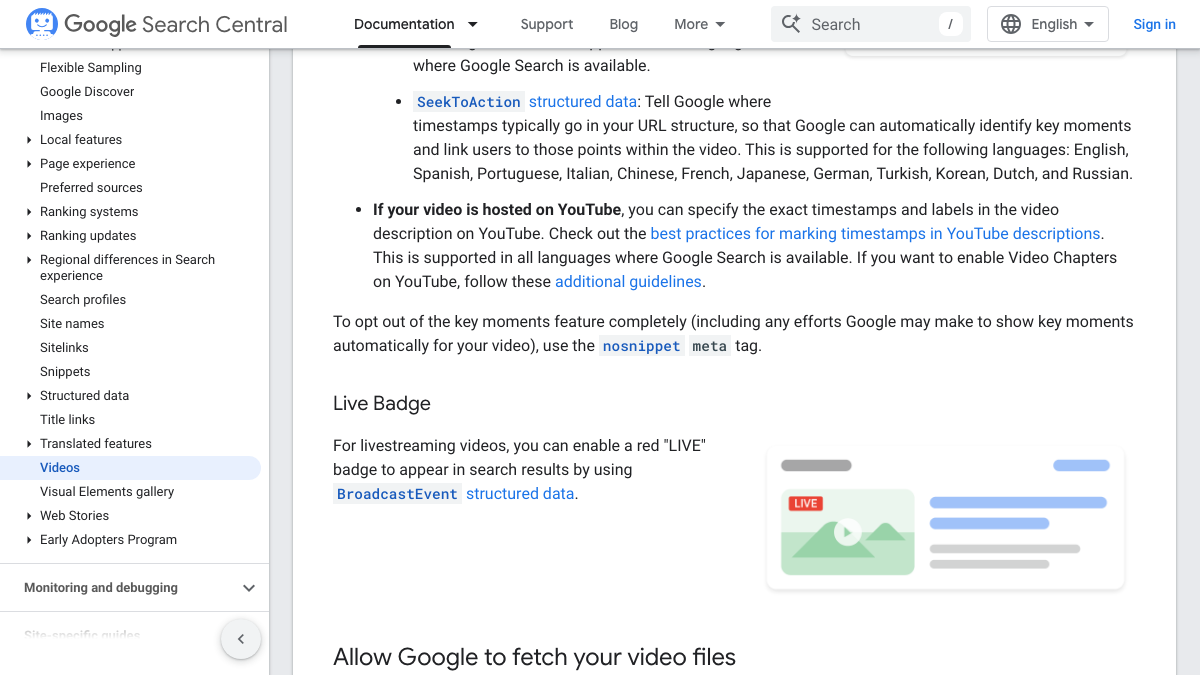
Chapters are a weaker signal than they used to be, though. On r/youtube in September, viewers complained that YouTube now adds generated chapters to videos whose creators never wrote any, so a video with chapters may not have a creator-written set.
There's AI-generated chapters now... EWWWWWW
I absolutely hate that they're indiscriminately adding these chapters to (almost) every video. It's incredibly frustrating. It's the same in (almost) every video, completely unrelated to what's being said, and always inserted in the middle...
I could only count timestamp lines in descriptions with certainty, so the table uses those. Our guide to the text around a video covers titles, descriptions and captions.
What can a team do with this, and what can't a one-day pull tell you?
Before you plan a series, I'd take four things from this data, none of them a cause. A video made for the exact question can be cited whether it ranks or not, and newer beats older here, so a dated explainer of yours may be worth remaking. A Short can be cited too, especially for a definition. Nothing says a channel needs an audience first, so check which videos Google cites for your own questions.
Checking your own questions takes an afternoon.
- List twenty questions your buyers ask in full sentences.
- Open each in Google while signed out and write down every YouTube video the AI Overview links.
- Note each video's age, length, channel type and whether it's a Short.
- Repeat a month later, since one search's videos can change within an hour.
Google's AI features page says there are "no additional requirements to appear in AI Overviews or AI Mode," which fits a result where ranking isn't the gate. Our posts on video schema and which engines show visual answers cover the markup and the display side.
| Limit | Why it matters |
|---|---|
| One day, US English | A snapshot, and one search's videos can change within an hour |
| Google AI Overviews only | Not AI Mode, ChatGPT or Perplexity |
| Searches I wrote | 12 formats in full-sentence form, so the 76% is higher than a panel of real searches |
| Six to ten blue links | A video ranking 11th or lower counts as not ranking |
| Views and ages read on the day | Counts moved within hours |
| Hand labels | Channel type 12.5% wrong, title format 17.5% |
| Description, not cause | It shows what the two sets look like, and tests no video's content |
RankControl shows who owns the answer for the questions you track.
Our Citation Sources view lists every domain the engines cite for your tracked queries with its share, so you can see when YouTube, Reddit or an editorial site holds an answer. Google's AI Overviews are one of the seven engines RankControl's AI visibility tracking checks every week, and the view reports domains, not individual videos. You can run a pull like this one by hand with a spreadsheet and a few weeks of patience, or let RankControl's agents do the tracking while you make the videos.
See your first AI citation report in under 5 minutes.
No setup calls. No onboarding meetings. Connect your domain and see where AI mentions your brand right now.