
In April, someone asked r/AISearchOptimizers whether anyone had actually moved budget from SEO to AI optimization. Everyone seemed to agree AI search was growing, they wrote, but most teams they talked to were still spending almost all of their budget on SEO.
Has anyone here actually moved budget from SEO → AI optimization yet?
Curious what people here are actually doing — not just thinking. Feels like everyone agrees AI search is growing like ChatGPT, Perplexity, but most teams I talk to are still spending almost all of their budget to SEO. So I’m trying to under...
The replies split three ways. One team had shifted about 15% of its content budget into what they called a GEO layer, on top of SEO rather than instead of it. Another reply guessed most teams were still around 90% on SEO. A third said they hadn't moved budget at all, because they'd stopped treating the two as different things.
All three can be right, depending on what gets counted as AEO. This guide covers where marketing budgets stand in 2026 and which parts of AEO are new work. It then covers three ways to budget for it and what the services cost. Sources were checked on September 27, 2026.
Where marketing budgets stand in 2026
AEO is competing for money in a flat budget. Gartner's 2026 CMO Spend Survey put the numbers in May:
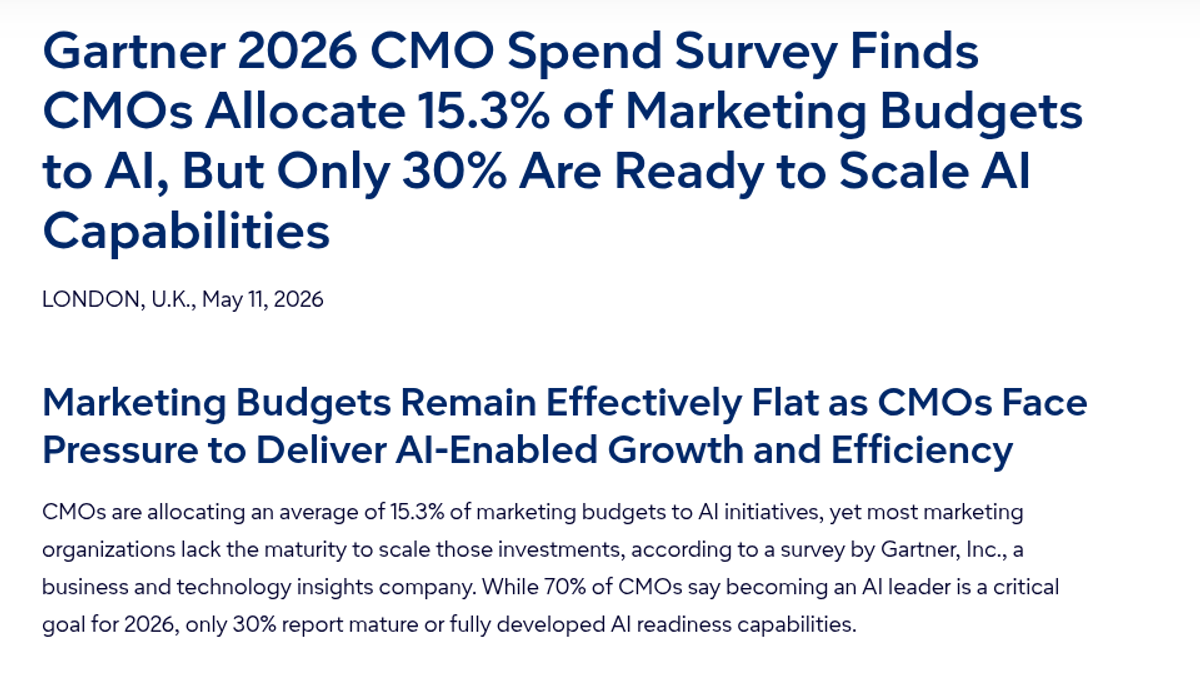
The survey of 401 marketing leaders, mostly at companies with over $1 billion in revenue, found budgets at 7.8% of company revenue, up from 7.7% in 2025. CMOs put 15.3% of their marketing budgets into AI initiatives, and the most AI-ready organizations put in 21.3%. Meanwhile, 56% said they lacked the budget to deliver their 2026 strategy.
That 15.3% covers every kind of AI initiative, from content tools to customer service. AI search is one claim on it among many. Surveys run by AEO software vendors report larger shares, such as an average of 12% of enterprise digital budgets going to AEO in 2025. Those come from companies selling the work, so treat them as a ceiling, not a benchmark.
200+ SaaS teams already track their AI citations.
They know exactly when ChatGPT mentions their brand, and when it stops. Do you?
Buyers search for it under SEO's name
How people search for help says something about how they see the work. We pulled US monthly Google search volumes on September 27:
| Search term | September 2025 | August 2026 |
|---|---|---|
| ai seo agency | 1,900 | 2,900 |
| ai search optimization services | 140 | 1,000 |
| generative engine optimization services | 720 | 720 |
| aeo agency | 480 | 590 |
| answer engine optimization agency | 110 | 480 |
For comparison, "seo agency" averaged about 27,100 searches a month over the same year. Two things stand out. Searches for AI-labeled services grew, with "ai search optimization services" rising roughly sevenfold. And the most common AI label was "ai seo agency," well ahead of "aeo agency." Buyers mostly describe this as SEO with AI in it, not a separate discipline. Google's volumes come in rough ranges and swing month to month, so read the direction, not the exact numbers.
Most AEO work is SEO, and a few jobs are new
Google's May 2026 guide to its generative AI features says that, from Google Search's perspective, optimizing for them is still SEO. Most of what gets sold as AEO fits that description. Technical access, pages that answer buyer questions and content in the formats engines cite all belong in the SEO and content plan you already fund.
A few jobs don't fit there, and they're the ones that go unfunded when AEO is folded into SEO without thought:
- Tracking answers across engines. Rankings don't show what ChatGPT, Perplexity, Claude, Gemini, Grok and Google's AI Mode say about you.
- Source gap work. Engines often cite third-party pages about you, and earning a place on them is closer to PR than SEO.
- Fact consistency. Prices, plans and product details need to match across your site, directories, marketplaces and review profiles.
- Correcting wrong answers, which needs an owner and a process, as our response plan for wrong AI answers lays out.
We call this the remainder line: a small, separate budget line for the AEO jobs SEO doesn't cover. Our guide to generative engine optimization goes into why these jobs sit outside normal SEO.
Three ways to budget for AEO
| Model | How it works | Fits | Main risk |
|---|---|---|---|
| Fold it into SEO | No separate line; the SEO team absorbs AEO | Small teams with one person on search | Tracking and source work never get time |
| Add a remainder line | Content and technical work stay in SEO; the new jobs get their own line | Most B2B companies | Scope creep if the line starts funding content that belongs in SEO |
| Run a separate AEO program | Its own team, agency and budget | Enterprises with many brands, products or markets | Paying twice for overlapping SEO and AEO work |
For most B2B teams, the remainder line is the right starting point. It protects the jobs that fall through the cracks without splitting the content plan in two. It also gives you a clean number to report against.
The separate program makes sense when AI answers already drive a measurable share of pipeline, or when a company has enough brands that tracking and corrections become a job in themselves. Even then, keep one content plan shared between the SEO and AEO teams. Two teams publishing against the same questions is an easy way to pay twice.
How often does ChatGPT mention your brand?
Most founders have no idea. The answer might surprise you.

What the remainder line covers and costs
Start with the work, then price it:
| Line item | What it pays for | How to estimate it |
|---|---|---|
| Answer tracking | A fixed set of buyer questions checked weekly on each engine | Checking 50 questions on seven engines by hand takes about six hours a week |
| Source gap work | Outreach to review sites, roundups and publications engines cite | Hours per month, or part of a PR retainer |
| Fact maintenance | Keeping listings, marketplaces and profiles current | A few hours a month, more after price changes |
| Corrections | Tracing and fixing wrong answers | Reserve time for incidents rather than a fixed amount |
If you'd rather buy it than staff it, prices are all over the place. In a May thread in r/aeo, a practitioner who had just signed a B2B SaaS retainer at $2,000 a month asked what others charged. Replies described small-business packages from about $500 a month, and bundled B2B programs at $5,000 to $10,000 or more. In a July r/content_marketing thread about enterprise budgets, people quoting agency work described low to mid five figures a month. Those are anecdotes, not a survey, but they show the spread.
Give the line one owner, usually whoever runs SEO or content, with PR and product marketing pulled in for source work and fact changes. Without an owner, tracking tends to run for a month and then stop, and nobody notices until a prospect repeats a wrong answer. Startup CMOs with a smaller team can start narrower, as our guide to AI search visibility for startup CMOs covers.
When you compare quotes, check what's in scope. A $2,000 retainer that includes content and tracking is a different product from a $15,000 program that also covers digital PR. Ask how results will be measured before you ask about price.
How to justify it to the CFO
A remainder line is easier to defend than a new program, because it's small and tied to specific jobs. Report on four things:
- How often your brand is named for buyer questions, compared with your closest competitors.
- Branded search trends, since many people who see your name in an AI answer search for you later.
- Leads who mention ChatGPT or other AI tools on forms or in sales calls.
- Visits and pipeline from tagged AI referrals.
Our guide to what B2B marketers should measure in ChatGPT and Google turns those into a monthly scorecard. For the meeting itself, our piece on justifying time spent on AI search visibility has a 90-day pilot frame and answers to the usual objections.
Start small, with a fixed question list and 90 days. If your mention rate and branded searches move, you have the numbers to ask for more. If they don't, you've spent a small amount to learn that your buyers aren't asking AI yet.
Done by hand, checking 50 questions on seven engines takes about six hours a week, and publishing eight solid articles a month takes 16 to 24 hours more. Those are rough estimates.
RankControl's AI visibility tracking runs your 50 questions every week on seven engines, marks each one as mentioned, cited or both, and records which competitors and sources each engine used. The content engine writes each article against the pages already ranking for its keyword and publishes it on your own domain.
You can run the remainder line yourself with a question list, a spreadsheet and a few hours a week. Or RankControl's agents can cover the tracking and publishing while your team handles source work and corrections.
15 hours a week manually. Or 15 minutes with RankControl.
Track citations, monitor competitors, and fix content gaps across every AI search engine. Automatically.