
A small-business owner on r/DigitalMarketing described their setup in one comment in October. They pay for the Semrush AI Visibility Toolkit, so they can see where their brand turns up in ChatGPT and Gemini. What they can't see is why competitors get recommended instead, or what to change about it.
That's the split this page is about. The Semrush AI Visibility Toolkit measures how AI answers treat your brand. RankControl measures it too, then writes the articles, publishes them on your domain and drafts the outreach for the links behind them.
I read Semrush's pricing page and its help pages on November 6, 2026, and every Semrush detail below comes from them. Semrush One and Semrush Enterprise AIO come up where they matter.
Semrush AI Visibility Toolkit vs RankControl, in short
Semrush's toolkit is a measuring tool. It scores your brand against its rivals and shows topics where they get named and you don't. It reads a short list of your prompts each day, and it stops there. Writing, publishing and linking are yours to do, or you buy them as other Semrush products at other prices.
RankControl is a pipeline. We plan titles from the questions your buyers search, write the articles and publish them as native posts on your own domain. We draft the link outreach too. Then we check 50 of your queries on seven AI engines every week.
For a team that wants articles written, published and linked, the best pick is RankControl, because one plan covers all of it. For a team that wants Claude and Grok in the weekly check, the best pick is RankControl too, because Semrush's pages name neither as a tracked engine.
Side by side
Checked on November 6, 2026 against Semrush's pricing page and help pages, and against our own plan.
| Semrush AI Visibility Toolkit | RankControl | |
|---|---|---|
| What it is | Measures AI visibility, researches prompts, tracks them daily | AI search visibility pipeline from plan to published article |
| Price | $99/mo per domain | $400/mo or $4,000/yr, one plan |
| Tracked | 25 prompts, read daily | 50 queries, read weekly |
| Engines | ChatGPT, Gemini, Google AI Overviews and AI Mode; Perplexity in weekly brand reports | ChatGPT, Perplexity, Claude, Gemini, Grok, Google AI Mode, Google AI Overviews |
| AI topic volume | Yes, in Prompt Research | Not offered; we plan from what buyers search on Google |
| Writes articles | No; separate Content Toolkit at $60/mo | 100 pages a month, 26 formats |
| Publishes to a CMS | No; the Content Toolkit sends to WordPress | 9 destinations, native posts |
| Link outreach | Not in the toolkit | Outreach from your mailbox; Managed Backlinks add-on, 5 links a month from DR 25+ sites, $350/mo |
| AI assistant access | Semrush MCP, read-only, on Semrush One and SEO Classic plans | MCP server and CLI, 80+ tools |
| Trial | None, per its help page | 7 days, card up front, $0 today |
What the Semrush AI Visibility Toolkit does
There are six reports, and they don't all refresh at the same pace.
| Report | What you get | Refresh, per Semrush help |
|---|---|---|
| Visibility Overview | A 0 to 100 score for any brand against its competitors | Daily |
| Competitor Research | Prompts and topics where rivals are named and you aren't | Daily |
| Prompt Research | Topic-level volume and difficulty, "keyword research for AI" | Daily |
| Brand Performance | Share of voice, sentiment and the story AI tells about you | Weekly |
| Prompt Tracking | Your chosen prompts, read once a day | Daily |
| AI Search Site Audit | Whether AI crawlers can reach up to 100 of your pages | When you run it |
Semrush's product page says Visibility Overviews refresh monthly, though. Its help page says daily. I'd ask support which is true before you build a client report on it.
Where the numbers come from matters more than the report names.
| Reports | Data behind them |
|---|---|
| Visibility Overview, Competitor Research, Prompt Research | A prompt database of 317 million+ prompts and responses, which Semrush says come from real requests and not the engines' APIs |
| Brand Performance | A separate repository of AI queries, updated weekly |
| Prompt Tracking | Semrush's rank tracker asking the engine your prompt each day |
| AI Search Site Audit | Semrush's crawler plus checks against 8 AI crawlers |
Semrush is frank about the limit, too. Its data page says no platform can give exact visibility numbers, and it calls its own figures "directional signals." That's a fair thing to admit. It's also the right way to read any number in this category, ours included.
Which engines count
Ask which engines the toolkit covers and you get a different answer on each page.
| Semrush page | Engines it names |
|---|---|
| Pricing page, AI Visibility plan | ChatGPT, Google AI, Gemini, Perplexity |
| Help page on data sources, Prompt Tracking | Google AI Mode, AI Overviews, Gemini, ChatGPT Search |
| Semrush One help page, Prompt Tracking | Google AI Overviews, AI Mode, ChatGPT |
| Help page, Brand Performance | Google AI Mode, ChatGPT, Perplexity, Gemini |
Claude turns up on those pages only in the list of AI crawlers the site audit checks. It isn't named as an engine whose answers get tracked, and neither is Grok.
What happens after tracking
The toolkit isn't silent once the numbers are in. Brand Performance ends with AI-written recommendations, and Semrush's tracking guide attaches a suggested action to each cited source. Say an AI cites a forum thread. The suggested action is to turn that thread's insights into FAQs on your own site.
You still have to write those FAQs. In Semrush that job belongs to the Content Toolkit, sold separately.
How often does ChatGPT mention your brand?
Most founders have no idea. The answer might surprise you.

What RankControl does instead
Start with the content engine. We plan titles from your buyers' questions, then write each article against the pages already ranking for its keyword. Each one gets a score for how easily AI engines can quote it, plus a fix list. We publish it as a native post on your domain. Auto-publish stays off until you switch it on.
Links come next. Backlinks looks for prospects around every published article and drafts the outreach, and you send it from your own mailbox. If you'd rather hand it off, the Managed Backlinks add-on gets you five links a month from DR 25+ sites for $350. A page nobody links to or mentions is hard for an engine to quote, so this half of the work matters.
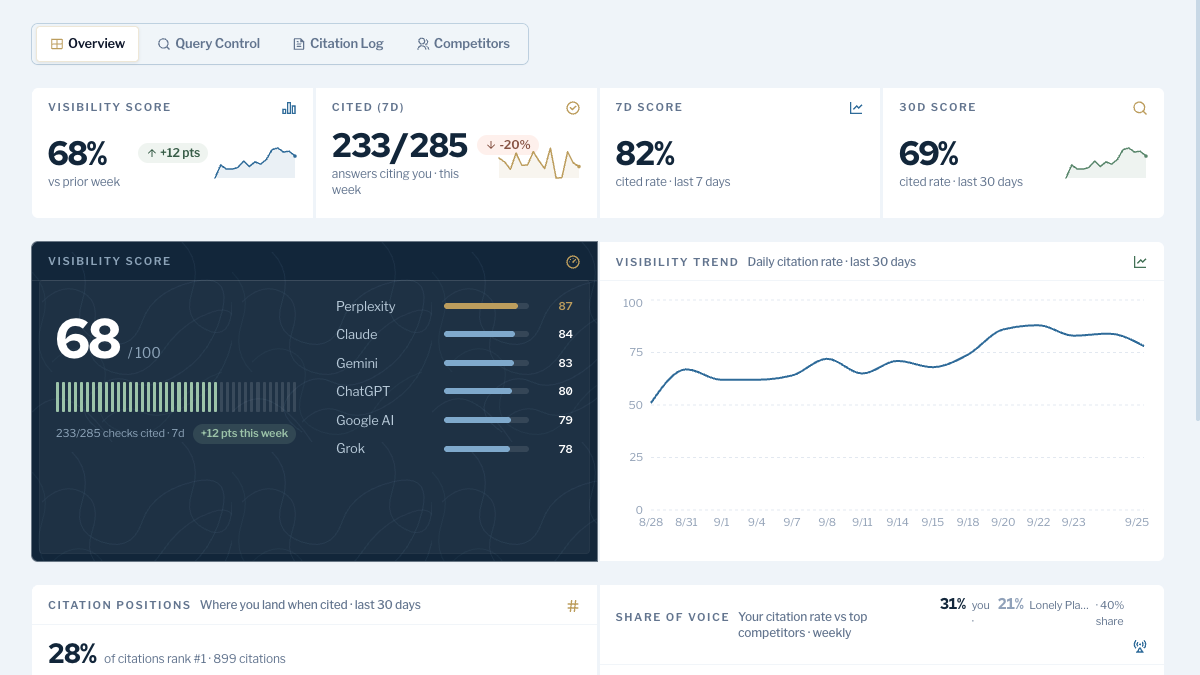
Then we check. AI visibility tracking sends each of your 50 queries to the seven engines every week. You see which engines cited you, which competitors got named instead and which sources the answers drew on. Our analytics also count visits from AI answers, so you can tell whether a mention sent anyone to your site.
One article, start to finish
Follow one article through each setup. For Semrush, that means the AI Visibility Toolkit plus its Content Toolkit.
| Step | Semrush AI Visibility Toolkit plus Content Toolkit | RankControl |
|---|---|---|
| Pick the topic | Prompt Research shows topic volume and difficulty | Titles planned from your buyers' questions; you approve |
| Write the draft | AI Article Generator; 5 SEO-boosted articles a month | Written against the pages already ranking |
| Check quality | Content Optimizer | Scored for how easily AI engines can quote it |
| Publish | Send it to WordPress | Native post on any of 9 destinations |
| Earn links | You | Prospects found, outreach drafted |
| Measure | 25 prompts a day | 50 queries a week on seven engines |
In the Semrush pair, the carrying is on you, from tool to tool and across the publish button. In RankControl you approve a title and read the draft, and that's most of your part.
Your first month with each
Here's how a first month tends to run if you set both up on day one.
| Week | Semrush AI Visibility Toolkit plus Content Toolkit | RankControl |
|---|---|---|
| 1 | Set up the project, choose your 25 prompts, read the overview score | Setup reads your site; you fix the brand profile and add queries |
| 2 | Pick topics in Prompt Research, draft in the Content Toolkit | First titles planned; you approve them |
| 3 | Send drafts to WordPress; start link work by hand | Articles publish; outreach drafts arrive |
| 4 | Read a month of daily prompt results | Fourth weekly check on seven engines |
By week four the Semrush side has the sharper daily picture of a small prompt list. The RankControl side has live articles, outreach in progress and four weekly readings to set against last month's.
Semrush AI Visibility Toolkit pricing
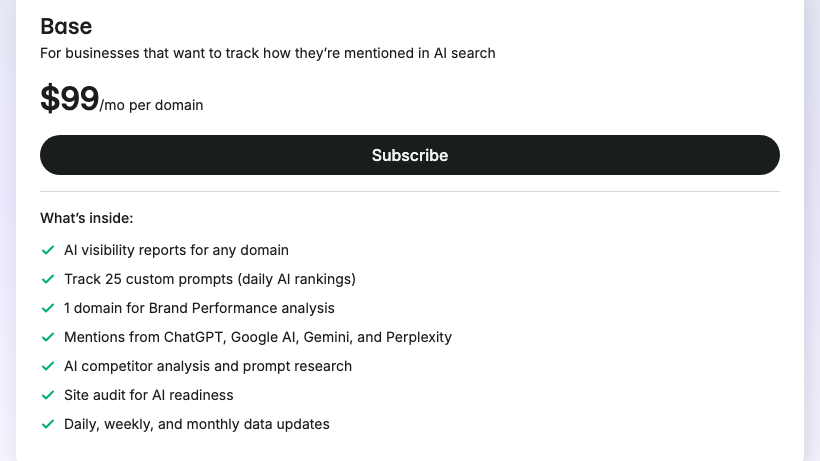
Semrush's pricing page shows $99 a month per domain, on monthly or yearly billing, with reports capped at 300 a day. The help page says there's no free trial. The base price is only the start of the bill.
| What you get or add | Semrush | RankControl |
|---|---|---|
| Base plan | $99/mo per domain, covering 25 prompts read daily, 1 domain for Brand Performance and 300 reports a day | $400/mo or $4,000/yr, covering 50 queries read weekly and 5 seats |
| More prompts | 50 more for $60/mo | Fixed at 50 queries on the plan |
| An extra teammate | $99 license per the help page; from $45/mo per the pricing page | 5 seats included |
| A writing tool | Content Toolkit, $60/mo after a 7-day trial | In the plan |
| Extra writing | 10 more SEO-boosted articles for $30/mo | 100 pages a month in the plan |
| Links | You | Outreach drafts included; $350/mo if managed |
| Tracking plus a writing tool | $159/mo, before any publishing, links or seats | $400/mo, with publishing, outreach drafts and 5 seats |
| One Semrush bill for SEO and AI tracking | Semrush One Starter, $199/mo (about $165 billed yearly), 50 prompts | Not offered |
Tracking plus a writing tool lands at about two fifths of our price. It isn't a like-for-like comparison, and I wouldn't pretend it is. Our plan covers publishing, outreach drafts and seats that the Semrush pair leaves to you. Enterprise AIO is the custom-priced product for big teams, and this page skips it.
Why one score isn't the point
I read a handful of threads about AI visibility scores, and the complaint repeats. A poster on r/DoSEO wrote that most trackers pick a prompt list, run it weekly, count brand mentions and call the total a score. Run the same prompt another day and you get a different answer, so you can lose a fifth of your visibility without touching your site.
most “ai visibility” tracking is just the same prompts on a loop. is anyone using one that holds up?
looked at a few of these properly after the gsc generative ai report discussion. the method is mostly: pick a prompt set, run it weekly, count brand mentions, call that a visibility score. two problems with that. nobody searches in clean fi...
In March, someone on r/DigitalMarketing whose team already used Semrush said they weren't convinced by its AI tracking accuracy. The replies split two ways. Some came from people selling a rival tool. The rest said to treat any tracker as a directional signal, which is what Semrush's own page says.
Is Semrush actually accurate for AI visibility tracking? Looking for alternatives.
I’m currently trying to measure our brand's AI visibility) and how often our website is being cited in AI-generated answers (ChatGPT, Perplexity, Claude, Gemini, etc.). My team is currently using Semrush, but to be honest, I’m not 100% conv...
The same caveat applies to us. We read a fixed list of 50 queries each week, so one week's reading is a sample. That's why our analytics put visits from AI answers next to the readings, and why we point you at traffic from Google and AI search as the payoff. Citations tend to follow links and mentions over a longer stretch.
One marketer on X ranked their own AI visibility stack cheapest first in October. Fresh chats in the models, Google's AI answers and GA4 split by AI source all came before any paid tracker.
15 hours a week manually. Or 15 minutes with RankControl.
Track citations, monitor competitors, and fix content gaps across every AI search engine. Automatically.

Working from your AI assistant
Semrush's MCP plugs its data into ChatGPT, Claude, Copilot and Perplexity, and it's read-only. The help page lists Semrush One and SEO Classic plans for access, and the standalone toolkit isn't among them. The data it names is keywords, traffic and backlinks. AI visibility reports aren't on that list.
RankControl's MCP server and CLI work differently. You can ask Claude, Cursor or Codex how your visibility moved this month, plan titles or draft an article. Anything that publishes or sends email runs as a dry run until you confirm. That's 80+ tools in the one plan.
What people say
Back to the comment that opened this page. The owner said knowing where they appear is only half the battle. They asked whether other tools gave advice that led to measurable gains. That's a question for any vendor, us included.
Other users were blunter about the topic ideas. One called the toolkit a content-ideation machine more than a measuring tool. Another ran it for a home-services company and got suggestions about mopping floors and cleaning stains. None of it was anything the company sells.
Most replies in those threads came from people pitching a rival tool, so I leaned on the ones describing their own use. It's a thin sample, and the March thread is eight months old.
When Semrush fits better
If your team already works in Semrush and wants daily readings on a short list of prompts, plus volume and difficulty for AI topics, the Semrush AI Visibility Toolkit does that and RankControl doesn't. Semrush's help page lists daily Prompt Tracking and the Prompt Research reports, and its pricing page shows the $99 price, both read on November 6, 2026.
Which wins?
For a team that wants the work done, the verdict is RankControl.
The Semrush AI Visibility Toolkit measures, and Semrush says it has sold SEO data for 17 years. It shows where you stand and where rivals get named. After that, the writing, the publishing and the linking are yours.
RankControl runs the whole loop for one price. We plan from your buyers' questions, write and publish on your domain and draft the outreach. Then we check seven engines every week. By the end of month one you have a title calendar, articles going live on your schedule and four weekly readings to compare.
You can do all of this by hand. Pull the prompts, write the pages, publish them, chase links and read 25 prompts a day. Or RankControl's agents can do it for you every month while you focus on your product.
If you've decided to move, our guide to switching from the Semrush AI Visibility Toolkit covers the exports, the cancellation and the setup.
Want a baseline first? Run a free check of your brand in AI answers.
AI search traffic grew 835% this year. Is your content ready?
RankControl generates 26 content formats optimized for ChatGPT, Claude, and Perplexity. Published on your domain, matched to your brand.