
A Perplexity rank tracker sounds simple until you ask what the rank is. Perplexity doesn't publish one, and its answers don't come with a top ten.
SEO consultant Lily Ray tweeted on October 3 that you can tell someone is selling you something once they start talking about your Perplexity visibility.
You can tell someone’s selling you something when they start talking about your visibility on Perplexity
 Lily Ray 😏@lilyraynycOct 3, 2026
She has a point, so this guide starts with the checks that cost nothing. You can run them by hand with a list of buyer questions, a fresh Perplexity thread and a log. What follows comes from Perplexity's own help pages and from a signed-out answer I opened on November 4, 2026.
Where can your brand appear in a Perplexity answer?
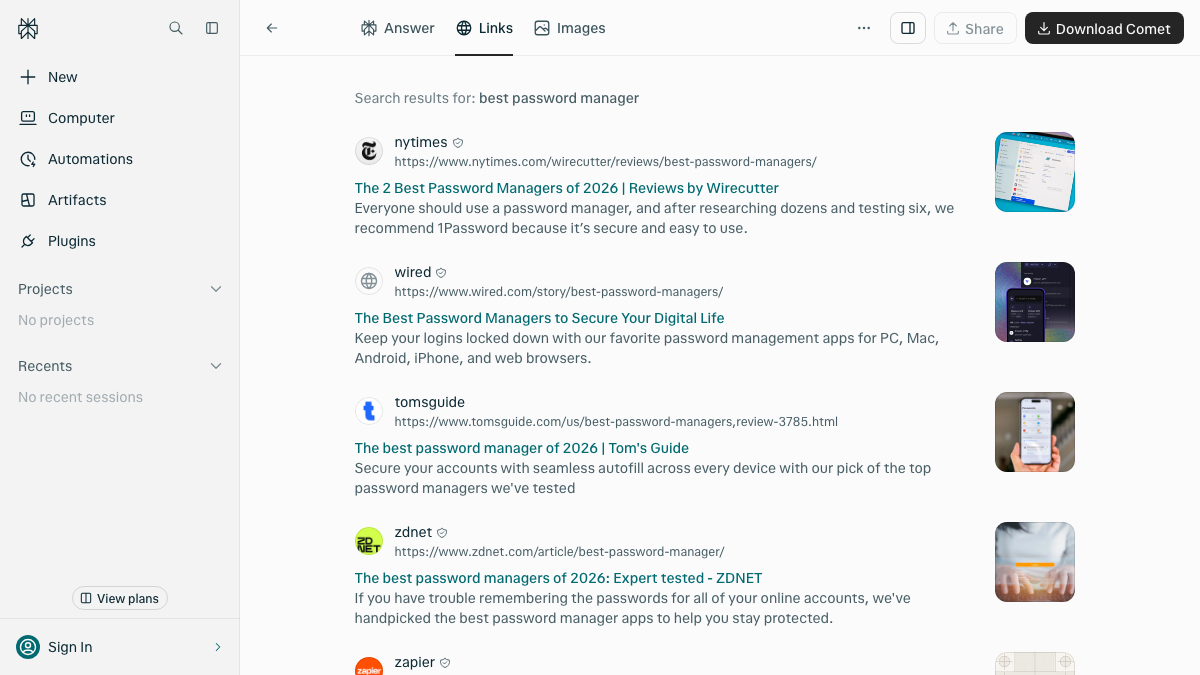
One answer has several places to look. I asked "best password manager" in a signed-out browser and found these.
| Place | What it looks like | What it tells you |
|---|---|---|
| Answer text | Brand names in sentences and tables | Whether you're named, and in what order |
| Citation chips | Domain names like "nytimes +2" | Which sources the answer leans on for a claim |
| Sources panel | Opens from a "10 sources" button | Domain, page title and snippet for each source |
| Links tab | "Search results for" your question, one row per page | Your position in the list |
| Related questions | Five follow-up suggestions | Which comparisons Perplexity expects next |
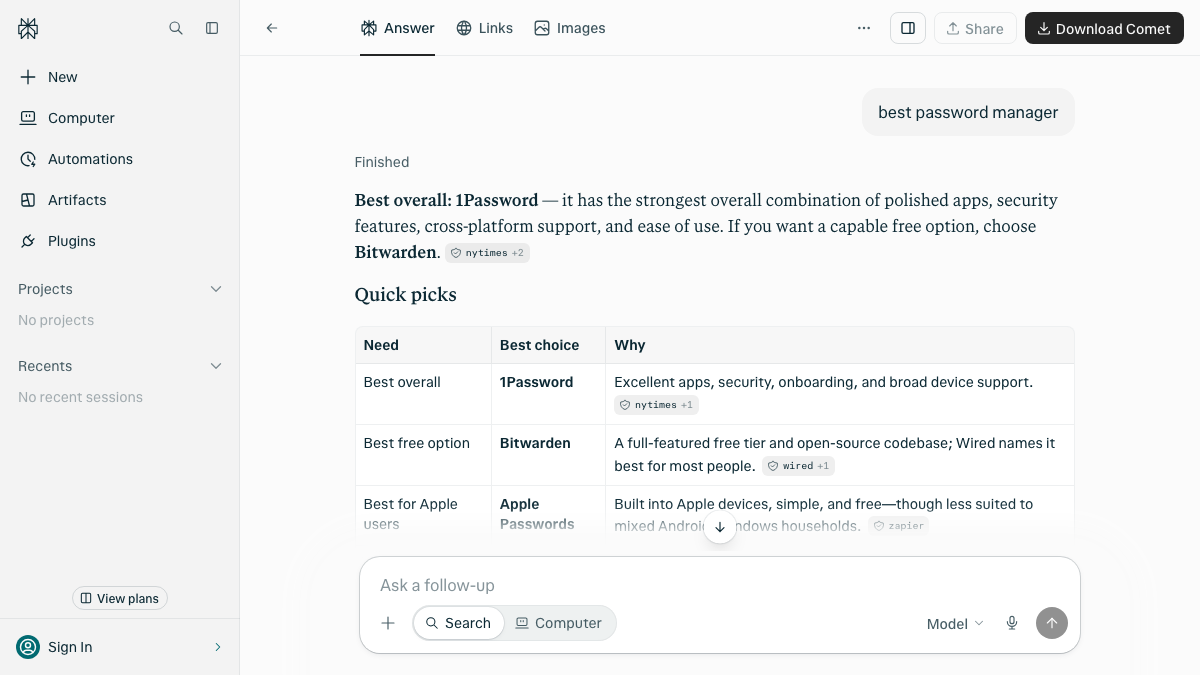
Perplexity's Help Center page on how it works still says each answer has numbered citations, and so do most guides. On my screen the answer showed domain chips instead. Mobile and signed-in views may differ, so check your own. Some chips carry a small shield. Perplexity's help page says that marks a site it labels Government, Academic or Trusted, that the label covers the whole site, and that payments and partnerships don't affect it.
What does rank mean in Perplexity?
Perplexity doesn't publish a ranking you can read. Its September engineering post says its search stack retrieves and ranks candidate pages, but I found no Perplexity statement saying the Links order is that ranking. That leaves three separate things to track.
| Meaning | Where you read it | What it records |
|---|---|---|
| Listed | Links tab | Your position among the sources |
| Cited | Chips in the answer | Whether the answer leans on your page |
| Named | Answer text | Whether your brand appears, and where |
Some guides give ranking factors with percentages, such as citation frequency at 35%. None of them trace back to a Perplexity page.

Your competitors are getting cited by AI. You're not.
Every day without citation tracking is a day your competitors pull ahead in ChatGPT, Perplexity, and Claude.
Which settings change what you see?
Several do, and Perplexity documents them in its Help Center.
| Setting | What Perplexity says | What to do |
|---|---|---|
| Signed in or out | Signed-out sessions are anonymous and kept for 14 days | Use signed-out for a clean baseline |
| Memory | Settings has "Use search history" and "Notes" toggles, and memories can show up as sources | Turn both off |
| Incognito | Sessions aren't saved, expire after 24 hours, and ignore memory and past searches | Use it when you're signed in |
| Pro Search | No longer a toggle, applied automatically up to your plan's limit | Note your plan in the log |
| Model menu | Needs a sign-in to open | Log the model if you can see it |
A private browser window only hides you from your browser. The setting that turns Perplexity's memory off is its own incognito mode. The free plan gets practically unlimited basic searches and a very limited number of Pro Searches, and Perplexity picks the model, so a free account and a paid one may not see the same answer.
Follow-ups cause trouble too. A poster in r/perplexity_ai described how, after two or three follow-up questions, the citations kept pointing at the first set of sources. Starting a new thread helped. A fresh thread for each check avoids it.
Perplexity's first answer is often well sourced, but follow-up questions seem to weaken the citations
I have noticed a specific pattern when using Perplexity for research. The first answer usually has citations that map fairly clearly to individual claims. After two or three follow-up questions, the response becomes more confident and conve...
How stable are the results from run to run?
I asked the same eight buyer questions three times, about five minutes apart, on November 4. I meant to test Perplexity's app. The app scraper I tried was returning login walls, so the test ran through a third-party Perplexity API route instead.
| Question | Source list the same in all 3 runs | First source listed | Brands named in all 3 runs |
|---|---|---|---|
| Best project management software for small teams | Yes | asana.com | 6 of 8 |
| Asana alternatives | Yes | zapier.com | 9 of 13 |
| Notion vs Obsidian | One URL swapped | obsidian.md | n/a |
| HubSpot vs Salesforce for small business | Yes | business.com | n/a |
| Is Zapier worth it | Yes | zapier.com | 2 of 3 |
| Best email marketing software | One URL swapped | forbes.com | 8 of 10 |
| Best CRM for startups | Yes | selecthub.com | 6 of 7 |
| Best password manager | Yes | askleo.com | 4 of 5 |
The source lists barely moved, and the first source matched in all eight questions. The answer text was different every time. And 11 of the 46 brand mentions, about a quarter, were missing from at least one run.
Now the caveat. On a one-question check against the real signed-out app, the two shared only 5 of 14 domains and listed different first sources. So this table describes that API, not Perplexity itself. That's not enough to call Perplexity stable or unstable. It does show that the three kinds of rank can move independently.
Other people see more movement. An r/perplexity_ai poster ran 75 searches on meeting-note tools and counted about 13.5 sources per run. Telling Perplexity to "use Reddit" moved the source mix on all five queries, while "use reviews" moved none.
I ran 75 Perplexity searches to see how much the cited sources change
I wanted to understand something about Perplexity that I kept noticing as a user: When you run the same kind of search more than once, how stable are the sources? And if you tell Perplexity to use a certain kind of source, does it actually...
No study I found says how many repeats are enough. Three runs is a sensible minimum, and five is better for a question that matters. One commenter in an r/AISEOforBeginners thread suggested a rule of thumb for reading the runs. A brand in more than 70% of them is consistently visible, 30% to 70% is a candidate, and under 30% is rare. That's one person's guide and not a standard.
200+ SaaS teams already track their AI citations.
They know exactly when ChatGPT mentions their brand, and when it stops. Do you?

How do you log a check?
Record each kind of rank in its own column, along with the conditions. Here's an example row.
| Date | Question | Signed in | Run | Links position | Cited | Named |
|---|---|---|---|---|---|---|
| Nov 4 | Your buyer question | No | 1 | 4 | Yes | Third |
Keep signed-in and signed-out checks in separate sheets. Our guide to AI citation tracking covers how to build the question list. For getting cited in the first place, see our Perplexity SEO tutorial.
What free signals does Perplexity leave in analytics and logs?
Two places hold evidence that costs nothing. Here's what each source documents and what to check on your own site.
| Signal | What the docs say | What to check |
|---|---|---|
| perplexity.ai referrals | Perplexity documents no UTM tag. Google's AI Assistant channel names ChatGPT, Gemini, Deepseek, Copilot and Grok, not Perplexity. A June release note added Perplexity to a separate Source Group field. | Where your perplexity.ai visits land in GA4 |
| PerplexityBot | Builds the search index and isn't used for training models | That robots.txt and your firewall let it in |
| Perplexity-User | Fetches a page when someone asks a question, and the crawler docs say it generally ignores robots.txt. A Help Center page says a related feature was disabled, so the current rule is unclear. | Its hits as a separate line in your logs |
| IP lists | Perplexity publishes JSON files for both bots and calls them the source of truth | Request IPs against those lists |
| Cloudflare | Bot Fight Mode can't be skipped with a custom rule, so it can still challenge these bots | Whether your logs show fewer visits than you expect |
Our guides to AI referral tracking in GA4 and AI traffic hiding in Direct explain why some visits arrive with no referrer.
User agent names can be faked, which is why the IP lists matter. One site owner matched two months of logs to the published ranges and found that 55% of "PerplexityBot" hits came from elsewhere. That was a small site, so read it as a warning and not a rate.
🤖 Do AI Assistants Actually Render Your JavaScript when Grounding? @andrealpar Put It to Test: The result? It’s not good 👇 * US AI assistants (ChatGPT, Gemini, Claude, Copilot, Perplexity, Meta AI) read raw HTML only * Chinese assistants (DeepSeek, ERNIE, Qwen, Kimi) and https://t.co/8jINzf66Zy
 Aleyda Solis 🕊️@aleydaJun 18, 2026

Aleyda Solis summarized a test in which Perplexity said in chat that it couldn't access a page its own crawler had already fetched with a 200. The lesson she took was to trust the server log over the chatbot. Our guide to tracking AI engines in server logs has the commands.
Doing it by hand or handing it off
Checking 50 questions on seven engines by hand takes about six hours a week, and that's a rough estimate. RankControl's AI visibility tracking runs your questions every week on seven engines, Perplexity among them. Our tracking marks each as mentioned, cited or both, and records which competitors and sources each engine used.
You can keep a spreadsheet and run every check yourself. Or RankControl's agents can run them every week while you work on the pages Perplexity cites.
How often does ChatGPT mention your brand?
Most founders have no idea. The answer might surprise you.