
A founder posted in r/SaaS in September that Paddle had stopped allowing checkouts for their business. The email cited possible risk or a breach of Paddle's terms or acceptable use policy, without saying which, and they already had paying subscribers running through Paddle's billing.
That's the other side of a merchant of record. Paddle takes 5% + 50¢ per checkout transaction and handles tax, fraud screening, chargebacks and billing support for you, which is a good deal for many SaaS companies. It also becomes the legal seller of your product, and that gives it a say over whether you can keep selling. This comparison covers what Paddle costs at real prices, the risks founders keep running into, and how the main alternatives compare. Pricing pages were checked on September 26, 2026.
What Paddle does for a SaaS company
Paddle is a merchant of record (MoR). When a customer buys your software, Paddle is legally the seller: it collects the payment, charges and remits the right sales tax or VAT, handles fraud screening and chargebacks, and answers billing questions from your customers. You receive the proceeds, minus its fee.
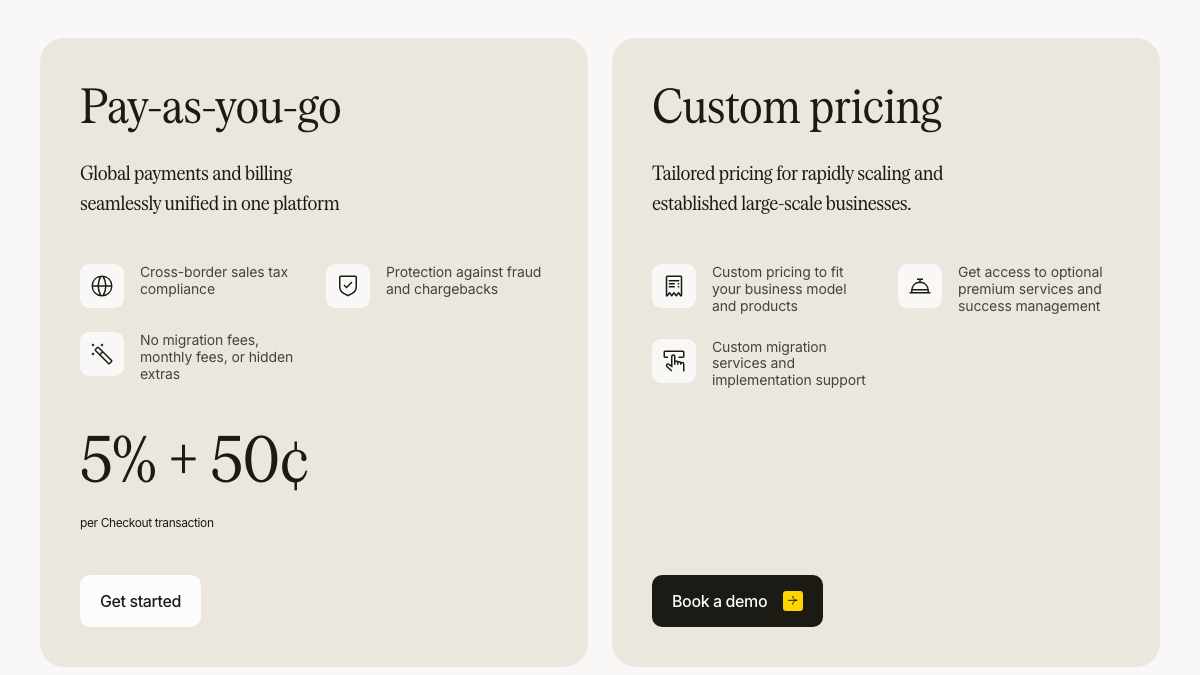
Its pricing page lists 5% + 50¢ per checkout transaction, with no monthly fee and no separate international surcharge. Products under $10 and businesses that need invoicing are asked to contact Paddle for custom pricing. On lock-in, its FAQ says there's no minimum term and that "your data is 100% yours and can be migrated to another provider if needed."
The page also quotes Tailwind Labs CEO Adam Wathan, who says his cross-border fees would have been around 3.5% with Stripe and 4.5% with PayPal, so the savings from going direct weren't worth the tax admin. Keep in mind where that quote lives. It's a customer story on Paddle's own pricing page, and the right answer depends on where your customers are.
What 5% + 50¢ costs at real prices
The fixed 50¢ matters more than the percentage for cheap plans. Here's Paddle's fee at a few common price points, before any currency conversion:
| Price | Paddle fee | Effective rate |
|---|---|---|
| $10 | $1.00 | 10.0% |
| $29 | $1.95 | 6.7% |
| $99 | $5.45 | 5.5% |
| $499 | $25.45 | 5.1% |
A $10 plan loses a tenth of its revenue to fees, which is why Paddle routes those products to custom pricing. Above $100, the rate settles close to 5%. For a SaaS priced per seat at $8 to $15, it's worth asking Paddle for a quote or bundling seats into larger invoices.

You're getting AI traffic. But do you know where it comes from?
RankControl credits every visit to the assistant that sent it: ChatGPT, Perplexity, Claude, Gemini, Copilot, or Grok. Full source attribution, next to your Google traffic.
The risks founders run into
Paddle's fee is easy to compare. Its risks are harder, and they come up often enough in founder communities to take seriously.
Approval can take weeks
Every MoR reviews your business before it will sell for you, because it takes on the legal and tax liability. In r/SaaSpayments this August, a founder said Paddle took almost a month to reject their application, after verification and several follow-ups, without really explaining why. The launch waited the whole time.
Apply to your first choice and a backup at the same time, before your launch date is fixed.
Access can end with little explanation
The r/SaaS founder above is not an isolated case. A reply in the same thread described Paddle turning away a nonprofit-sector app, which then moved to Stripe, and another warned that relying on one processor with no backup is the real risk.
DO NOT USE PADDLE AS YOUR PAYMENT PROCESSOR
I wanted to share my experience with Paddle so other SaaS founders can make an informed decision before building their businesses around it. I recently received an email from Paddle informing me that they were unable to continue allowing ch...
Read the acceptable use policy of any MoR before you build on it, and check it against what you actually sell. If what you sell sits near the edge of a policy, such as services delivered by people, marketplaces or anything regulated, raise it during onboarding rather than after launch.
You inherit their billing surface
Because the MoR is the seller, its checkout, invoice format, dunning emails and refund windows become yours. A founder in r/SaaS put it well: anything a customer asks for that the MoR doesn't support becomes a support ticket you can't solve. Ask for sample invoices and a test checkout in your main markets before signing.
Support speed matters for the same reason. One reply in an r/SaaS thread about Lemon Squeezy said Paddle took more than a month to process a simple change to business details.
Data you can export versus data you can move
Paddle says your data is yours and can be migrated. Before you rely on that, ask one specific question: can saved payment methods for active subscribers move to a new provider, or will customers need to re-enter their cards? The answer decides how painful a future switch would be.
Do you need a merchant of record at all?
The answer depends more on who buys than on where you are. For consumer sales of digital services into the EU, a seller based outside the EU owes VAT from the first euro, with no threshold. UK VAT, Australian GST and US state sales tax rules each add their own registration and filing. An MoR takes all of that off your hands.
A discussion in r/SaaS in August made the same point from several angles. A French founder selling worldwide said a local payment gateway solves taking the money but not owing tax in the buyer's country, and chose Paddle over Stripe for that reason.
Do I really need a Merchant of Record for a micro-SaaS?
I’m based in Asia and building a small SaaS selling worldwide. Do I really need an MoR like Paddle/Lemon Squeezy, or would a local payment gateway that accepts international payments be enough? For those selling internationally without an M...
B2B is different. Many business customers account for VAT themselves under reverse charge rules, and US states treat business software purchases in varied ways. A SaaS that sells mostly to companies, with invoices, often does fine with a processor plus a tax tool, and keeps full control of its billing.
The alternatives compared
These are the main options founders are comparing in 2026. All prices are list prices from each provider's page for standard card payments.
| Provider | Model | Standard fee | Notable extras |
|---|---|---|---|
| Paddle | Merchant of record | 5% + 50¢ | Custom pricing under $10 |
| Stripe Managed Payments | Merchant of record | 3.5% on top of Stripe's 2.9% + 30¢ | Subscriptions need Stripe Billing |
| Stripe | Processor | 2.9% + 30¢ | Billing 0.7%, Tax 0.5%, +1.5% international cards |
| Polar | Merchant of record | 5% + 50¢ on Starter; 3.8% + 40¢ on the $20 Pro plan | +1.5% international cards |
| Dodo Payments | Merchant of record | 4% + 40¢ | +1.5% international, +0.5% subscriptions |
| Creem | Merchant of record | 3.9% + 40¢ | No international card fee |
| Lemon Squeezy | Merchant of record | 5% + 50¢ | Team now focused on Stripe Managed Payments |
Stripe Managed Payments
Stripe's own MoR became generally available on April 29, 2026. It handles tax, fraud, disputes and customer support for digital products, and it charges 3.5% per transaction on top of Stripe's standard payment fees. Stripe's pages don't quite agree on coverage: the pricing page says tax compliance in more than 75 countries, and the docs say more than 80. It doesn't support Stripe Connect or embedded payment components, so check your integration first.
The appeal is staying inside Stripe. Founder Kitze asked his followers in May whether to move all his apps from Paddle, Polar and Lemon Squeezy to it, which is the question many small SaaS teams are weighing.
should i move all of my apps from paddle/polar/lemonsqueezy to stripe's merchant of record? https://t.co/eP5oJRE6eX
 kitze 🛠️ tinkerer.club@thekitzeMay 6, 2026

Polar
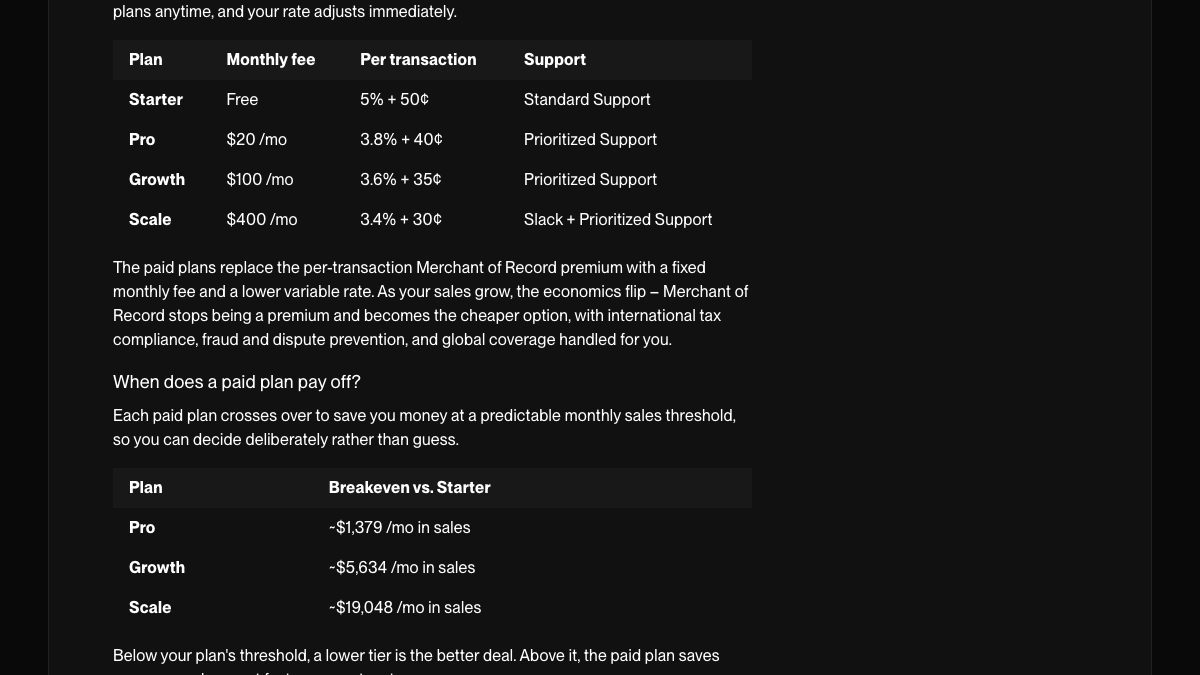
Polar publishes its whole price list, with lower rates for a monthly fee. New organizations since May 27, 2026 start on the free Starter plan at 5% + 50¢, and the $20 Pro plan drops that to 3.8% + 40¢. By Polar's own math, Pro starts saving money at about $1,379 a month in sales.
Dodo Payments and Creem
Both undercut Paddle on the headline rate. Dodo charges 4% + 40¢ for US cards, with 1.5% more for international cards, 0.5% more on subscriptions and 3% more for PayPal. Creem charges 3.9% + 40¢ with no international card fee, and pays out on the 1st and 15th of each month.
Lemon Squeezy
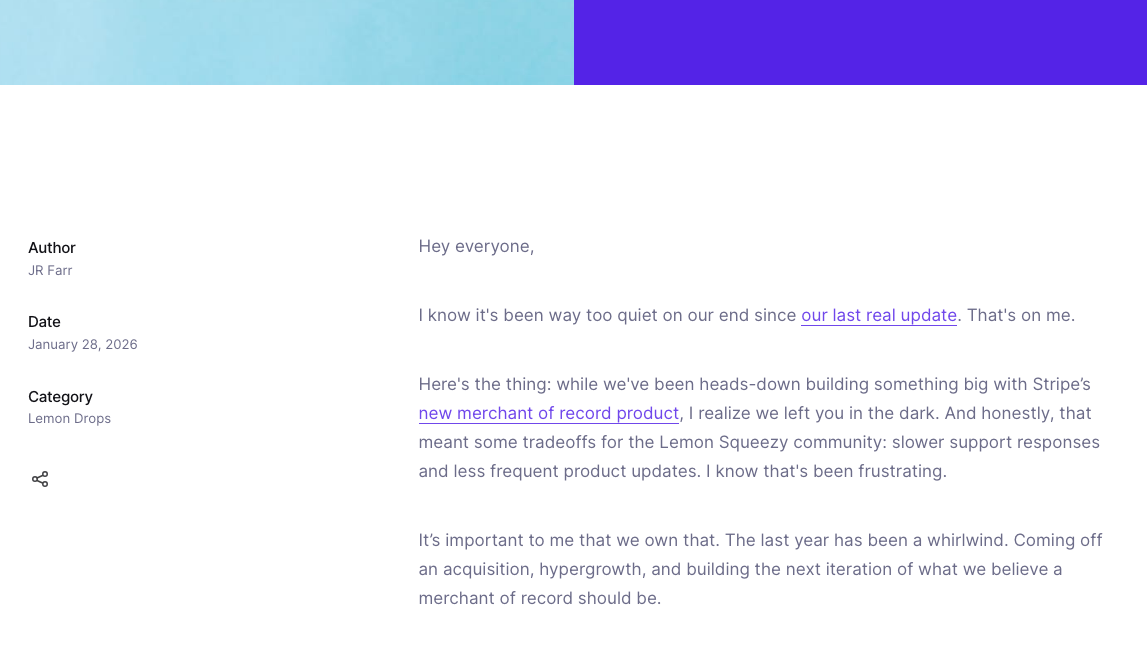
Lemon Squeezy still lists 5% + 50¢, but its future is tied to Stripe, which bought it in 2024. In a January 2026 post, CEO JR Farr said the team had been building Stripe Managed Payments and admitted that meant "slower support responses and less frequent product updates" for Lemon Squeezy users.
If you're on Lemon Squeezy today, plan where you'll go next rather than waiting to be moved.
We'll show you exactly where your brand stands in AI search.
No commitment. $0 due today, cancel anytime. See how ChatGPT, Perplexity, Claude, Gemini, Grok, and Google AI Mode talk about your brand today.

What each option costs at $10,000 a month
List prices only tell part of the story, so here's one worked example: $10,000 in monthly recurring revenue from 200 subscriptions at $50, with 40% paid on international cards.
| Option | Estimated monthly fees | Share of revenue |
|---|---|---|
| Creem | $470 | 4.7% |
| Stripe, Billing and Tax (you file taxes) | $530 | 5.3% |
| Polar Pro | $540 | 5.4% |
| Dodo Payments | $590 | 5.9% |
| Paddle | $600 | 6.0% |
| Polar Starter | $660 | 6.6% |
| Stripe Managed Payments with Billing | $830 | 8.3% |
These are our estimates from list prices. They leave out currency conversion, payout fees, disputes and any volume discounts. The Stripe-direct row also leaves out what registering and filing tax in each market costs you in time or accountant fees, which is the work an MoR is doing for its extra percentage points.
Two things stand out. The spread between the cheapest and most expensive MoR is about $360 a month at this size, or roughly $4,300 a year. And Stripe Managed Payments costs the most here, because its 3.5% sits on top of standard card fees and the international card surcharge.
How to choose
| If you... | Consider |
|---|---|
| Sell to consumers worldwide and want tax off your plate | An MoR: compare Paddle, Polar, Dodo and Creem on your price points |
| Sell mostly to businesses, with invoices | Stripe with Billing and Tax, or Paddle's custom invoicing |
| Already run everything on Stripe | Stripe Managed Payments, if the extra cost is acceptable |
| Sell plans under $10 | Ask for custom pricing, or pick a lower fixed fee |
| Are on Lemon Squeezy today | Plan a move before you're forced into one |
Whatever you pick, keep a second provider approved and ready. Payment access is a single point of failure, and a backup that took three weeks to approve is useless on the day you need it.
Before you switch providers
Moving payment providers touches more than checkout. Before you commit, work through these:
- Ask whether saved cards for active subscriptions can move, or whether customers must re-enter them
- Map which tax registrations you'd need to hold yourself if you leave an MoR
- List every webhook, license key and entitlement check tied to the current provider
- Draft the email to existing customers about new invoices and card statements
- Run the new checkout in your three biggest markets with real cards before launch
After billing, the next bottleneck
Picking a payment provider is a one-time decision you revisit every year or two. Getting buyers to find you is the ongoing one, and more of them now start their research in an AI chatbot. A pricing page with real numbers and clear plan limits helps there too, since AI engines can only quote prices you publish.
Once your billing is settled, RankControl's content engine plans and publishes articles that answer the questions your buyers ask, and AI visibility tracking checks weekly whether ChatGPT and five other engines cite you. For a quick first read, our free AI visibility checker shows who ChatGPT recommends for three questions from your market.
Know exactly what AI says about your competitors.
RankControl's Recon Agent monitors competitor citations across ChatGPT, Perplexity, Claude, Gemini, Grok, and Google AI Mode. See where they show up and you don't.