
In April, a site owner posted in r/SEO about a brand-new SaaS site. They'd put up close to 30 pages from day one, watched impressions climb, then watched them fall to almost nothing by day four or five. Their question is the one every new site owner eventually asks. Is this the sandbox, or is the content just bad?
That post is really a symptom of the actual gap in link building for a new website. A site with zero links has nothing telling Google or a blogger that it's real, and most link advice skips straight past that to outreach.
This plan puts the work in the order it should happen. Month one proves you exist, month two builds one page worth linking to, and outreach waits until month three. I read Google's spam policies and its AI features guide on October 19, 2026, and every Reddit thread quoted below is from the past year.
Why link building for a new website starts somewhere else
Sites that already rank pick up links a brand-new site simply can't. Writers find them through search and cite them, as our post on natural backlinks explains, and a site with no rankings yet never gets discovered that way.
Cold outreach is usually the first thing people try, and it's the weakest possible move in month one. In an r/SEO thread from June, a financial services owner doing their own SEO asked for free backlink tricks. One reply said a brand-new site emailing strangers for links mostly just hears nothing back, and suggested two or three months of directory listings and content first, so people see a real business before you ever ask them for anything.
New to SEO, backlinks
I am new to SEO and do my own website for my financial services business. Any tricks to getting some free backlinks?
Another reply made a blunter point: there are no free tricks, every link costs either time or money. Call it proof before pitch. Each month earns you the right to ask for the next kind of link.
A link building plan for a new website at a glance
| Month | Main job | What it gives you |
|---|---|---|
| 1 | Business profiles, real directories and trade groups, people you already work with, social profiles | Proof the site and the business are real, mostly through nofollow links |
| 2 | One page built to be linked to | Something worth pointing at when you ask |
| 3 onward | Outreach for that page, a few links a month | Followed links from relevant sites in your niche |
The order matters more than the dates do. If the month two page runs six weeks instead of two, outreach simply waits that much longer.
Month 1: foundations that prove the site is real
Month one covers places where you can add your own site, plus people who already know you. None of it needs a cold pitch.
Start with business profiles: set up a Google Business Profile if you serve customers in an area, and Bing Places too, keeping your name and address identical everywhere. Then work through real directories and trade groups, the associations you actually belong to, your local chamber, and the handful of directories people in your field actually use; an r/SEO thread on whether directories still make sense landed on one shared test, list only where the directory gets real visitors and real updates. Founder, partner and supplier mentions come next: a founder's LinkedIn and personal site can link back, and suppliers or partners often keep customer or reseller lists, people who already have a reason to say yes. Finish with social profiles, claiming your name on whatever networks your buyers use and linking each one to the site; one reply in an r/DoSEO thread called these the fastest start for a new site, simply because you control them outright.
Plenty of these links are nofollow, and that's fine. The top reply in an r/bigseo thread on first backlinks argued nofollow links get ignored for rankings entirely. Even taking that at face value, ranking credit isn't the job here. These links put your name where buyers look, and prove a real business sits behind the site.
Paid listings work the same way. Google's guide to qualifying outbound links asks sites to mark paid links as sponsored, with nofollow still accepted, so a listing you pay for should carry one of those tags regardless.
Run one check before you submit to any directory, though. Google lists low-quality directory and bookmark links as link spam, so a site that exists only to sell listings can hurt more than help. A founder running an Instagram growth tool shared a year of SEO notes on two of his own products, checking dofollow and nofollow status by hand and finding 11 free directories that passed a link.
I am not an SEO expert. Here is a year of SEO for two products I own: dofollow vs nofollow checked by hand, 11 free directories that pass a link, why programmatic pages stalled at position 77, and the 9 steps that actually moved rankings. https://t.co/AlaB6JDsFO
 Piyush Sachdeva - ReelDrop #1 Instagram GrowthTool@techie_piyushSep 2, 2026
Open one live listing on each directory and look at the link yourself before you pay or submit anything.
You're getting AI traffic. But do you know where it comes from?
RankControl credits every visit to the assistant that sent it: ChatGPT, Perplexity, Claude, Gemini, Copilot, or Grok. Full source attribution, next to your Google traffic.
Month 2: build one page worth linking to
Outreach needs something to point at, and a homepage is a weak ask. In month two, build one page a writer in your field would genuinely want to cite: a small data set you gathered yourself, a free tool, a template, or a guide that answers a common question better than whatever currently ranks.
Pull the topic from questions your niche keeps asking. Google's own guide to AI features, last updated in July 2026, calls for content that adds value "beyond common knowledge," which happens to be a fair bar for a link-worthy page too.
Keep publishing normal posts around it, since one strong page sitting alone on an otherwise empty domain looks odd. Once the page is live, our guide to digital PR backlinks shows how to turn it into an actual press pitch.
Month 3 onward: start outreach, slowly
By now you have proof and a page, so outreach can finally start, kept small and genuinely relevant. In that r/bigseo thread, one reply argued 5 to 10 solid, relevant links do more than 100 random ones.
Start with four places. Resource pages that already list tools or guides like yours; our post on resource page link building has the search strings and two pitch emails. Small sites in your niche that write about your exact topic; our guide to finding link chances in a small niche sorts them by type. Posts citing an old stat or a dead page that your page now replaces. And partners or customers who blog, now that you have something worth sharing.
For each new article going forward, our post on getting backlinks to blog posts has a quick test for which tactic fits. Later, once guest posts and resource pages stop paying off, advanced link building techniques picks up where this plan leaves off.
How many links a month is actually right? Nobody really agrees. In an r/linkbuilding thread on link velocity, posters described building 2 or 3, or 4 to 5, a month by hand. One tied their own pace to a client's rivals, aiming for just one more quality link a month than that rival's average.
Link velocity and the sandbox
No study we could find gives a genuinely safe number of links per month for a new site, or a count of days until it ranks. Every number floating around traces back to someone's own sites.
Google's latest on-record answer dates from a February 2018 Webmaster Central hangout, where John Mueller said Google doesn't run a sandbox as such, though several algorithms take time working out where a new site fits, since there are few signals yet. Ahrefs reported that quote in July, and Google hasn't offered anything newer since.
Site owners still report a real lag, though. In that r/SEO sandbox thread, one reply told the poster to give it six to eight months before judging anything, since new sites stay volatile. Another said new sites usually take a few months before anything sticks.
Is Sandbox real?
Hi everyone! I'm not an SEO specialist, just familiar with some SEO stuff. I've created a new website (SaaS). From day 1, I created nearly 30 pages of content. I started to gain traction in terms of impressions.I continued to post content,...
Treat both as anecdotes, same as the two-to-three-month directory advice earlier, since nobody actually measured either one. A new site picking up a few relevant links each month looks normal. One that jumps from zero to hundreds in a few weeks fits exactly what Google's link spam rules describe.
What Google says not to buy
Google's spam policies, last updated August 28, 2026, define link spam as links made mainly to manipulate rankings.
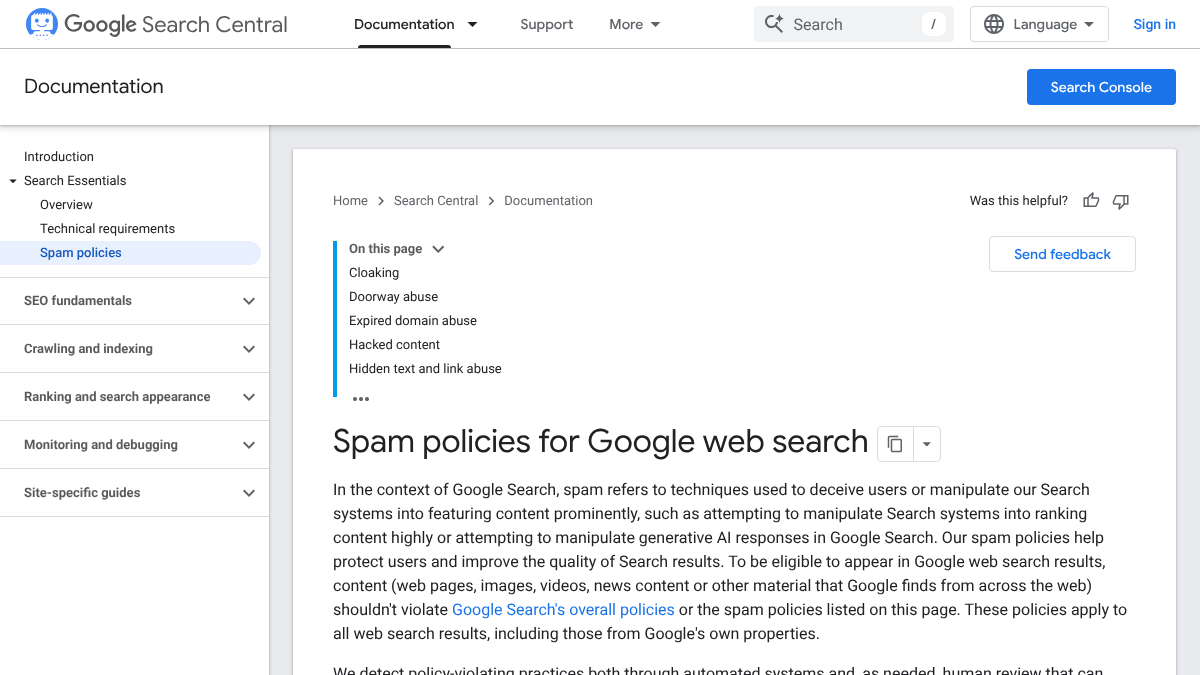
These are the ones a brand-new site is most tempted to reach for.
| Tactic | Why new sites try it | What the policy says |
|---|---|---|
| Buying links, or trading goods or services for them | Fastest way past zero | Link spam, unless marked nofollow or sponsored |
| Links made by automated tools or services | Cheap and quick | Link spam |
| Low-quality directory and bookmark sites | Easy to submit in bulk | Link spam |
| Keyword-rich anchors in guest posts and press releases | Feels like it should help rankings | Link spam |
| "Link to me and I'll link to you" swaps | Free | Link spam when excessive |
Google does say buying links is a normal part of advertising, as long as the links carry the nofollow or sponsored tag. A sponsored newsletter spot is fine when it's properly tagged, and it can still send you real visitors.
We'll show you exactly where your brand stands in AI search.
No commitment. $0 due today, cancel anytime. See how ChatGPT, Perplexity, Claude, Gemini, Grok, Google AI Mode, and Google AI Overviews talk about your brand today.
How a new site can show up in AI answers before it has many links
Links aren't the only signal AI engines seem to weigh. Ahrefs looked at 75,000 brands and found branded web mentions correlated with visibility in Google's AI Overviews at 0.664, roughly three times the 0.218 it found for backlinks. Our post on brand mentions vs backlinks covers that study in full.
That's good news for a new site, because month one is already full of mentions. Your directory listings, partner pages, community answers and founder profiles all name you, whether or not any pass an actual link.
Two caveats are worth holding onto. The study measured brands that already exist at scale, so it says little about a site that's three months old, and a correlation isn't proof of anything. Google's guide to AI features in Search also warns that chasing inauthentic mentions "isn't as helpful as it might seem," since its spam systems apply there too.
Aim for real mentions in places your buyers already read. AI citations tend to arrive slowly, mostly as other sites link to and mention you, so start tracking them early and you'll notice when the first ones show up.
What this takes in hours
These are rough estimates, and your own niche will shift them around.
- Month one takes 8 to 12 hours, mostly forms and short emails to partners.
- The month two page takes 15 to 30 hours, more if you're gathering your own data.
- Outreach takes 4 to 6 hours a week for finding sites and writing emails.
- Each supporting article takes 2 to 3 hours if you write it yourself.
That's roughly 25 to 40 hours before your first pitch goes out, then several hours every week after.
Doing it yourself or handing it off
You can run all of this yourself with a spreadsheet. Or RankControl can take on the parts that repeat, writing and publishing articles on your new site, so you keep adding pages worth linking to.
Our outreach finds link prospects for each published article and drafts the emails from your mailbox, with follow-ups that stop the moment someone replies. There's one plan at $400 a month with a 7-day free trial.
Month one stays with you either way, since only you can claim your own business profile or ask your own suppliers for a link.
Know exactly what AI says about your competitors.
RankControl's Recon Agent monitors competitor citations across ChatGPT, Perplexity, Claude, Gemini, Grok, Google AI Mode, and Google AI Overviews. See where they show up and you don't.