
Going from four articles a month to thirty sounds like a writing problem. It isn't. Writing got cheap. What breaks as you scale is everything around it: deciding what to write, editing, checking facts, getting approvals and publishing.
This guide walks through what breaks first at each stage, from 4 to 10, 20 and 30 articles a month, and how to fix it. It also covers what time-per-post data and real publishing records show about doing this well.
Why volume alone doesn't work
Orbit Media's 2026 blogging survey of 1,042 content marketers shows the trap. It found "92.4% now use AI for blogging," and added that it "correlates with nothing."
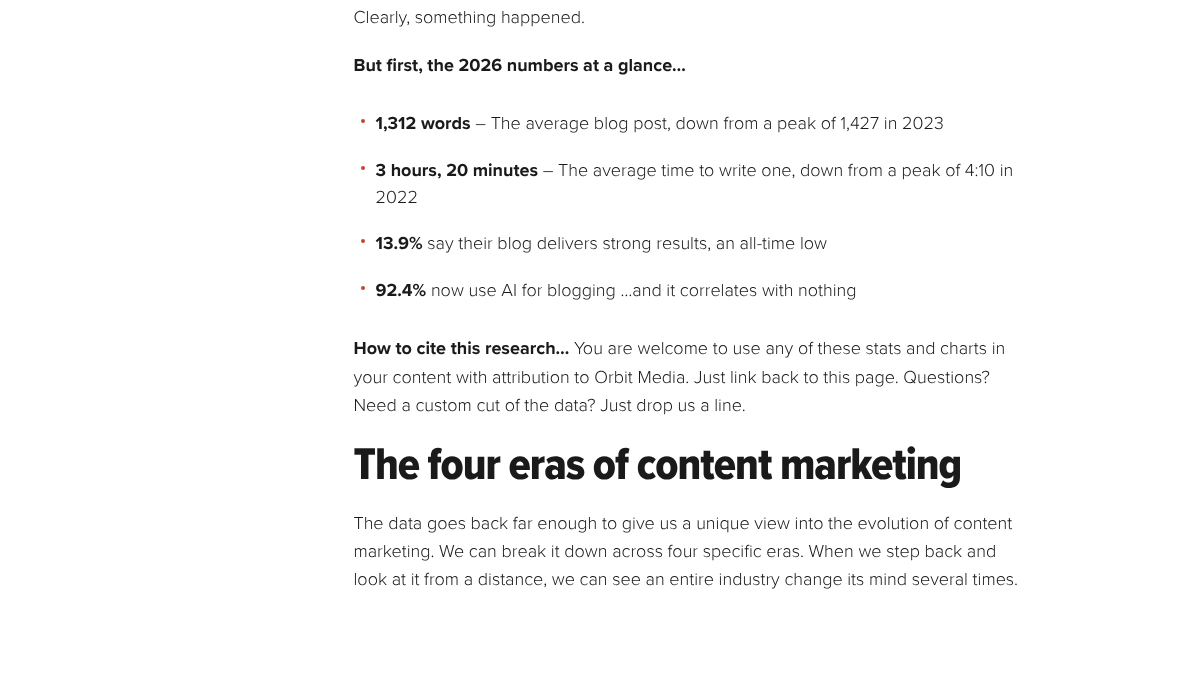
Writing got faster. The survey found the average post takes "3 hours, 20 minutes," down from a peak of 4 hours 10 minutes in 2022. But results got worse. Only 13.9% said their blog delivers strong results, which the survey called "an all-time low."
The lesson is that faster drafting doesn't produce better outcomes on its own. Scaling well means protecting the steps that make an article worth reading.
There's a risk side too. Google's spam policies define scaled content abuse as "when many pages are generated for the primary purpose of manipulating search rankings and not helping users." Our post on AI content and Google penalties covers what that looks like in practice.
What breaks at each stage
| Monthly output | What breaks first | The fix |
|---|---|---|
| 4 to 10 | Ideas run out | A steady topic source from customers and search data |
| 10 to 20 | Editing backs up | A standard brief and a fixed editing pass |
| 20 to 30 | Facts and approvals slip | A fact-check step and an approval deadline |
| 30+ | Publishing and tracking get messy | A publishing checklist and one source of truth |
We call the point where editing can't keep up the editing ceiling. Most teams hit it somewhere between 10 and 20 articles a month, and pushing past it is where quality drops.
15 hours a week manually. Or 15 minutes with RankControl.
Track citations, monitor competitors, and fix content gaps across every AI search engine. Automatically.

Stage 1: 4 to 10 a month, ideas run out
At four a month, the team usually knows what to write. Somebody has a list. At ten, that list is gone in a few weeks.
The fix is a topic source that refills itself.
- Sales and support questions. Every repeated customer question is a potential article.
- Search Console. Queries you already show up for with impressions but few clicks.
- Search data. The questions buyers type, from autocomplete and People Also Ask.
- Competitor gaps. Questions competitors answer that you don't.
In an r/content_marketing thread asking how anyone keeps quality up once content is cheap to make, the top reply made the same point. The writing isn't the hard part anymore, the commenter wrote. The hard part is having something worth saying, so pull ideas from customer calls, support tickets, sales questions and search data, turn the good ones into briefs and have someone actually edit.
If content is cheap to create, what's your system to create quality content at scale?
Everyone's noticed content is basically free to produce now. AI can write a competent "10 best practices for X" post in ten minutes. I am curious to hear how people are creating better content/more valuable content for their companies at sc...
Keep a backlog of at least two months of approved topics. If it drops below one month, slow down publishing before quality suffers.
Stage 2: 10 to 20 a month, editing backs up
This is the editing ceiling. At ten a month, one editor can read everything carefully. At twenty, they can't, and drafts start going out with only a skim.
Two fixes help most, and both cut editing time per draft.
A standard brief. Every article starts from the same template. It names the reader, the one question the piece answers, the main points, the sources to cite and the facts that must be right. A good brief means the draft arrives closer to done.
A fixed editing pass. The same checks, in the same order, for every draft:
- Does the intro answer the question?
- Is every number sourced?
- Is anything vague or generic?
- Does it sound like us?
- Are the links and headings right?
If one editor still can't keep up, add a second editor before adding more writers. More drafts with the same editing capacity is how quality drops.
Stage 3: 20 to 30 a month, facts and approvals slip
At twenty or more, two things start going wrong at once.
Facts. AI drafts invent statistics and cite pages that don't exist. At low volume, an editor catches them. At high volume, some get through. Make fact-checking its own step, separate from editing. The rule is simple. Every number and quote gets checked against its original source.
Approvals. Subject-matter reviewers and stakeholders become the queue. Give every review a fixed deadline. If feedback doesn't arrive, the piece moves to the next cycle and the next approved piece takes its slot. Our guide to a monthly content process for agency clients covers this kind of approval deadline in more detail.
AI search traffic grew 835% this year. Is your content ready?
RankControl generates 26 content formats optimized for ChatGPT, Claude, and Perplexity. Published on your domain, matched to your brand.

Stage 4: 30 and up, publishing gets messy
At thirty a month, publishing itself becomes work. Each post needs images, formatting, internal links, metadata and a final check before it goes live.
Use a publishing checklist and one place where every article's status lives, from idea to published URL. Spreadsheets break down at this volume.
What real publishing records show
We wanted to see how high-volume SaaS blogs actually publish. On October 19, 2026, we pulled the public sitemaps of five well-known SaaS blogs and counted how often their article URLs changed each month from January 2025 to October 2026, using each page's last-modified date.
| Blog | Pattern | Monthly range |
|---|---|---|
| Zapier | Steady | About 33 to 100 URLs a month |
| Semrush | Bursts | 7 to 133, with both Septembers far above the rest |
| Notion | One planned push | 1 to 7 most months, then 21 to 42 a month from January to April 2026 |
| HubSpot | Unreadable | One month showed 1,440 changes, likely a site-wide update |
| Intercom | Unreadable | Every blog URL showed the same month |
Last-modified dates count updates as well as new posts, so these aren't exact publishing counts. But two patterns stand out.
First, even large blogs don't publish at a constant rate. Semrush pushes hard each September. Notion ran a four-month sprint and then slowed back down. Volume moves in planned stages, not a flat line.
Second, two of the five sitemaps were too messy to read. Bulk site updates had re-stamped thousands of pages at once. It's a small sign of how record-keeping gets harder as a content library grows.
How long it takes at each stage
Orbit Media's 3 hours 20 minutes covers writing only. Add the rest and a realistic per-article total looks like this:
| Step | Time per article |
|---|---|
| Topic research and brief | 45 to 60 minutes |
| Drafting, with AI help | 1 to 2 hours |
| Editing | 1 to 2 hours |
| Fact-checking | 30 to 45 minutes |
| Approvals and revisions | 30 minutes |
| Publishing and checks | 20 to 30 minutes |
That's roughly 4 to 6 hours per article. At thirty a month, that's 120 to 180 hours, close to a full-time team of one or two people before anyone works on promotion. Our breakdown of freelance writers covers what outsourcing that time costs.
Who does what at 30 a month
The roles change as volume grows. At four a month, one person often does everything. At thirty, splitting the work is what keeps quality steady.
| Role | Main job | Roughly how many articles they can handle |
|---|---|---|
| Content lead | Topics, briefs and final calls | All of them, at the planning stage |
| Writers or AI drafting | First drafts from briefs | Scales easily |
| Editors | The editing pass on every draft | About 10 to 15 a month each, done properly |
| Fact-checker | Every number, quote and source | 20 to 30 a month |
| Publisher | Formatting, images, links and checks | 30 or more a month |
The editor row is the one to watch. If you plan for thirty articles and have one editor, you've planned for skimming.
When not to scale
Scaling isn't always the right move. Hold at your current volume if:
- Your backlog has less than a month of approved topics.
- Your editor is already skimming.
- Older articles haven't been checked or updated in a year.
- You can't tell which existing articles bring traffic or leads.
Our guide to publishing cadence for AI search covers how many new pages you need in the first place.
Doing it yourself or handing it off
Scaling to thirty a month means building a production line: topic sourcing, briefs, editing, fact-checking, approvals and publishing, all running every week.
RankControl runs that line for you. We find the questions your buyers search, write each article from your brand's facts and the pages already ranking for it, with sources cited, and publish up to 100 pages a month to your site once you approve them. Our AI visibility tracking checks up to 50 buyer questions every week across seven AI engines. Expect traffic from Google first, with AI citations following more slowly as links and mentions build up.

Built by the team that got cited in 48 hours.
Content generation, backlink building, AI visibility tracking, and Google rankings. One platform, zero guesswork.