
Four standing desk brands, every blog post each one had ever published, pulled on October 19, 2026. Autonomous had written 3,406. Branch had 192, Uplift 163, Vari just 113. We ran a content gap analysis for Vari against the other three, hunting for topics its rivals cover that it simply doesn't.
The first pass turned up 29 gaps. By the time we'd checked each one against actual search demand and what currently wins the results page, that list had shrunk to about six worth writing. This guide walks through every step of that process with the real numbers, so you can run the same thing on your own market.
What a content gap analysis finds
At its core, a content gap analysis compares topics. You list what your competitors publish, sort it into subjects, and mark the subjects they cover that you don't.
Two related checks sit right next to it. A keyword gap analysis compares the actual searches each site ranks for, and a backlink gap analysis compares the sites linking to each one. Our SEO competitor analysis runs a keyword gap between two help desk tools, so this post sticks to topics and only touches links at the end.
We picked Vari as the example because its resource center is a fairly typical size for a mid-sized brand. The three rivals, Uplift, Branch and Autonomous, all sell standing desks and office chairs online too.
Step 1: List every page your competitors publish
You don't need a paid tool for this step. Most sites list every page in a sitemap, and the robots.txt file at the root of the domain usually says exactly where to find it.
We fetched each brand's sitemap and kept only the blog and resource URLs. One rival, FlexiSpot, returned nothing to our script, so we left it out entirely.
| Brand | Blog or resource articles |
|---|---|
| Autonomous | 3,406 |
| Branch | 192 |
| Uplift | 163 |
| Vari | 113 |
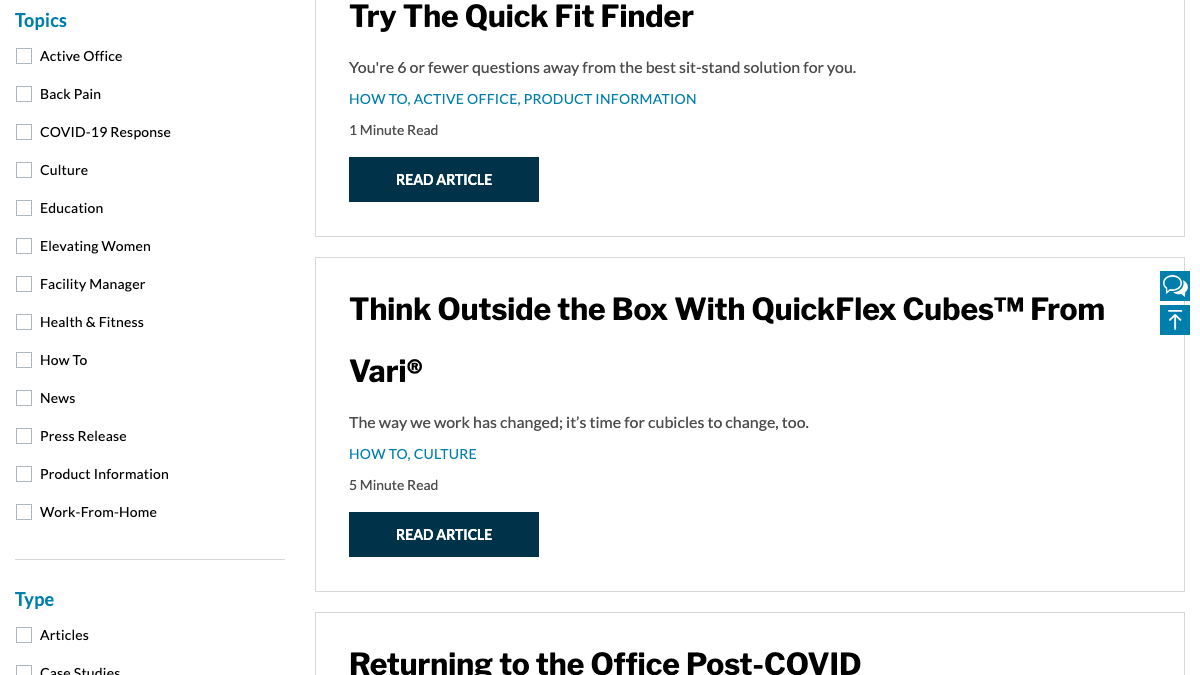
The URL slugs alone already tell you a lot before you've read a single word. Branch's slugs read like questions a buyer would actually type, things like how-long-should-you-stand-at-a-standing-desk and office-chair-sinking-fix. By our rough sort, roughly two-thirds of Vari's 113 articles are about Vari itself, workplace culture or the return to the office, not about the desks.
Step 2: Group the pages into topics
A list of 3,874 URLs isn't a plan on its own. We wrote 45 buyer topics by hand, running from "how long to stand at a standing desk" to "standing desk wobble," and matched every single slug to one of them.
A topic counted as a gap when Vari had no article on it and at least two of the three rivals did. That gave us 29 gaps. Here's a sample of what that table looked like.
| Topic | Vari | Uplift | Branch | Autonomous |
|---|---|---|---|---|
| How long to stand at a standing desk | 0 | 2 | 2 | 2 |
| Under desk treadmills | 0 | 1 | 2 | 36 |
| Cable management | 0 | 5 | 2 | 7 |
| Standing desk height | 0 | 0 | 3 | 4 |
| Dual monitor setup | 0 | 0 | 3 | 20 |
| Tech neck | 0 | 0 | 1 | 14 |
| Standing desk weight capacity | 0 | 2 | 0 | 3 |
Slug matching is a blunt tool, and it misses any topic a site covers inside a page carrying an unrelated URL. Treat this as a long, rough list for now. The next three steps exist specifically to shrink it down.
We'll show you exactly where your brand stands in AI search.
No commitment. $0 due today, cancel anytime. See how ChatGPT, Perplexity, Claude, Gemini, Grok, Google AI Mode, and Google AI Overviews talk about your brand today.

Step 3: Cross off gaps a product page already covers
Before writing a single word, check whether you already rank for the topic some other way. We pulled the top 1,000 searches Vari ranks for on Google's first two pages and compared them against the gap list.
Two gaps disappeared almost immediately. Vari already ranked first for "anti fatigue mat standing desk" with its standing mats category page, and fourth for "l shaped standing desk" with the product page itself. A blog post on either would only end up competing with Vari's own pages for the same click.
This step matters most of all in ecommerce. A topic gap often turns out to really be a search that wants a product, in which case the fix is a better category page, not another article.
Step 4: Check that people search for it
Next we pulled US monthly search volume for every remaining gap, and the spread was enormous.
| Gap search | US searches a month |
|---|---|
| under desk treadmill | 60,500 |
| tech neck | 33,100 |
| dual monitor setup | 18,100 |
| standard desk size | 1,600 |
| standing desk height | 1,300 |
| standing desk cable management | 1,300 |
| standing desk calories burned | 170 |
| how long should you stand at a standing desk | 140 |
| standing desk weight capacity | 20 |
Low volume doesn't rule a topic out by itself. "Standing desk weight capacity" only gets about 20 searches a month, but whoever's asking is close to buying, which can be worth more than thousands of casual readers skimming past.
Step 5: See who actually wins each search
Most gap reports stop short of this step, and running it changed our list more than anything else did. We searched 15 of the gaps on Google, read the AI Overview on each, and asked ChatGPT the same question.
None of the four brands came out as the main winner anywhere. Between all of them, they reached Google's top 10 on only 4 of the 15 searches. Reddit sat somewhere in the top three on 9 of them, and YouTube showed up in 12 of the 15 AI Overviews we checked.
The health-adjacent topics went straight to clinics and hospitals instead. Tech neck, sciatica and wrist pain from a mouse all surfaced spine centers, orthopedic practices and hospital pages, and ChatGPT specifically cited NHS pages when answering on sciatica. A furniture brand would struggle hard to outrank any of them, and honestly probably shouldn't try.
ChatGPT cited no source at all on 10 of the 15 questions, answering purely from what it already knew. For "how long should you stand at a standing desk," there simply wasn't a page to cite. Writing one won't get you into ChatGPT's answer to that exact question anytime soon, even though the same page can still rank perfectly well on Google.
Know exactly what AI says about your competitors.
RankControl's Recon Agent monitors competitor citations across ChatGPT, Perplexity, Claude, Gemini, Grok, Google AI Mode, and Google AI Overviews. See where they show up and you don't.

More posts didn't mean more wins
Autonomous is the clearest lesson sitting in this whole dataset. Its 3,406 posts covered nearly every topic on our list, often dozens of times over, with 201 separate posts matching "gaming" alone. Despite all that, it reached Google's top 10 for exactly 1 of the 15 gap searches, landing seventh for "standing desk height."
Uplift won with a fraction of that output. It ranked second for "standing desk cable management" and second again for "standing desk weight capacity," and the AI Overview cited Uplift directly on both. Those happen to be questions a desk maker can answer better than practically anyone else, since the real answer lives in its own product specs.
Call it the owner test. A gap is worth filling when your own product team could genuinely answer it better than whatever's currently ranking. Cable routing on a sit-stand frame passes that test easily. Tech neck doesn't come close.
Step 6: Turn what's left into a short list
After running all five checks, here's the list we'd actually hand to Vari's content team.
- Standing desk cable management, with real photos of Vari's own trays and routing.
- Standing desk height, laid out as a chart by the user's height.
- How long to stand at a standing desk, citing published research on sit-stand time.
- Standing desk weight capacity, with real load ratings pulled per frame.
- Standing desk wobble, covering why it happens and how frame design cuts it down.
- Dual monitor setup on a standing desk, since Vari already ranks for dual monitor arms.
That's six pages surviving out of the original 29 gaps. Every one passes the owner test and sits in front of a buyer who's close to purchasing. Forums currently hold several of these answers, which tells you a clear, specific page genuinely has room to rank there instead.
The backlink gap, briefly
We also pulled the list of sites that link to Uplift, Branch and Autonomous but not to Vari. There were 61 of them.
Most turned out to be coupon sites, link shorteners, directories and scrapers, not worth chasing. About ten were real, including Dwell, House Digest, AnandTech, the Bogleheads forum and the Relay FM podcast network. Those ten make up the actual backlink gap worth working, and the other fifty-odd aren't worth the price of an email.
Where the best gaps come from
Competitors only ever show you the gaps they've already noticed themselves. In an r/bigseo thread on finding content gaps, one marketer said keyword volume mainly surfaces the gaps competitors already know about. Another said they mine support tickets, sales calls and forum threads instead, which turns up different things entirely.
A reply in a similar r/content_marketing thread put the whole idea simply. If people keep asking something and Google's answers for it are poor, that's the real gap, regardless of what any competitor happens to be publishing.
Content Gap Analysis: How Do You Do It?
I often find that some of the best content ideas come from questions users are asking but websites aren't answering properly. Whether it's keyword research, competitor analysis, Reddit, or customer feedback, everyone seems to have a differe...
So add one more source to your own list beyond competitors. Pull the questions straight from your support inbox and your reviews, then run each one through steps 3 to 5 exactly like any other gap. Our guide to a content audit covers checking the pages you already have before you go adding new ones on top.
What this takes each month
Here's a rough monthly budget for running this on one market by hand, based on our own estimate.
| Task | Hours |
|---|---|
| Pull and clean competitor sitemaps | 1 to 2 |
| Group pages into topics | 3 to 5 |
| Check your own rankings and search volume | 2 to 3 |
| Search each gap and read the results | 3 to 4 |
| Backlink gap review | 1 to 2 |
| Write the short list and briefs | 1 to 2 |
| Total for the first run | 11 to 18 |
After that first run, plan on two to three hours a month just to catch whatever competitors publish next.
Doing it yourself or handing it off
You can run every one of these steps by hand yourself. Or RankControl can take over the ongoing part of it. We scan your competitors' content every week, track which competitors ChatGPT, Perplexity, Claude, Gemini, Grok, Google AI Mode and Google AI Overviews cite for your buying questions, and write the articles that close the gaps once you approve them, while you stay focused on your product.
26 content formats. Published on your domain. Matched to your brand.
Guides, comparisons, listicles, case studies, and more. RankControl generates content that gets cited by ChatGPT, Perplexity, Claude, Gemini, Grok, Google AI Mode, and Google AI Overviews.