
Backlinks don't stay put. On October 19, 2026, we pulled 12 months of link history for four software companies from a commercial backlink index. Every one of them had lost referring domains equal to at least 17% of the domains linking to them today. Two lost more linking sites than they gained.
That's why backlink monitoring tools exist. They tell you when a link appears, when one disappears and whether the links you paid or worked for are still there.
This list compares nine of them. They are Ahrefs, Semrush, RankControl, Google Search Console, SE Ranking, Moz Pro, Majestic, SEO PowerSuite and BacklinkManager. Every price was checked on October 19, 2026, against each vendor's pricing page and docs.
How fast sites lose links
Here's what the index showed for the 12 months to September 2026.
| Site | Referring domains today | New in 12 months | Lost in 12 months | Lost as share of today |
|---|---|---|---|---|
| Invoice Ninja | 5,386 | 1,730 | 1,342 | 25% |
| Joist | 3,444 | 782 | 570 | 17% |
| Help Scout | 28,995 | 6,818 | 8,330 | 29% |
| Buzzsprout | 125,434 | 31,180 | 40,884 | 33% |
Help Scout and Buzzsprout both lost more linking domains than they gained. Some of those losses are normal churn, like expired pages, spam sites dropping out of the index and redesigns. Some are links that mattered. A monitoring tool is how you tell the difference.
Paid links are the most fragile. A user in r/linkbuilding asked why links bought as "permanent" kept disappearing after a few months. One reply explained that many are placed on sites built to sell guest posts, which delete older posts to make room for new buyers. Another reply was blunter, saying you need to be tracking links, especially if you've paid for them.
Why are the backlinks I buy on the platform always deleted so quickly?
I found several backlink marketplaces and purchased some backlinks. Before buying, they were labeled as “permanent,” but after a few months they get removed, which is very frustrating. I don’t understand why this happens. Have you met this...
The short answer
- For most teams that want alerts on new and lost links, the best pick is Ahrefs, because its alerts cover any site or URL from $129 a month.
- For teams already using Semrush, the best pick is Semrush, because its backlink tools sit in the same SEO plan.
- For teams building links to new articles, the best pick is RankControl, because it checks every link it helps you build each week and writes the articles that earn them.
- For a free baseline, the best pick is Google Search Console, because it shows your top linking sites at no cost.
- For tracking specific paid or traded links, the best pick is BacklinkManager, because it checks each placed link and its indexing from $39 a month.
Your competitors are building backlinks while you read this.
Organic outreach, social mentions, and citations from Editorial Circle member sites, with managed backlinks available as an add-on. Grow your domain authority without running the campaign yourself.

Backlink monitoring tools compared
| Tool | Starting price | Lost-link alerts | What it watches | Free option |
|---|---|---|---|---|
| Ahrefs | $129/mo | Yes, new and lost | Any site or URL, from its own index | Ahrefs Webmaster Tools |
| Semrush | $139/mo | New and lost in reports | Your site and competitors | Limited free account |
| RankControl | $400/mo | Yes, for links it helps build | Your link profile, refreshed weekly | 7-day trial |
| Google Search Console | Free | No | Your own verified site | Free |
| SE Ranking | $129/mo | Monitoring included | Your site and chosen links | 14-day trial |
| Moz Pro | $49/mo | Via link tracking lists | Any site, from its own index | Limited free account |
| Majestic | $49.99/mo | Email alerts on Pro ($99.99) | Any site, from its own index | Free tools, limited |
| SEO PowerSuite | $349/yr | Yes, automatic checks | Your sites, from its own index | Free version |
| BacklinkManager | $39/mo, yearly | Yes, per placed link | Links you add to it | Free signup |
1. Ahrefs
Ahrefs is the default for link data. Its Alerts tool notifies you whenever a site or a single URL gains or loses backlinks, and you can point it at competitors as well as your own site. The same tool covers web mentions and new keyword rankings.
Plans start at $129 a month for Lite, with Standard at $249, Advanced at $449 and Enterprise at $1,499. Ahrefs Webmaster Tools gives site owners free access to their own verified site's link data, which is enough for a small site's baseline.
Ahrefs is the tool to beat if you want the widest view. It's also more than most small sites need, and Lite has usage limits worth checking before you plan heavy monitoring.
2. Semrush
Semrush's backlink tools sit inside its SEO plans. Backlink Analytics shows new and lost links for your site and any competitor, and Backlink Audit tracks your own profile over time and flags links it scores as risky.
The SEO plan costs $139 a month, Starter $199 and Pro+ $299, or less billed yearly. If your team already uses Semrush for keywords and audits, its link monitoring is the obvious place to start.
One caution on audit tools generally. Treat "toxic" scores with care. When a site owner posted in r/SEO that they had disavowed hundreds of domains and lost a top-three ranking, the most upvoted reply said there's no need to disavow links at all in most cases. Google's own help says most sites don't need the disavow tool.
3. RankControl
RankControl isn't a standalone link index, and it doesn't try to replace Ahrefs or Semrush for researching any domain. It monitors links as part of a bigger job, which is creating the content that earns them.
Its Link Control section shows your link profile, refreshed weekly, with referring domains and total backlinks. Every link it helps you build, through outreach drafted from your own mailbox or its Managed Backlinks service, is checked every week. If a link goes missing, it's marked lost and you get a notification.
It's one plan at $400 a month that also plans, writes and publishes articles and checks six AI engines weekly. Managed Backlinks is a separate $350-a-month add-on. That makes RankControl a fit for teams who want links pointed at new content, not for teams who only want an index. Our guide to getting backlinks to blog posts covers that work.
4. Google Search Console
Search Console's Links report is free for any site you verify. It shows your top linking sites, your most linked pages and the anchor text people use.
It won't alert you when a link disappears, and the data is a sample, not every link. But it comes straight from Google, so it's a good reality check against paid tools. Our guide to backlinks in Google Search Console shows how to read it.
5. SE Ranking
SE Ranking lists backlink research and monitoring in its plans, so you can track your full profile and keep an eye on specific links you care about.
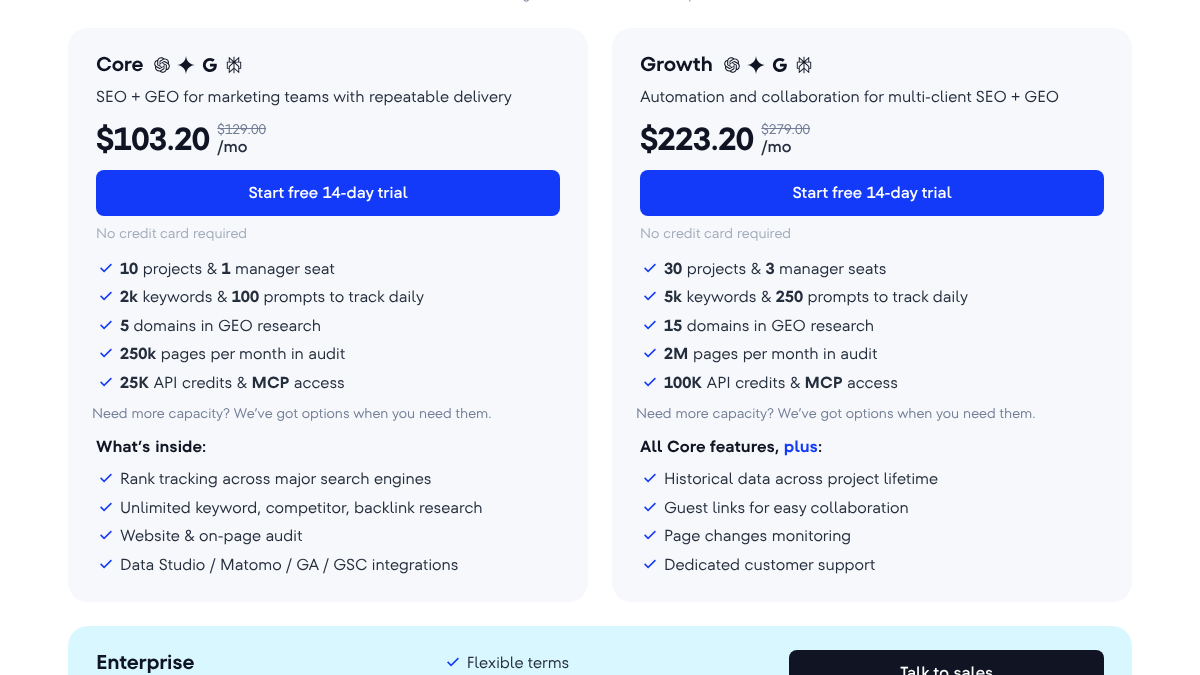
Plans start at $129 a month for Core, or $103.20 billed yearly, with Growth at $279. It's good value if you want rank tracking, audits and link monitoring in one place for less than Ahrefs or Semrush.
6. Moz Pro
Moz Pro's Link Explorer has its own link index and Domain Authority, the metric many people still quote. Link tracking lists let you watch whether specific sites link to you.
Plans start at $49 a month, then $99, $179 and $299. It's the cheapest of the big index tools, though the lower plans limit how many queries you can run.
7. Majestic
Majestic is a link specialist. It runs its own index and invented Trust Flow and Citation Flow, two link quality scores many link builders still use.
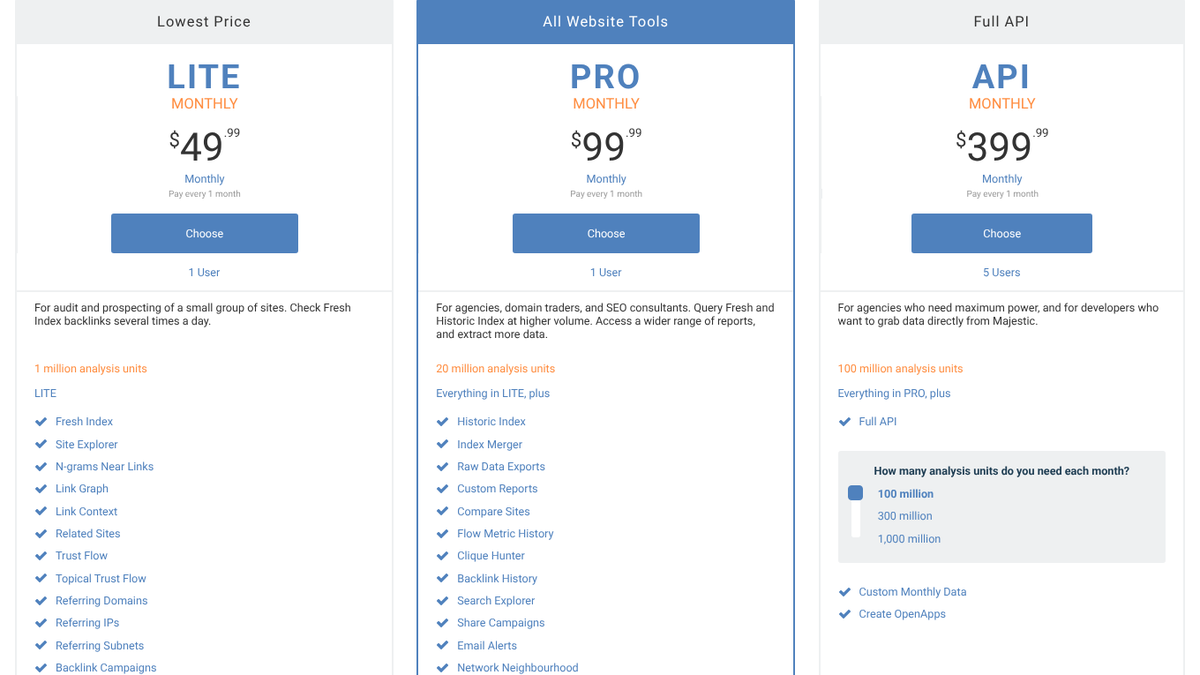
Lite costs $49.99 a month and covers a small group of sites. Email alerts, backlink history and raw exports start on Pro at $99.99. API at $399.99 is for agencies and developers.
8. SEO PowerSuite
SEO PowerSuite is desktop software, and SEO SpyGlass is its backlink tool. It tracks new and lost links over time and runs automatic backlink checks with alerts.
The Professional plan costs $349 a year, about $29 a month, with unlimited projects and backlinks tracked. Enterprise is $599 a year. There's also a free version of SEO SpyGlass with limits. It suits people who prefer a yearly price over a monthly one and don't mind running software on their own computer.
9. BacklinkManager
BacklinkManager does something different from the index tools. Instead of discovering every link to your site, it checks the specific links you add, like guest posts, paid placements and link exchanges. It tells you if a link is removed, changed or no longer indexed by Google.
Starter costs from $39 a month billed yearly, with 200 backlinks and three users. Growth is $99 for 1,000 backlinks. If you pay for links or trade them, this is the cheapest way to make sure you're getting what you paid for.

You're getting AI traffic. But do you know where it comes from?
RankControl credits every visit to the assistant that sent it: ChatGPT, Perplexity, Claude, Gemini, Copilot, or Grok. Full source attribution, next to your Google traffic.
Index tools and link checkers do different jobs
The nine tools split into two kinds, and most sites need one of each.
Index tools, like Ahrefs, Semrush, Moz, Majestic and SE Ranking, crawl the web and report every link they find to your site. They're good at spotting new links you didn't know about and drops across your whole profile. But their indexes differ in size and freshness, so two tools will report different totals for the same site. A link can also vanish from an index because the crawler stopped visiting the page, not because the link was removed.
Link checkers, like BacklinkManager, and the built-link checks in RankControl, visit the exact pages where you know a link should be. They're slower to discover anything new, but they're more reliable about whether a specific link is still live.
If you pay for links or run outreach, use a checker for those links and an index tool or Search Console for everything else.
What to do when a good link disappears
First, check the page yourself. Many reported losses are false alarms, where the page moved, the site changed its URL structure or the crawler simply hasn't been back. If the page now returns an error or redirects, the link went with it.
If the link was removed on a live page, email the site owner. Be specific, naming the page, the anchor text and what changed, and offer an updated resource if yours has moved. For paid or exchanged links, go back to whoever placed it.
Users in r/linkbuilding reported that sellers often promise "permanent" links that last only months. So keep records of every placement, its date and its price, and check them on a schedule rather than when you happen to notice.
What to monitor, and how often
Most sites need three checks.
- New and lost referring domains, weekly. An alert tool handles this. Look for sudden drops, which can mean a site migration broke links to you.
- The specific links you built or paid for, monthly. These are the ones worth chasing if they vanish. Email the site owner with the exact page and anchor that changed.
- The full profile, quarterly. Look at which pages earn links and which competitors are gaining them. Our backlink audit guide covers that review.
Don't chase every lost link. Many disappear for boring reasons, like a dead forum or a scraper site dropping out of the index. Spend your time on the links that came from real sites with real readers.
What this costs in hours
Setting up monitoring takes about two hours, including connecting your site, adding the links you've built and setting alerts. After that, plan on 30 minutes a week to review alerts and one to two hours a month to chase lost links that matter. A quarterly review adds three or four hours.
You can do all of this by hand. Or RankControl can do part of it for you, finding link prospects for each article, drafting outreach from your mailbox for your approval and checking every link it helps build each week, while it writes the articles worth linking to.
We'll show you exactly where your brand stands in AI search.
No commitment. $0 due today, cancel anytime. See how ChatGPT, Perplexity, Claude, Gemini, Grok, and Google AI Mode talk about your brand today.