
A site owner asked r/SEO this spring whether it's still worth buying backlinks. Outreach rarely got replies, the quoted prices felt crazy, and Fiverr looked like the easy way out.
Is it still worth buying backlinks
Getting backlinks feels really tough right now. Outreach rarely gets replies and when it does, the prices are crazy, so Fiverr seems like the easy way out. But I keep hearing those links are risky and Google can spot them easily now. I'm tr...
The top reply warned that when anyone can buy a link from the same site, it creates a pattern. Another said the cheap ones land you on link farms that give "absolutely ZERO power" other than draining your wallet.
Those are opinions. We wanted to see what you actually get when you buy. So we found sites selling links in the open and looked at their traffic.
The short answer
For most businesses, don't buy links that pass ranking credit. It breaks Google's rules, and most of what's for sale sits on sites with almost no visitors.
There are exceptions. Paid placements marked as sponsored are allowed and can send real traffic. Paying an agency for outreach time is different from paying a site for a link. We'll cover both below.
What Google says about paid links
Google's spam policies are blunt about this. Link spam includes "buying or selling links for ranking purposes," and that covers money for links, posts that contain links, and goods or services traded for links.
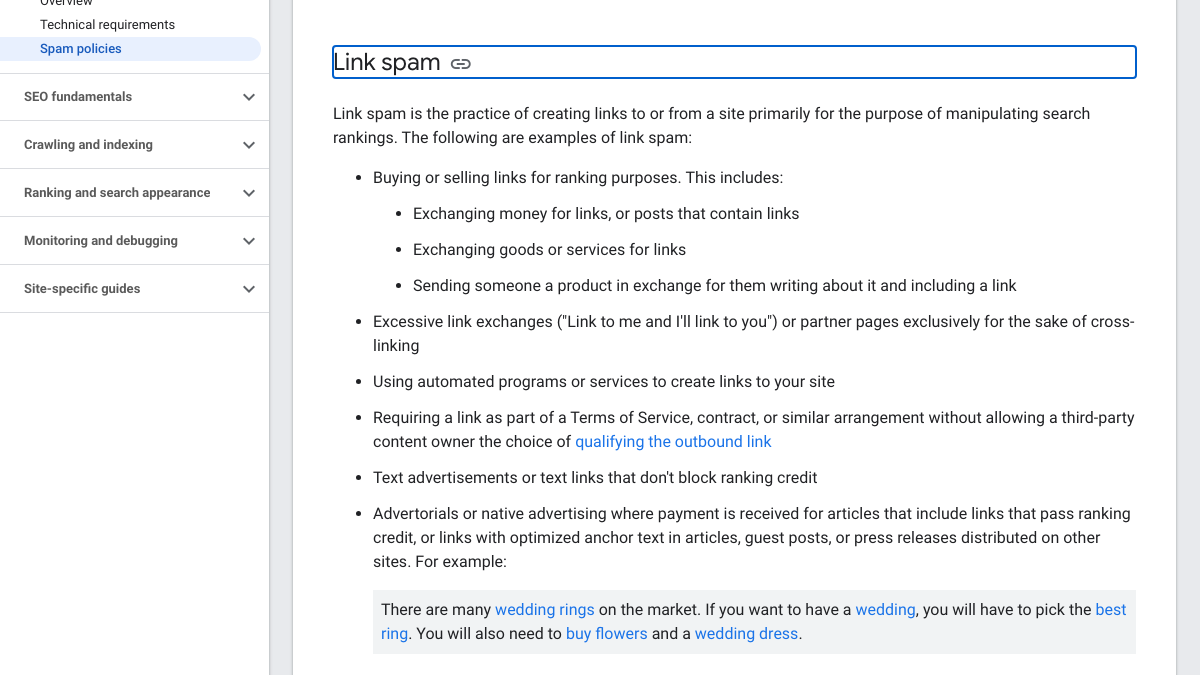
The same list names advertorials and guest posts where payment buys links that pass ranking credit. Paid links are allowed only when they're marked with rel="sponsored" or rel="nofollow", and then they pass no ranking credit.
That's the catch most sellers skip. A link that's honest about being paid can't do what buyers want it to do.
We checked who's selling
On October 19, 2026, we searched Google for sites with "write for us" and advertising pages that offer sponsored posts with dofollow links. These are site owners selling directly, not marketplaces or SEO agencies.
We kept 25 sites whose own pages offered dofollow links for sponsored or paid posts, across tech, business, finance, health, food, pets and lifestyle. Then we pulled each site's estimated monthly US Google traffic over the past two years from a search data provider.
For comparison, we ran the same check on 25 ordinary business sites that showed up in our business blog examples study.
| What we measured | 25 link-selling sites | 25 ordinary business sites |
|---|---|---|
| Median estimated monthly Google visits | about 300 | about 151,000 |
| Under 100 visits a month | 9 | 0 |
| No measurable traffic at all | 5 | 0 |
| Had no traffic a year earlier | 4 more, all new | 0 |
| More than 15,000 visits a month | 2 | 21 |
The median link seller gets about 300 estimated Google visits a month. Nine get fewer than 100, and five had no measurable traffic at all. Four more had no traffic a year ago, so they look like sites built recently to sell links.
Only 2 of the 25 had more than 15,000 monthly visits. That matters because someone posted in r/BacklinkSEO this month looking for paid guest posts for a SaaS site, on sites with at least 15,000 visits. Our sample says 23 of the 25 sellers wouldn't pass that buyer's own test.
15 hours a week manually. Or 15 minutes with RankControl.
Track citations, monitor competitors, and fix content gaps across every AI search engine. Automatically.

Traffic drops hit everyone, so look at size
We expected link sellers to be losing traffic faster than other sites. That's not quite what we found.
Both groups shrank. The ordinary business sites were down to a median of 63% of their traffic a year earlier, which fits the clicks AI answers have taken from Google results. Sixteen of them were below half their two-year peak.
The sellers had steep falls too. One site dropped from about 25,000 visits in January 2026 to about 210. Another site went from 2,600 visits a year ago to 18. But the honest finding is about size, not decline.
A link from a site nobody visits sends no visitors, and it's hard to argue it carries much weight with Google either. Our study of high quality backlinks looked at it from the other side, and found most links even top-ranking pages have come from sites with little traffic.
What these links cost
Seven of the sellers listed prices on their pages. Here's what they asked, next to their estimated traffic.
| Site type | Price per post | Est. monthly Google visits |
|---|---|---|
| Blog advice site | $250 to $400 | about 1,400 |
| Web services company blog | $49 to $99 | about 37,500 |
| Transport company blog | $99 | about 4,400 |
| Fashion and style blog | $40 to $45 | about 300 |
| Business and tech blog | $100 | about 100 |
| Crypto news blog | $17 to $100 | under 50 |
| Tech blog | $50 to $300 | none measurable |
Prices had little to do with traffic. The most expensive offer, $250 and up, came from a site with about 1,400 monthly visits, while one of the biggest sites asked $49. A tech blog with no measurable traffic still asked up to $300.
Our breakdown of how much backlinks cost covers price ranges across guest posts, niche edits and digital PR.
The real risks of buying backlinks
The risk isn't only a Google penalty. These are the ways bought links usually go wrong.
- They do nothing. Google says its systems can ignore spammy links, so many bought links simply never count.
- They draw a manual action. If Google's reviewers find a pattern of paid links, rankings can drop until you clean them up and file a reconsideration request.
- The site dies. Several sellers we checked lost most of their traffic within a year, and a link on a dead site is worth nothing.
- The page disappears. Sellers delete old posts or let domains lapse, and "permanent" links vanish.
- You pay for an audience that isn't there. A link from a 300-visit site sends almost no buyers.
Our guides to PBN backlinks and backlink builder packages cover what Google catches and what happens next.
AI search traffic grew 835% this year. Is your content ready?
RankControl generates 26 content formats optimized for ChatGPT, Claude, and Perplexity. Published on your domain, matched to your brand.

How to spot a link offer that will waste your money
The sellers we found shared the same habits, and they make offers easy to spot.
- The page promises "dofollow" or "permanent" links. A site that sells on dofollow is selling ranking credit, which is what Google's policy rules out.
- Prices are listed per post on a "write for us" or advertising page.
- The pitch leans on domain scores like DA 50 or DR 60, not on readers. Scores can be pushed up with links of their own, and traffic is much harder to fake.
- The site covers unrelated topics at once, from finance to pets to fashion.
- Estimated traffic is tiny, or the site is less than a year old.
If an offer ticks three of these, walk away. Checking a site's traffic takes a minute in any SEO tool, and it was the clearest warning sign in our data.
Limits of our check
We found these sellers through Google on one day, so they're the ones who advertise openly, not the private lists sold behind a login. Traffic figures are one data provider's estimates for US Google, and small sites are hard to estimate well. We've described the sites by type rather than naming them, since the point is the pattern.
When paying for links is fine
Some paid placements are allowed and worth it. The test is whether you'd pay for it with no SEO value at all.
- Sponsored posts or newsletter mentions on sites your buyers really read, marked rel="sponsored".
- Directory and marketplace listings that send customers, like industry associations.
- Paying a person or agency for outreach time, where the sites decide on their own whether to link.
- Sponsoring an event or community, with a link that's marked as sponsored.
In all of these you're buying attention or labor, not ranking credit.
Safer ways to get links
The links that last are the ones a site chooses to give. Here's where they usually come from.
- Original data. A survey, benchmark or test result gives writers something to cite.
- Useful tools and templates. Calculators and checklists earn links for years.
- Digital PR. Pitch a story or expert comment to journalists covering your field. Our guide to digital PR backlinks walks through it.
- Resource and partner pages. Find pages that already link to resources like yours and ask to be added.
- Unlinked mentions. Ask sites that already name your brand to add a link.
Our guide to white hat link building covers each of these in more detail.
What safe link building takes by hand
Here's a rough monthly budget for earning links without buying them, by our estimate.
| Task | Hours a month |
|---|---|
| Building one linkable asset, like data or a tool | 8 to 15 |
| Finding sites that link to similar pages | 3 to 5 |
| Writing and sending personal pitches | 4 to 8 |
| Following up and tracking replies | 2 to 4 |
| Checking new links and their traffic | 1 to 2 |
| Total | 18 to 34 |
Doing it by hand or with help
You can do all of this yourself. Or RankControl can take the steady part. Its link building agent finds prospects for each article it publishes, finds contacts, and drafts personal outreach from your own mailbox. If you'd rather hand it off, the Managed Backlinks add-on delivers 5 links a month from DR 25+ sites for $350 a month.

Built by the team that got cited in 48 hours.
Content generation, backlink building, AI visibility tracking, and Google rankings. One platform, zero guesswork.