
The trial ends at midnight. In the morning, Stripe shows the first charge as failed, and it's tempting to write the customer off as someone who typed in a fake card. In September, one indie founder posted on X about doing exactly that. Two days later that payment came through, the founder's first $7.
A failed first charge is often recoverable, but only if the retries are set up well, the customer hears from you in the right words, and you've done a few things before the trial ends. Our post on why SaaS trials decline at payment covers the diagnosis. This guide is the operating manual: what Stripe does on its own, what to prevent, and what to write.
Why the first charge fails
The decline code tells you most of what you need, and it decides what the customer should do next. Stripe returns these as a decline_code inside a card_declined error. Here are the ones that matter most at trial end, with Stripe's own explanation from its decline codes reference:
| Decline code | What Stripe says it means | What the customer should do |
|---|---|---|
| insufficient_funds | "The card has insufficient funds to complete the purchase." | Use another card, or wait for a retry |
| do_not_honor | "The card was declined for an unknown reason." | Contact their bank or use another card |
| generic_decline | Declined for an unknown reason, or blocked by Stripe's fraud tools | Contact their bank or use another card |
| expired_card | "The card has expired." | Add a new card |
| authentication_required | The charge needs authentication such as 3D Secure | Complete authentication on your site |
| fraudulent | Stripe suspects fraud | Show it like a generic decline |
That last row matters for your emails. Stripe's guidance for fraudulent is: "Don't report more detailed information to your customer. Instead, present it in the same manner as generic_decline."
The first charge after a trial is a special case. It's the first time your company's name appears on that customer's statement, it's usually charged while the customer isn't present, and it's often a larger amount than the card has seen from you before. Banks are cautious with all three.
The retry window: what Stripe does on its own
We call the days between the first failed charge and the last retry the retry window. During it, the customer usually has no idea anything's wrong, and most recoveries happen here.
Stripe's Smart Retries choose when to retry using signals like the best time of day to charge and how many devices have used the card recently. You set how many tries and over how long, from one week up to two months, and Stripe's Smart Retries documentation says "the recommended default setting is 8 tries within 2 weeks."
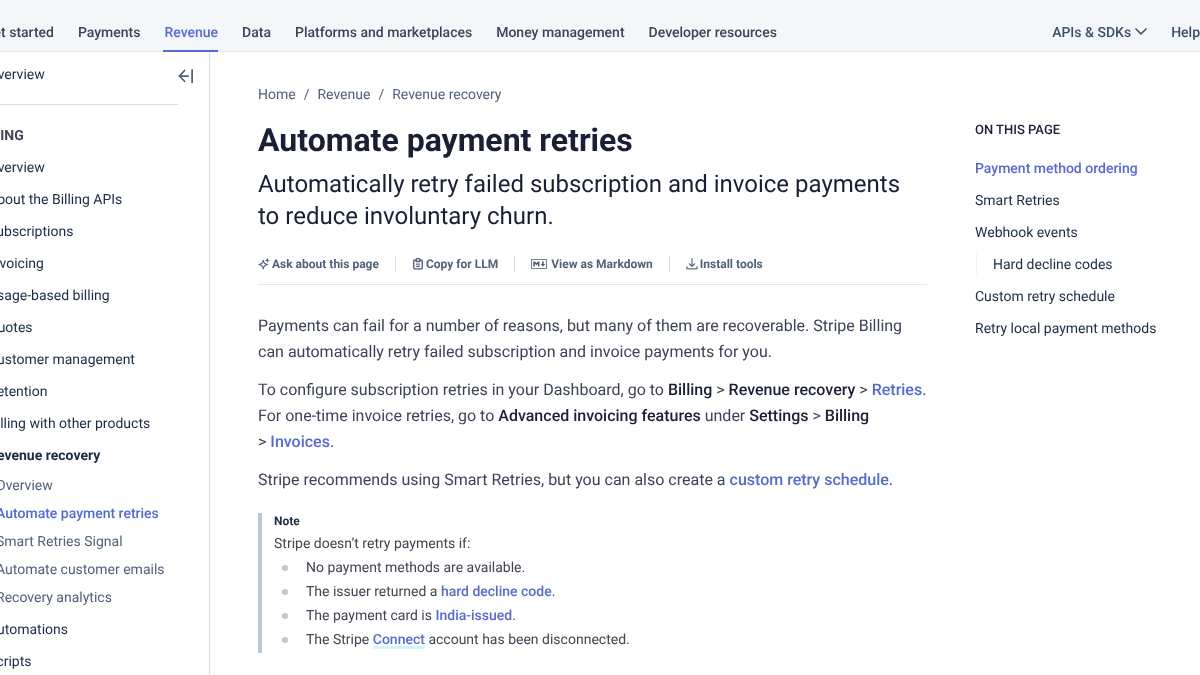
Two details catch people out. First, some declines are hard declines, and retrying won't help. Stripe lists nine, including lost or stolen cards, transaction_not_allowed and authentication_required. For these, "the scheduled retries continue but the payment only executes if you obtain a new payment method." So a card that needs 3D Secure will fail every retry until the customer comes back and authenticates.
Second, you choose what happens when retries run out: cancel the subscription, mark it unpaid, or leave it past due. Pick deliberately. For a first charge after a trial, cancelling right away throws away a customer who might have fixed their card next week.
If you handle billing in your own code, the invoice.payment_failed webhook carries an attempt_count for how many tries have happened. The invoice also shows when the next attempt is scheduled, which is the date your emails should mention.
How often does ChatGPT mention your brand?
Most founders have no idea. The answer might surprise you.

Prevent failures before the trial ends
Several of the most common failures are preventable, and the fixes are mostly settings.
Send a reminder before the charge. Stripe can email customers automatically: its customer emails settings include "Send a reminder email 7 days before a free trial ends." Separately, the customer.subscription.trial_will_end webhook fires three days before a trial ends if you'd rather send your own.
For Mastercard payments this isn't optional. Mastercard's recurring billing rules, as Stripe's support guidance summarizes them, require a reminder three to seven days before a trial converts to paid, including how to cancel. A reminder also gives the customer a chance to swap a card they know is about to be declined.
Authenticate the card when you collect it. In Europe and other places with Strong Customer Authentication, a charge made while the customer is away can be declined if the card wasn't authenticated when they entered it. Stripe's SCA guide says that if the bank declines such a charge, the payment "changes to requires_payment_method, and you must notify your customer to complete the payment." Saving the card with authentication at signup avoids most of these.
Let expired cards update themselves. Stripe automatically tries to update saved cards when a customer gets a replacement, and it's widely supported for US cards. Its customer emails can also warn customers "1 month before your customer's card on file expires."
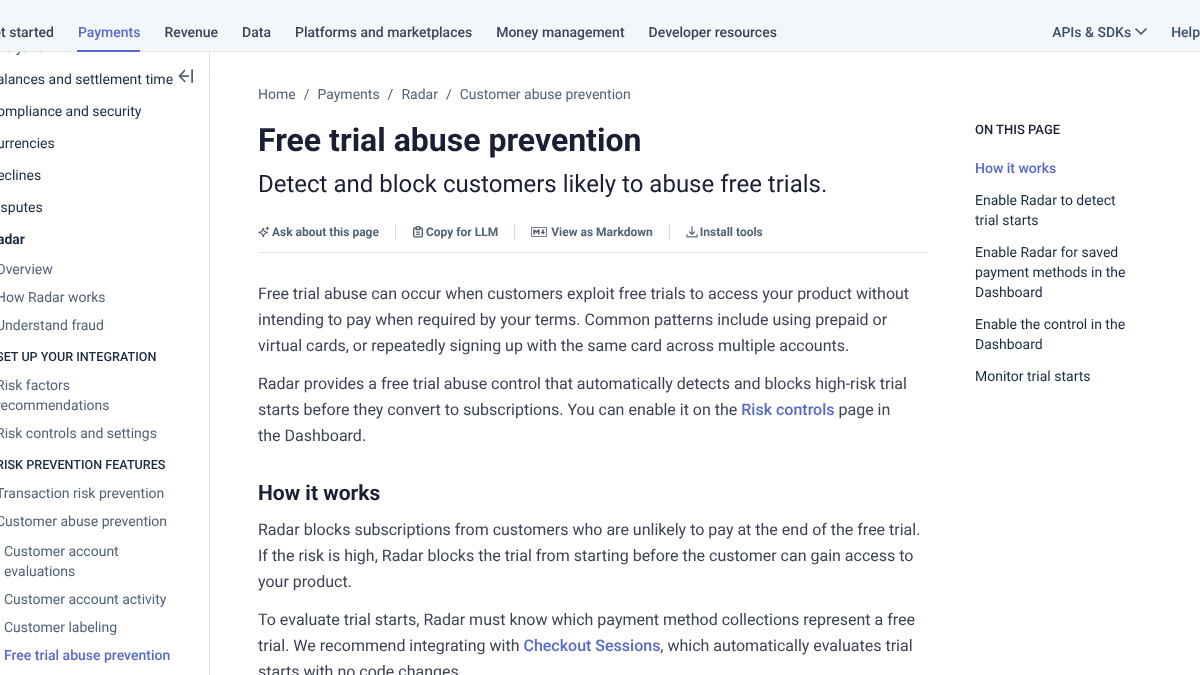
Filter out trials that were never going to pay. Stripe Radar has a free trial abuse control aimed at patterns like prepaid or virtual cards and the same card used across several accounts. When the risk is high, Stripe says Radar "blocks the trial from starting before the customer can gain access to your product."
The recovery emails: what to send and when
Stripe's built-in failed-payment email works, and it links to a hosted page where the customer updates the card and pays in one step. But it's generic. One SaaS help center shows customers what the default subject line looks like: "Your payment failed, please update." That's clear enough, but it doesn't say when access would stop or that nothing is lost yet.
Every good recovery email we looked at does three things. It says what happened, what happens next, and what to do. A small sequence built on that looks like this:
| When | Subject line idea | What it says |
|---|---|---|
| Day 0, first failure | Your payment for [product] didn't go through | What failed, the next retry date, one link to update the card |
| Day 3 | Still having trouble with your card | We're still retrying, your access is unchanged until [date] |
| Day 7 | A quick note from [founder name] | Personal, plain text, asks if they need a different plan or have questions |
| Two days before retries end | Your [product] access pauses on [date] | The date, what's kept, one-click fix |
Here's a day-0 email you can adapt:
Hi Sam, the $49 payment for your Acme plan didn't go through this morning. Your bank declined it for insufficient funds. Nothing's lost: your account and data are exactly as you left them, and we'll try the card again on Thursday. If you'd like to use a different card, you can update it here in under a minute: [update payment method]. No need to cancel or sign up again.
Three things make that email work. It gives the reason in plain words when the code allows it, which cuts support tickets. For fraud-related codes, stick to "your bank declined the payment." It names the next retry date. And it tells the customer not to cancel. One trading-tools company, Cornix, puts that line directly in its help center: "Do not cancel your Cornix subscription during the grace period; please update your payment method in PayPal instead."
Compare that with the vague version many small products use: "If your payment fails, you will receive a notification, and we will attempt to process the payment again after a short period." It never says when, what happens to the account, or what to click.
The day-7 email matters more than it looks. A plain-text note from a founder reads as a person asking a question, not a system sending a warning, and it catches the customers who didn't convert for reasons a new card won't fix, like price or a missing feature.
15 hours a week manually. Or 15 minutes with RankControl.
Track citations, monitor competitors, and fix content gaps across every AI search engine. Automatically.

Keep access during the retry window
Cutting access the moment a first charge fails punishes customers for their bank's caution. Most products keep the account working through the retry window and pause it only when retries run out. Cornix, for example, gives a 72-hour grace period for failed PayPal renewals. A week is a reasonable default for a trial conversion.
Make the way back easy too. Stripe's hosted payment-update link stops working in some cases, such as 30 days after a trial-ending email or once the subscription is cancelled. So your final email should link to a page on your own site where the customer can reactivate without starting over.
One more thing on cancellation: the FTC's 2024 "click to cancel" rule was vacated by a federal appeals court in July 2025, but about 30 states have their own automatic renewal laws. Making cancellation as easy as signup keeps you on the right side of most of them.
Doing it yourself or handing it off
Setting this up takes an afternoon: turn on Smart Retries and the customer emails in Stripe, choose what happens when retries run out, enable Radar's trial abuse control, and write four emails. After that, check the failed payments report weekly for a month to see which decline codes show up most.
RankControl doesn't run your billing. But buyers now ask AI assistants questions like "does [product] charge after the free trial," and the answers draw on your pricing and help pages. Our AI visibility tracking can check questions like that every week across seven AI engines, marking each answer as mentioned, cited or both and recording every source it used, and our content engine writes help and pricing content that answers them clearly. Our guide to updating what ChatGPT and Perplexity say about your company covers fixing an answer that's wrong.
AI search traffic grew 835% this year. Is your content ready?
RankControl generates 26 content formats optimized for ChatGPT, Claude, and Perplexity. Published on your domain, matched to your brand.