There's a corner of the AI search world that never shows up in citation dashboards: people who built their own Perplexity. The stack has matured enough that "run a private answer engine on your own hardware" went from weekend hackery to a docker command, and one open-source project doing it crossed 36,000 GitHub stars on the strength of a single viral pitch: a full Perplexity clone, running 100 percent locally, for zero dollars.
This explainer unpacks the three names that keep coming up, Perplexica, Ollama, and SearXNG, because they're routinely confused and they're actually three different layers of one machine. And since this blog cares about visibility, we'll end with the question the other write-ups skip: what self-hosted AI search means for the sites being searched.
The Stack In One Picture
A Perplexity-style answer takes three jobs: something has to search the web, something has to read what came back and write the answer, and something has to orchestrate the two behind an interface. In the local stack, SearXNG searches, a model served by Ollama writes, and Perplexica orchestrates. Swap any layer and the machine still runs, which is exactly why the ecosystem standardized on the trio: each is the least-locked-in option for its job.
Perplexica, Which Is Now Called Vane
First, the naming wrinkle that trips up every search for this tool: Perplexica renamed itself to Vane about six months ago. Same repository, same maintainer, same MIT license, and the rename commits sit right in the file history.
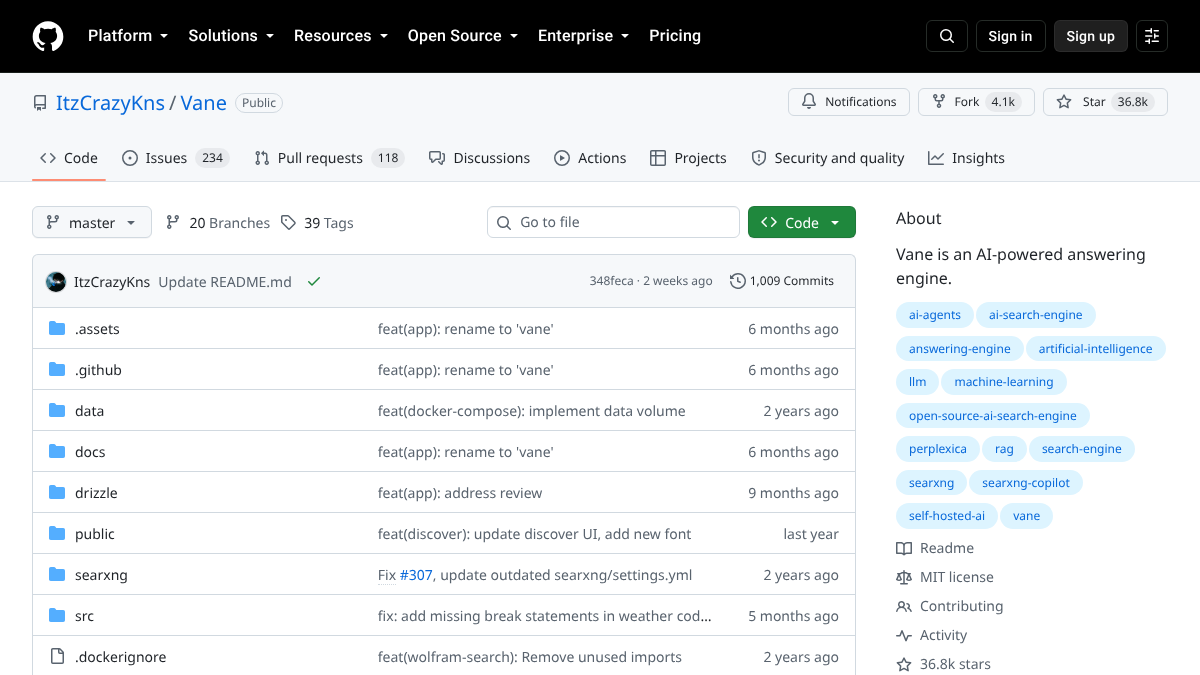
Vane is the orchestration and interface layer: an AI answering engine that searches the web in real time, cites every source it uses, and lets you pick your trade-off with Speed, Balanced, and Quality modes. It can pull from general web search, discussions, or academic sources, accepts file uploads, and handles image and video search. On the model side it's promiscuous by design: local models through Ollama, or hosted ones from OpenAI, Anthropic, Groq, and Google. SearXNG ships bundled as its default retrieval layer, which is the sensible choice, and the reason the next section exists.
The project's GitHub is the canonical starting point, and the health signals are what you'd want from a community tool this popular: four-digit commit count, active issue traffic, and a steady release rhythm.
SearXNG, The Retrieval Layer
SearXNG is the oldest idea in the stack and the least AI: a free, self-hostable metasearch engine that fans one query out to other search services, up to 264 of them, and merges the results without tracking or profiling anyone. It predates the AI search wave, and the wave adopted it because an answer engine's first problem is getting good web results without paying a search API per query.
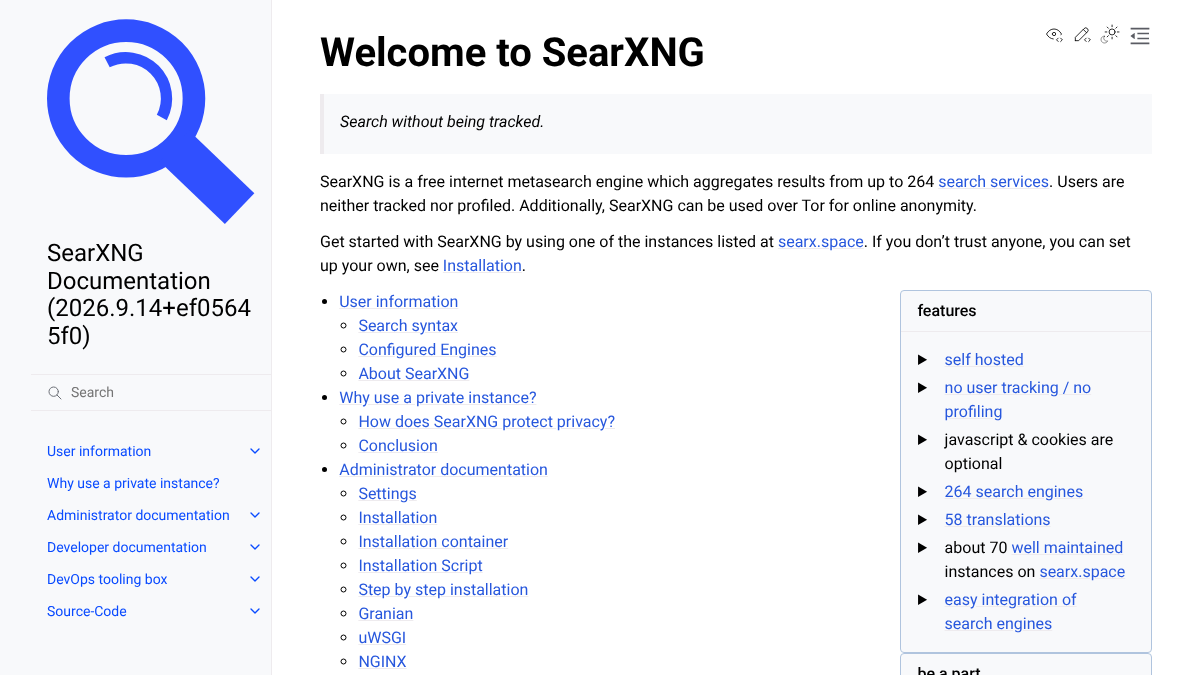
Around seventy public instances run at searx.space if you want to try it bare, though for an AI stack you self-host it, both for rate-limit sanity and because that privacy promise only fully holds on your own box. The r/LocalLLaMA crowd's affection for it is genuine; a well-upvoted thread on giving a local agent web access without paid search or scraping APIs lands on SearXNG as the answer, for the simple reason that real web access changes what local AI is for, and this is the free way to get it.
Giving a local agent web access without paid search/scrape APIs: SearXNG + Scrapling
I wanted web access for a local-first agent without reaching for Tavily, Serper, Firecrawl, etc. For this agent path, I wanted no paid API keys, a search service I control, and page extraction I can run myself. What I ended up with is two t...
The honest caveat from the same community: free web results at scale is the hard problem no self-hosted project fully solves. Public engines rate-limit aggressively, and a heavy research workload will feel it. For personal and small-team volume, SearXNG is quietly excellent.
We'll show you exactly where your brand stands in AI search.
No commitment. $0 due today, cancel anytime. See how ChatGPT, Perplexity, Claude, Gemini, Grok, and Google AI Mode talk about your brand today.
Ollama, The Model Layer
Ollama is where the intelligence runs. It began as the easiest way to serve open models on your own machine, one command to pull and run, and has grown into something broader: a desktop app, a model library, and now a cloud tier that hosts larger open models in the US, Europe, and Singapore for workloads your laptop can't hold, free to start with a Pro tier at $20 a month.
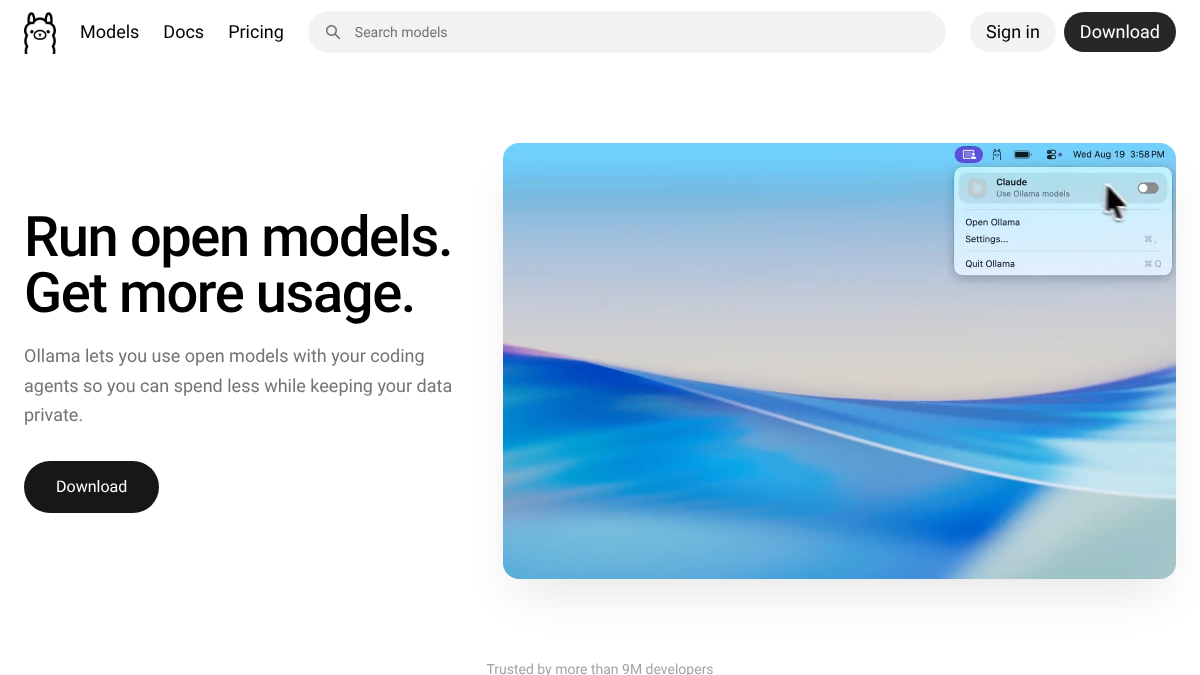
Worth being precise about what Ollama is in this stack, because the marketing around it drifts: it's a model server, and it doesn't search anything by itself. Its 2026 homepage leans hard into coding agents, which tells you where its nine million developers actually live, but for our purposes the relevant sentence is simpler. Point Vane at your Ollama endpoint, pick an open model that fits your hardware, and the answer-writing layer of your search engine now runs entirely on silicon you own, with prompts that never leave the building.
The Honest State Of The Ecosystem
Now the part the viral threads skip. A community survey of local research tools this May found a field with two healthy flagships and a long tail of semi-abandoned experiments: projects with hundreds of open issues nobody answers, last commits eight months old, and pull requests hanging for weeks. The pattern behind the pattern: chat is solved locally, coding is solved locally, but deep multi-step research synthesis still needs more scaffolding than it should, and every project that promised it for free eventually met the same rate-limited wall.
So calibrate expectations by use case. Daily question-answering with citations: the Vane stack is genuinely good, and the privacy is absolute rather than promised. Deep research reports: possible, patchy, and more assembly required. Team-wide replacement for a Perplexity subscription: only if someone owns the maintenance, because self-hosted means self-repaired.
The thirty-minute version of setup, for the curious: docker compose brings up Vane with bundled SearXNG, ollama pull fetches an open model sized to your RAM, and the settings screen wires the two together. A mid-range machine handles the retrieval and interface easily; the model is the only layer that cares about your hardware budget.
Know exactly what AI says about your competitors.
RankControl's Recon Agent monitors competitor citations across ChatGPT, Perplexity, Claude, Gemini, Grok, and Google AI Mode. See where they show up and you don't.

Choosing Your Mix
Nobody actually faces a binary between all-local and all-hosted; the stack's whole appeal is that each layer picks its own side. Three configurations cover most teams.
Fully local. Vane plus bundled SearXNG plus Ollama serving an open model on your own hardware. Total privacy, zero per-query cost, and answer quality that tracks whatever model your RAM can hold, which for a 16 GB machine means a capable small model and for a workstation with a real GPU means something genuinely competitive. This is the configuration for regulated environments and for anyone whose search history is itself sensitive.
Local retrieval, hosted brain. SearXNG handles the searching on your box while an API model writes the answers. Your queries still avoid search vendors' logs, the synthesis quality jumps to frontier level, and the cost lands at API pennies instead of a subscription. The pragmatic middle that most self-hosters quietly settle on.
Ollama cloud hybrid. Keep the stack local but point Vane at Ollama's hosted tier when a job outgrows your hardware, then point it back. Same interface, elastic capability, twenty dollars a month at the ceiling.
The cost math against a Perplexity subscription is unromantic: hardware you own, electricity you already pay, and time, which is the honest line item. Setup is thirty minutes; staying updated across three moving projects is a recurring chore someone has to own. Price that in before declaring victory over your subscription, and price in the failure mode too: a stack nobody maintains degrades into a chat window that can't search, usually the week you need it.
What This Means For The Sites Being Searched
Here's the marketer's coda, and it cuts in an unexpected direction. Users of these stacks are invisible to you. Their queries hit no vendor's logs, their answers render on private hardware, and no citation tracker anywhere can sample what a thousand self-hosted instances told their owners this week. A slice of AI search just went permanently dark, and it skews toward exactly the technical, privacy-conscious buyers B2B teams care about.
The twist is that influencing them requires nothing new. SearXNG retrieves through the same mainstream indexes your SEO already targets, so ranking remains the ticket into these answers too. And these stacks read raw HTML without executing JavaScript, exactly like the hosted engines' own fetchers, which makes server-rendered, plainly structured pages the shared prerequisite across every surface, hosted or local. The playbook doesn't fork; the measurement does. You can track your citations across the six big engines weekly and treat that as your proxy for the dark slice, on the reasonable theory that a page the measurable engines keep citing is winning the invisible retrievals too, since they're all drinking from the same indexes.
One prediction to hold loosely: as answer engines consolidate and their source selection tightens, the self-hosted stack becomes the escape hatch power users reach for, the way RSS readers and ad blockers were. The brands that stay visible there will be the ones that won retrieval the boring way, with pages worth citing, on domains that rank. Which is to say: the weirdest corner of AI search rewards exactly the strategy the mainstream corner does, and that's the most reassuring sentence in this post.
26 content formats. Published on your domain. Matched to your brand.
Guides, comparisons, listicles, case studies, and more. RankControl generates content that gets cited by ChatGPT, Perplexity, Claude, Gemini, Grok, and Google AI Mode.