
In early September, a team on r/SEO posted a problem a lot of content leads will recognize. They'd been shipping 20 to 25 articles a month for several months, all optimized and internally linked, and traffic barely moved.
New pages got indexed and sat between positions 30 and 60. Meanwhile, old articles nobody had touched in months still brought in more traffic than the new ones.
That's the question behind how often to publish blog posts, and most answers online are guesses. Google's AI Overview for the phrase gives a tidy table by site type, sourced to Quora, Reddit and small agency blogs, with no study behind any row.
So I went the other way and collected every frequency study I could trace. For each one I noted who ran it, when, on how many people and what it really measured.
Every publishing frequency study, side by side
Here's the full set. Some are surveys, one is a traffic analysis, and one is a claim whose source no longer exists.
| Study | Who ran it | Date | Sample | Method | What it says about frequency |
|---|---|---|---|---|---|
| "16+ posts a month" | HubSpot | Undated; quoted on a post updated June 13, 2025 | Not stated on the page | Not stated | Almost 3.5x more inbound traffic than 0 to 4 posts a month. The linked source page no longer has the number |
| Blogging frequency guidance | HubSpot (Ankit Vora) | May 22, 2025 | None | Advice, not a study | 6 to 8 posts a month for new blogs, 2 to 4 in complex niches, 5 to 10 for mature, well-staffed blogs |
| Blogger survey, 2018 edition | Orbit Media | Late 2018 | 1,000+ bloggers | Self-reported survey | Weekly or more was nearly 2.5x more likely to report strong results than monthly or less |
| Blogger survey, 2026 edition | Orbit Media | September 8, 2026 | 1,042 | Self-reported survey | Posting 2 to 6 times a week fell from 28% (2014) to 12% (2022). No public split of results by frequency |
| 275 SaaS blogs | Glen Allsopp (ViperChill) | December 30, 2025 | 275 blogs | Estimated search traffic, 2025 | 64% grew. Frequency was not analyzed |
| AI citation freshness | Ahrefs (Ryan Law) | July 28, 2025 | 16.975M cited URLs | Page age of AI citations vs Google results | About freshness of pages, not how often new ones go out |
| Pages with zero search traffic | Ahrefs | December 2023 | About 14 billion pages | Search traffic estimates | 96.55% of pages get no Google traffic at all |
Two things jump out once it's laid out like this. Only two rows tie frequency to an outcome at all, and neither is recent. And the most quoted number on the list is the one with the least behind it.
The HubSpot number everyone quotes
You'll find "companies that publish 16+ posts a month get 3.5x more traffic" in most frequency articles. I read the HubSpot pages on October 19, 2026 to see where it comes from.
The sentence lives on a HubSpot post last updated June 13, 2025. It says companies that published 16 or more posts a month got almost 3.5x more inbound traffic than companies that published 0 to 4.
There's no study name, year or sample size next to it, only a link to HubSpot's own frequency benchmarks page. That page, updated May 22, 2025, doesn't contain the number anywhere.
A sister claim, that the same group got 4.5x more leads, doesn't show up on any HubSpot page I could find. It survives in third-party recaps, such as a February 2020 LinkedIn article by Michael Brenner that credits a HubSpot analysis of more than 13,500 companies. So treat both multipliers as numbers with no live source page. They may once have described HubSpot's own customers, but nobody outside HubSpot can check that now.
Even if the study were on the page, there'd be a problem with what it compares. A company that can publish 16 posts a month usually has a bigger team and a bigger budget than one that publishes four. Either could explain the traffic gap. Call it the budget shadow, where the frequency number is really standing in for how much a company spends.
HubSpot's own current advice has moved away from a single number. The May 2025 benchmarks page says there's no answer that fits everyone and gives ranges by blog stage instead. Our blogging statistics roundup for 2026 traces a few more HubSpot-era numbers that also lead nowhere.
What Orbit Media found about how often to publish blog posts
Orbit Media's annual blogger survey is the longest-running data I found on this question, because it asks the same things every year and checks which habits line up with "strong results." The two editions eight years apart tell different stories.
I pulled the 2018 edition from the Internet Archive, the fifth year of the survey with more than 1,000 bloggers. Andy Crestodina wrote then that "nothing in the data suggests any benefit to publishing less often." His headline finding was that bloggers who published weekly or more were nearly 2.5 times more likely to report strong results than those who published monthly or less.
The 2026 edition, published September 8 with 1,042 respondents, reads very differently.
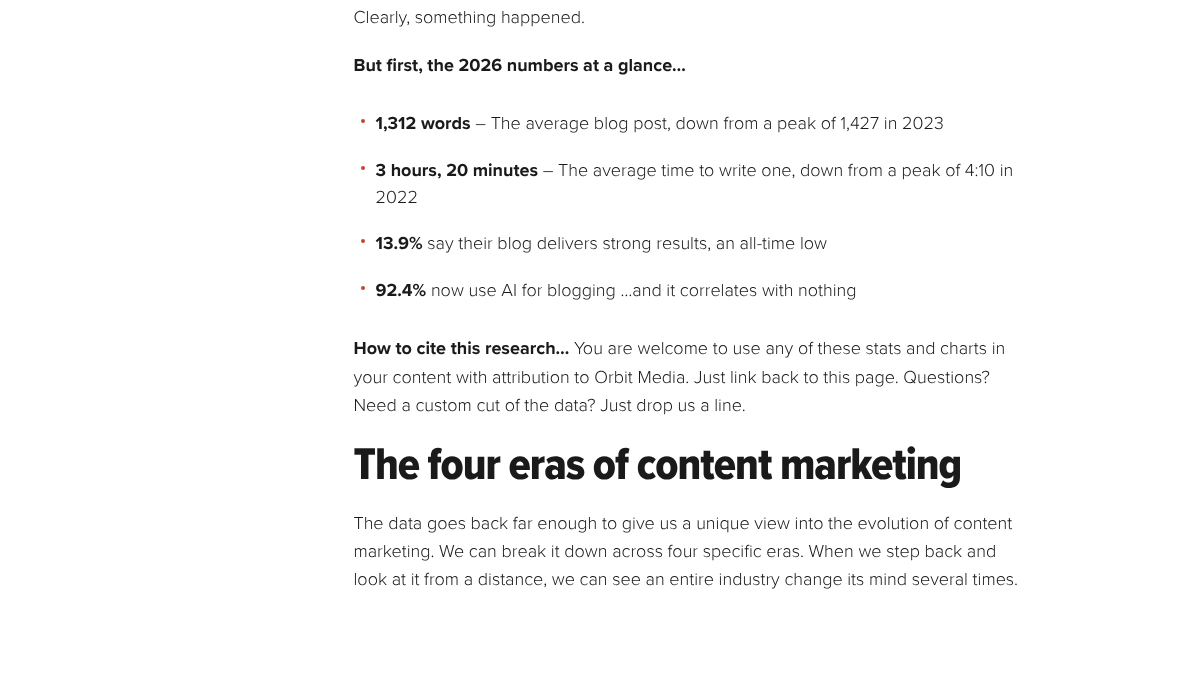
Frequency kept falling. The share of bloggers posting 2 to 6 times a week dropped from 28% in 2014 to 12% by 2022, while monthly posting doubled.
Results fell too. Only 13.9% of bloggers now report strong results, the lowest the survey has recorded, even though 92.4% use AI.
HubSpot's survey looks busier. Its 2025 State of Blogging Report, updated in July 2026 and based on more than 500 marketers, found 22% of businesses with blogs post every day. That sample only counts businesses still keeping a blog, though, so teams that gave up on posting often never show up in it.
One caution before reading too much into Orbit's numbers. Its public 2026 page doesn't break strong results down by how often people post. So nobody outside Orbit can say whether the 2018 gap still holds this year.
What the page does show is where the strong results moved. Bloggers with a human editor report them at nearly twice the survey-wide rate, and those who use six or more of Orbit's eight habits are nearly three times as likely to.
Why the old link weakened
My read is that frequency used to be a stand-in for effort. In 2018, a blogger who shipped a post every week was usually someone with time, a process and a plan, and those things drove the results. I'll call it the effort proxy.
AI broke that proxy. When nearly everyone in the survey drafts with AI, a weekly post costs a lot less work than it used to and tells you much less about the person behind it. The habits Orbit now ties to results, such as a human editor and original research, are the parts of a post that AI doesn't do for you.

Your competitors are getting cited by AI. You're not.
Every day without citation tracking is a day your competitors pull ahead in ChatGPT, Perplexity, and Claude.
275 SaaS blogs, and what they can't tell you
The biggest outside dataset I found on SaaS blog traffic in 2025 doesn't measure frequency at all, and it's worth knowing why. On December 30, 2025, Glen Allsopp, who writes as ViperChill, posted an analysis of estimated search traffic for 275 SaaS blogs across the year.
176 of them, or 64%, grew. The winners gained about 15,250 visitors a month on average, and the losers dropped about 69,270.
That gap is the part I'd keep in mind. The blogs that lost, lost more than four times as much as the winners gained, so a bad year cost far more than a good year paid.
Allsopp was clear about the limits himself. Some of the gains came from redirects and acquisitions rather than content, and he said publishing frequency was one of the things he hadn't analyzed yet. The traffic numbers are also third-party estimates, not the blogs' own analytics.
So it's one analyst's dataset. It shows SaaS blog traffic swung hard in 2025, and it can't tell you whether posting more made a blog a winner.
That's the pattern across the whole table. The bigger and newer the dataset, the less it says about cadence, because the people running it know how hard it is to separate frequency from budget, topic and domain strength.
What Google says about publishing frequency
Google has been fairly direct on this. In January 2023, someone asked John Mueller about a site that posted every day, and Search Engine Roundtable reported his answer, dated January 12.
"Posting every day is fine, if you have new & relevant things to post every day," he wrote. He doubted there was daily news about LED lights, the topic in question, and added that "publishing frequency alone does not make something spam."
Read that both ways. Posting often won't get you penalized by itself, and it won't help you by itself either. What matters is whether each post has something new in it.
The risk sits in what high volume tends to produce. Google's spam policies page, last updated August 28, 2026, defines scaled content abuse as "when many pages are generated for the primary purpose of manipulating search rankings and not helping users." Its first example is using generative AI tools "to generate many pages without adding value for users."
That's no longer a theory. In April 2026, Glenn Gabe documented a manual action against National Today's /us/ section, which he said held more than 850,000 indexed AI-written local news pages. The section dropped out of Google's index, and the rest of the site kept ranking. Our post on where Google draws the spam line on auto-generated content walks through the policy's history, and our look at AI content penalties covers that case in full.
If you want the bigger story of how Google's updates changed the economics of volume, from content farms to programmatic SEO, we cover that in is the publish-more SEO era dead. This post sticks to what the frequency numbers show.
Freshness is a different dial
People often mix up two questions. One is how often you publish new posts. The other is how recently your existing pages were updated, and the second has better evidence behind it.
In a study published July 28, 2025, Ryan Law of Ahrefs looked at 16.975 million URLs cited by AI assistants and compared them with Google's organic results. Cited pages were about 25.7% fresher on average. ChatGPT leaned furthest, citing pages 458 days newer than the ones Google ranked.
That rewards keeping good pages current, which is a different job from adding new ones. A team that posts four new articles a week while its best comparison page goes a year without an update is spending its hours on the wrong dial. Our guide to content freshness as a ranking factor covers what counts as a real update. For the cadence that keeps AI engines citing you, see how to set a publishing cadence for AI search visibility.
The authority ceiling: what practitioners report
The forum evidence doesn't have sample sizes, but it does have a pattern. The r/SEO thread from the opening is the clearest version of it.
We’re publishing 20+ articles a month and organic traffic barely moves
I’m starting to question whether we’re just publishing content for the sake of publishing content. We’ve been putting out around 20–25 articles a month for the last few months. Most are properly optimized, internally linked, have decent wor...
One reply in that thread gave the pattern a name. At 20 to 25 articles a month, the commenter wrote, the team didn't have a content shortage but an authority ceiling. New pages stuck at 30 to 60 while old pages keep their traffic is a sign Google already trusts the old URLs more.
Their advice was to pause new posts, merge or redirect the thin ones, and spend the writing time on outreach.
Other replies came at it from the side. One suggested stopping for a month or two and looking at pages already sitting at positions 8 to 20, since lifting those is often worth more than another 20 new articles. Another noted that if the topics are mostly informational, Google's AI Overview may answer them before anyone clicks.
A second thread, on r/Blogging, asked the question more directly. The poster had heard four approaches, from publishing as much as possible to AI autoblogging to fewer, better posts, and wanted to know which one holds up.
More blog content = more organic traffic? I’m getting conflicting advice
I’m trying to understand the best possible approach to blogging for SEO, and I’ve been getting very different opinions from people. Here are the four approaches I’ve come across: Person A:The more blog content you publish, the more opportun...
The top reply said they'd watched people burn domains on autoblogging, with a short traffic bump and then a flagged site. Another made the most useful point in either thread. Extra posts only help when they circle the same few subjects, so ten linked posts on one topic beat forty posts on forty unrelated topics.
None of this is a study. But it lines up with the one number in the table about where pages end up. Ahrefs' 2023 study found 96.55% of the pages it looked at get no Google traffic, so adding pages to a site that can't rank them mostly adds to that pile.
200+ SaaS teams already track their AI citations.
They know exactly when ChatGPT mentions their brand, and when it stops. Do you?

So how often should you publish blog posts?
Put the evidence together and the answer depends less on a number than on where your site is. Here's how I'd set the pace at each stage. Treat it as guidance drawn from the studies above, not a promise of traffic at any volume.
| Site stage | What it looks like | Suggested pace | Where the rest of the time goes |
|---|---|---|---|
| New site | Under a year old, few links, a few dozen posts | 1 to 2 strong posts a week on two or three topics | Making each post the best answer to one real question |
| Growing site | Some pages on page one, many on page two | About the same, only for gaps in topics you already cover | Lifting pages at positions 8 to 20, adding links between related posts |
| Mature site | Hundreds of posts, old pages carry most traffic | Fewer new posts, aimed at real gaps | Refreshing, merging and redirecting old pages before adding new ones |
For a new site, pace matters less than focus. HubSpot's own range for new blogs is 6 to 8 posts a month around a few topic clusters, which is close to what the forum replies describe. A new site has no authority to spread, so ten posts on one subject do more than thirty on ten.
For a growing site, the cheapest traffic usually sits on page two. Before you publish the next post, check how many pages rank between 8 and 20 and what it would take to lift them. Keep new posts for questions your site doesn't answer yet.
For a mature site, refreshes come first. Our cadence guide linked above calls this the cadence floor, the number of updates a month needed to keep every page current. Only the capacity left after that goes to new posts.
Signs you're past your ceiling
You'll usually see it in Search Console before you feel it in traffic. A few signals are worth checking every month:
- New posts take longer to get indexed, or some never do
- New posts stall between positions 30 and 60 while older pages hold steady
- Impressions per new post fall even as total posts rise
- Old posts start trading places with new posts on the same topic
If two or more show up, slow down and spend a month on the pages you already have. Then compare the month's results with the one before, which is the simple test one r/content_marketing commenter suggested for settling the argument with a client.
What the time adds up to
Orbit's 2026 survey puts the average post at about 3 hours 20 minutes to write. At 8 posts a month, that's close to 27 hours of writing, about two-thirds of a work week. Editing, images, publishing and any refreshes come on top of that.
Doing it yourself or handing it off
You can run all of this by hand. Pick the pace for your stage, write each post against what already ranks, keep a monthly list of pages to lift or refresh, and check Search Console for the signs above.
Or RankControl can take on most of the work. Our content engine writes up to 100 pages a month as native posts on your own site, each one written against the pages already ranking for its keyword. Auto-publish is off by default, so you review every post before it goes live.
You set the pace that fits your site, and 100 is the most the content engine writes in a month. RankControl's AI visibility tracking also checks your questions every week across seven AI engines. We offer one plan at $400/mo with a 7-day free trial.
How often does ChatGPT mention your brand?
Most founders have no idea. The answer might surprise you.