
On November 4, I asked Google "is geo different from seo google." Its AI Overview said yes. Google's own guide to AI search says optimizing for generative AI search is "still SEO."
Google published that guide on May 15, 2026, and has edited it four times since. I read the live page and its Wayback Machine history on November 4. Then I read 18 top-ranking AEO and GEO guides to see how many follow it. None cited it.
What does Google's guide say about AEO and GEO?
It names both terms, calls them common online, and says many suggested hacks aren't supported by how Google Search works. Its rule of thumb is that optimizing for generative AI search is optimizing for the search experience.
The advice it gives is plain SEO. Make content that isn't a commodity, keep the technical side clean, and give people a good page experience. Google's example of a commodity page is "7 Tips for First-Time Homebuyers." A page like "Why We Waived the Inspection & Saved Money" has a point of view only its author could write. Google says that kind of content will likely influence AI visibility more than any other suggestion in the guide.
One limit matters later. Everything in the guide is for Google Search, and it says nothing about ChatGPT, Perplexity, Claude or Bing.
Which five things does Google say you can ignore?
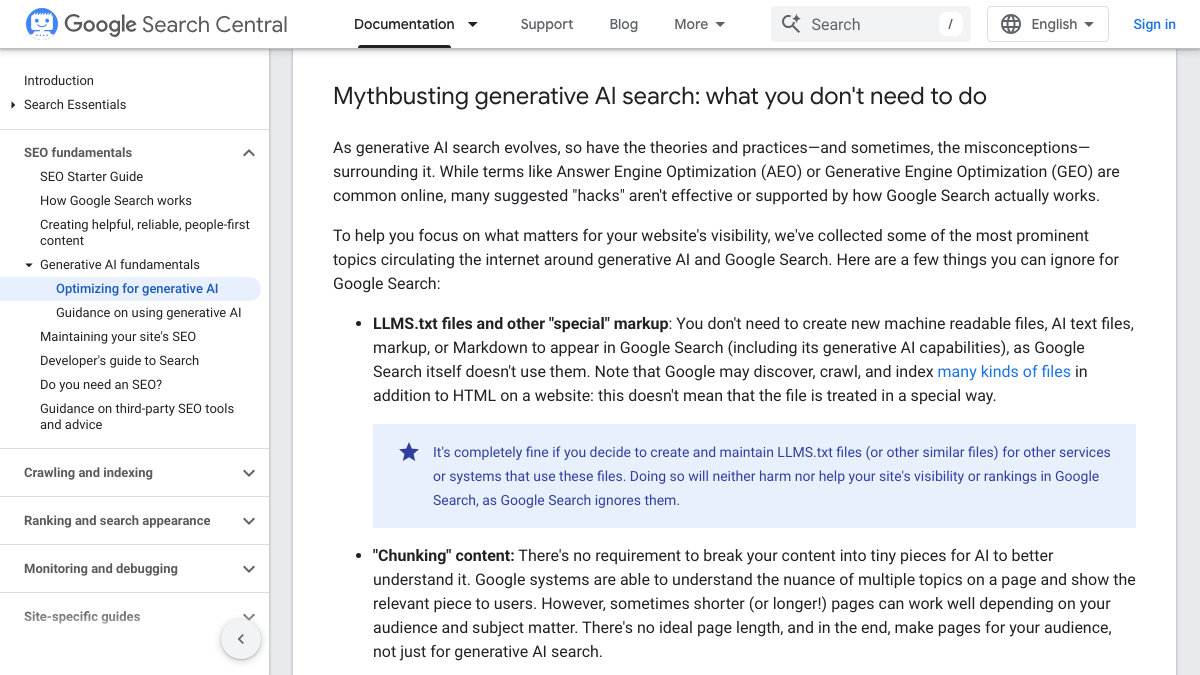
The guide's mythbusting section lists five.
| Myth | What Google says |
|---|---|
| LLMS.txt and special markup | Search doesn't use them. Keeping one will neither harm nor help your rankings, and it's fine for other services. |
| Chunking content | There's no requirement to break content into tiny pieces for AI, and shorter or longer pages can work. |
| Rewriting content just for AI | You don't need to write in a specific way just for generative AI search. |
| Seeking inauthentic mentions | It isn't as helpful as it might seem. |
| Overfocusing on structured data | It isn't required for generative AI search. |
Lily Ray's summary tweet on launch day put it as ignoring most GEO hacks, with chunking and llms.txt named first.
Google just put out its first official article on optimizing for AI search (AEO/GEO)! TL;DR: ⭐️ SEO is still the foundation for AI search. ⭐️ Create non-commodity, "people-first" content. ⭐️ Ignore most "GEO/AEO hacks like chunking and llms.txt. https://t.co/RbUOOPFl2I https://t.co/YSM4cJgDOX
 Lily Ray 😏@lilyraynycMay 15, 2026

Notice that Google doesn't say mentions on other sites are worthless. It says chasing fake ones isn't helpful, and it never tells you to seek any.
The guide also warns about a tactic that some GEO advice invites. Writing a separate page for every query variant the model might fan out to, mainly to manipulate rankings or AI answers, violates Google's scaled content abuse policy. It adds that a high quantity of pages doesn't make a site higher quality.
What has changed since May?
Quite a lot, and it went almost unnoticed. A sentence-level diff of Wayback snapshots shows four edits after launch, and nothing was removed.
| Date | What changed |
|---|---|
| May 15 | Launch version with five mythbusting items |
| June 5 | Pointer to Google's page on third-party SEO advice added to the AEO and GEO callout |
| June 15 | llms.txt reworded, with a note that keeping one is fine for other systems |
| June 29 | Wording tightened to "neither harm nor help" |
| July 10 | Eligibility line, a new measurement section and a warning about third-party tools |
The July edit says a site must be included in Search generative AI features in Search Console to be eligible. It also points you to a report and a control that didn't exist when the guide launched.
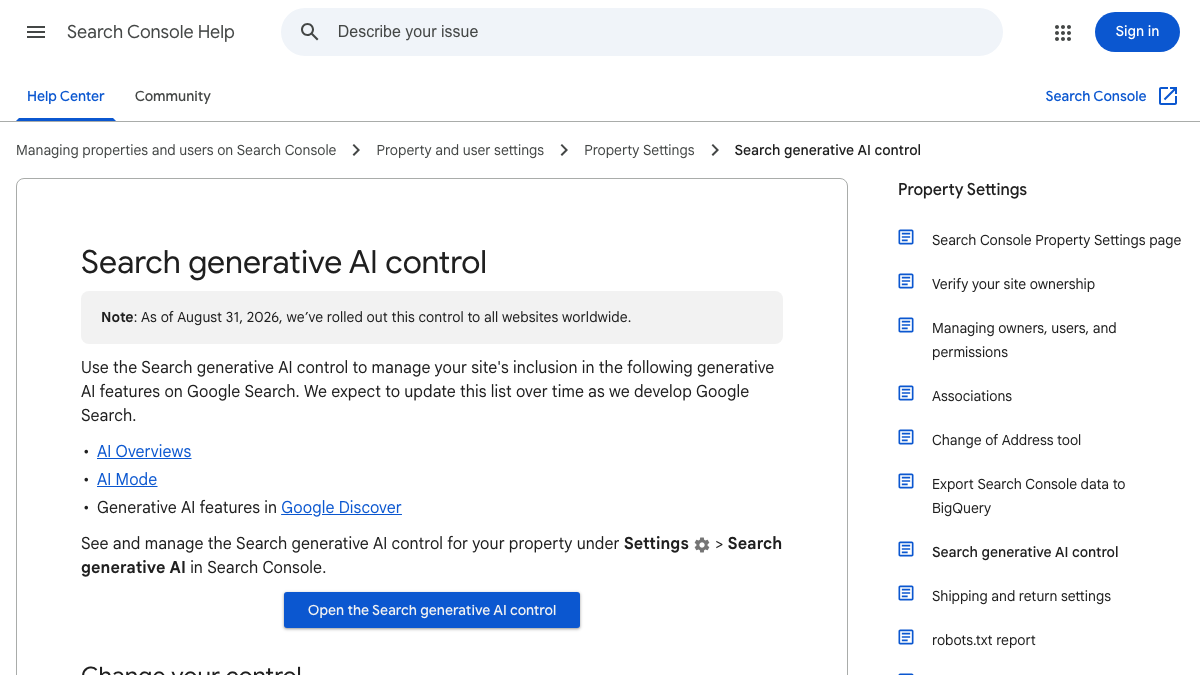
Google's help pages say both rolled out to all websites worldwide as of August 31, 2026. The Generative AI performance report covers AI Overviews and AI Mode. It lists impressions by page, country, date and device, and has no clicks or queries. The control lives under Settings, then Search generative AI, and offers include, exclude and inherit. Excluding means no traffic or impressions from those features. Google says it doesn't affect AI training, which is Google-Extended's job. Google's older AI features page, last updated in December 2025, mentions neither.
Google Search Console generative-AI performance report is now available for ALL - check it out - yea, missing query and click data https://t.co/VkWOoVDWDq hat tip @VijayChauhanSEO https://t.co/7qfudJUYHL
 Barry Schwartz@rustybrickAug 11, 2026
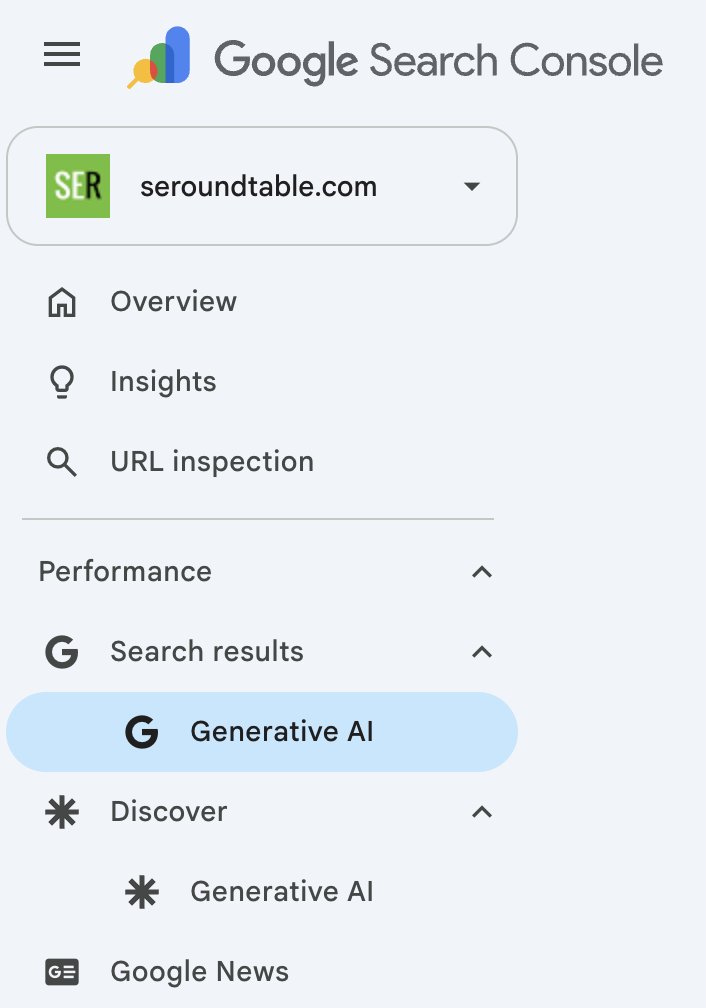
Barry Schwartz noted when the report arrived that it lacks query and click data. Our field guide to the Search Console AI report covers what its numbers can and can't tell you.
See your first AI citation report in under 5 minutes.
No setup calls. No onboarding meetings. Connect your domain and see where AI mentions your brand right now.

What do top-ranking guides tell people to do?
On November 4, I pulled Google's results for "how to optimize for google ai overviews," "geo optimization guide" and "aeo checklist." I dropped forum threads and PDFs, then read what was left in full. Two pages were behind bot checks, and one was about customs certification. That left 18, which I coded claim by claim.
| Claim on the page | Pages out of 18 | Google's position |
|---|---|---|
| Add an llms.txt | 7 | Search ignores it |
| Break content into chunks or answer blocks for AI | 10 | No requirement |
| Write or format content specially for AI | 15 | Not needed |
| Schema helps you appear in AI answers | 14 | Not required |
| Use FAQ sections or FAQ schema | 11 | Guide doesn't mention FAQ |
| Earn third-party mentions | 7 | Not listed as a lever |
| SEO fundamentals still apply | 10 | Agrees |
| AEO or GEO is distinct from SEO | 2 | Disagrees |
| Cites Google's AI optimization guide | 0 | n/a |
Of the eight pages dated June 2026 or later, six still recommend llms.txt, and none cites the guide. Chunking advice came mostly from agencies and consultants, nine of the 12 non-vendor pages, against one of the six tool vendors.
Seven of the 18 pages date from 2025, so they predate the guide by months and still rank today. This was one day, one noisy results page and my own coding. A second same-day run of the three searches shared only five URLs with the first, so read the counts as "seven of the 18 pages I read" and not as a share of all guides. "Write for AI" is also my fuzziest code, since Google itself tells you to organize content so it helps readers.
Does Google contradict itself?
A little, on the same day. Here are three cases I found.
| Where | What it says | What the guide says |
|---|---|---|
| AI Overview for "is geo different from seo google" | Yes, GEO is different from traditional SEO | Still SEO |
| AI Overview for "aeo checklist" | Place a curated llms.txt at your domain root and use FAQ markup | Search ignores llms.txt |
| Chrome's Lighthouse docs | An llms.txt audit says providing the file is optional at the moment | Search ignores it |
An r/SEO thread asked about the Chrome clash. The best reply said they're two teams with two purposes. Lighthouse checks whether agents can read a site, and Search says no file is needed to appear in generative AI results.
LLMs.txt: Google saying two different things?
Google Search Central says you don’t need special AI files like LLMs.txt to appear in generative AI search, but Chrome Developers says LLMs.txt can help agents understand a site’s structure and primary content. I’m anti-LLMs.txt, but is thi...
AI Overviews are volatile, so treat these as what appeared on November 4. John Mueller said on Bluesky in August that there's "nothing really special you need to do for generative AI responses in search."
Where does Google's guide stop?
At Google Search. The guide's last section covers agentic experiences, such as AI agents that act for a person, but frames it as something to explore if you have extra time. It links to a web.dev guide on agent-friendly sites. A reply under Lily Ray's tweet asked whether Google simply doesn't want you optimizing for its competitors. That's fair. Google can speak for its own crawlers and ranking systems, and not for how other engines choose sources. Our post on why Google says llms.txt won't help covers that split, and AEO vs GEO covers the terms.
One more wrinkle. Google-Extended doesn't govern AI Overviews or AI Mode. Googlebot does. Google's October 30 post says allowing Google-Extended makes a site eligible for grounding in Gemini apps.
Your competitors are building backlinks while you read this.
Organic outreach, social mentions, and citations from Editorial Circle member sites, with managed backlinks available as an add-on. Grow your domain authority without running the campaign yourself.

What should you do with it?
| If you care about | Do this |
|---|---|
| Google AI Overviews and AI Mode | Fix crawling and page experience, then publish pages with a real point of view |
| Seeing what happens | Check the Generative AI performance report for impressions |
| Opting out | Use the Search generative AI control, not an llms.txt file |
| Scaled pages | Don't write one page per fan-out query, which Google says breaks its spam policy |
| Other AI engines | Check what they cite, because Google's guide doesn't cover them |
Google also warns against third-party tools that promise ranking success, since none sees its internal systems. RankControl doesn't claim to. We check what AI engines answer, and our AI visibility tracking runs your questions every week on seven engines. The content engine writes each article against the pages already ranking for its keyword and publishes it on your own domain.
You can follow Google's guide by hand with Search Console and a spreadsheet. Or RankControl's agents can write, publish and track the pages every month while you work on your product.

You're getting AI traffic. But do you know where it comes from?
RankControl credits every visit to the assistant that sent it: ChatGPT, Perplexity, Claude, Gemini, Copilot, or Grok. Full source attribution, next to your Google traffic.