On November 4, the AI Overview on Google's results for "how to get edu backlinks" opened with one tactic. Create a scholarship or grant, starting at $1,000, and pitch it to university financial aid offices. It came up the same way in two separate pulls of the results page.
That same day, I pulled 1,200 live .edu links pointing at eight SaaS tools, one link per university domain. The tools were Zapier, Todoist, Otter.ai, Loom, Trello, Typeform, Buffer and Grammarly. Not one of the 1,200 came from a scholarship listing.
Here's where they did come from, and how a smaller company can earn the same kinds of links.
Are .edu links worth more than other links?
Not because of the domain. In 2018, Google's John Mueller said .edu sites get link-spammed quite a bit because of the misconception that their links are more valuable, and Search Engine Roundtable reported that Google ignores a lot of them for that reason. In 2021 he pushed back on the idea that Google ignores all .edu links, writing that people who focus on .edu links "usually have bigger problems to worry about."
Google's spam policy doesn't mention .edu or scholarships at all. It lists exchanging money for links and exchanging goods or services for links as link spam, and a scholarship offered for a link fits the second one. A link from a university page is worth what that page is worth.
A thread on r/linkbuilding in March put the history plainly. One reply said .edu links worked until students started selling links from their own pages on university domains. The same reply said they can still help when they sit on well-sourced pages in the right part of the site.
Do you build .edu backlinks?
I just wrote and released a huge post on how to get .edu backlinks with 10 different strategies that I've used over the years - https://presswhizz.com/blog/how-to-get-edu-backlinks/ Do you still build .edu backlinks? And which strategies ar...
Where do SaaS tools get their .edu links?
I sorted the 1,200 links by the linking page's address, title and anchor text, so treat the split as rough. The sample took the 150 highest-ranked .edu domains for each tool.
| Why the page links | Share of links | Example from the data |
|---|---|---|
| Staff use the product | 27% | Loom videos and Typeform forms on department pages |
| Listed as a tool or resource | 26% | Otter.ai on a disability services page at the University of Michigan-Flint |
| Cites the company's content | 21% | Todoist's Pomodoro guide on a UC Riverside writing blog |
| Career services | 4% | Zapier's remote work guide on Ohio State's career site |
| Other mentions | 22% | Campus news stories and student blogs |
| Scholarship listings | 0% | None found |
Each tool leaned one way. Typeform got 124 of its 150 links from forms that universities had built with it, and Loom got 119 from shared videos. Zapier picked up 96 citations of its blog posts and guides, and Buffer 66. Otter.ai got 88 tool listings, and 46 of its 150 links came from accessibility pages, including Harvard's accessibility office. And 95% of all 1,200 links were followed links.
Every row comes down to the same thing. The school had a reason to point at the page that had nothing to do with a link request.

Your competitors are getting cited by AI. You're not.
Every day without citation tracking is a day your competitors pull ahead in ChatGPT, Perplexity, and Claude.
Why do universities link to tools they use?
Because the people who work there use them every day. Typeform got 124 of its 150 links from forms that university offices had built with it, and Loom got 119 from videos staff recorded and shared. At Michigan, Calendly links turn up wherever someone takes appointments, from a grants office to faculty pages.
The IT department often adds a page of its own once a school pays for a tool.
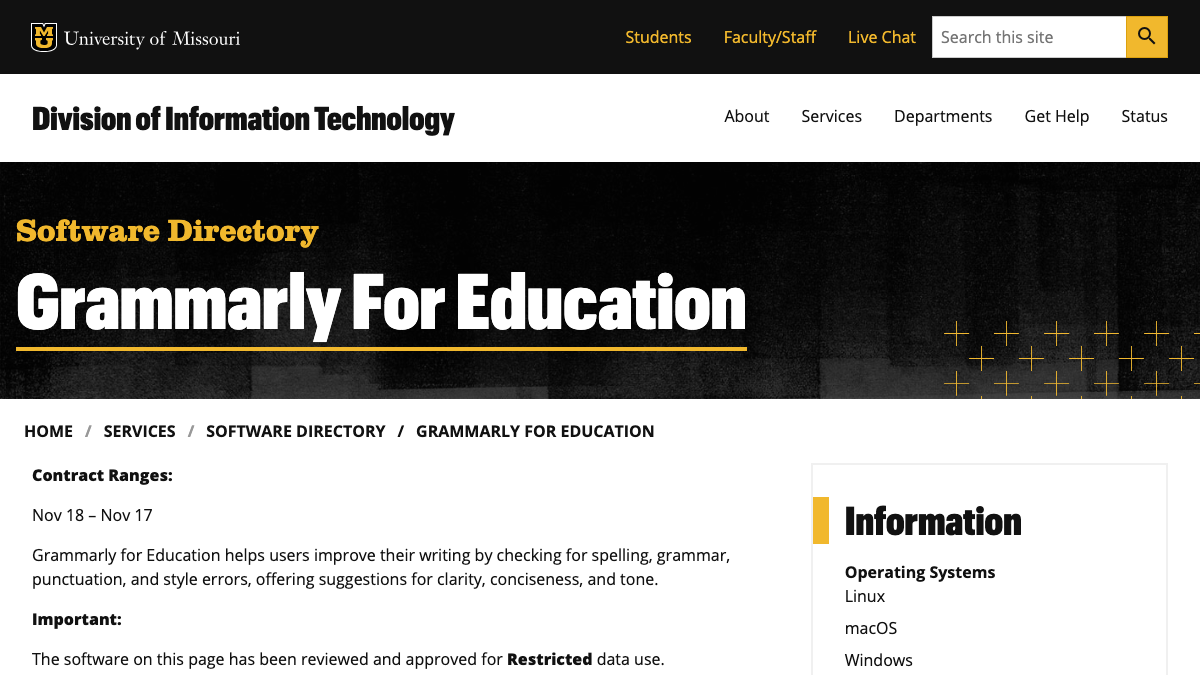
That one at the University of Missouri lists Grammarly for Education and links to Grammarly's terms. Education plans are behind a lot of this. GitHub says more than 2,000 institutions take part in its education program, and Figma says Figma and FigJam are free for students, educators and schools.
Here are more of the pages I found, picked from across the sample.
| Tool | Linked from | What the page was |
|---|---|---|
| Calendly | University of Michigan grants office | A booking link for consultation calls |
| Grammarly | University of Missouri IT | A software directory entry |
| GitHub, Canva, Autodesk, Microsoft 365 | Florida Atlantic University library | An answer to "Is there free software available for students?" |
| Todoist | UC Riverside graduate writing blog, UCLA recreation program | Its Pomodoro and time-blocking guides |
| Zapier | University of Michigan generative AI tools page, Ohio State career site | Its AI image generator list and remote work guide |
| Buffer | University of Oklahoma Libraries | Its write-up of blogging research |
| Grammarly | University of Oklahoma online program, Bowling Green writing lab | A recommended writing tool |
| Trello | University of Nebraska-Lincoln | A list of project management tools |
| Otter.ai | Harvard, Illinois, Michigan State, UCLA, Wharton, Fresno State | Accessibility, note-taking and AI tool pages |
Which company pages get cited by universities?
The guides that got linked were about skills, and none of them pitched the product. Todoist's Pomodoro page doesn't ask you to buy Todoist, which is probably why a graduate writing blog was happy to send students there. Zapier's remote work guide on a careers site works the same way.
If your product sits next to a skill students look up, like writing, studying, job hunting or remote work, that guide is the page a university is most likely to link.
Who keeps the accessibility lists?
Disability and accessibility offices, and they were a bigger source than I expected. In my sample, 81 links came from accessibility, disability or assistive technology pages. Otter.ai alone had 46 of them, several on pages about note-taking support for students with a disability.
Who edits a university resource page?
Usually a person, not the department inbox. In the r/linkbuilding thread, someone asked how to reach the people behind .edu career pages that list job boards. One reply said a "careers office blast almost never works" because it ends up in a shared inbox nobody checks. The same reply said most .edu resource pages are kept by a specific web coordinator or department admin. Our guide to resource page link building has search operators for .edu pages and two short pitch emails.
What to do with this
| If your product | What to set up | Where the links came from |
|---|---|---|
| Is used by staff or students | A free or discounted education plan with its own page | IT software lists, library FAQs, booking links and forms on department pages |
| Teaches a skill students search for | A practical guide you keep current | Writing centers, career pages and library chapters |
| Helps students with a disability | A clear accessibility page and easy student pricing | Disability and accessibility offices |
| Fits an existing resource list | A short note to the person who edits that page | Resource, career and library pages |
200+ SaaS teams already track their AI citations.
They know exactly when ChatGPT mentions their brand, and when it stops. Do you?
What happened to scholarship links?
They didn't show up. Five pages in my first pass matched the word "scholarship," and I checked each one by hand. They were a research office, a teaching page, a news item, a summer research blog and a video tutorial on a scholarships page, and none of them listed a company's scholarship.
Some SEOs still defend the tactic. In January, one argued on X that scholarship link building done ethically helps students and builds strong links.
Scholarship link building gets criticized as manipulative. But when done ethically, it can benefit students and create high-quality, authoritative links. Organizations using this approach can build valuable links without exploiting anyone. Here’s a generalized framework that
 Noel Ceta@noelcetaSEOJan 31, 2026
The students may well get the money. The link is still a trade under Google's policy, though, and it was missing from every one of the 1,200 profiles I looked at.
Paid .edu links are the other shortcut. In one of my two pulls of the results page, a site selling them ranked on page one for "how to get edu backlinks." The r/linkbuilding reply named one source of them, which was students selling links from their own university pages. Our breakdown of what backlinks cost covers what you pay when you earn them instead.
Do .edu links help with AI search?
There's a newer pitch that .edu links can shape what ChatGPT says about a brand. In October, a post on r/SEO_for_AI described it as data injection. The first reply asked for proof that it changes anything an AI engine says about a brand, and the thread didn't offer any. A useful page on a university site can still be cited by AI answers like any other page, but nothing I found shows the .edu ending itself matters there.
Doing it by hand or with help
My estimate for an education plan page and one practical guide is one to two weeks of work. After that, finding the right editor for each .edu list takes about 20 minutes a page.
You can keep that up by hand. Or RankControl's Backlinks can find link prospects for each article you publish. Backlinks includes .edu library and department resource pages, finds a contact and drafts the email. Nothing goes out until you approve it, and every email sends from your own mailbox.
How often does ChatGPT mention your brand?
Most founders have no idea. The answer might surprise you.